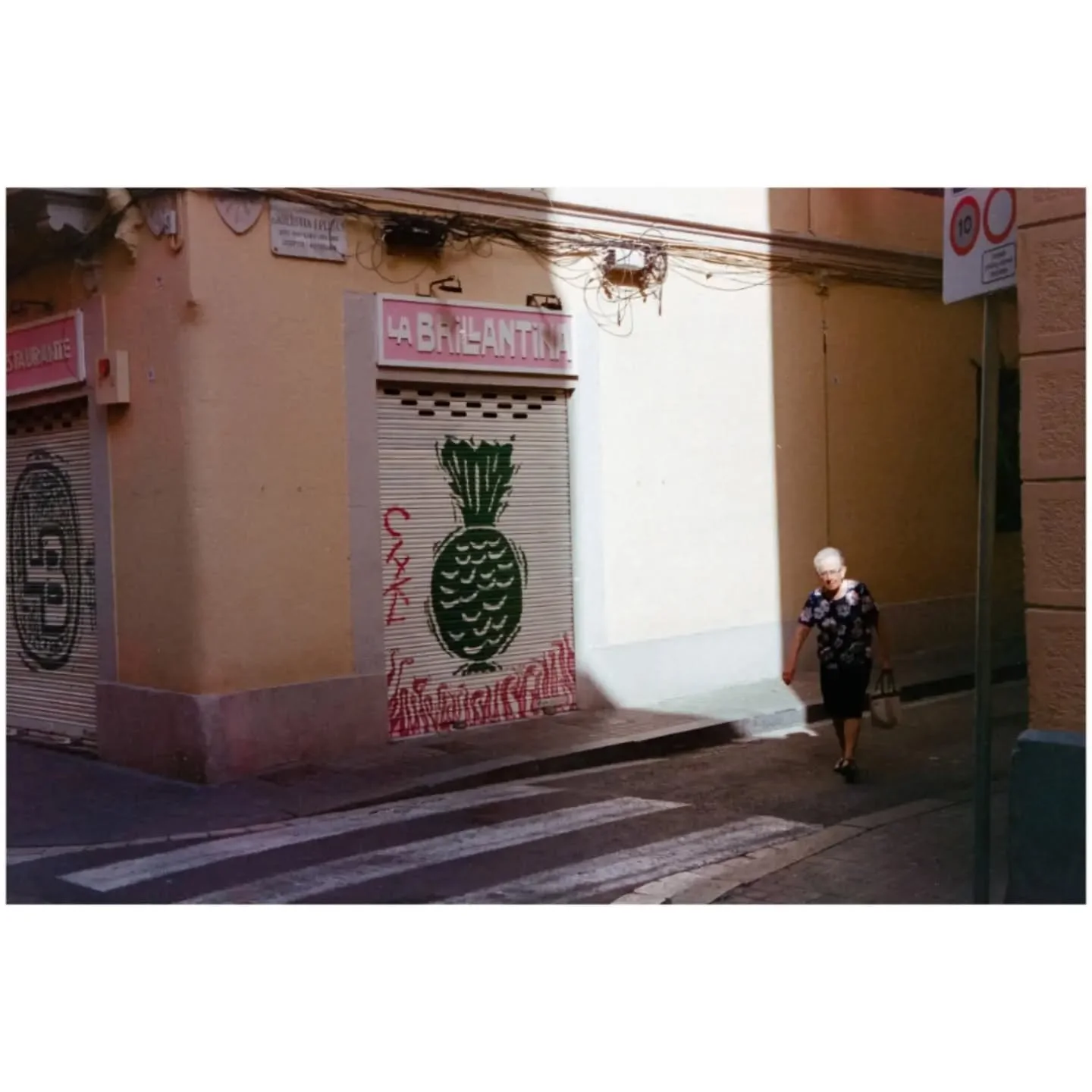
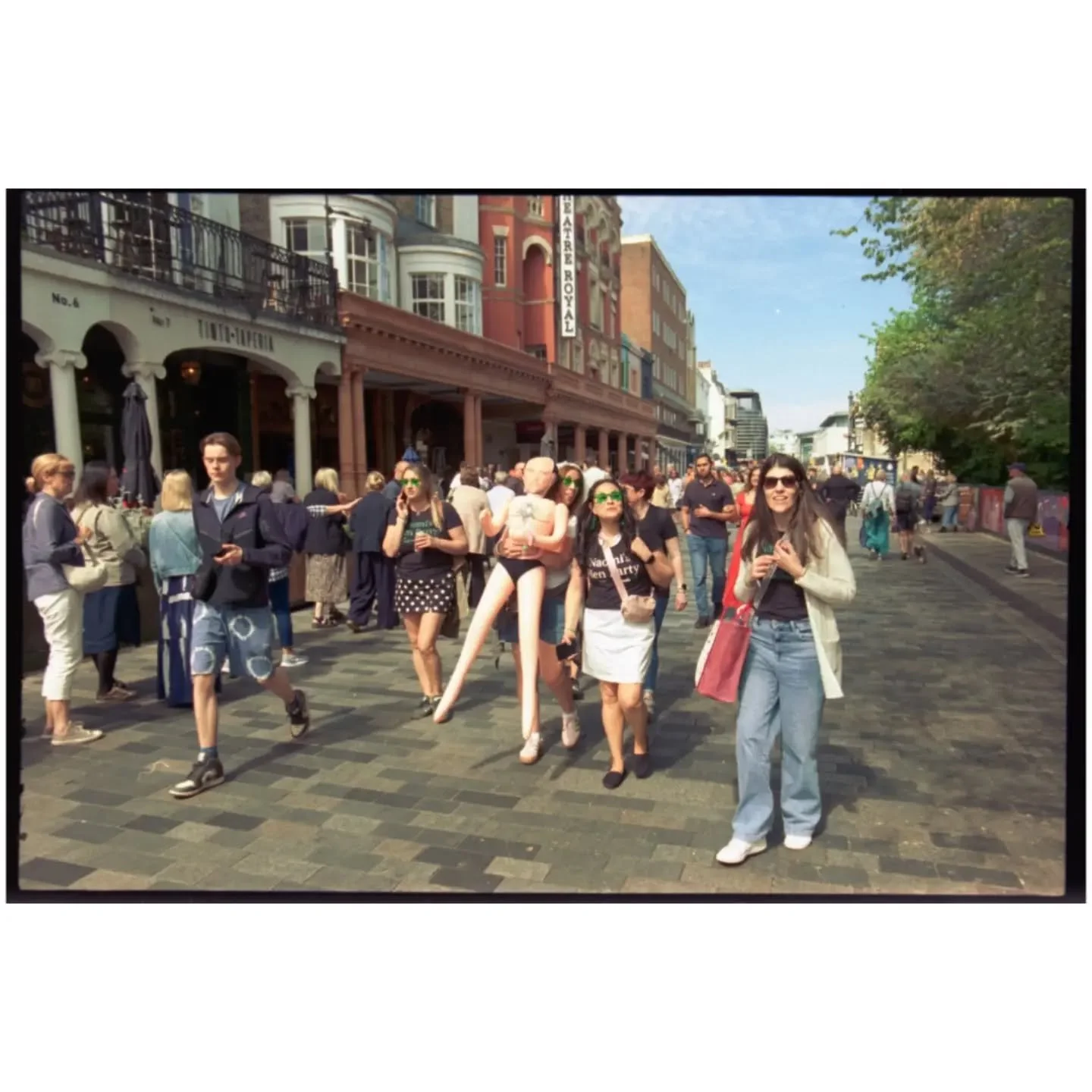
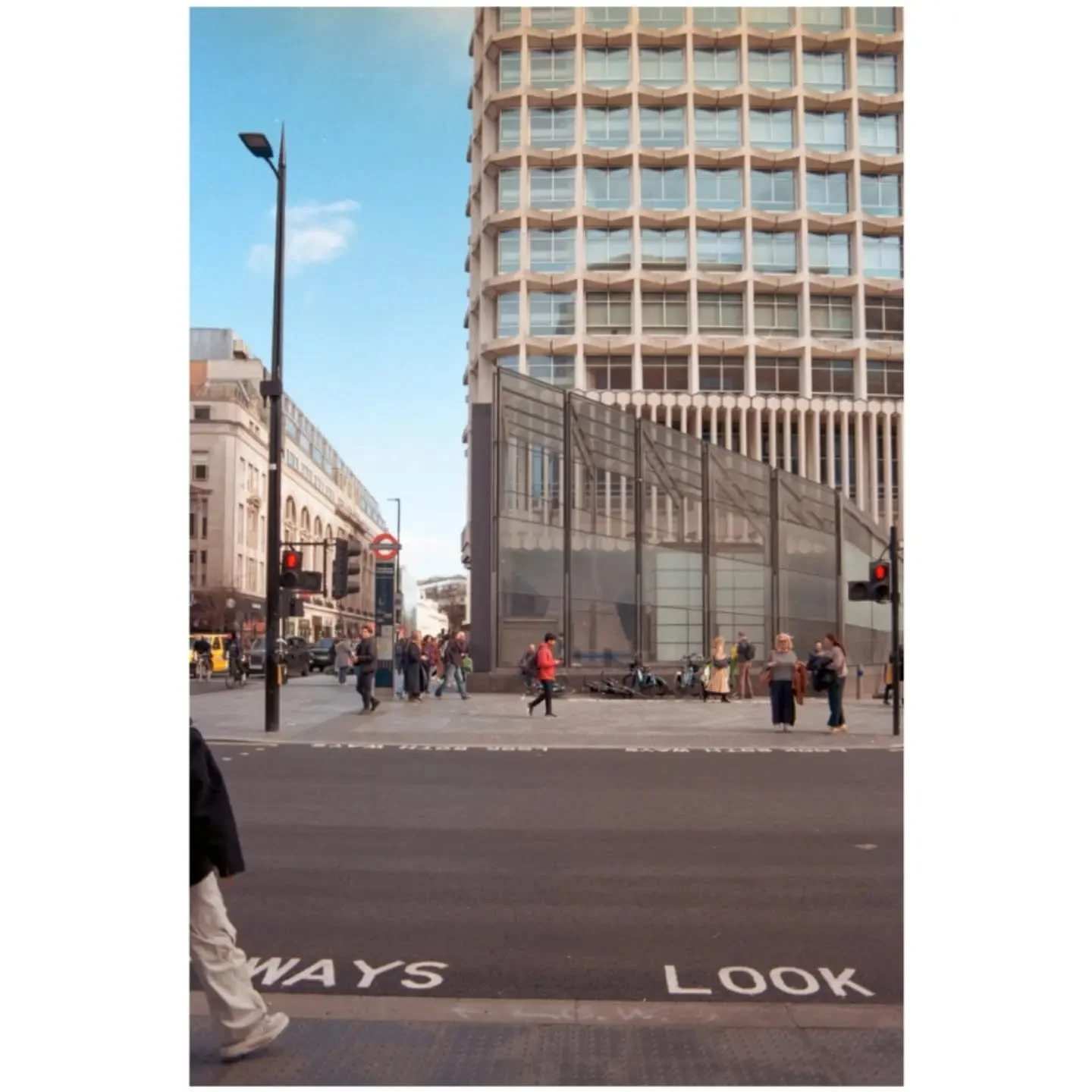
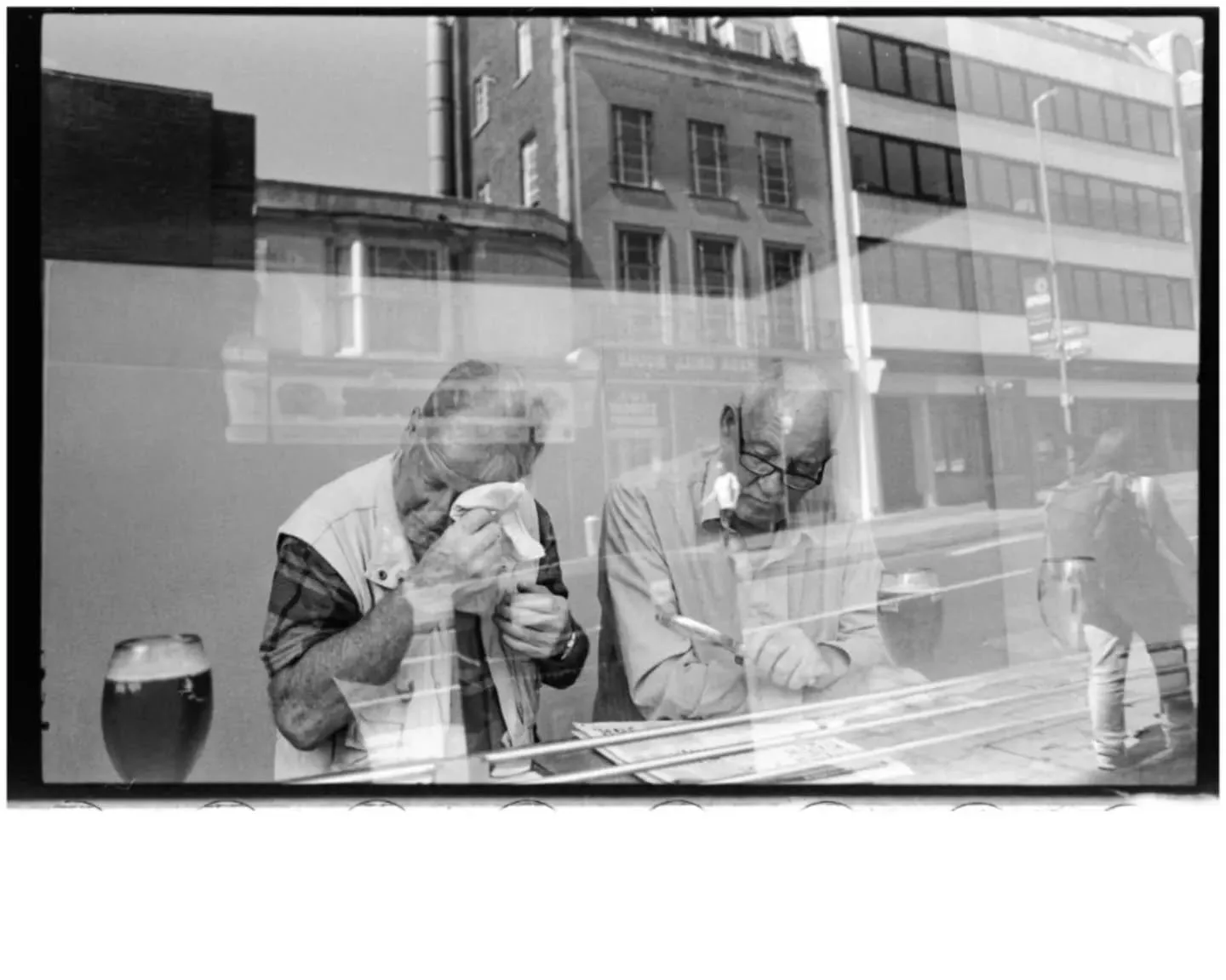
in the frame

POV Street Photography: First Look at the DJI Osmo Nano in Brighton
Two days ago I took the DJI Osmo Nano out onto the streets of Brighton for its first proper test — running it alongside my usual setup, the Sony A7 III with a 24mm lens. The idea was simple: capture the same walk two ways, one through stills, one through continuous POV video, and see what each format actually gives you that the other doesn't.
Two days ago I took the DJI Osmo Nano out onto the streets of Brighton for its first proper test — running it alongside my usual setup, the Sony A7 III with a 24mm lens. The idea was simple: capture the same walk two ways, one through stills, one through continuous POV video, and see what each format actually gives you that the other doesn't.
There's an old distinction in street photography between hunters and fishermen. Fishermen find a spot — a doorway, a corner, a patch of good light — and wait for the scene to arrive. Hunters keep moving, reading the street, closing distance on a moment before it disappears. I've always been a hunter. I don't work a scene; I'm constantly on the go, which is exactly why the Osmo Nano interested me — a camera that rolls continuously seemed like the obvious pairing for someone who never stops walking. What I hadn't expected was how differently the two approaches actually felt once I was out there: the A7 III still demanded the hunter's instinct, spot-and-strike, while the Nano just kept recording regardless of whether I'd found anything worth catching.

Brexit, my Brexit
O Captain, my Captain — our fearful trip is done.
Except it isn't done. That's the problem. We don't know where we're going.
Ten years ago this month, Britain pressed a button it couldn't un-press. Twenty-third of June, 2016. The margin was thin — 52 to 48 — but the consequences were not. A decision made in the space of a single day has been ricocheting ever since, a butterfly flapping its wings somewhere over a polling booth in Sunderland, and a decade later the storm has not arrived, but something is building on the horizon that we cannot quite name.
"The unknown sent us on a trajectory into the unknown."
That is Brexit's defining condition. Not the trade deals or the queues at Dover or the strawberries rotting unpicked in Kent. It is the shapelessness of what comes next. We voted to leave something. We never agreed on what we were arriving at.
An Englishman's Home Is His Kebab Shop
There is an old saying — An Englishman's home is his castle — and it contains within it everything you need to understand the Leave vote. The drawbridge. The moat. The idea that Englishness is a thing to be defended rather than shared, inherited rather than made.
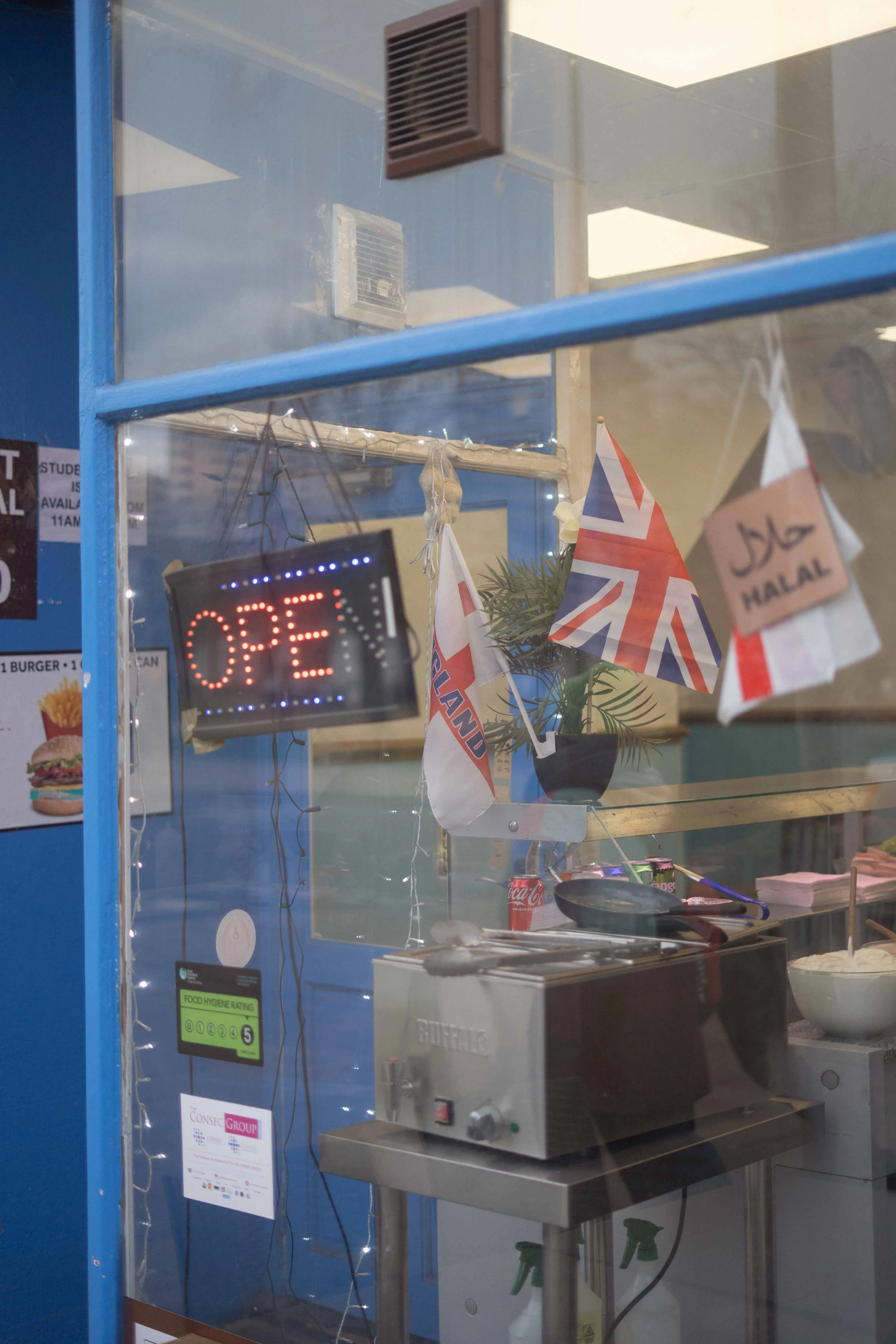
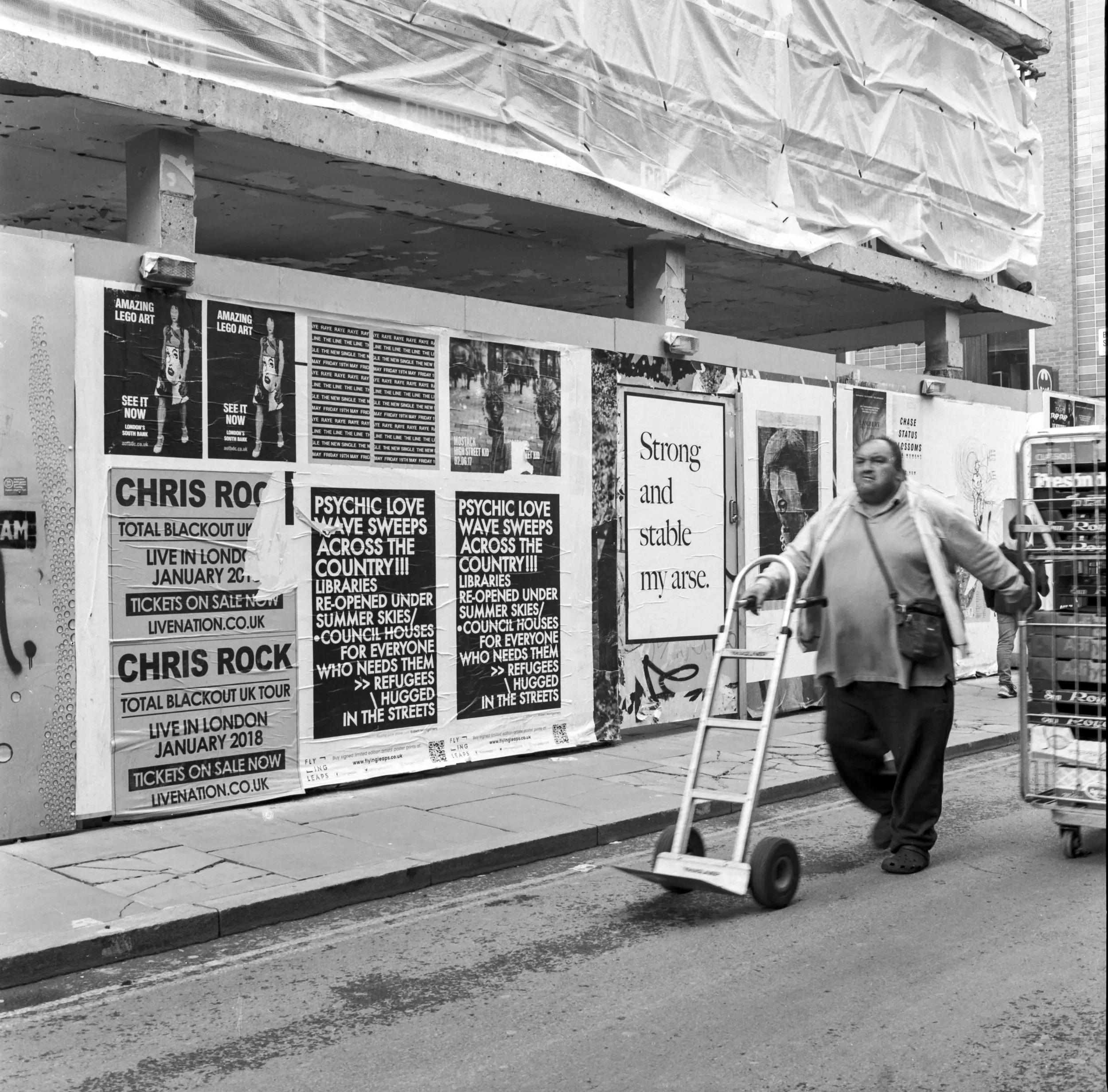
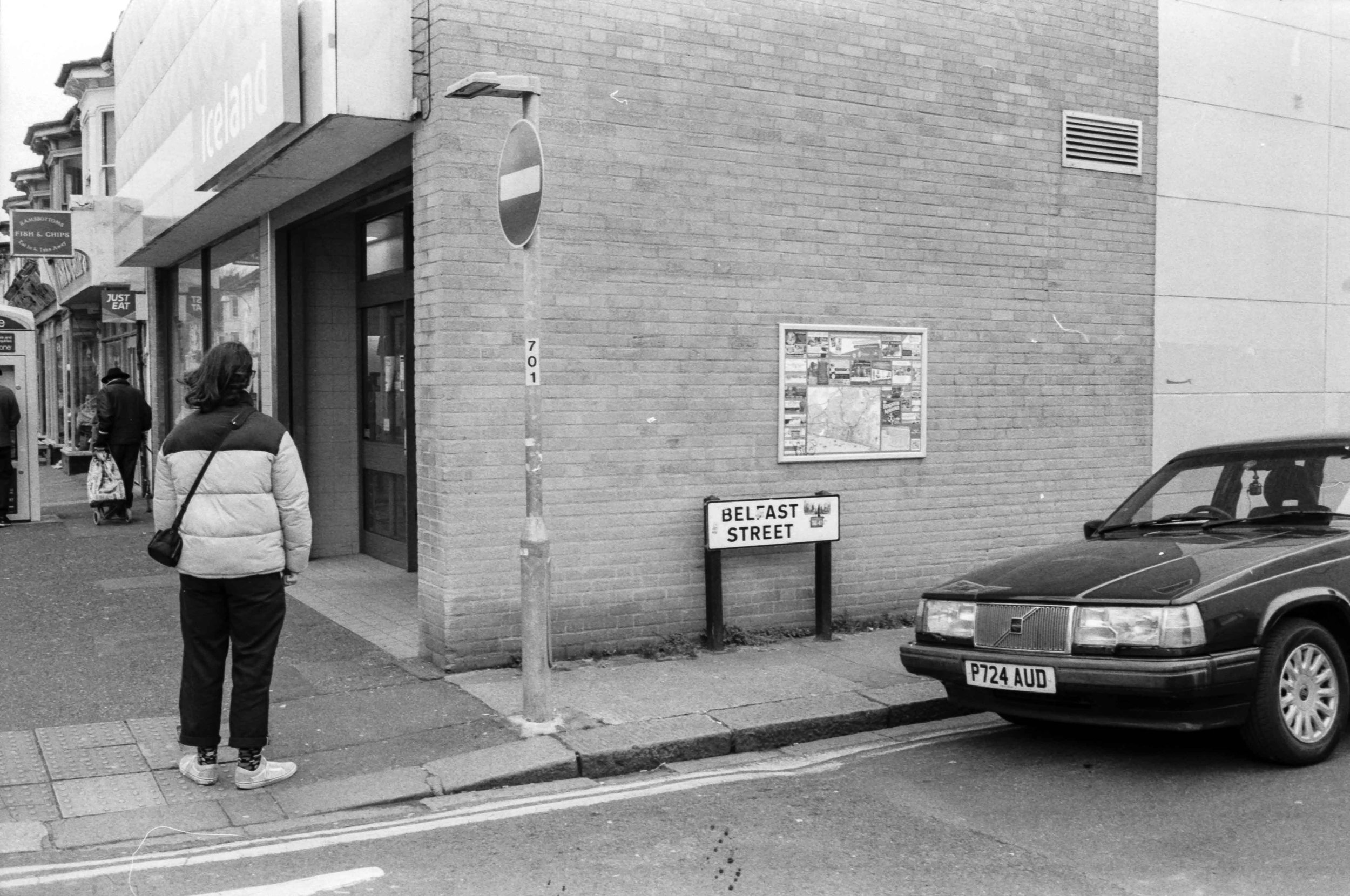
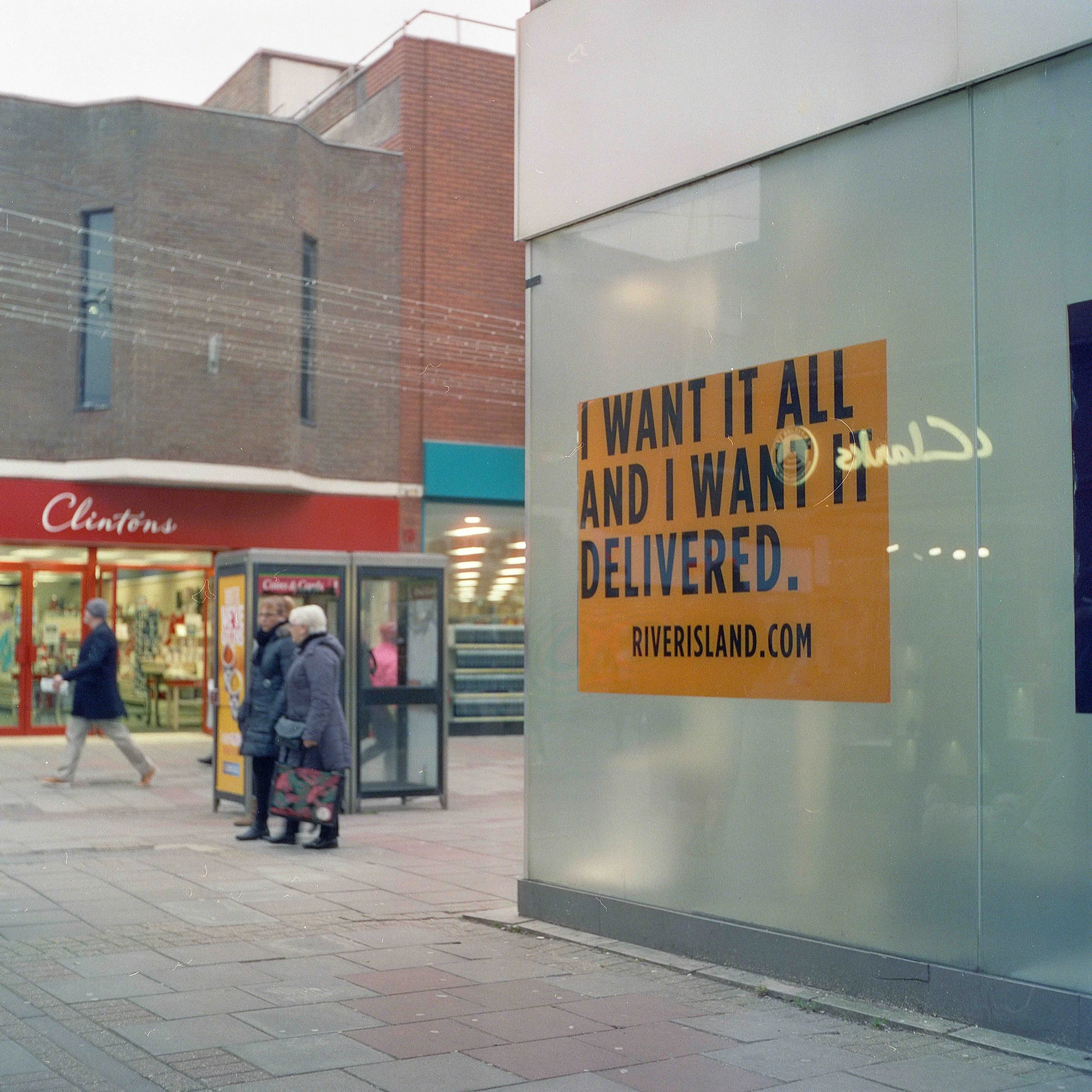
Walk the streets of any English town and ask it what England actually looks like. The answer is not the castle. It is the kebab shop: Union Jack in the window, halal sign alongside it, England flag between the two, the OPEN sign glowing red. It is the most English thing imaginable and the most unEnglish thing imaginable, simultaneously. It is the country that voted to close the door, feeding itself every night through the gap underneath it.
This is not irony. It is identity. Britain has always been a country of contradictions held in uneasy balance. Brexit did not create the tension — it detonated it.
The Spell Cast in June
Spells & Charms. Harry Potter. Lord of the Rings. The Hobbit. Game of Thrones. Britain sells its mythology to the world by the container-load and cannot understand why the world keeps arriving to live inside it.
The referendum was a spell cast by people who wanted their country back. What they got was a country more contested, more divided, and more uncertain of itself than at any point in living memory. The spell worked. Just not the way they intended.
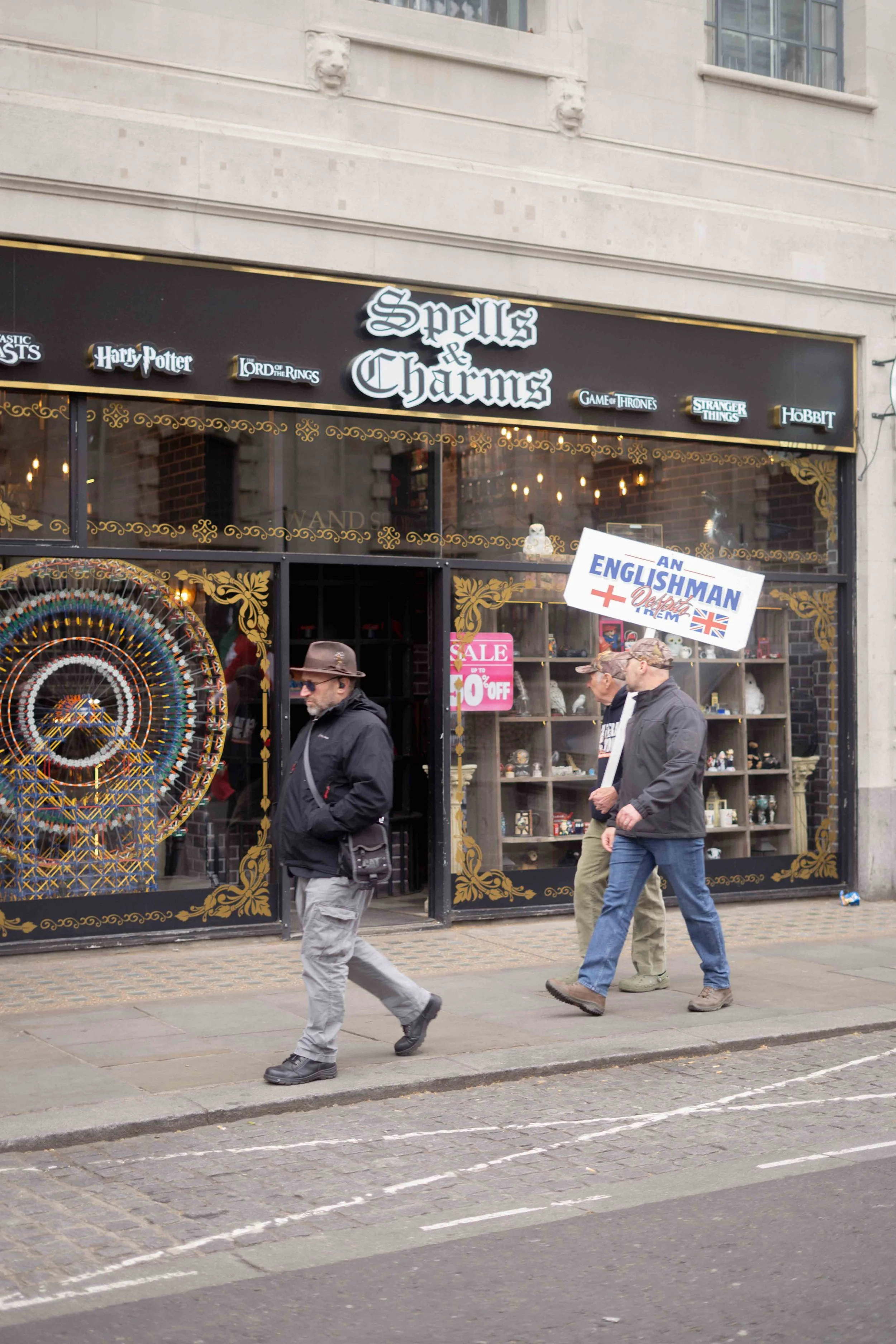
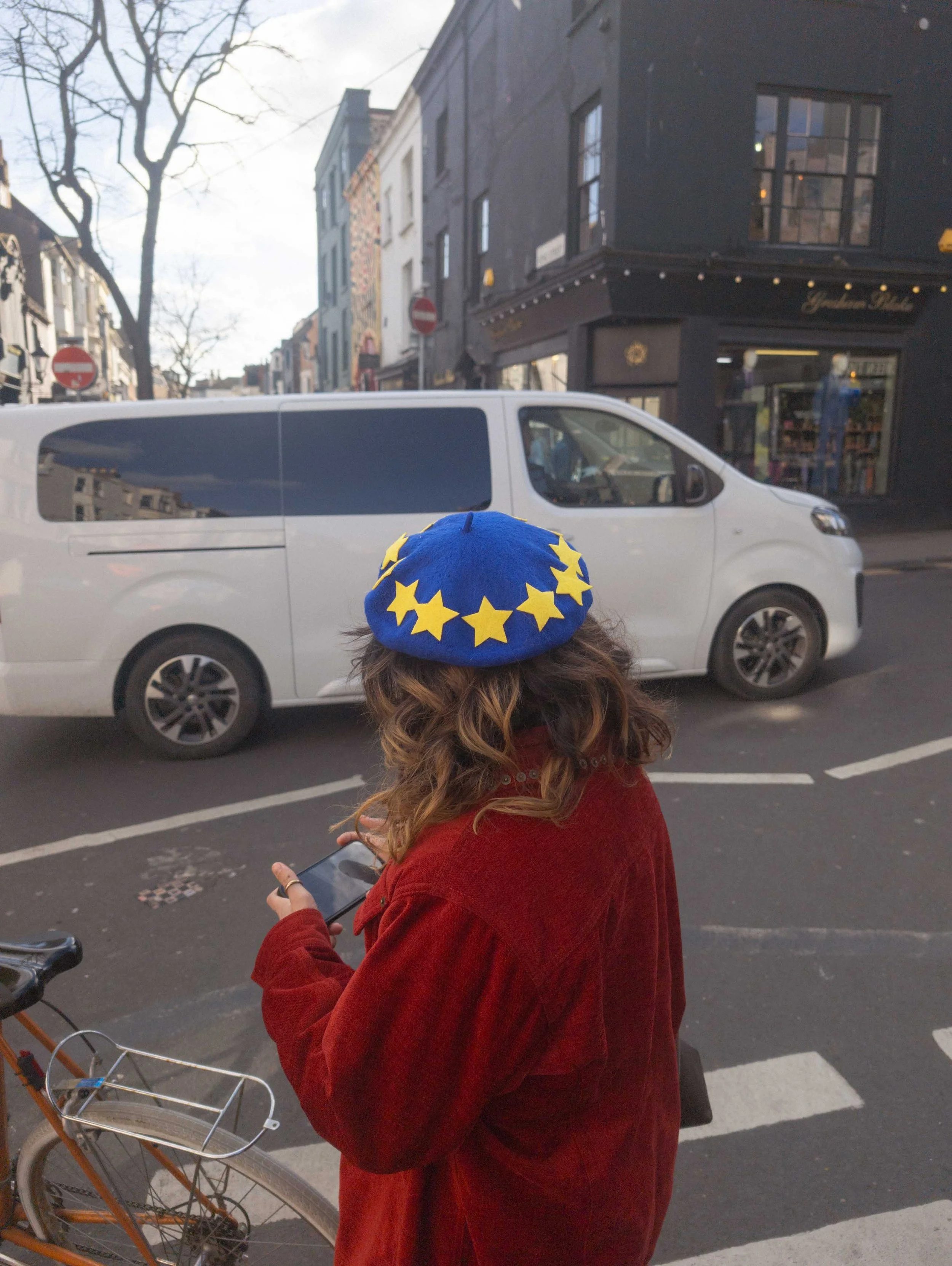
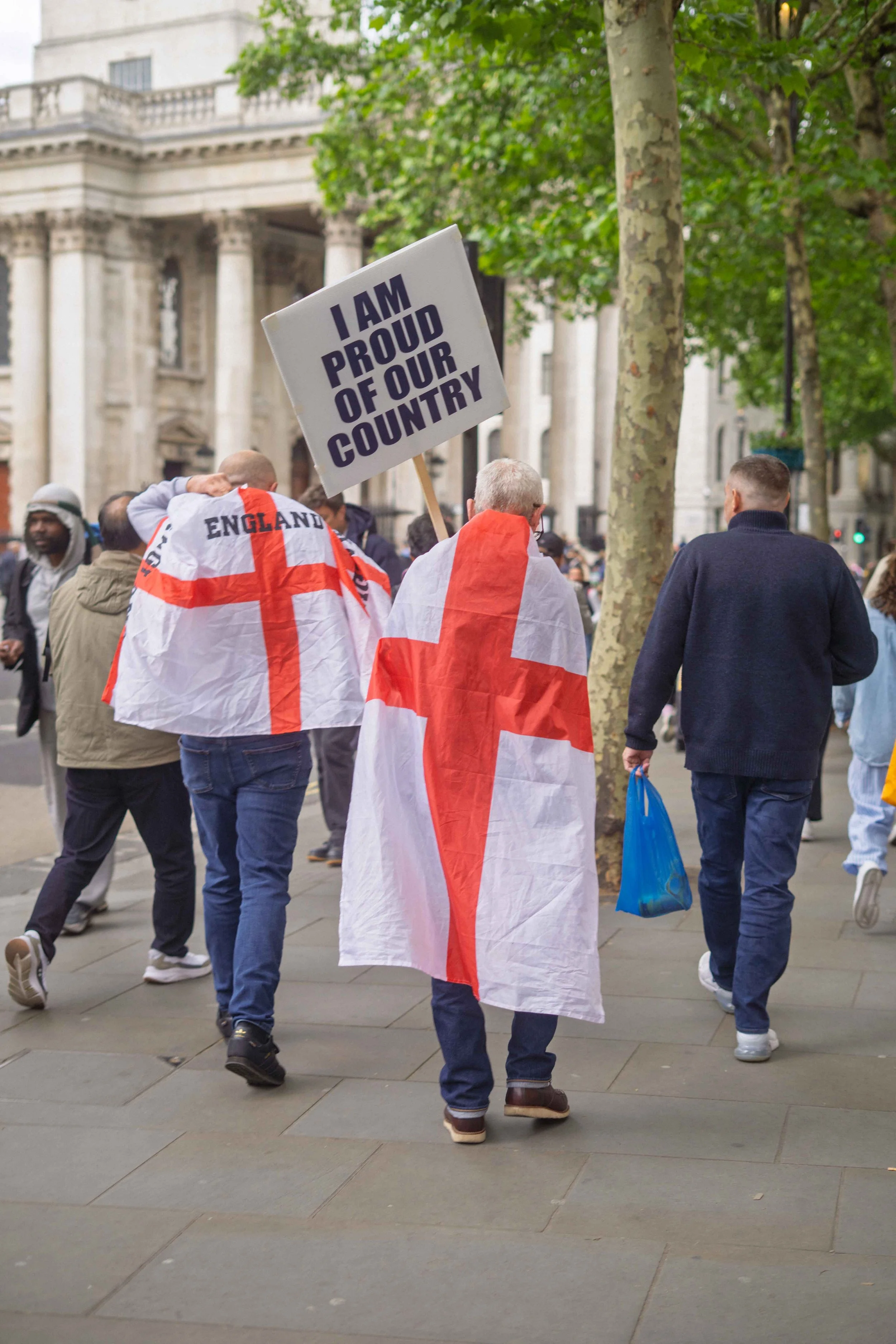
You can still see the believers and the bereaved on the same streets, sometimes passing within feet of each other without acknowledgement. A woman in a blue beret ringed with yellow stars, scrolling her phone at a Brighton crossroads. Men carrying placards through the old city. Neither speaking to the other. Both certain they are right.
The Era of Salvage
ERA — Salvage & Interiors. A Union Jack draped between two wooden chests of drawers in a shop window, half-decorative, half-forgotten. There is something in that image that captures the post-Brexit condition perfectly: a national symbol repurposed as furniture dressing, displayed alongside things that belonged to another time, offered for sale at an uncertain price.
Britain has been in the salvage business since 2016. Salvaging its reputation. Salvaging its institutions. Salvaging its sense of itself. The interiors have been rearranged; nobody is entirely sure they prefer the new layout.
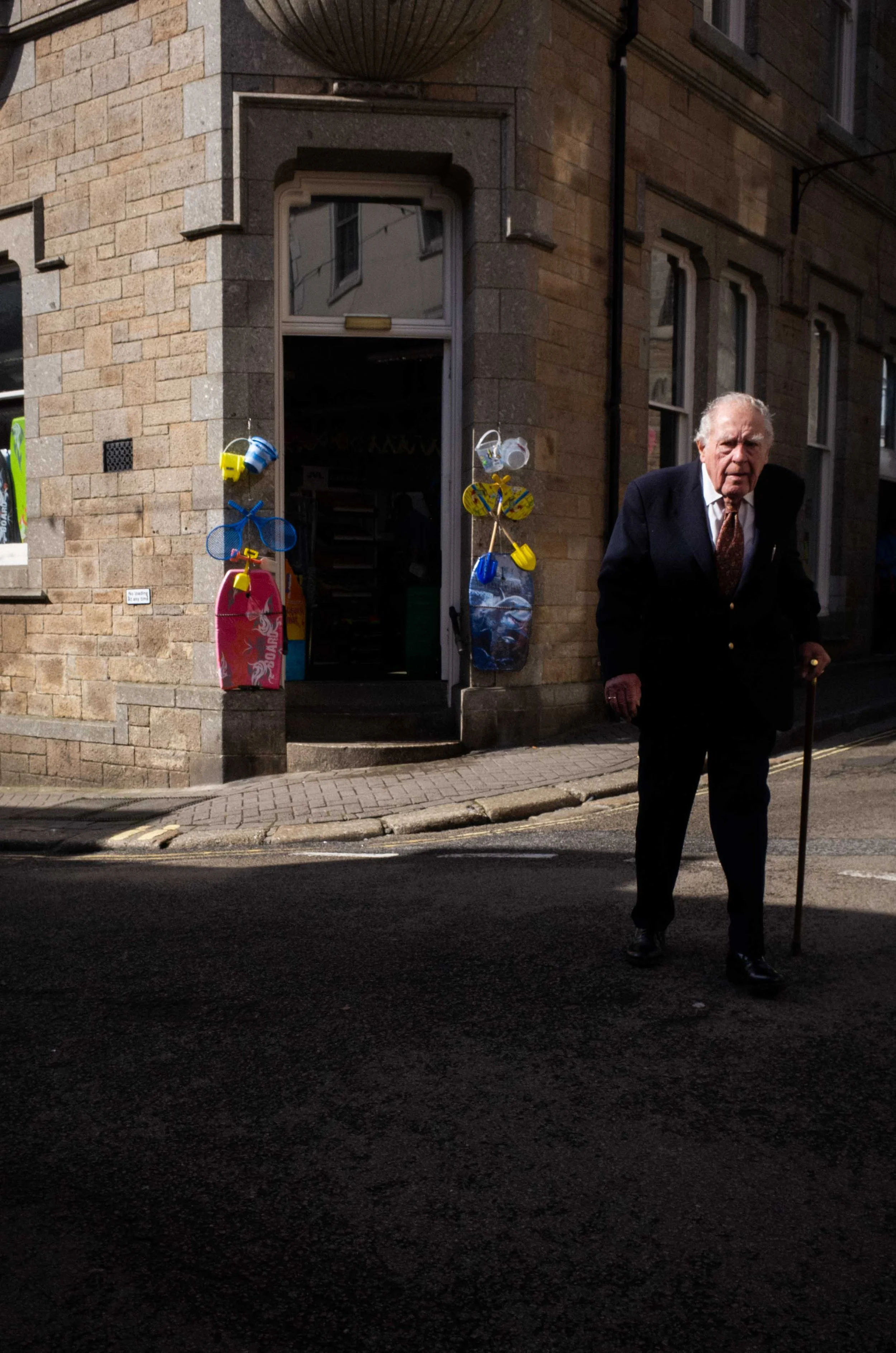
The elderly man walking the seafront town in his dark suit, cane in hand, dressed for a formality that the street no longer requires — he carries himself with the bearing of a country that remembers itself differently. Whether that memory is accurate is another question.

Little Britain, Under Construction
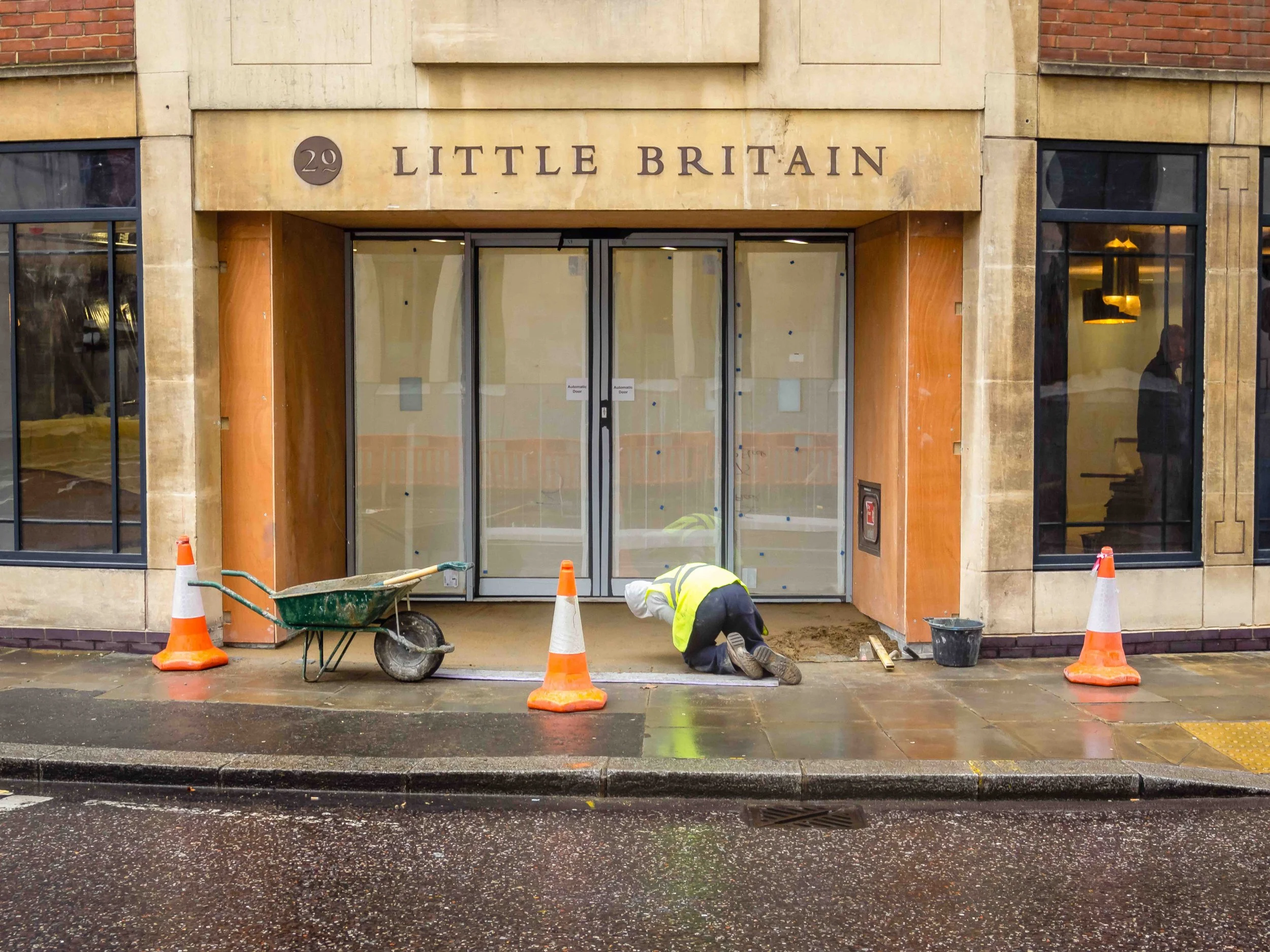
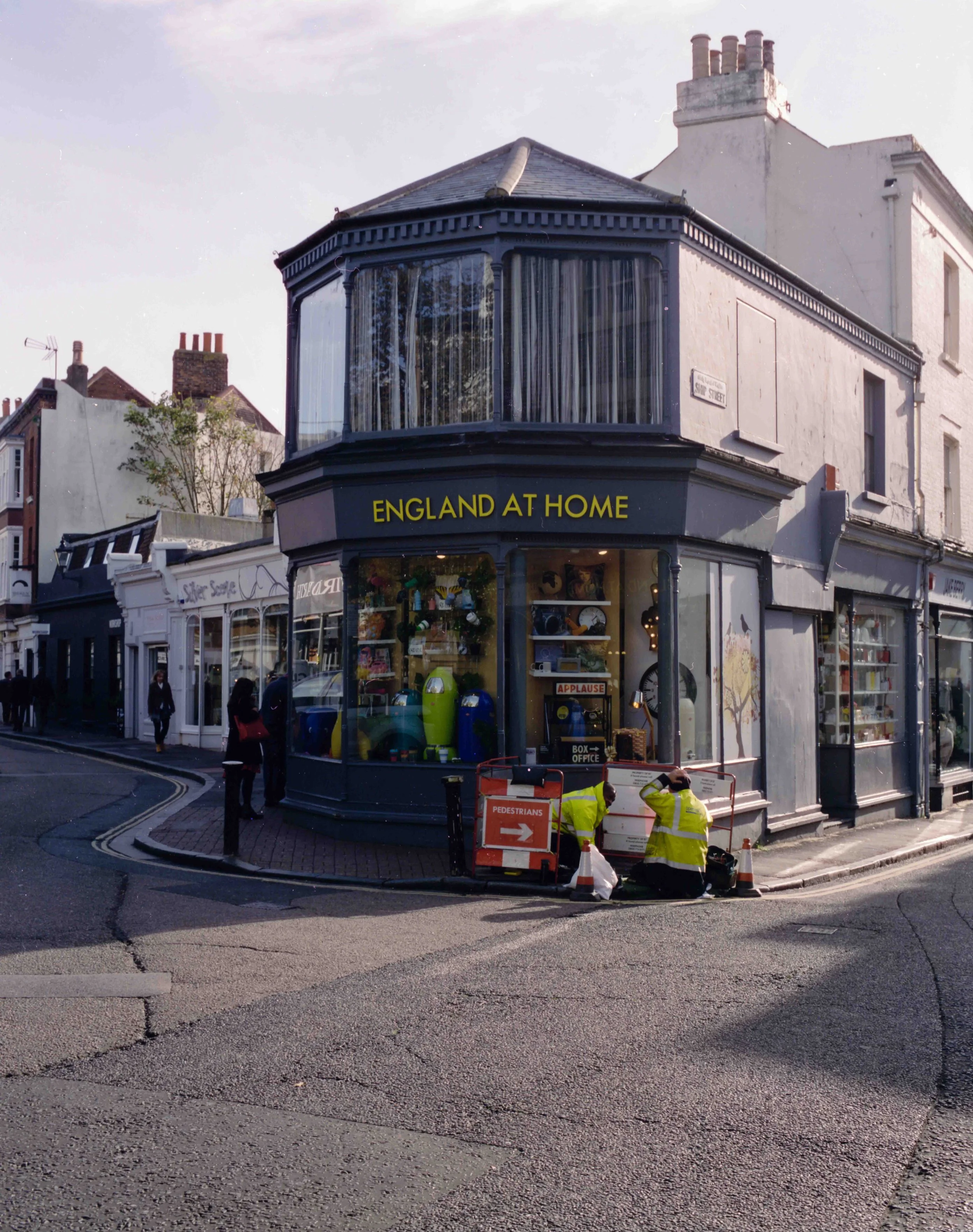
There is a building in London called Little Britain. Outside it, a worker in a hi-vis jacket kneels on the wet pavement, head down, working at something in the ground. The entrance behind him is boarded up. Cones everywhere.
It could be a photograph taken on the morning of 24th June 2016.
The vision of Little Britain — sovereign, self-sufficient, free from the bureaucratic grip of Brussels — has spent a decade under construction and remains, in important ways, boarded up. The project is not abandoned. But the entrance is not yet open.
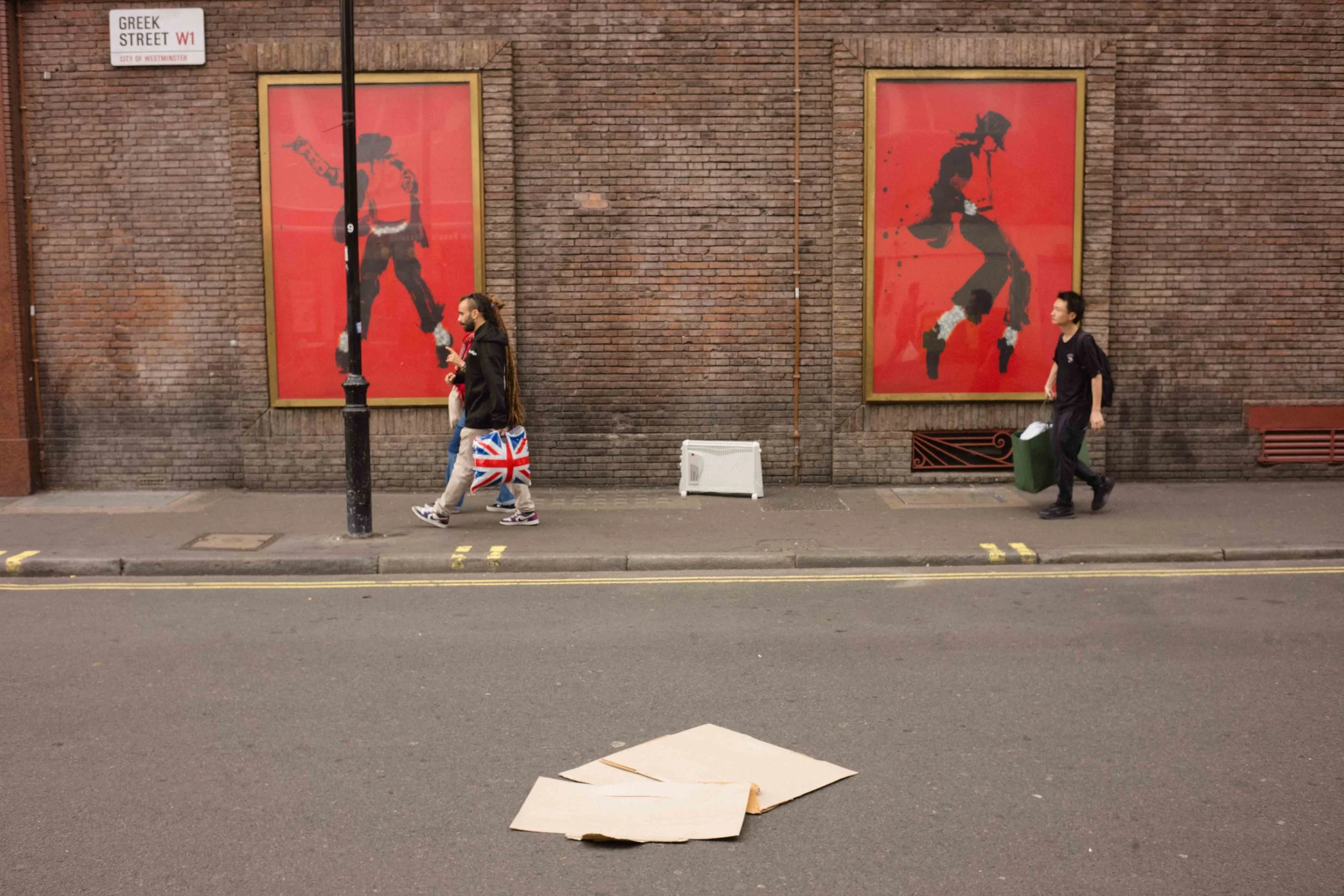
Meanwhile, the street outside carries on regardless. Multicultural, busy, indifferent to the political weather. On Greek Street, a man with long dreadlocks carries a Union Jack bag past a Chinese man heading the other way, both of them moving in front of twin red posters of Michael Jackson mid-dance. This is what London looks like. This is what Britain looks like, whether the dreamers of Little Britain want it or not.
The Trajectory
Here is what concerns me. Brexit did not emerge from nothing. It was the product of decades of austerity, deindustrialisation, and a political class that had stopped listening. The Leave vote was, in part, a howl from communities that had been told for thirty years that globalisation was working for them when they could see with their own eyes that it was not.
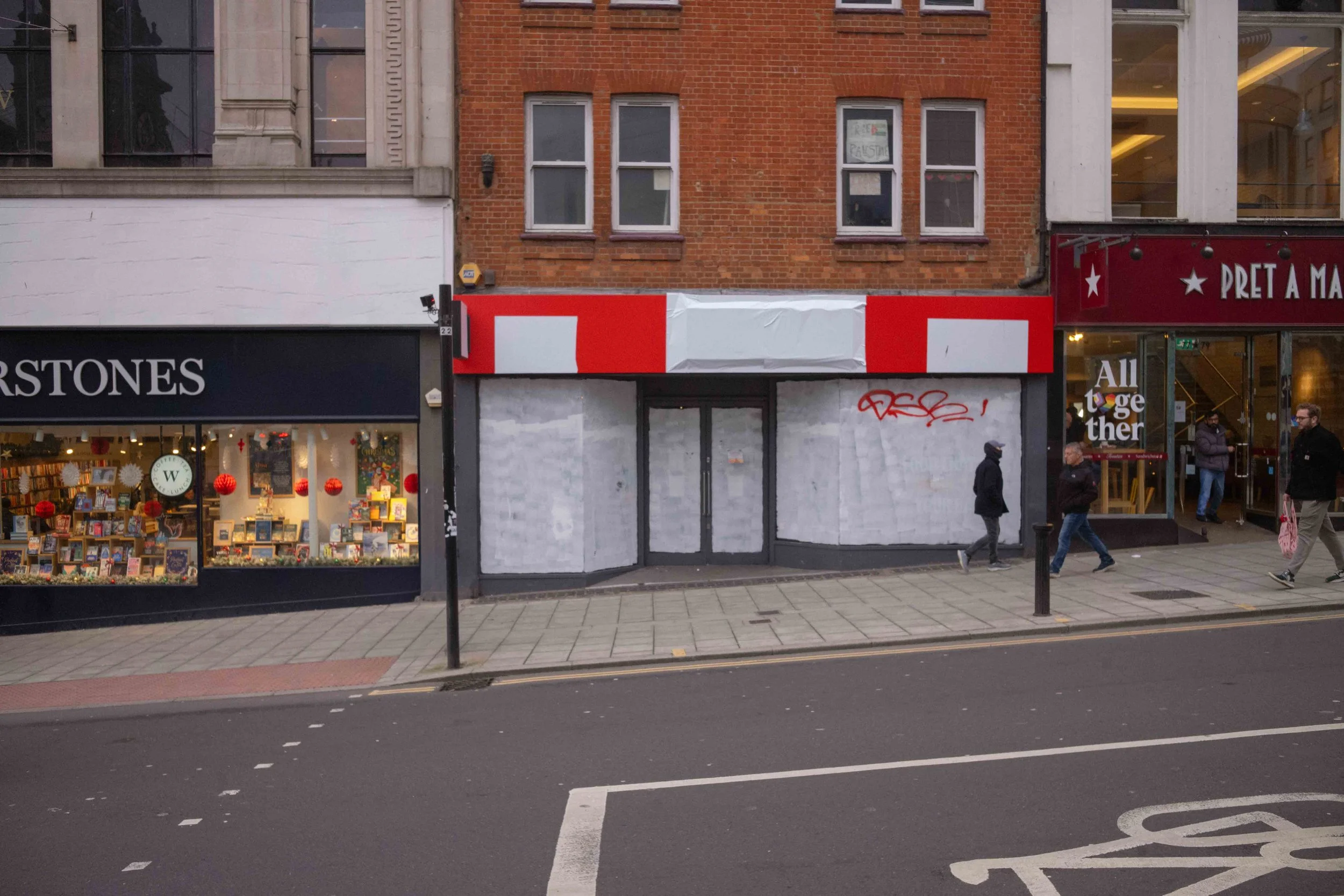
That howl found its expression in Brexit. But Brexit did not fix the thing that generated the howl. The shops are still boarded up — not just in London, but in every high street that Waterstones and Pret a Manger and "All Together" slogans cannot paper over. The anger did not dissipate. It continued downstream.
"The butterfly flaps its wings. Ten years later, the storm has not yet broken. But the sky has a particular colour."
The far right did not invent British disillusionment. It found it, already there, and offered it a shape. That is the butterfly effect of June 2016 that nobody in the campaign — Leave or Remain — wanted to acknowledge. When you destabilise a consensus without offering a replacement, you do not create a vacuum. You create a space that something else will fill.
We have not arrived there yet. That is the honest answer. We are in the ten-year corridor between the decision and its final destination, and neither door at either end is fully in view.
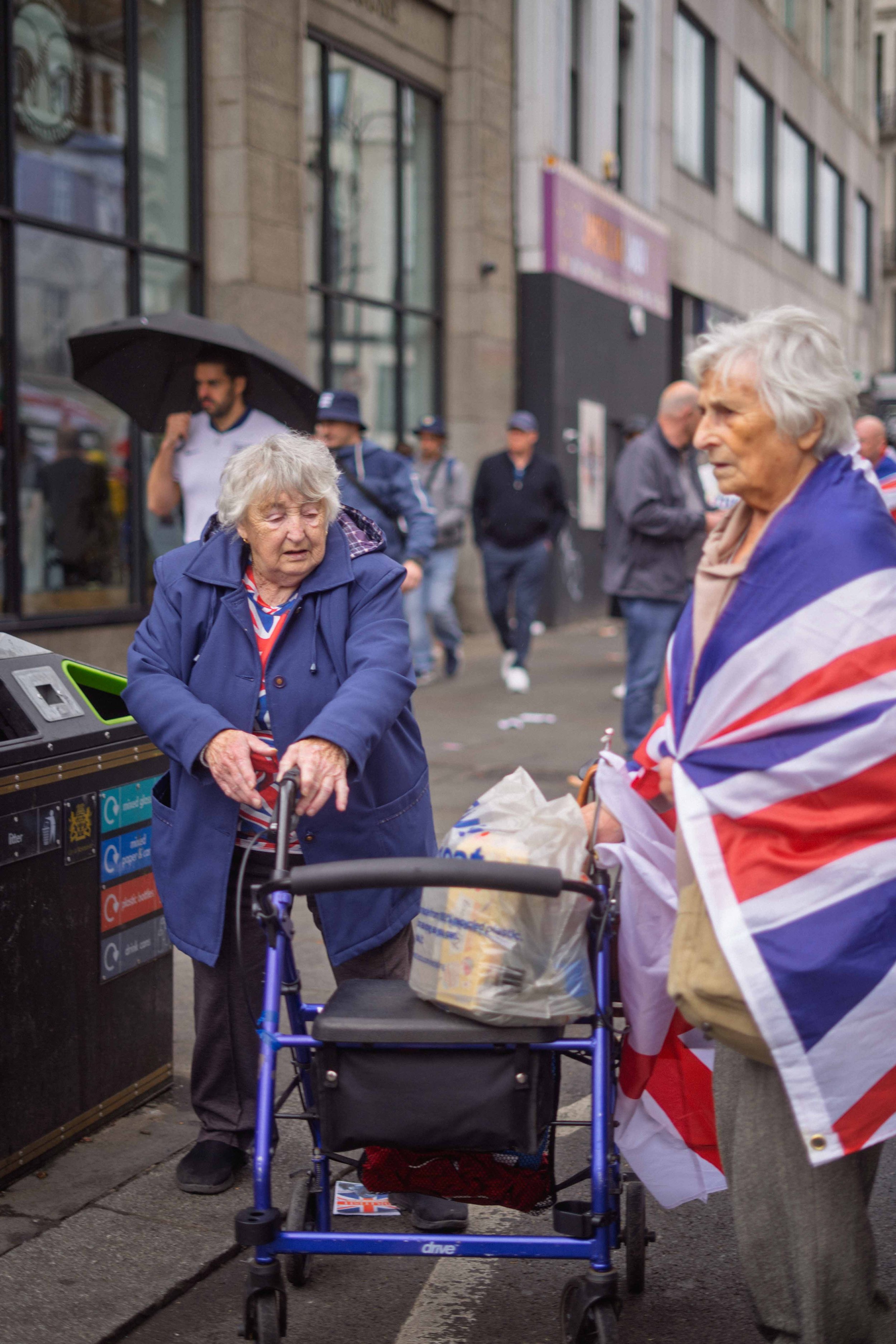
What England Is
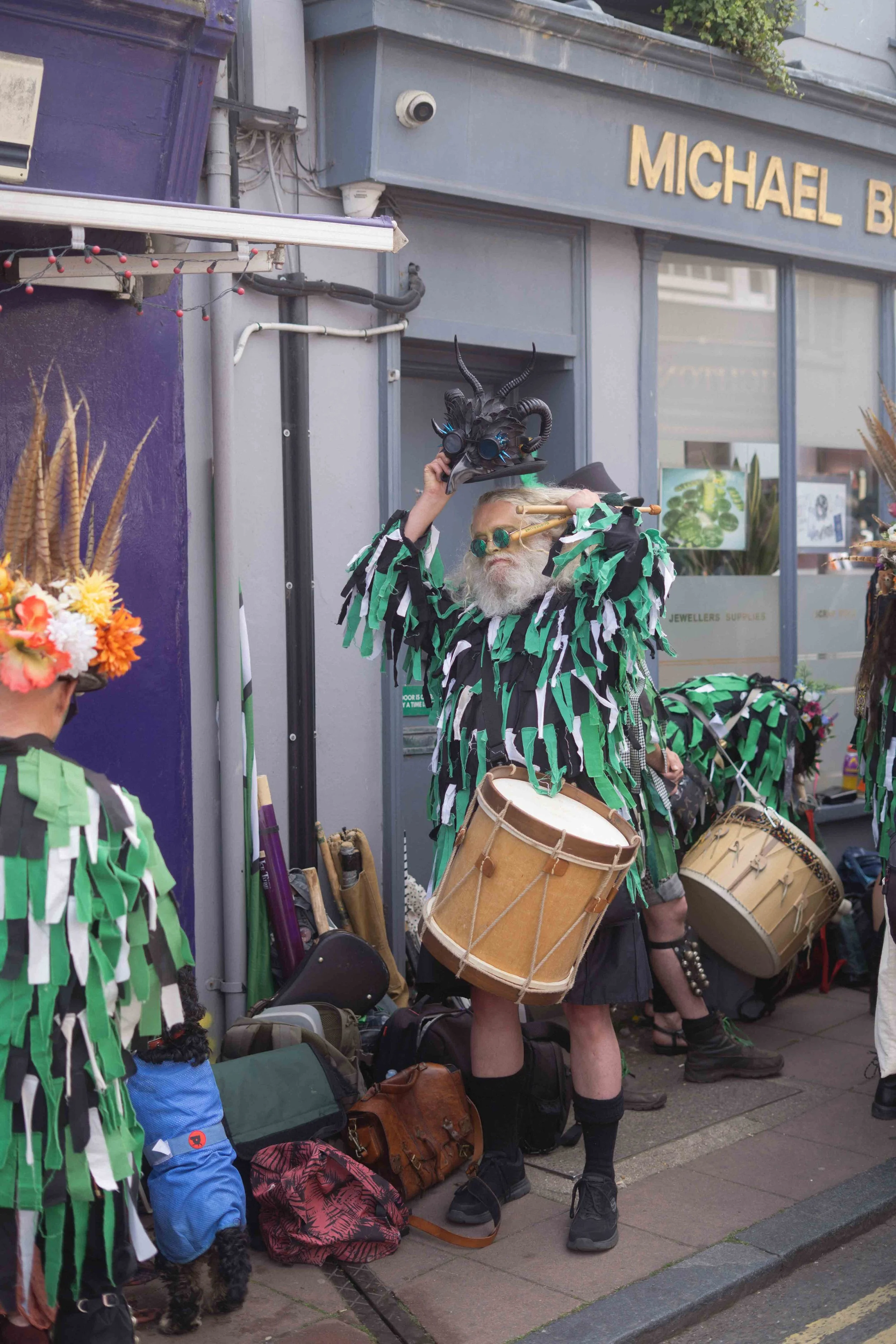
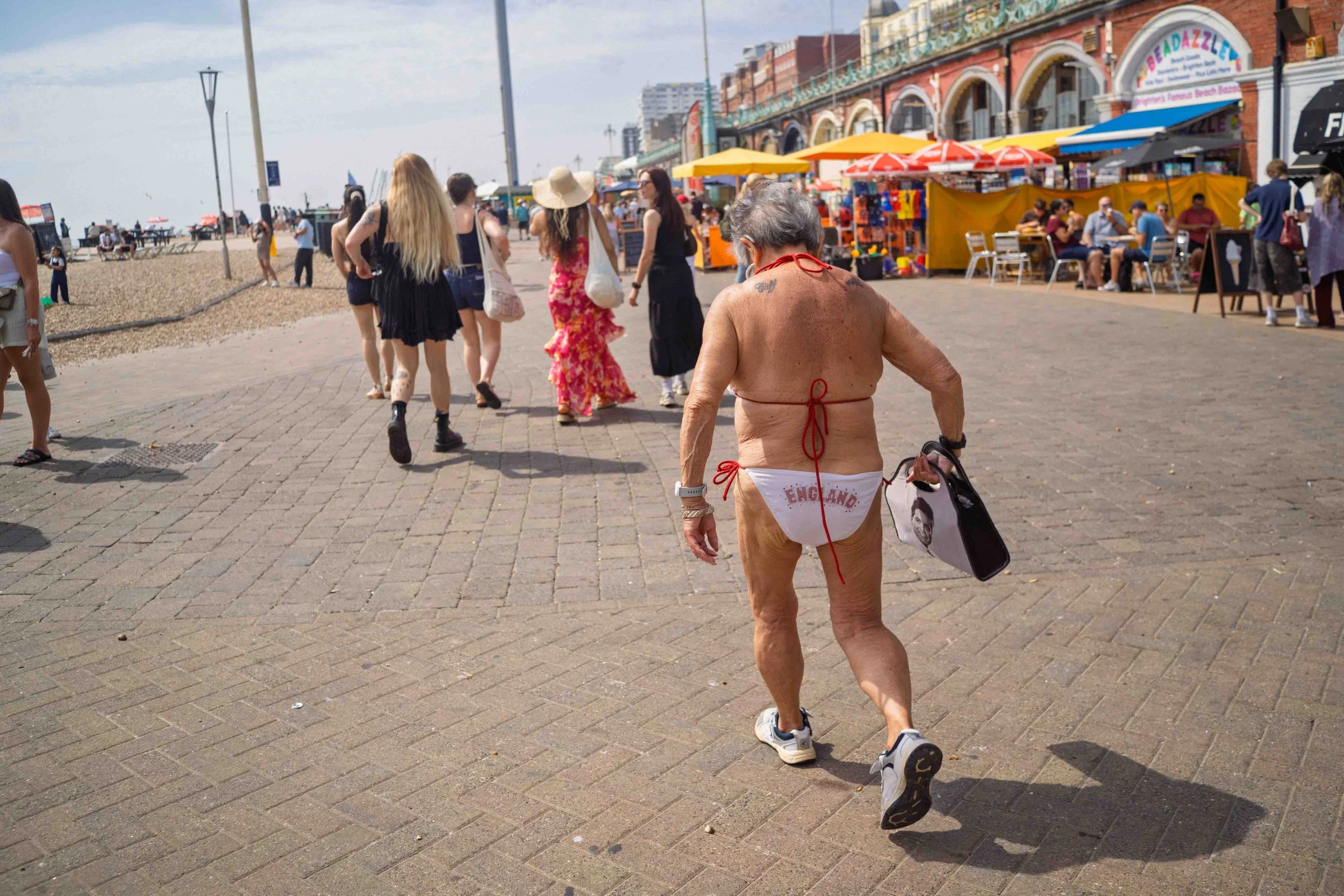
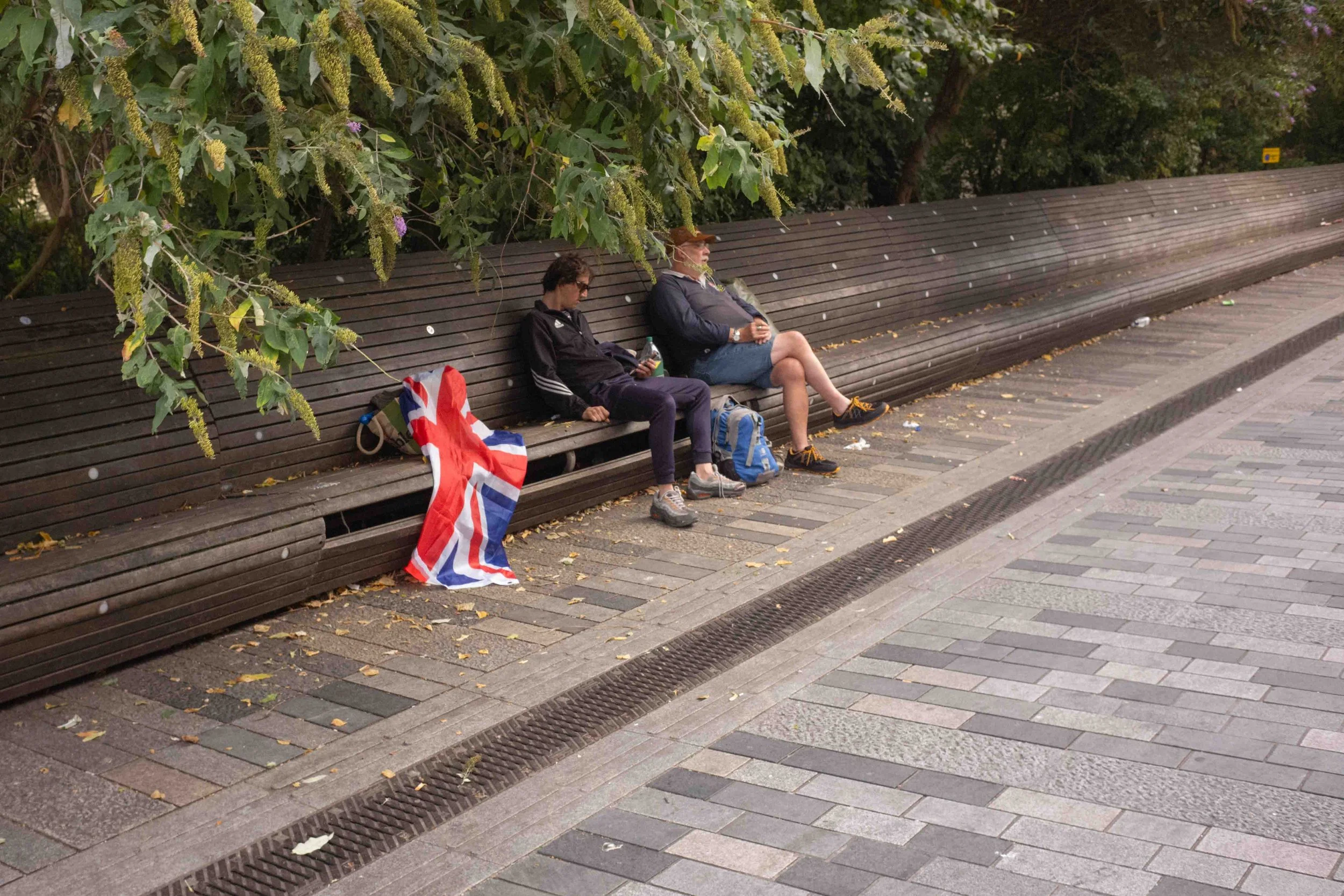
England, this summer, is an older man on a Brighton promenade in an England bikini, walking in the full sun without apology. It is Morris dancers in horned hats and shredded green coats keeping something old alive in a Brighton side street, whatever that old thing is. It is a Union Jack left on a park bench like something forgotten, or discarded, or simply put down for a moment's rest.
It is loud and quiet, proud and deflated, certain and entirely lost, all at once.
The kebab shop is open. The England flags are in the window. The halal sign is next to them. Whatever Britain thought it was voting for in June 2016, this is what it got: itself, unresolved.
The unknown sent us into the unknown. We haven't arrived yet. The question is where we're heading.
Until next time, keep snapping

Oh, I Do Like to Be Beside the Seaside
Brighton doesn't do things quietly. That's partly why I moved here.
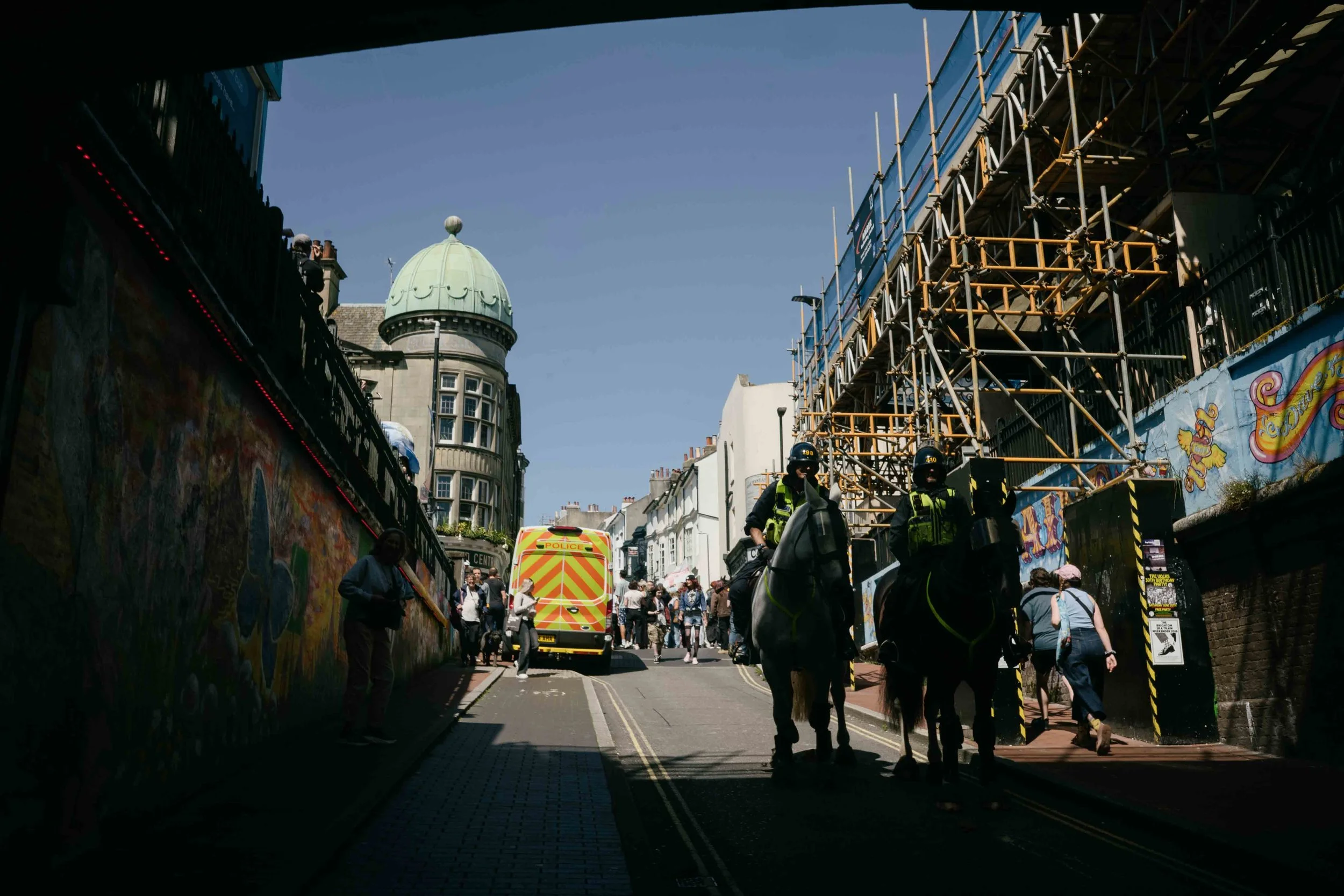
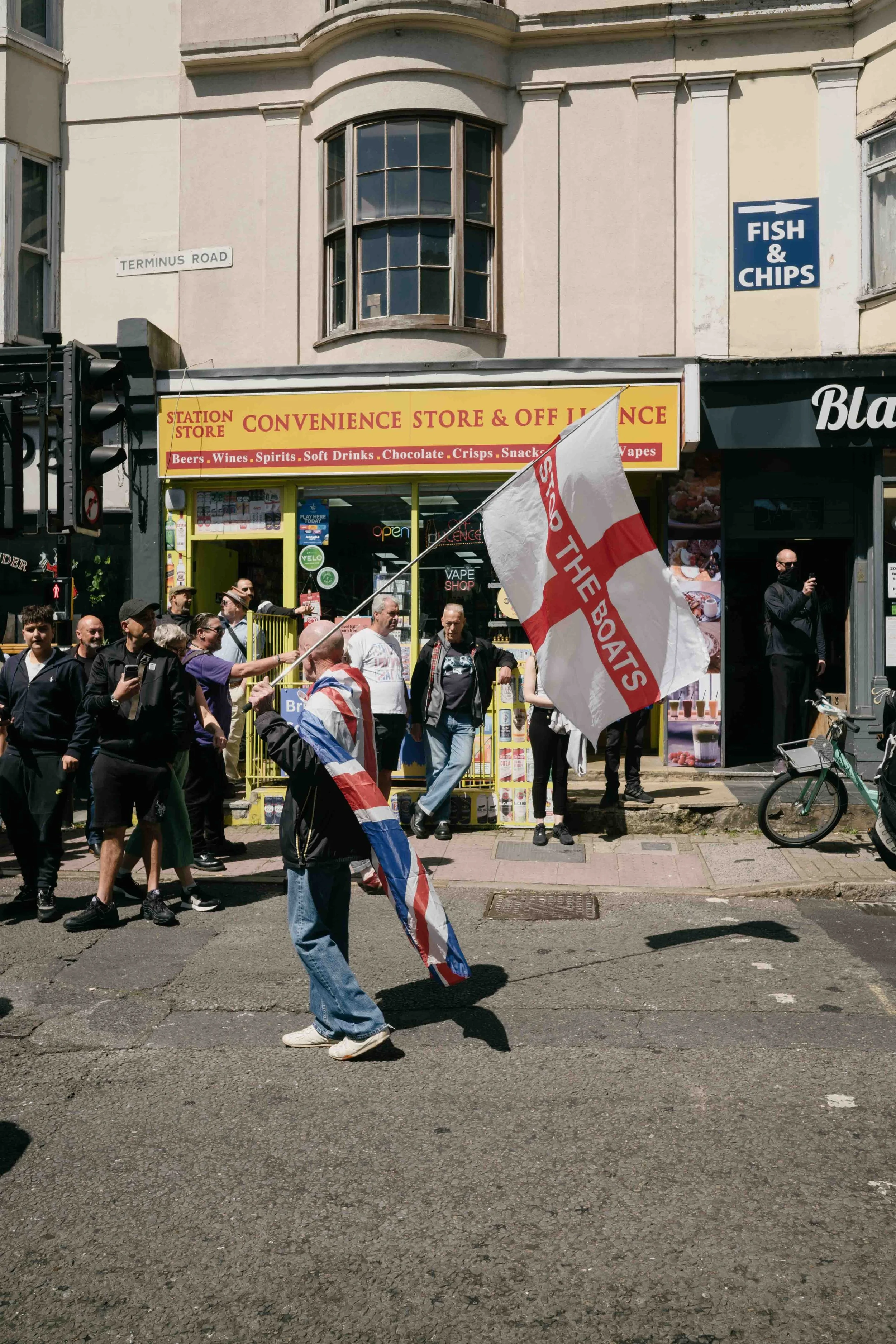
Today the city had two sets of visitors — the Carnival Against Fascism and the South East Patriots — and for a few hours the streets held both of them, pressed together by police lines and competing chants, while the rest of us tried to work out what we were watching.
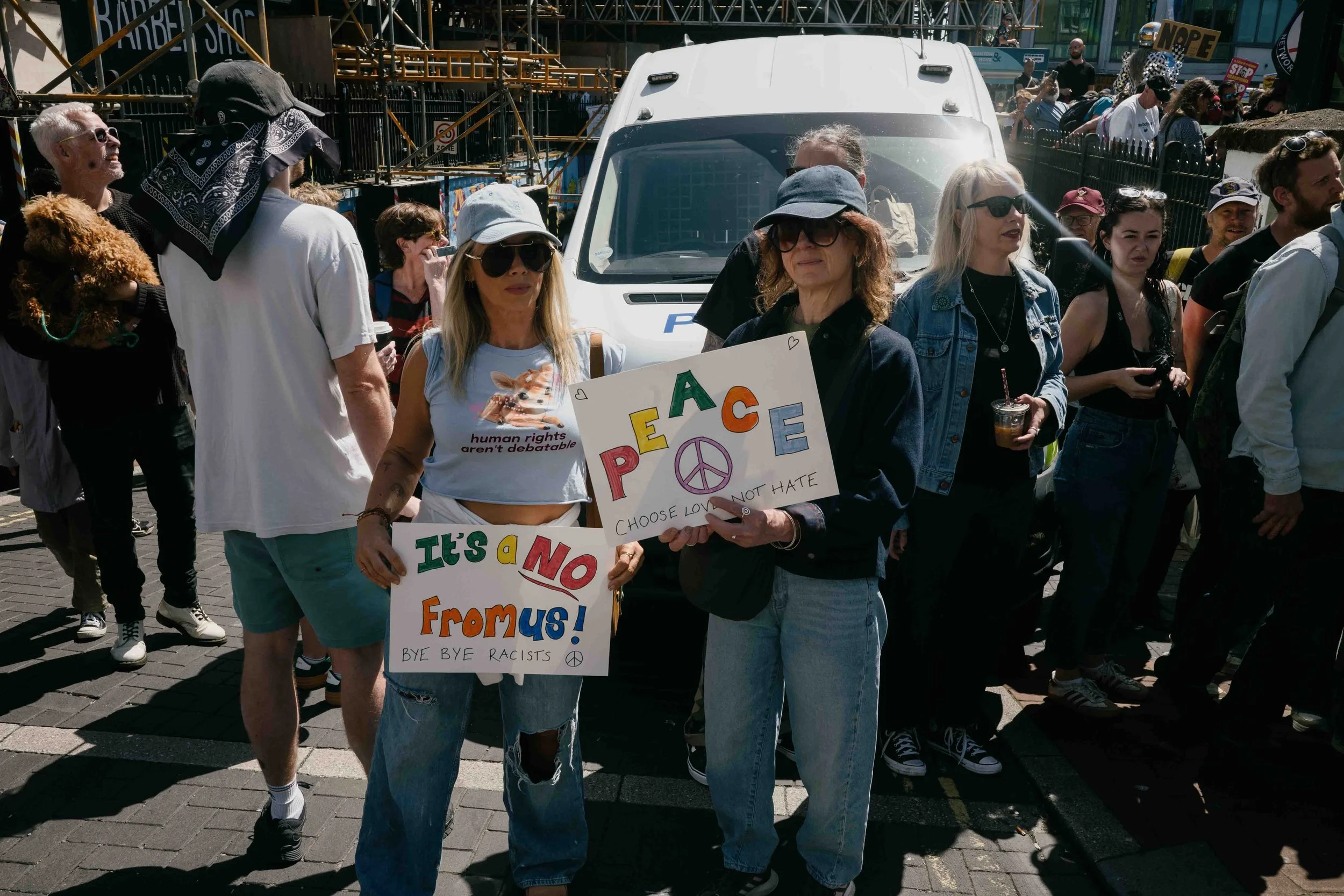
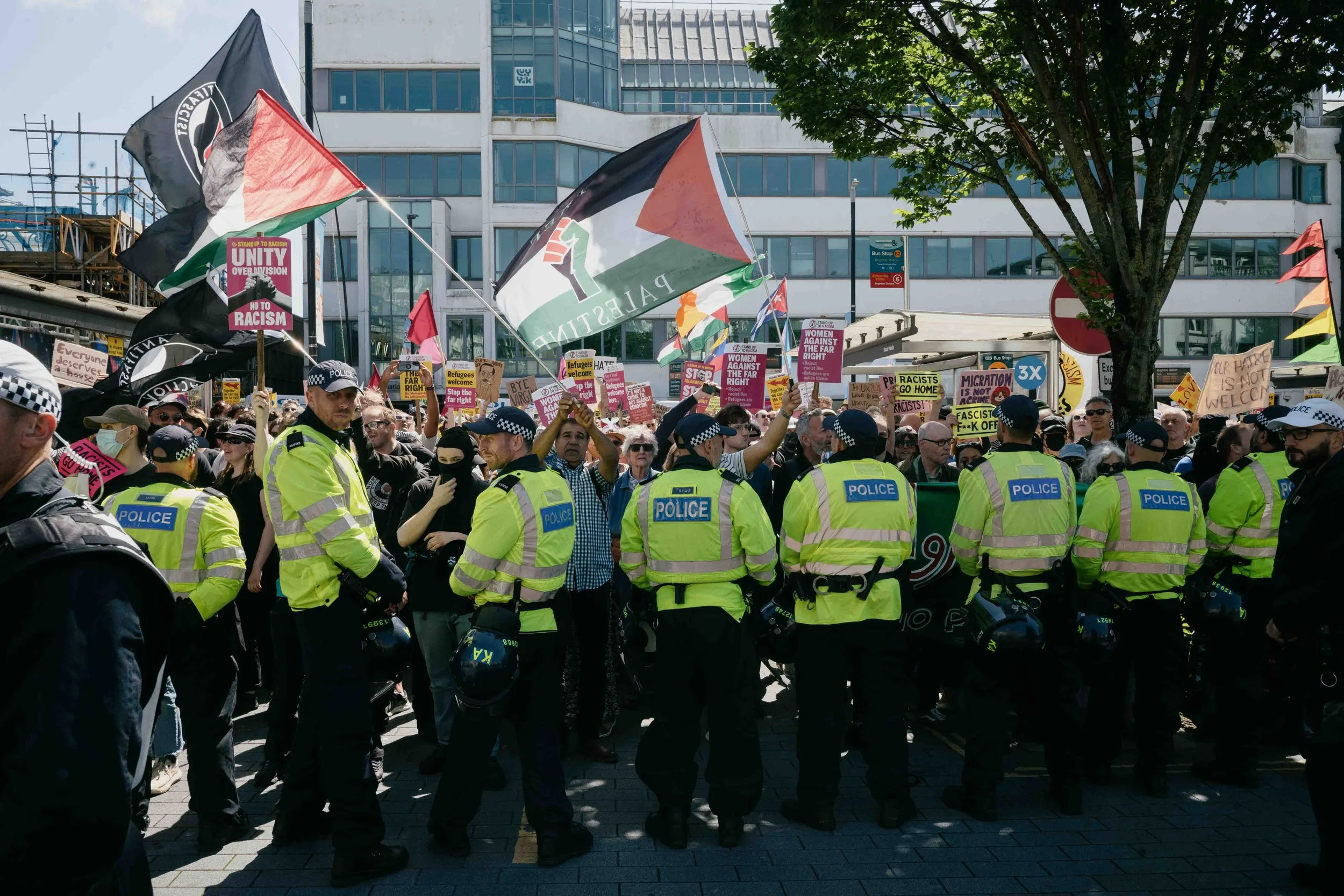
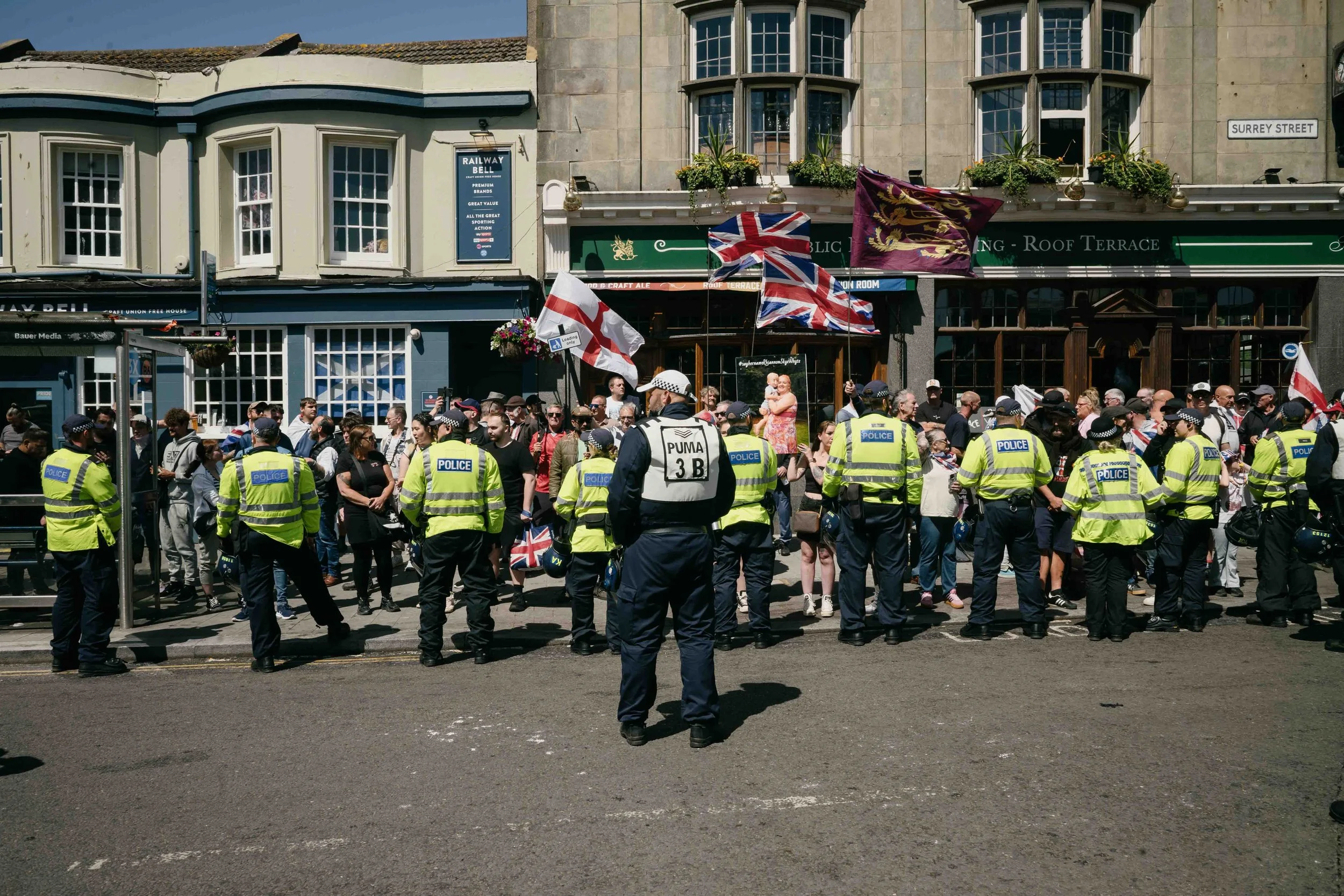
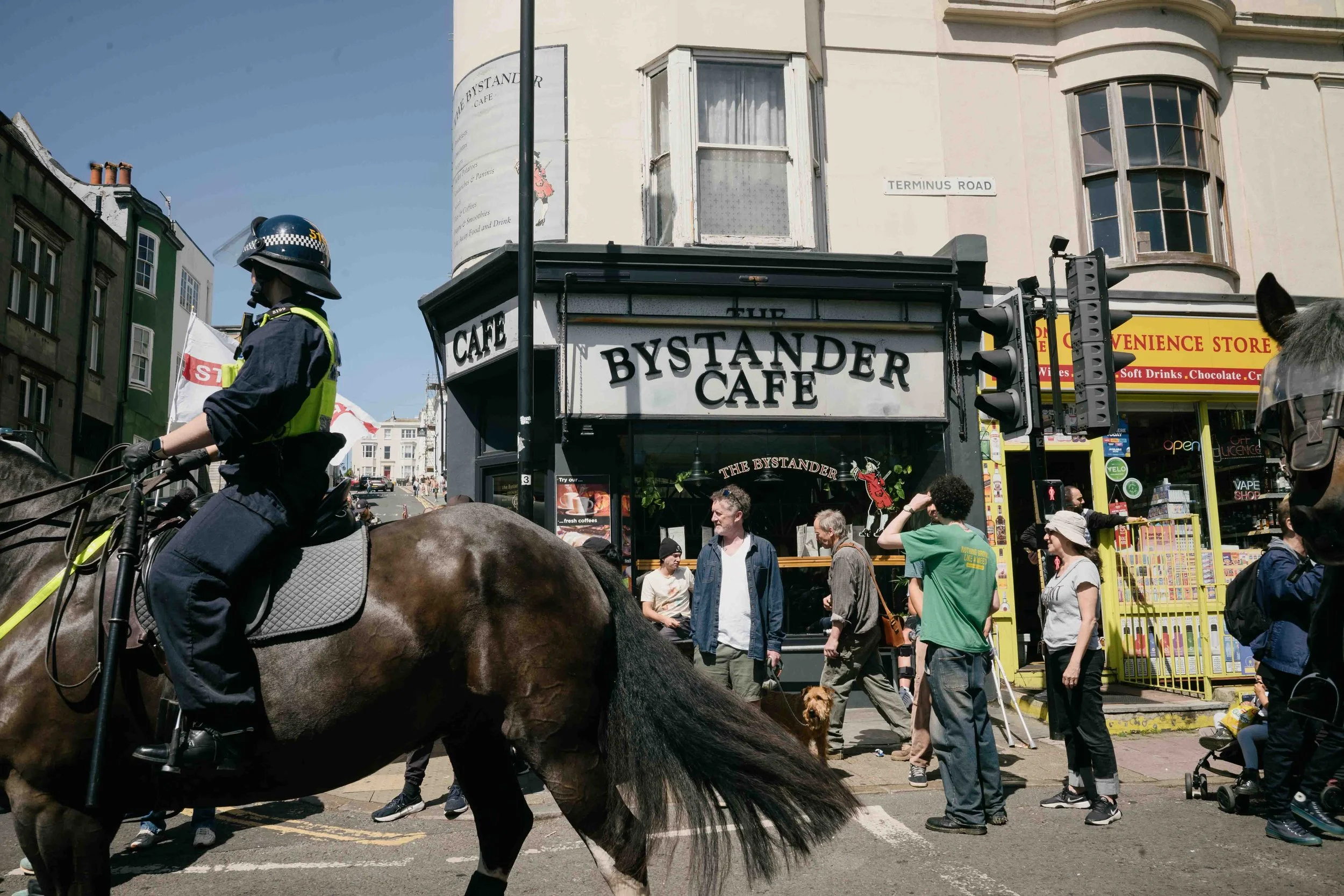
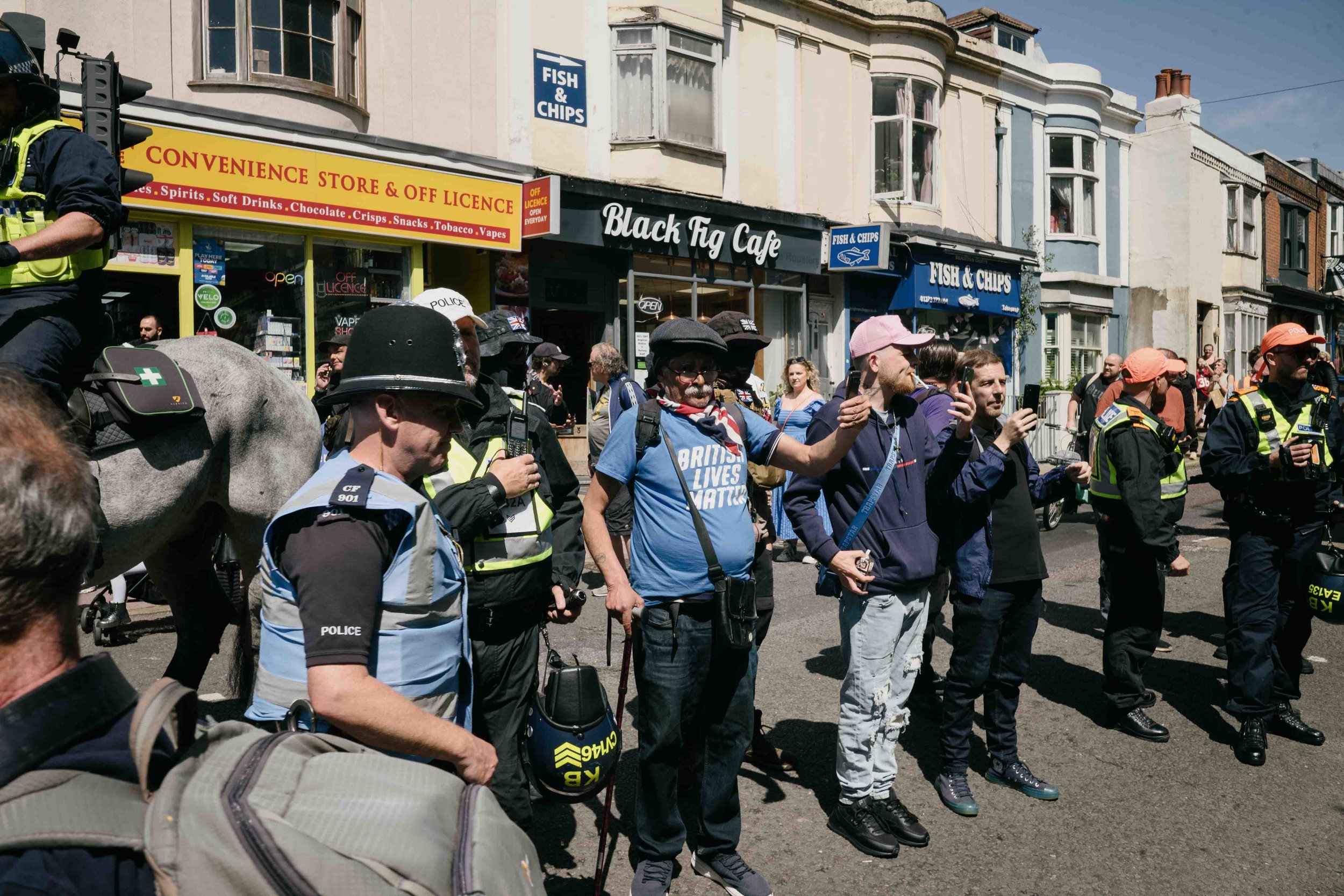
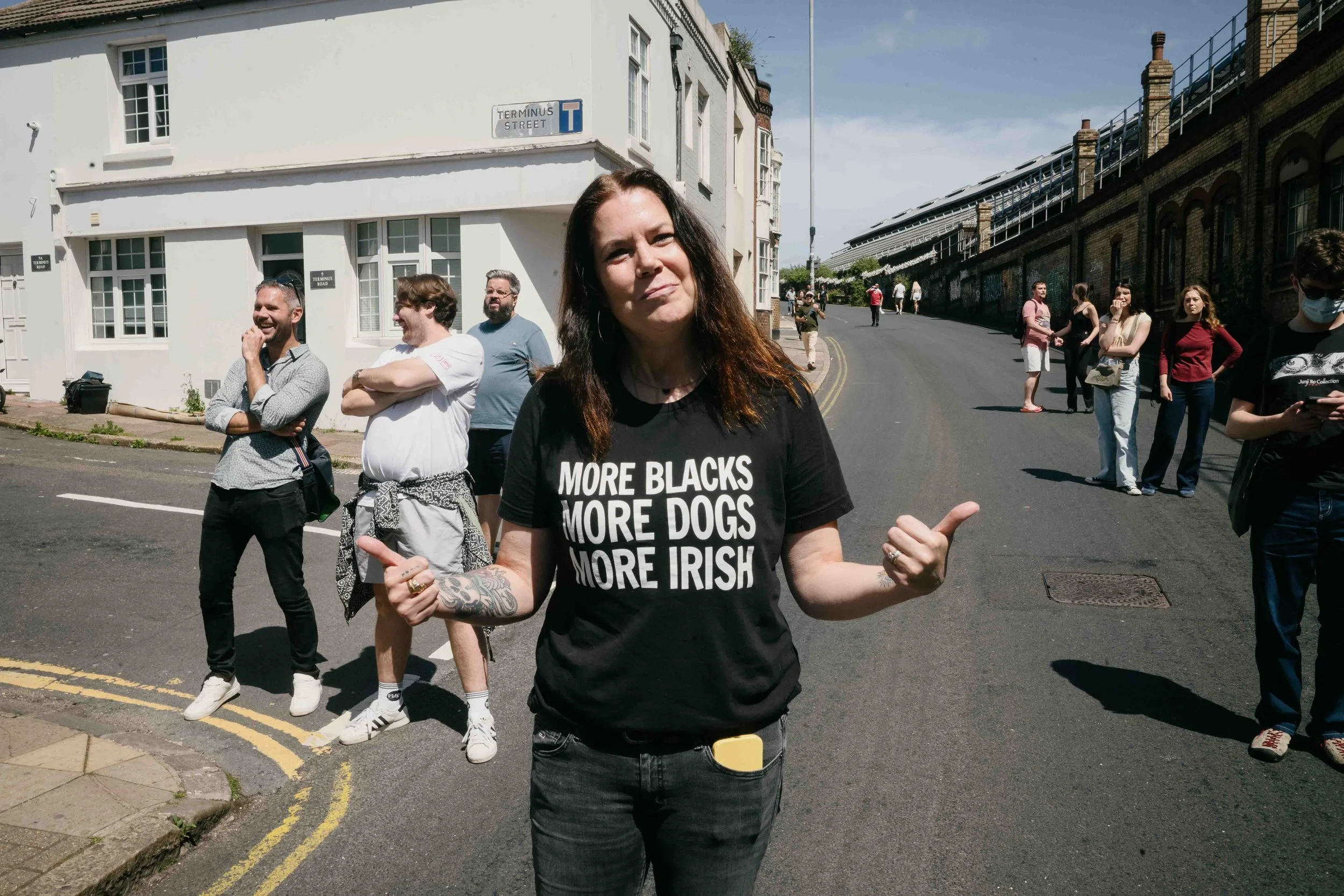
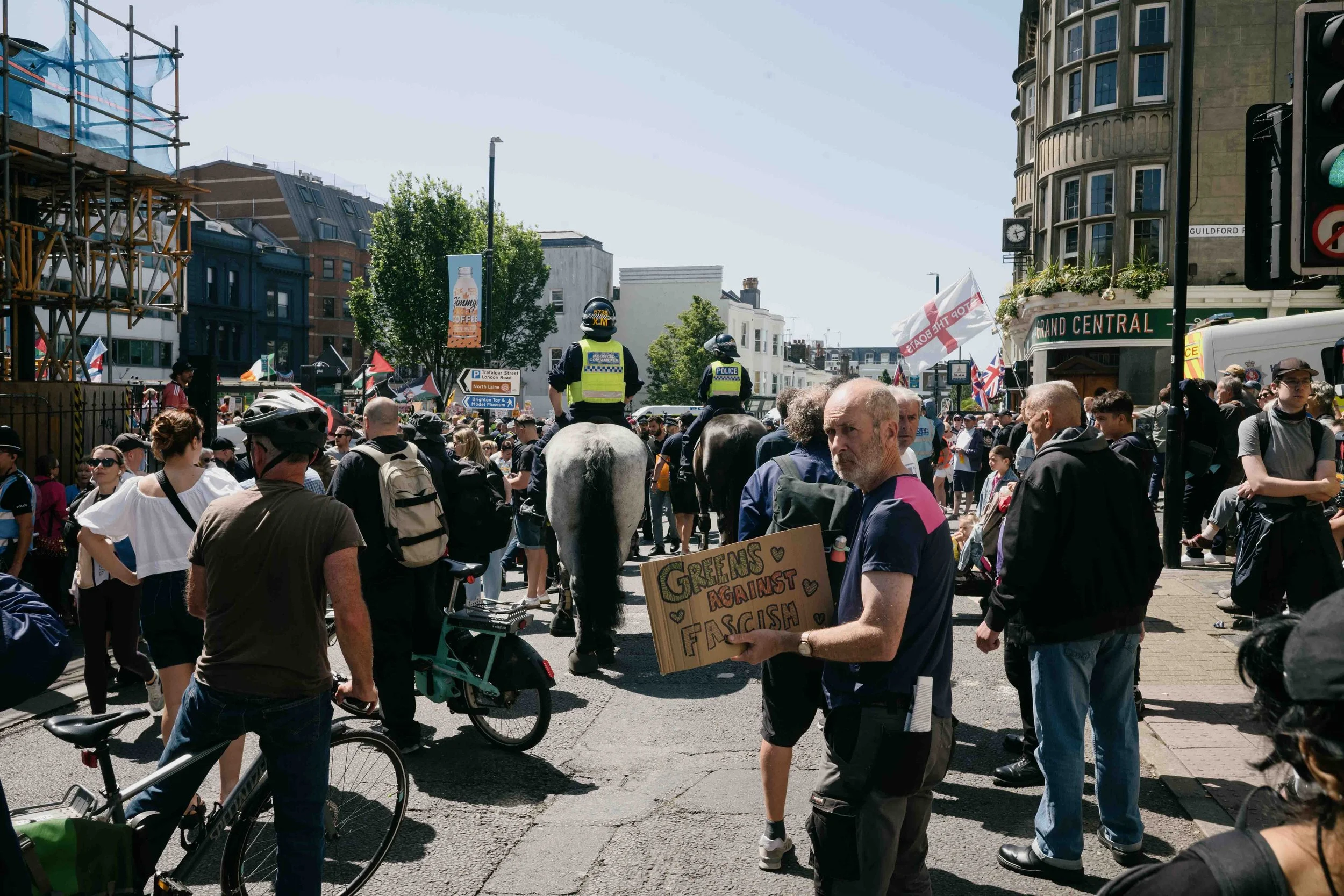
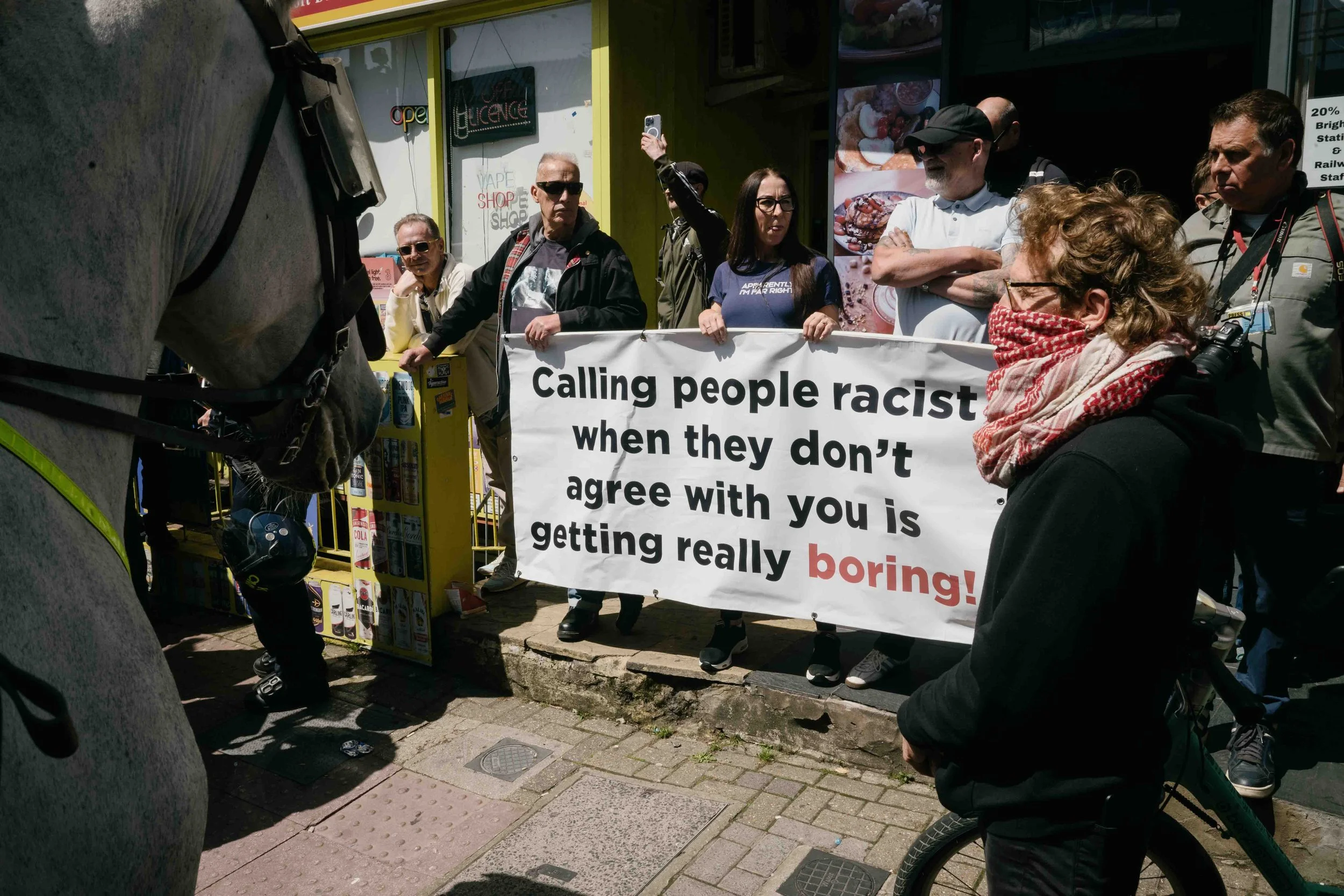
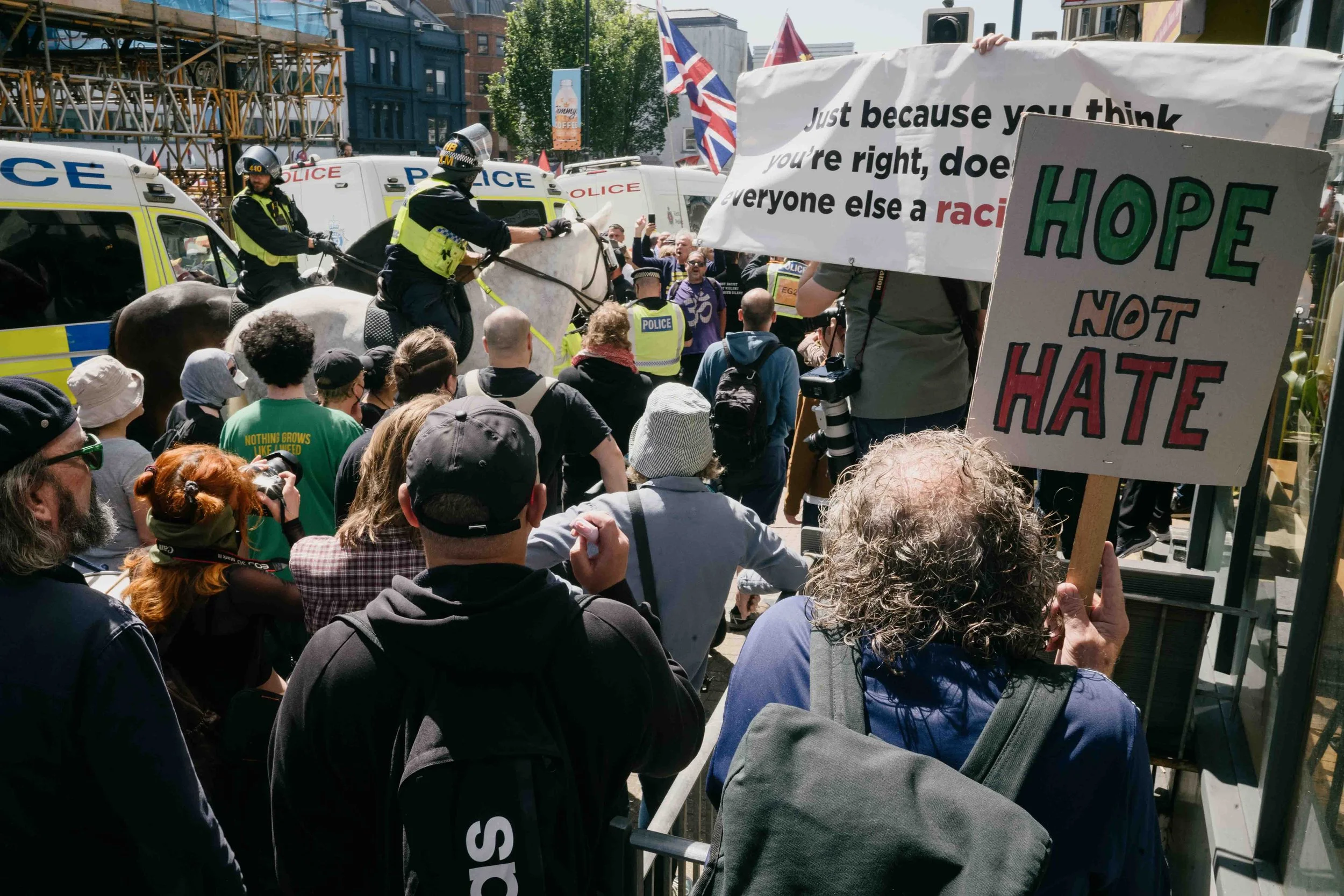
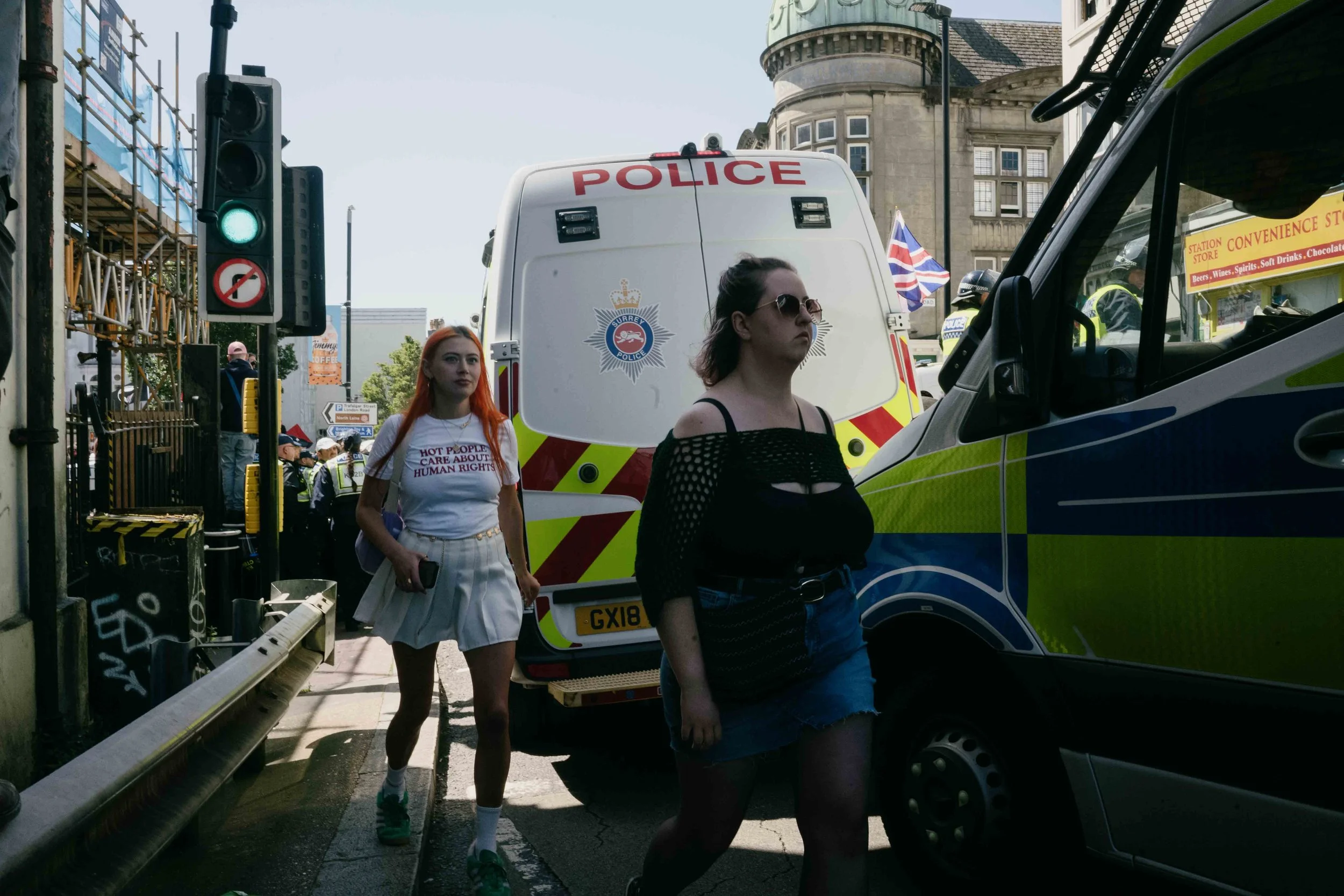
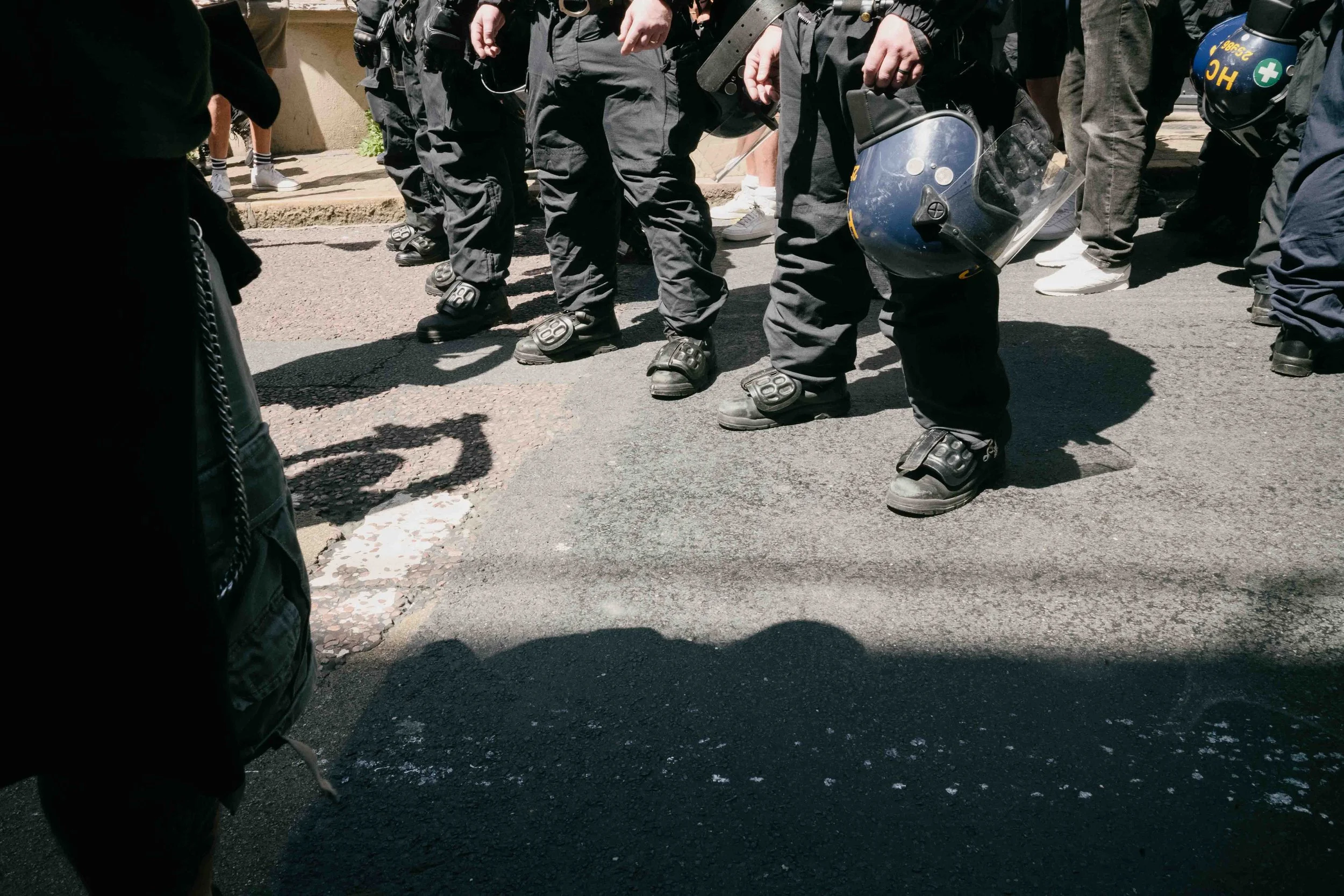
Not a Brightonian by Birth
I've lived here since 2014. Long enough to feel like home, not long enough to claim it as mine by right. I came for the community, for the sea, for the kind of place I wanted to bring my children up in. Brighton gave me all of that.
It hasn't always been the most multicultural city — I say that honestly, not as criticism. But it's changing, and the change is good. New food, new voices, new texture. A city finding more of itself.
"It's great for the community, great for cuisine, and great for culture."
I mean that. So when I saw far-right flags moving through these streets, something in me reacted. Not just politically — personally.
Heart is where the home is.
My dad was Yugoslav and my mum was Catholic Northern Irish. They met in Australia and settled in the Midlands, which meant I grew up knowing all corners of a community — accents, faiths, kitchens, stories. That background didn't make me tolerant in some abstract, theoretical way. It made me know people. Knowing people makes abstraction harder.
I'm immigrant stock. When I see flags that say otherwise, I don't see politics. I see a mirror held up the wrong way.
The Man on the Pavement
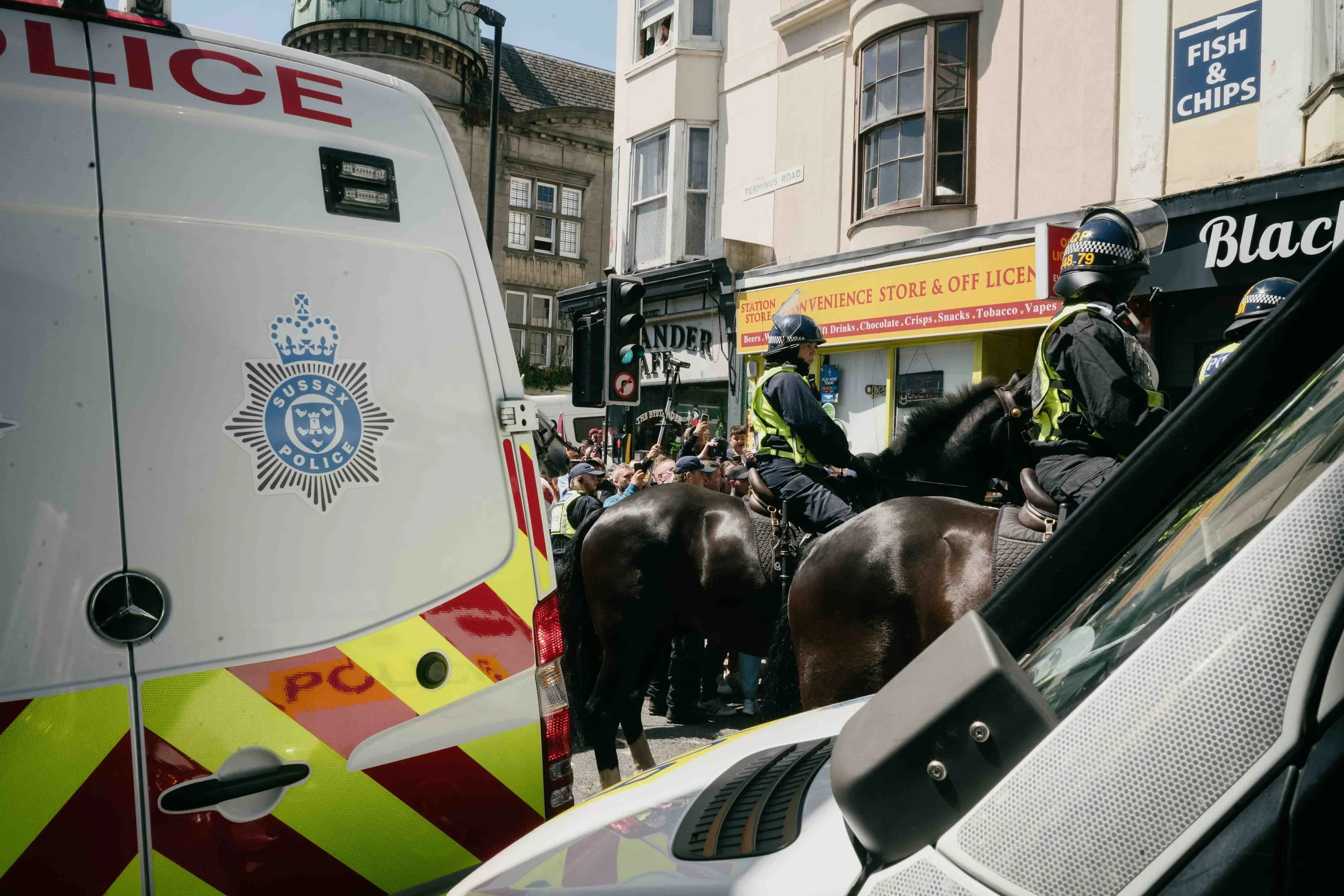
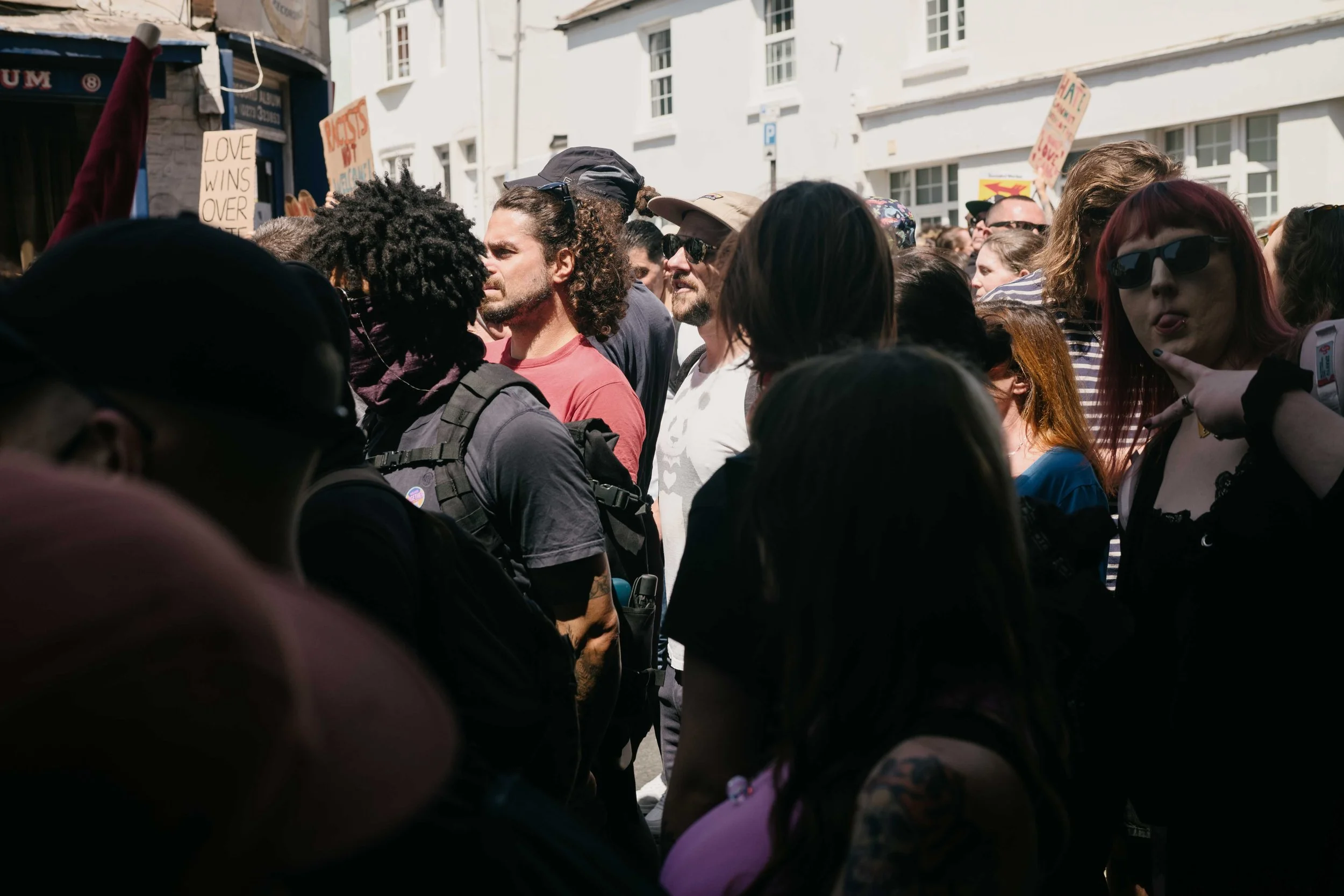
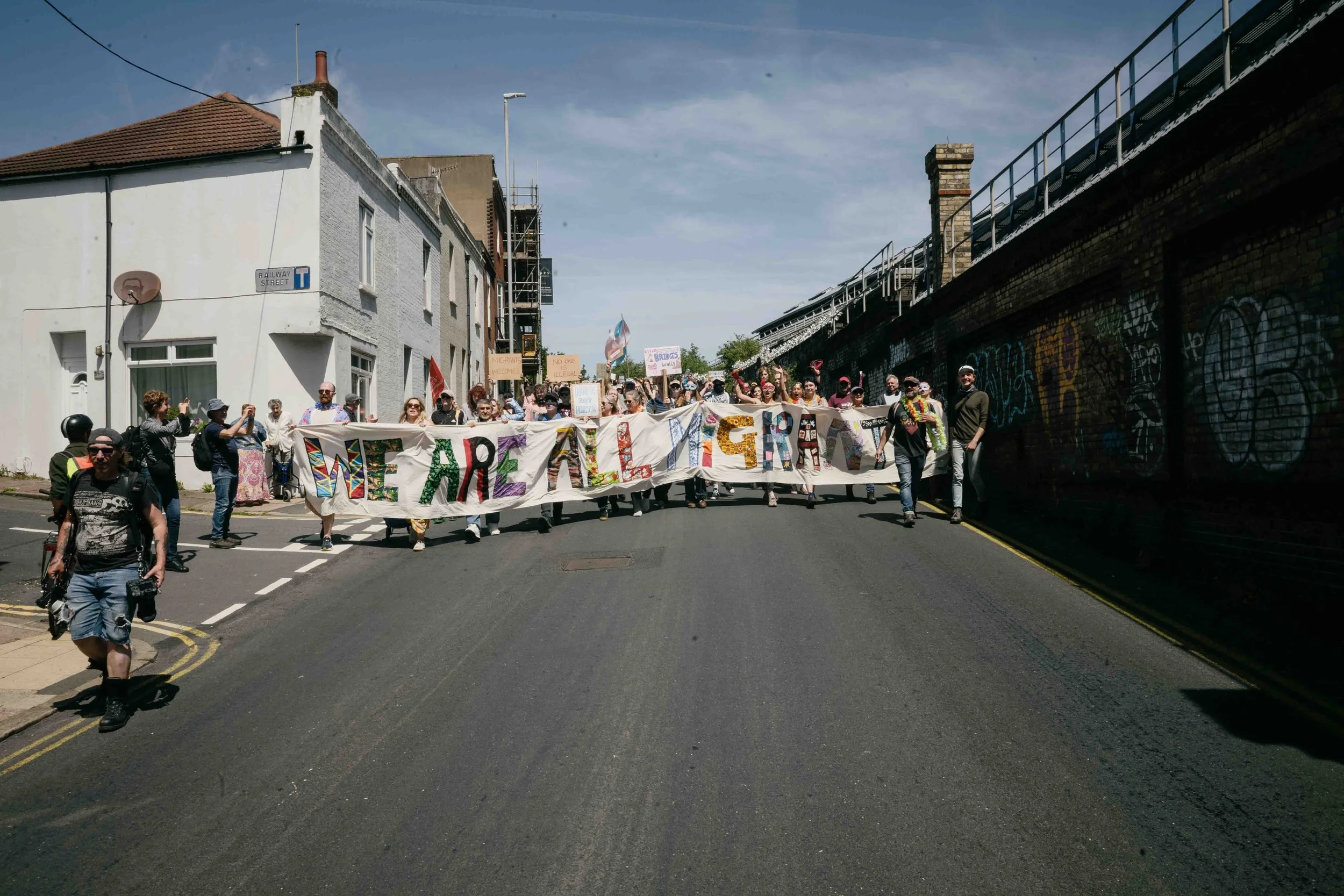
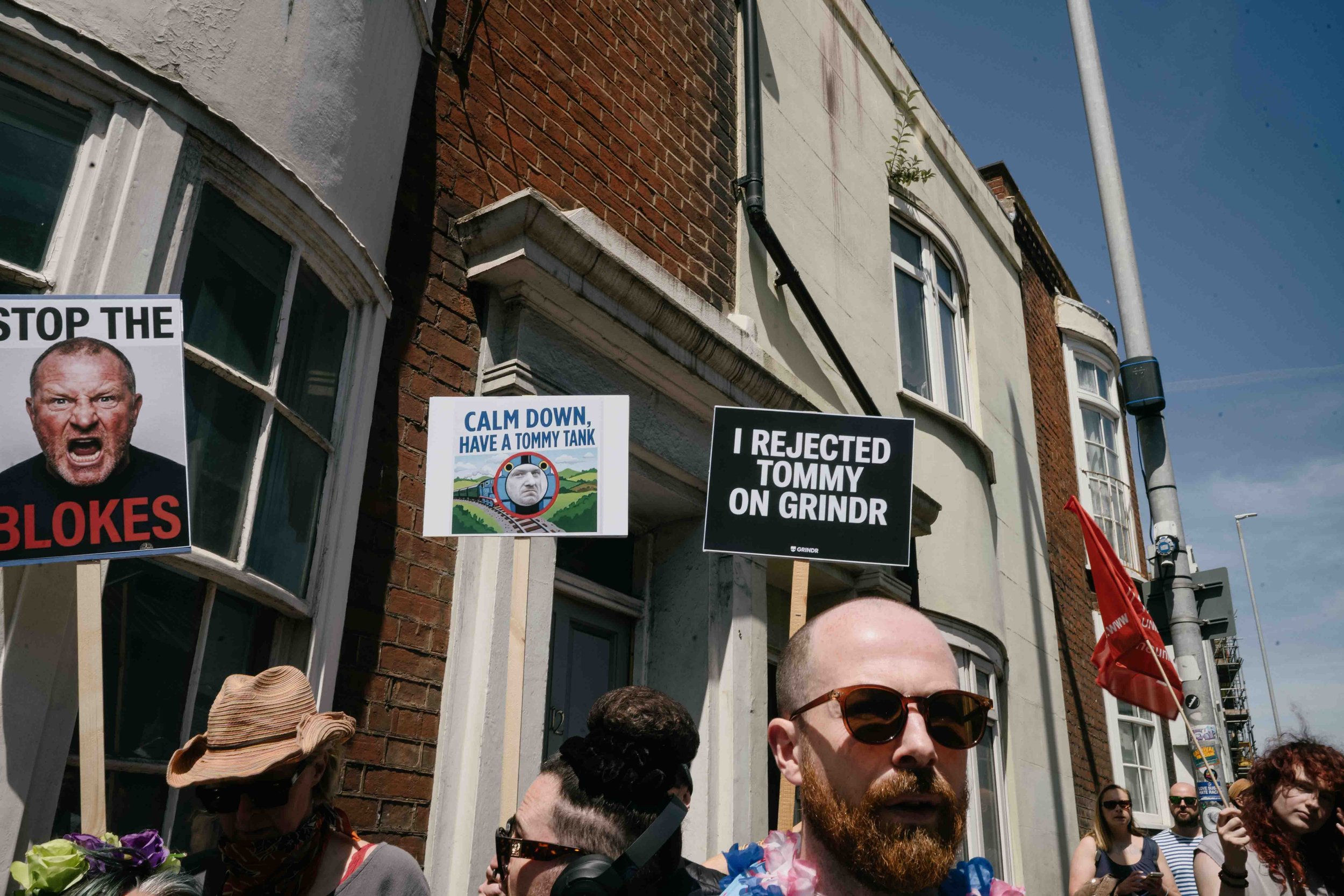
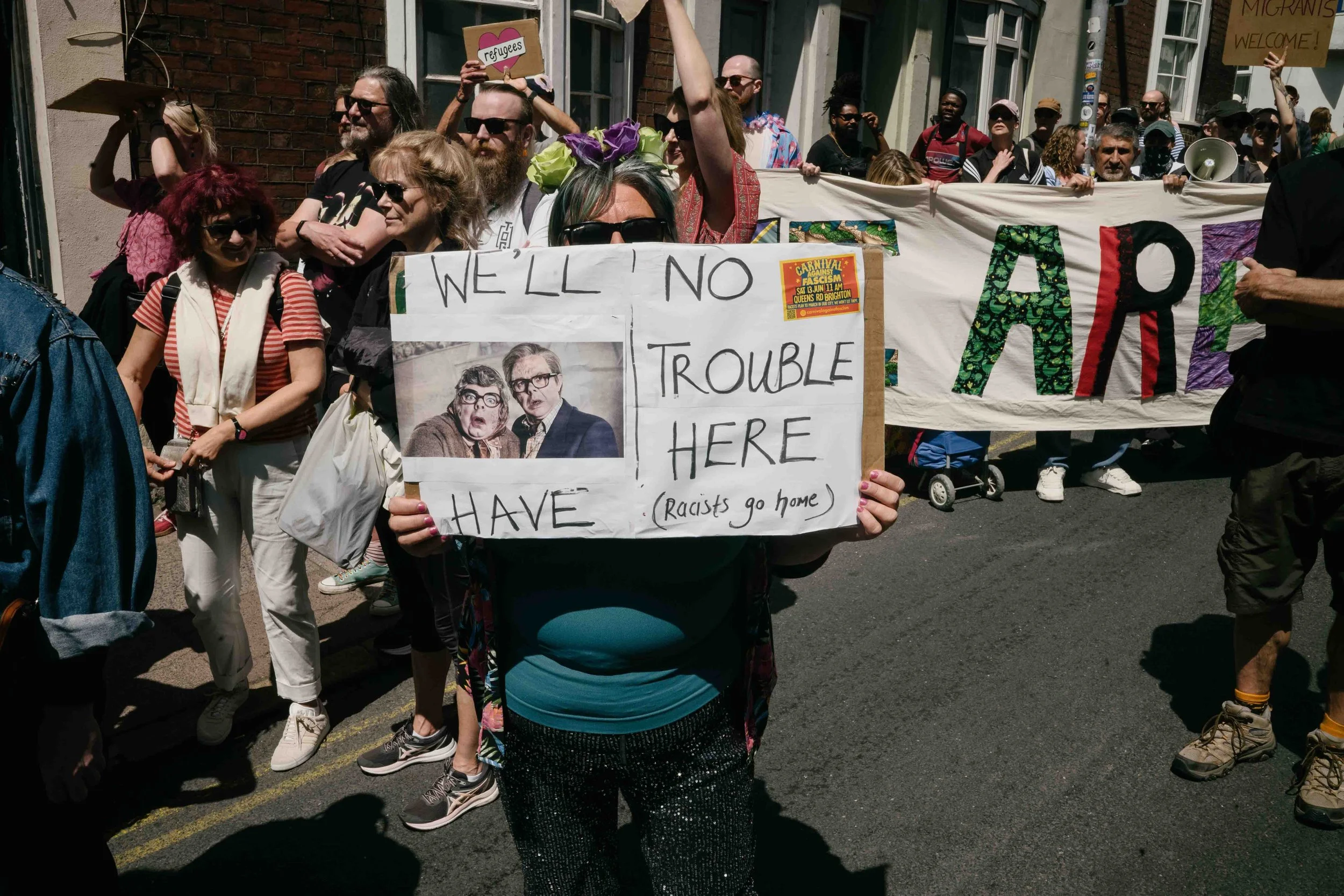
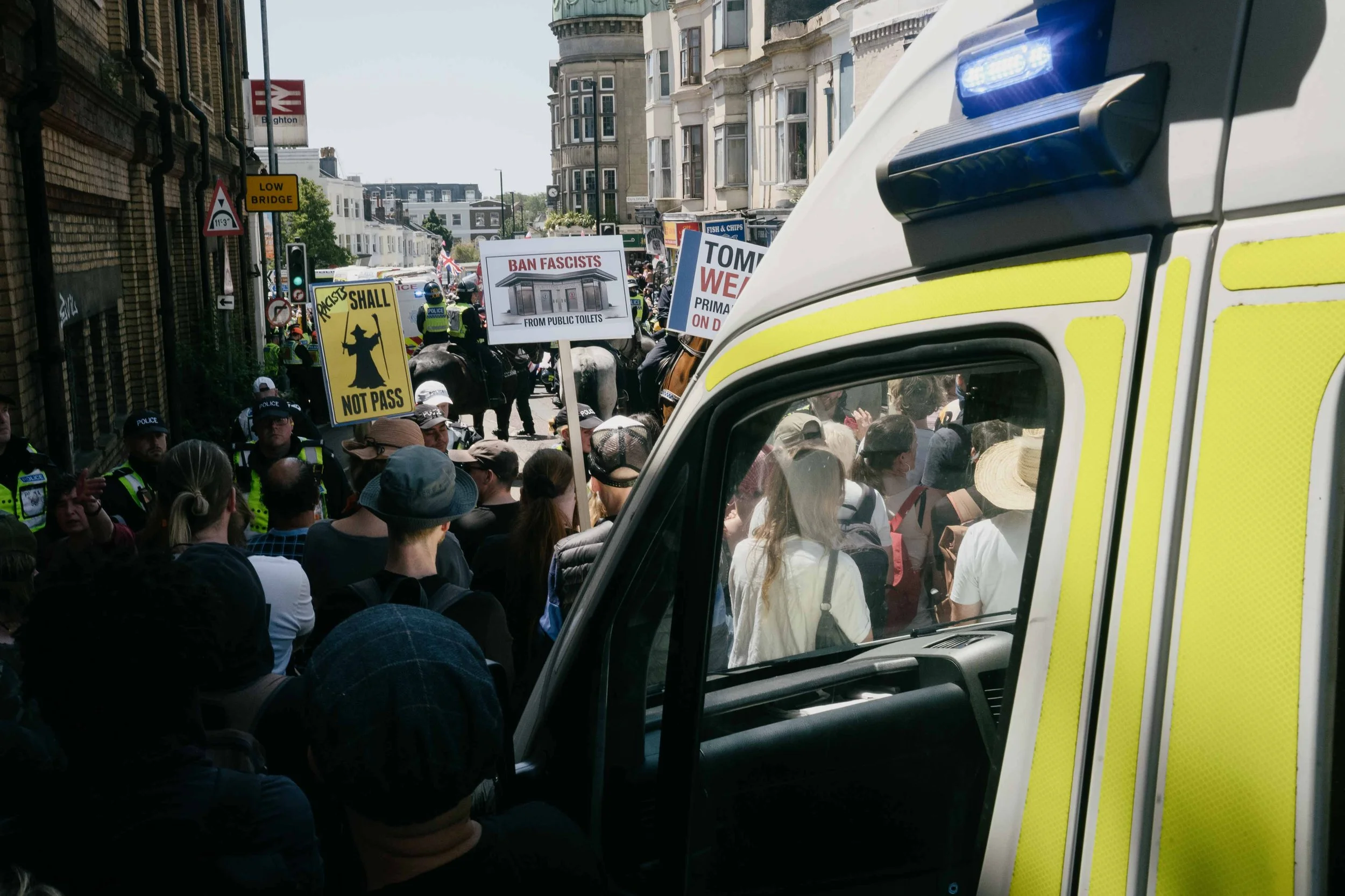
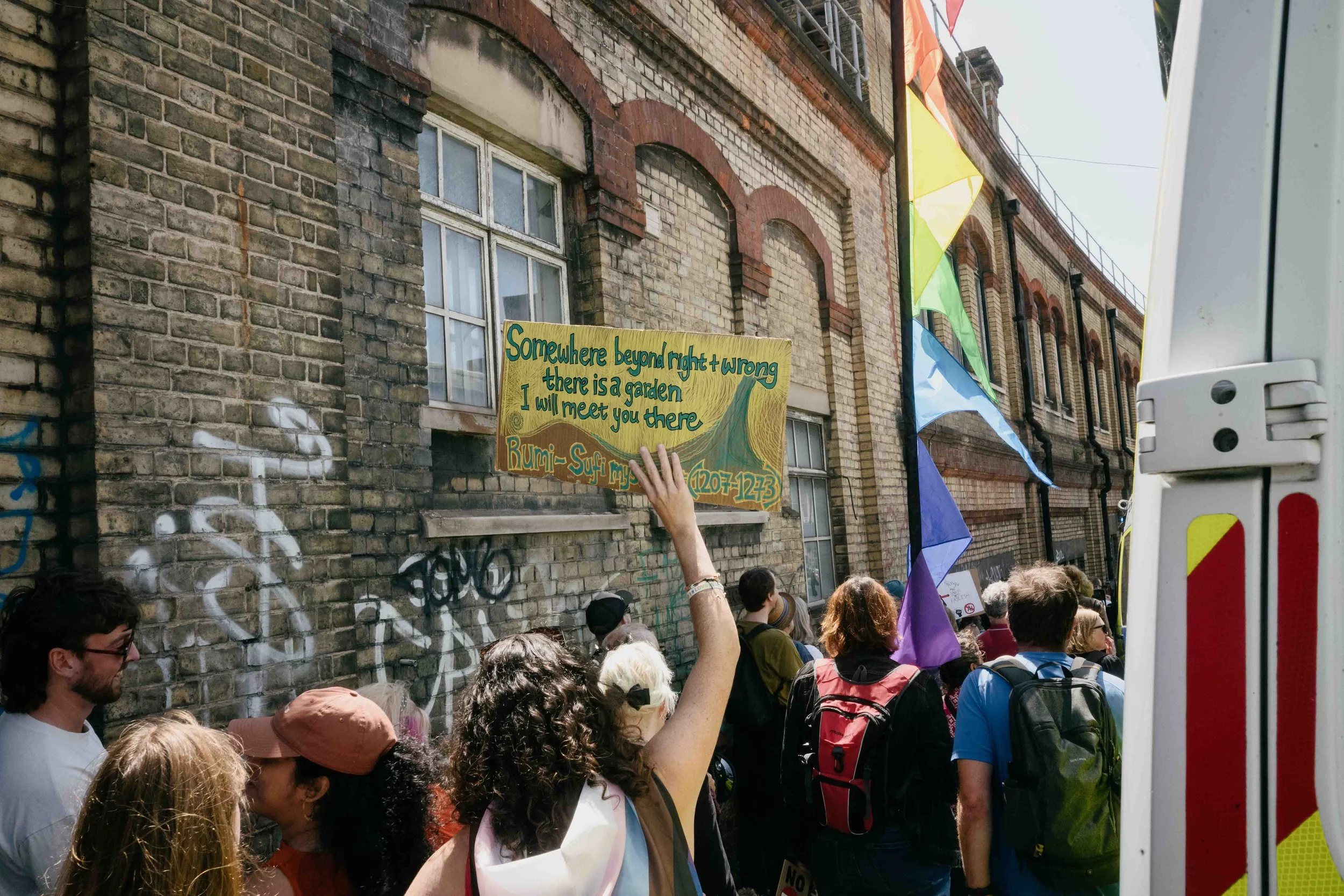
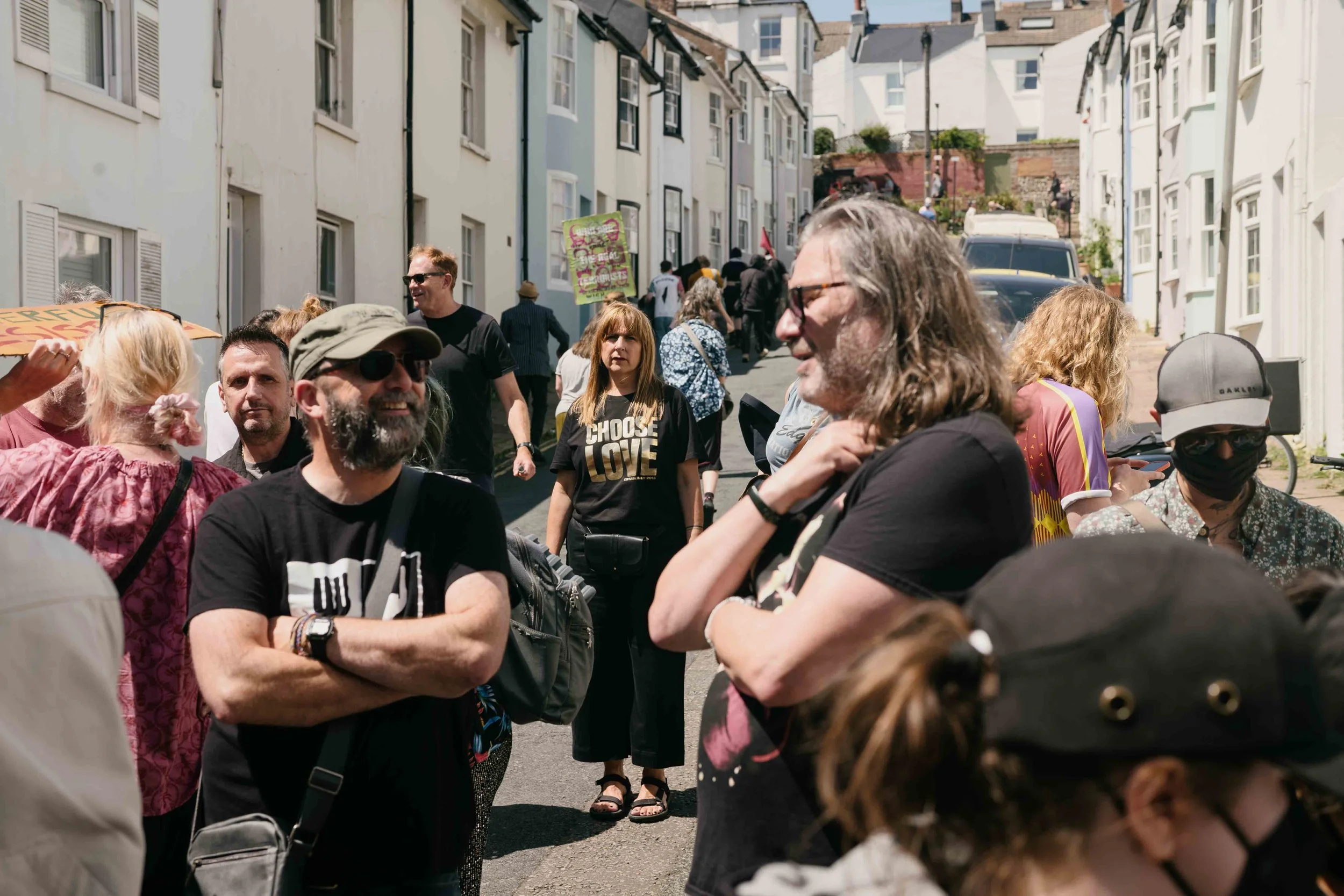
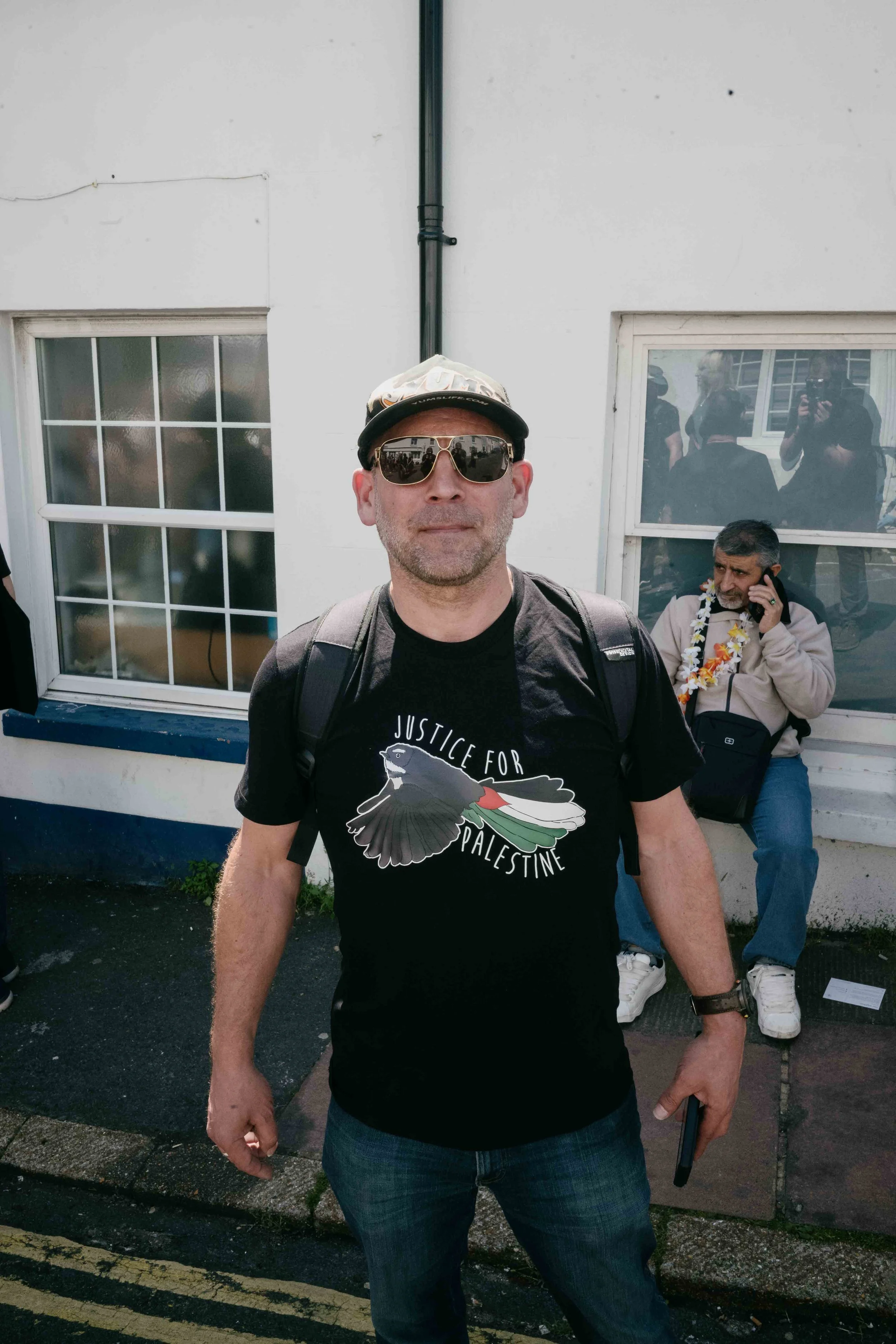
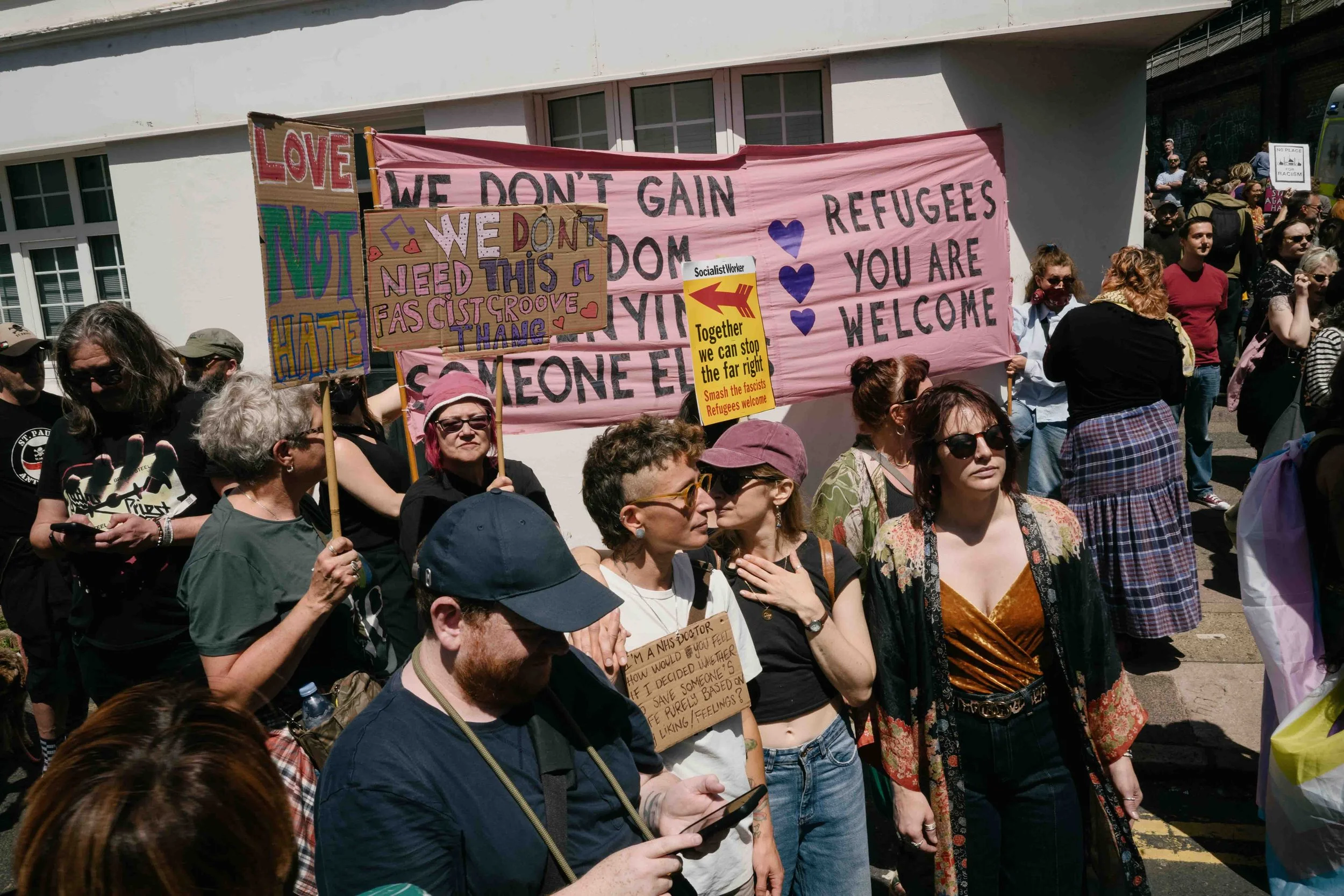
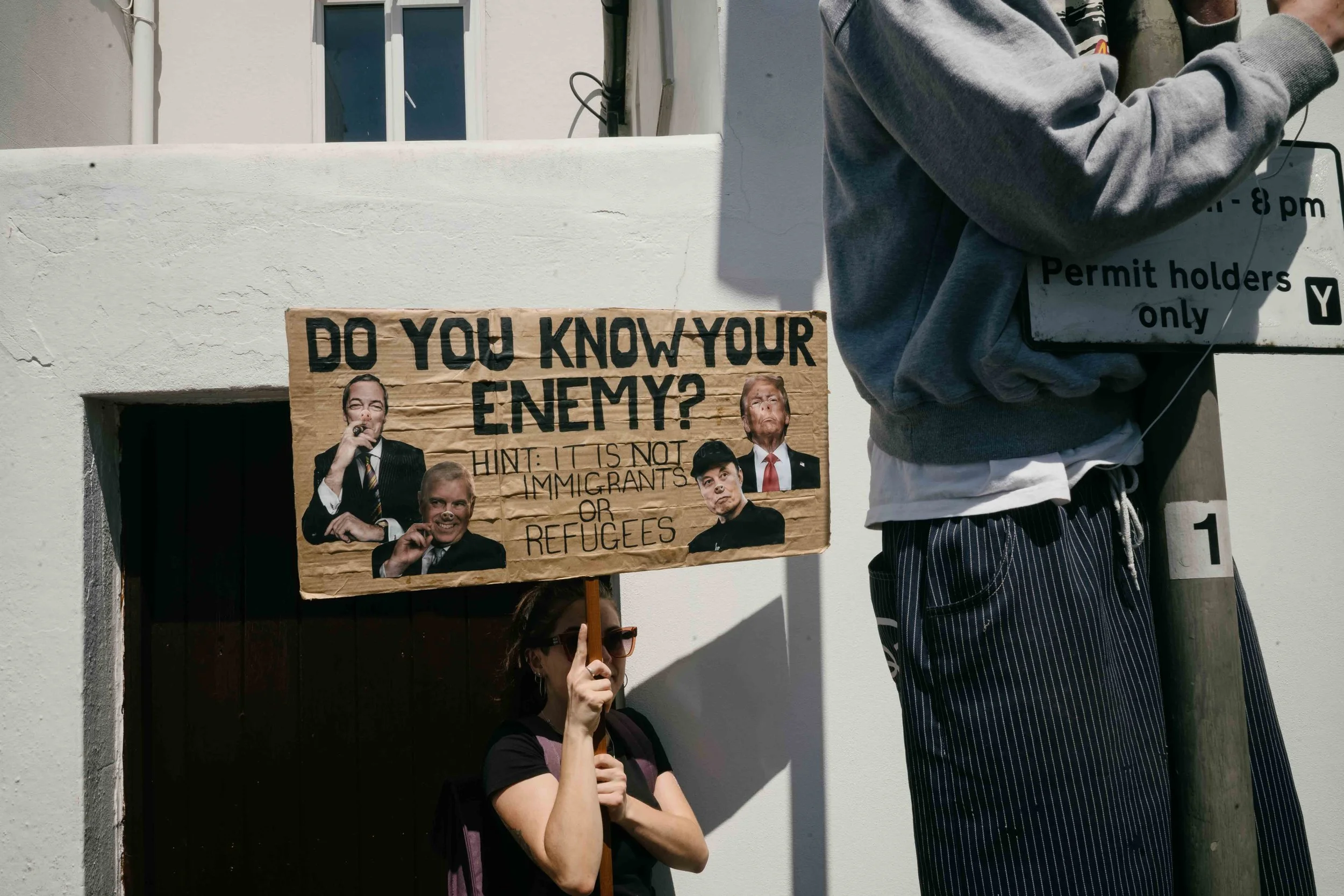
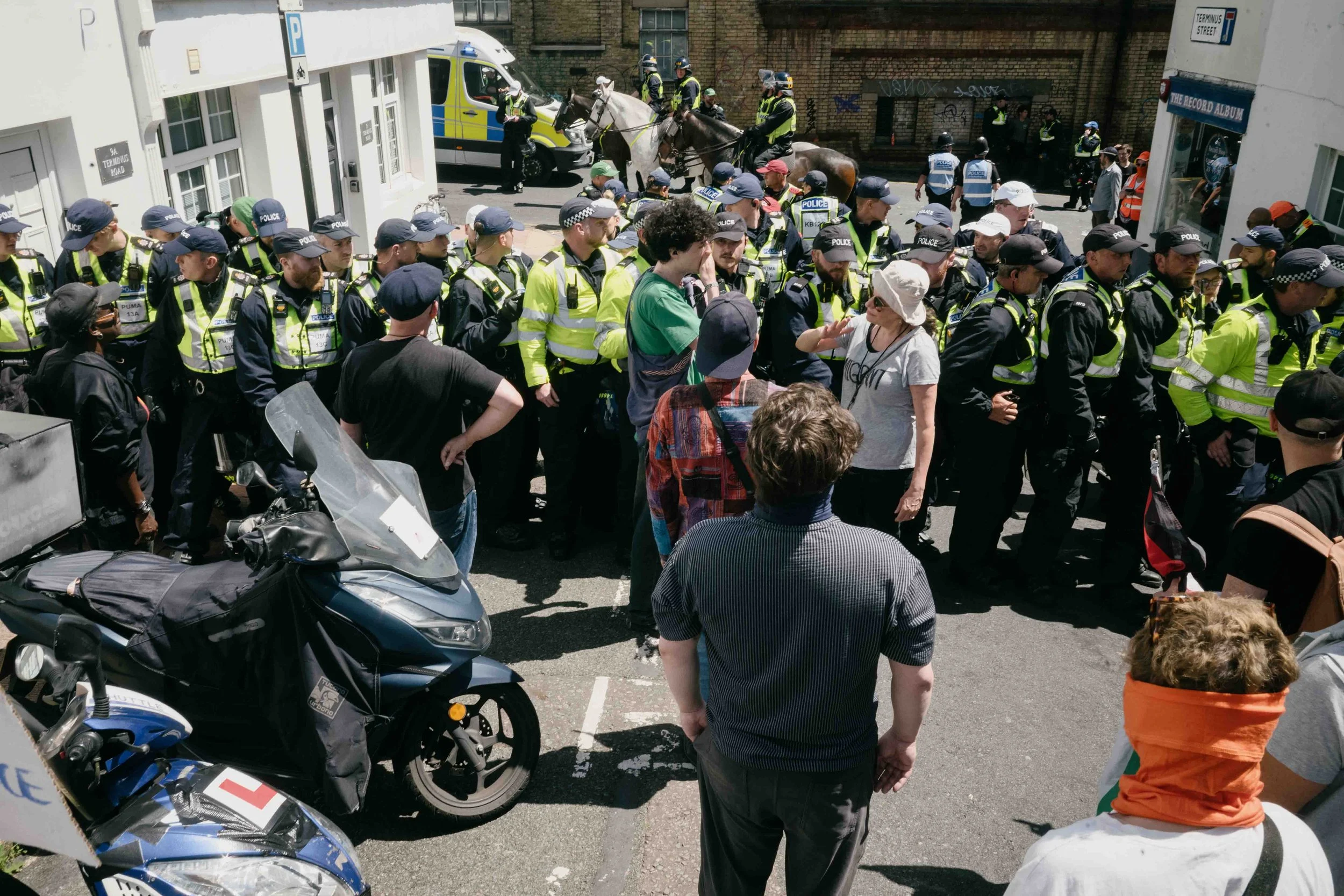
I was genuinely unsettled seeing those flags here. Brighton felt like it shouldn't be on that particular map.
Then a local stopped and talked to me. Born and bred Brightonian. He'd seen it before — thirty years of it, he said.
"They've been coming here for thirty years. The only reason they come to Brighton is to stir up the local community. And it hasn't changed in the twelve years you've been here. I can assure you it hasn't changed in the twenty years before that either."
It should have been deflating. Instead it was clarifying. This wasn't an incursion. It was a pattern, and Brighton had been absorbing it, unchanged, for decades. The city knew what it was. The city had already decided.
That conversation was worth more than anything I photographed.
The Police
I was at the far-left / far-right march in London not long ago, so I had a comparison to make.
Brighton's police today were also exceptional.
Young officers — some looked barely into their twenties — holding a difficult line between two groups that weren't there to listen to each other. A handful of people tried to goad them, to find the edge that would make them react. They didn't find it. The officers I watched were calm, present, and professional in a way that the situation didn't make easy.
It matters. It doesn't always go that way.
What I Brought Home
A camera gets you close to things. Sometimes that's a privilege, sometimes it's a responsibility, and occasionally it's both at once.
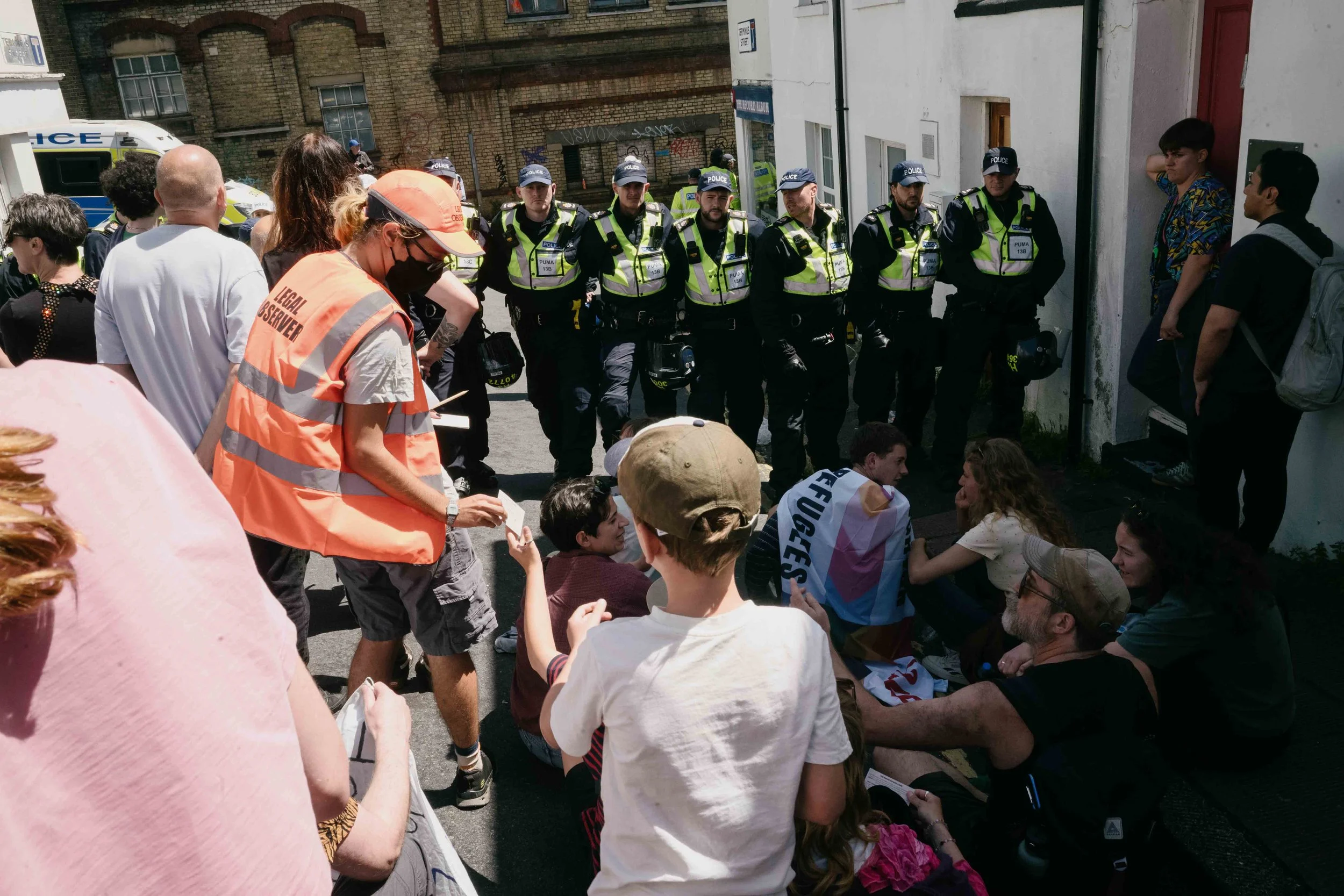
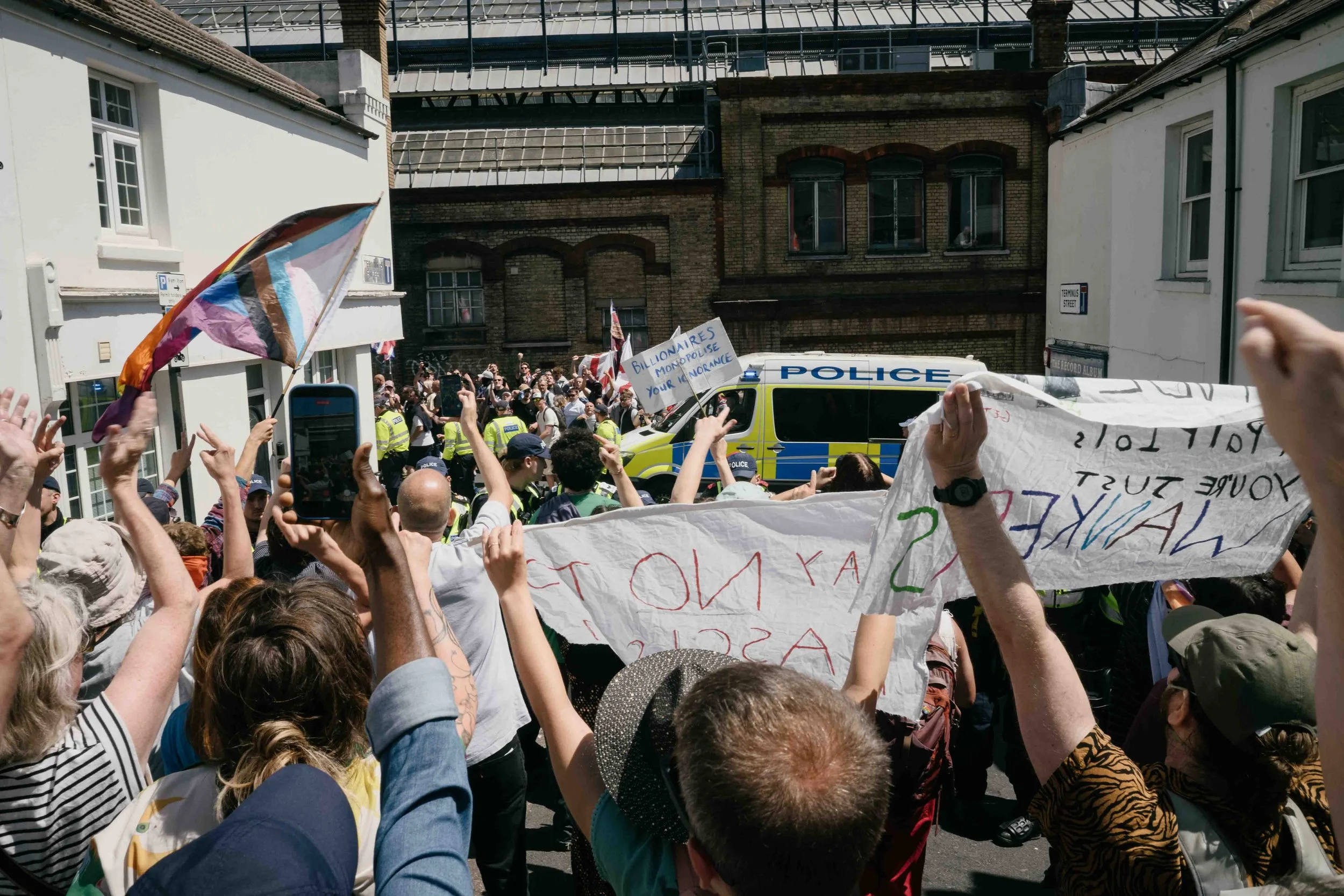
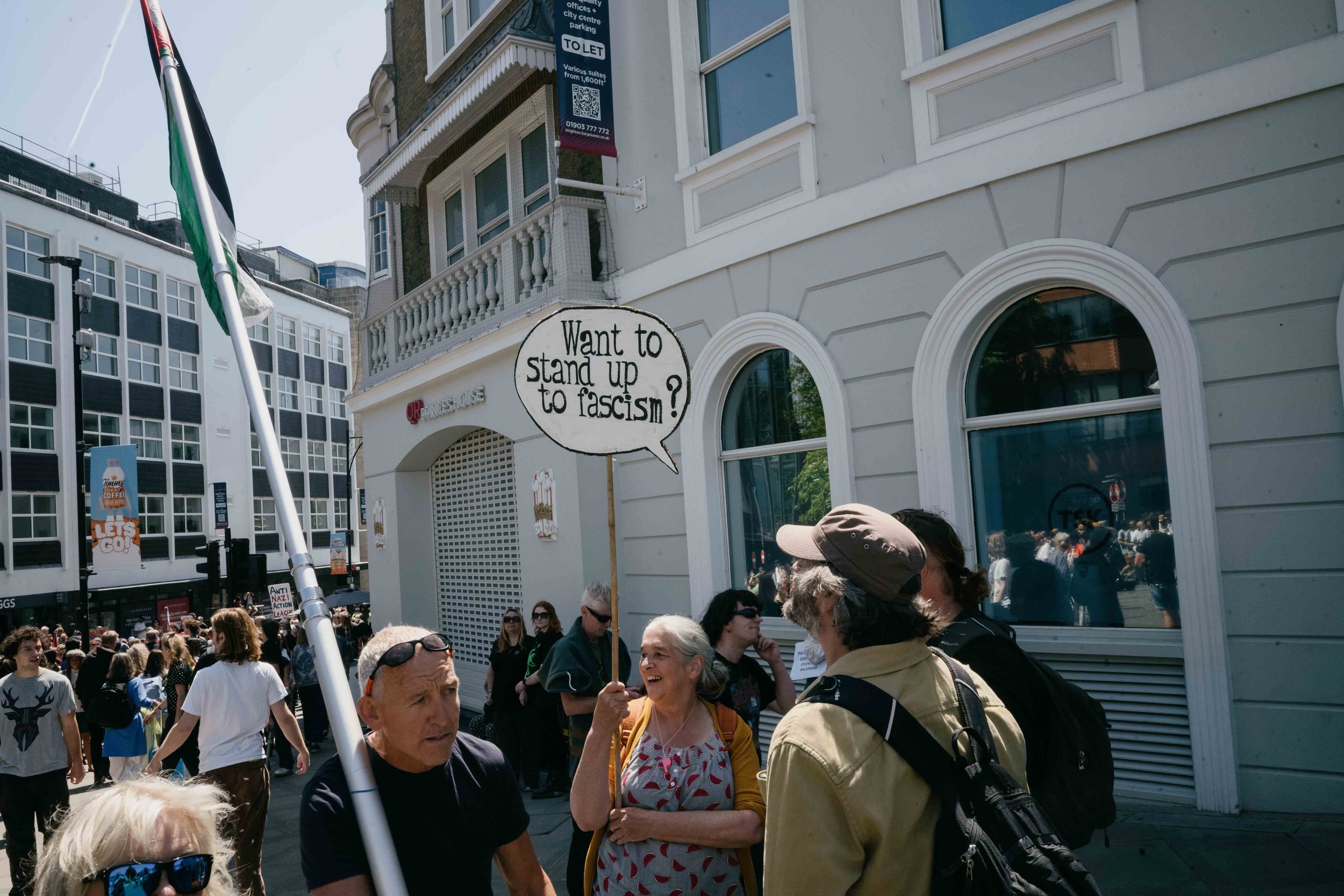
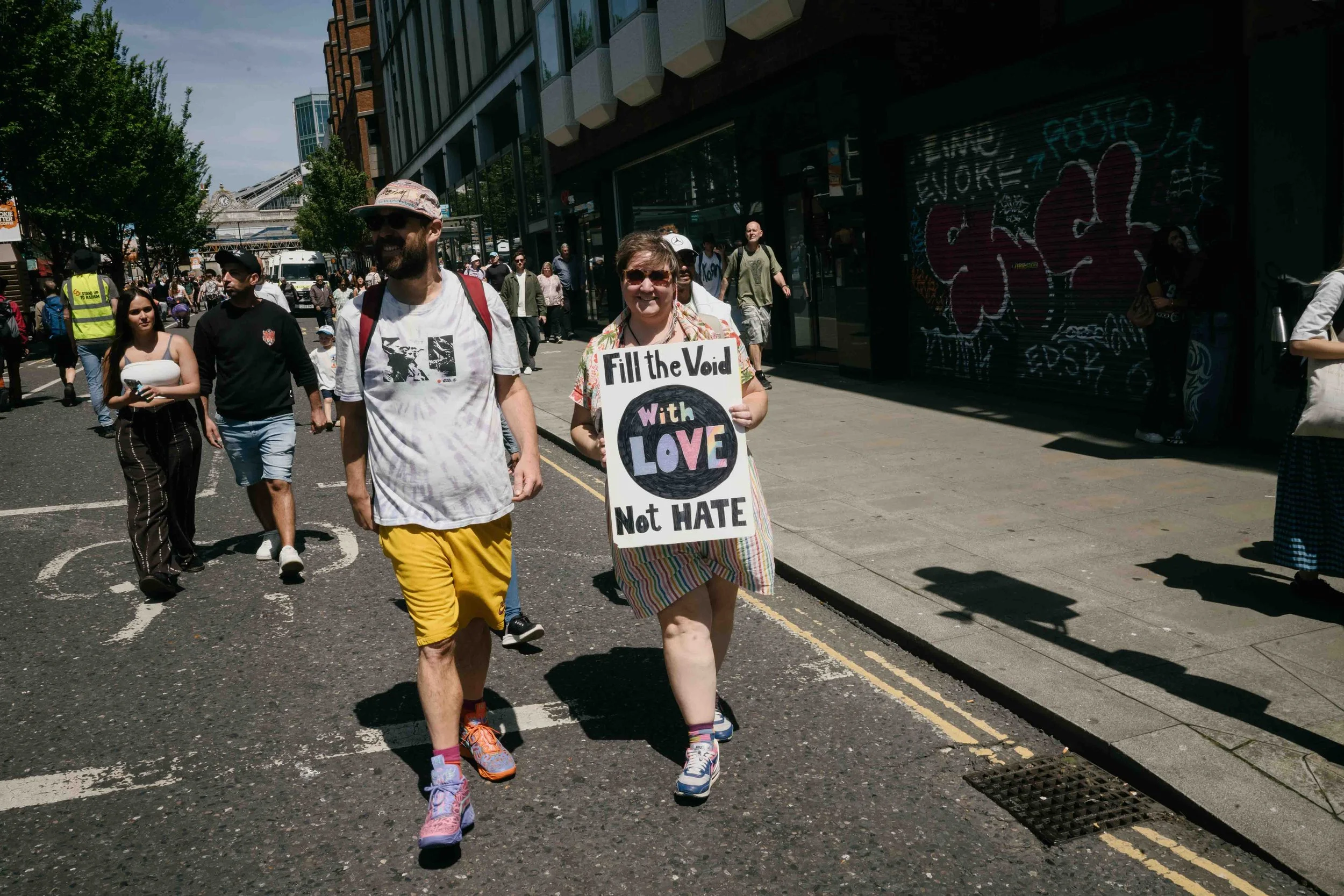
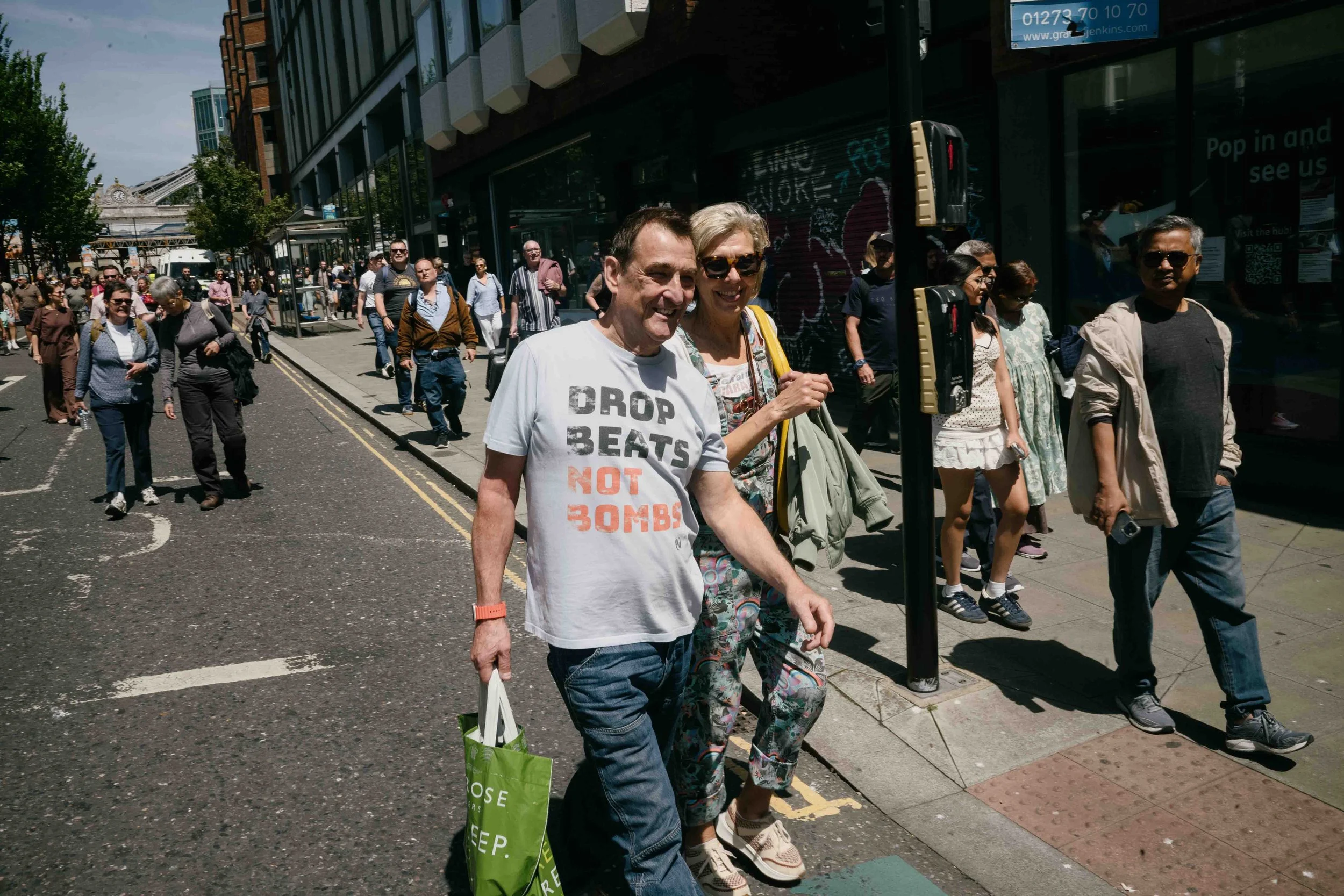
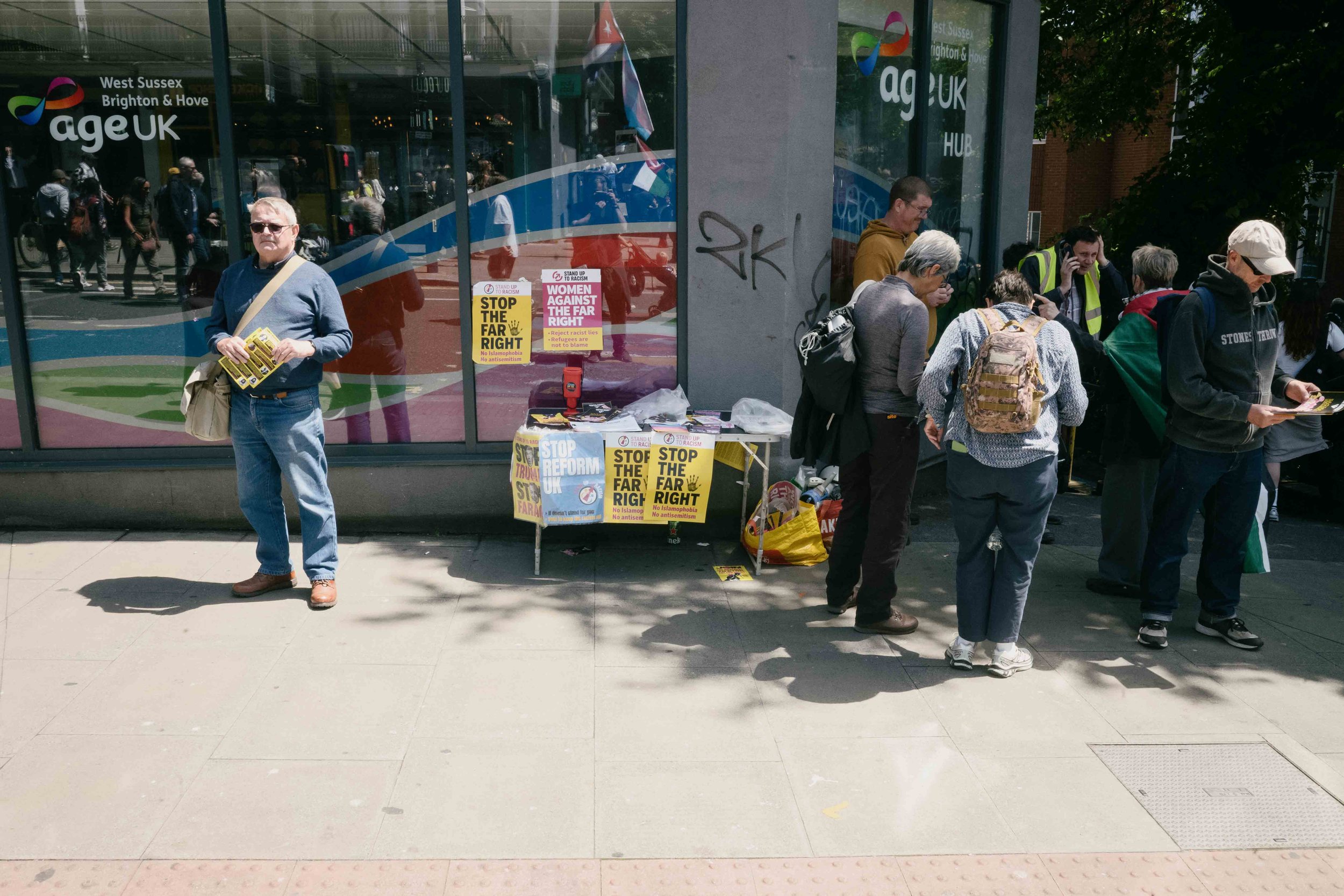
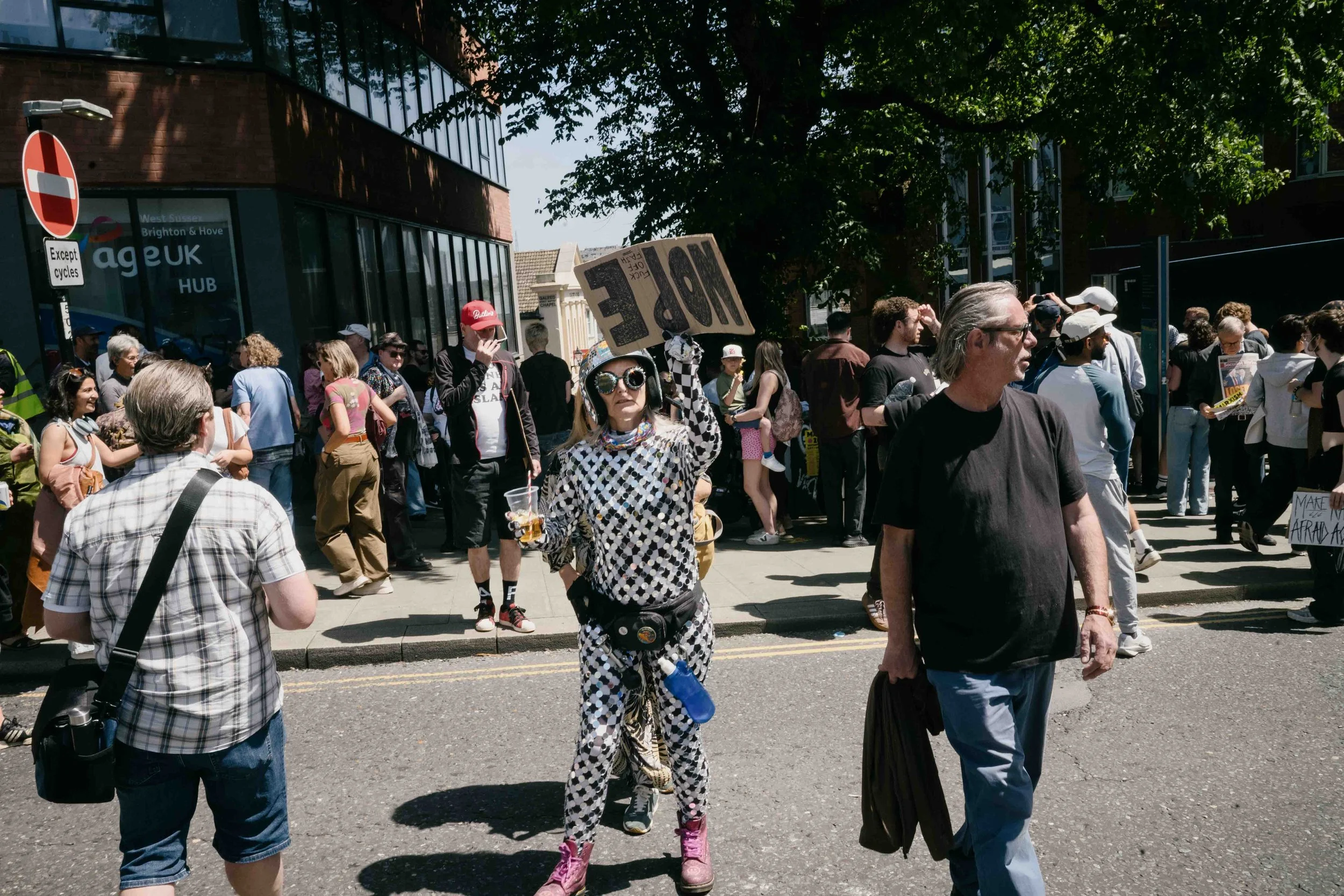
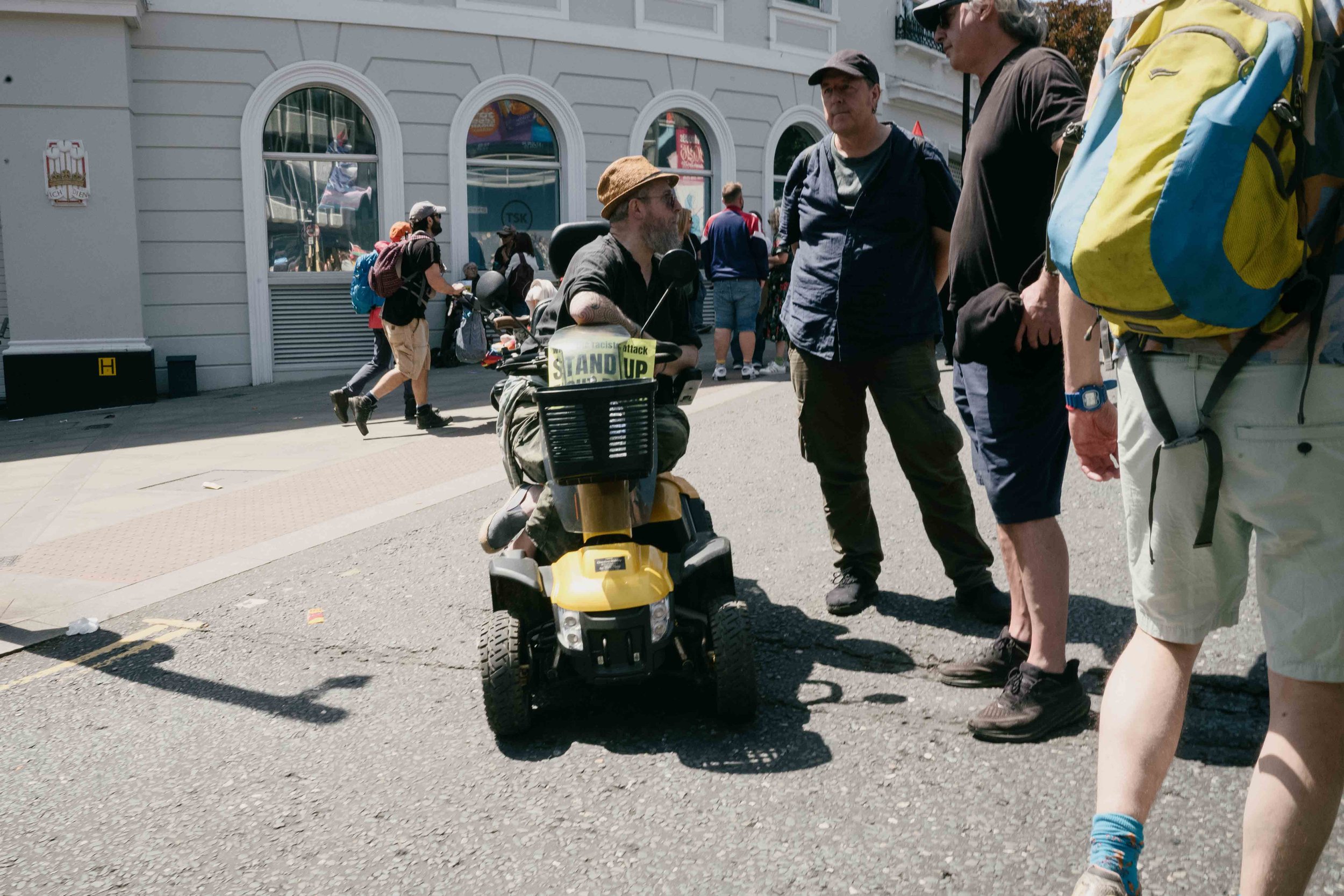
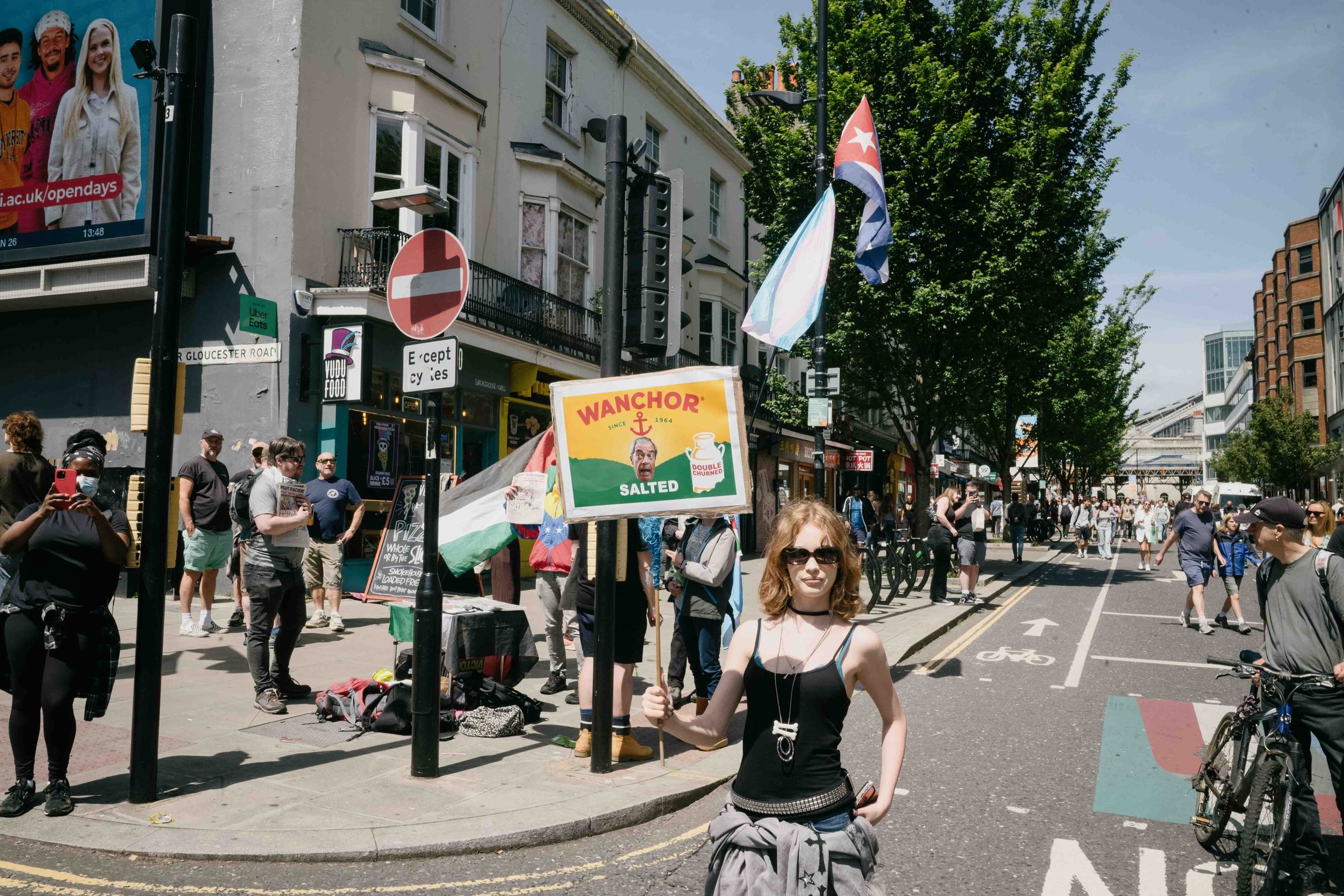
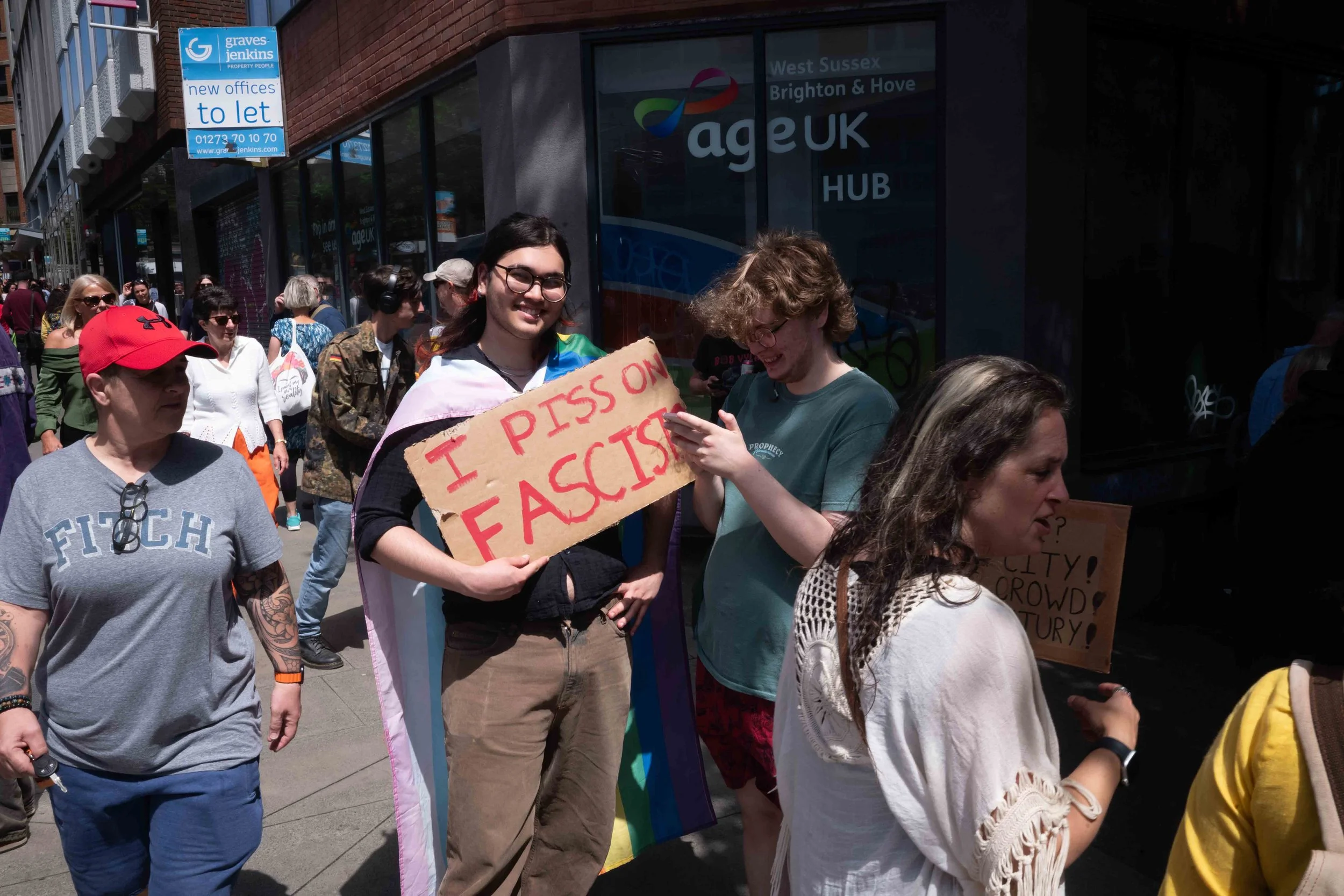
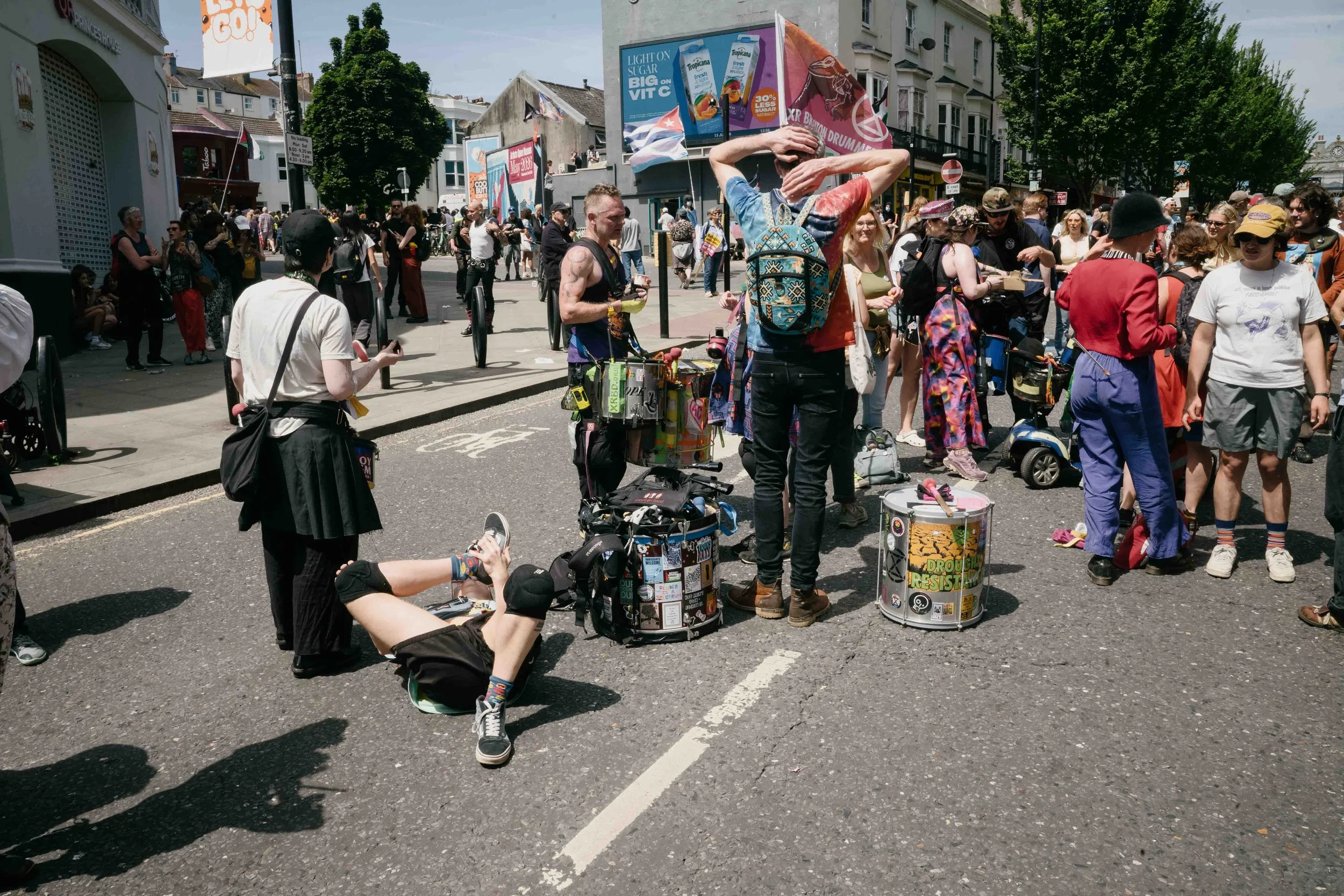
Today felt like both. Two sides of something old, playing out again by the sea. A city that's seen it before and knows its own mind. A stranger who gave me thirty years of context in two minutes. Young officers doing a hard job with quiet dignity.
Brighton doesn't do things quietly — but it does do them with a kind of stubborn confidence that I've come to love. Today was a reminder of why.
Until next time, keep snapping

The Latent Image: On Redundancy, Film Photography, and Transitions by William Bridges
I was made redundant at the end of May 2026, after nearly eighteen years in financial services. I didn't see it coming with any particular clarity, even though the restructuring had been visible on the horizon for a while. One day I had a role, a portfolio, a set of relationships built over nearly two decades. The next I didn't. The strange thing wasn't the shock — it was the silence that followed it.
I went looking for something useful. I typed "reset" and "transition" into an AI search and Transitions: Making Sense of Life's Changes by William Bridges came back at me. I bought it the same day.
Books · June 2026
I was made redundant at the end of May 2026, after nearly eighteen years in financial services. I didn't see it coming with any particular clarity, even though the restructuring had been visible on the horizon for a while. One day I had a role, a portfolio, a set of relationships built over nearly two decades. The next I didn't. The strange thing wasn't the shock — it was the silence that followed it.
I went looking for something useful. I typed "reset" and "transition" into an AI search and Transitions: Making Sense of Life's Changes by William Bridges came back at me. I bought it the same day.
Change and Transition Are Not the Same Thing
This is Bridges' foundational move, and it's worth sitting with. Change, he argues, is situational and external — a job ending, a relationship breaking, a bereavement, a diagnosis, a move. Transition is something else entirely: the internal, psychological process of reorientation that any change demands. Most of us treat upheaval as a logistics problem to be solved as quickly as possible. Get the new job. Find the new rhythm. Stop feeling odd. Bridges quietly dismantles that impulse.
He maps every transition across three stages — The Ending, The Neutral Zone, and The New Beginning — and the insight that hits hardest is that endings come first, not last. You don't begin a transition by starting something new. You begin it by fully experiencing what has stopped.
The Darkroom Analogy Nobody Asked For (But I'm Making Anyway)
I shoot film. Mostly street, some documentary, always analogue when I want the work to matter. And the more I read Bridges, the more his framework started to look like a description of the developing process.
When you shoot a roll of film, the image exists the moment the shutter fires. Light has hit silver halide crystals, chemical bonds have shifted, a latent image is there — invisible, but real. The exposure has happened. You just can't see it yet.
The Neutral Zone — Bridges' most important and most misunderstood concept — is that darkroom. It is the place between what has ended and what has not yet begun. It is uncomfortable. It can feel like nothing is happening. Most people try to rush it, flooding the room with light too early, overexposing the print, destroying what was forming.
Bridges argues this is a mistake. The Neutral Zone, when honoured rather than fled, is where the actual psychological work happens. "It is not merely the pace of change that leaves us disoriented," he writes, "but the loss of faith that the transition is actually taking us somewhere meaningful." That's the feeling. Not confusion exactly — more like standing in the dark, hands in chemicals, waiting for something to resolve.
In the darkroom, you don't rush the developer. You keep the temperature right, you agitate correctly, you wait. The image comes up when it's ready.
Who This Book Is For……
I'd push this into the hands of anyone navigating what Bridges calls a genuine rupture in identity. Not just redundancy — though God knows that qualifies. Divorce. Bereavement. The children leaving. The diagnosis. The relationship that ended before you understood it had. Any moment where the external change has happened and the internal geography hasn't caught up yet.
The framework is almost too clean. Three stages, neatly labelled, with the implication that you move through them sequentially. Real experience is messier than that. And the additional workplace chapter bolted onto later editions sits a little uneasily alongside the more existential register of the original material — it's a different gear, and the shift is audible.
But these are minor complaints against a book that does something genuinely rare in this genre. It doesn't try to accelerate you. It doesn't offer a shortcut. Before entering the field of transitional management, Bridges was a professor of English, and that background is visible in the quality of his prose — in his habit of reaching for myth and story rather than bullet points. The book reads like someone who has actually thought about this, and has had the generosity not to simplify it more than necessary.
For anyone navigating the end of a long chapter — Bridges offers something rarer than advice.
He offers permission to be lost for a while.
The Print, Eventually
I'm in the Neutral Zone right now. I know that because I've read the map. The latent image is there. I trust that much. What it will look like when it comes up — what the next chapter is, what the new beginning actually consists of — I genuinely don't know yet.
But I'm keeping the temperature right, and I'm not turning the lights on too early.
Until next time, keep reading.
William Bridges, Transitions: Making Sense of Life's Changes (revised 25th anniversary edition). Perseus Books, 2004.

Sun, Shadows, and Strangers: A Pixel 8 Pro Walk Through Brighton
There is no place quite like Brighton on a bright, sun-drenched afternoon. It’s a city that breathes character—a vibrant melting pot of style, coastal grit, and unvarnished humanity. Armed with just my Google Pixel 8 Pro, I spent the day doing my favorite thing: getting lost in the crowd and capturing the fleeting, unposed moments that make this city tick.
There is no place quite like Brighton on a bright, sun-drenched afternoon. It’s a city that breathes character—a vibrant melting pot of style, coastal grit, and unvarnished humanity. Armed with just my Google Pixel 8 Pro, I spent the day doing my favorite thing: getting lost in the crowd and capturing the fleeting, unposed moments that make this city tick. Leaving the heavy DSLR gear at home and relying entirely on a phone allowed me to blend seamlessly into the scenery, capturing genuine slices of life without disrupting the natural flow of the street.
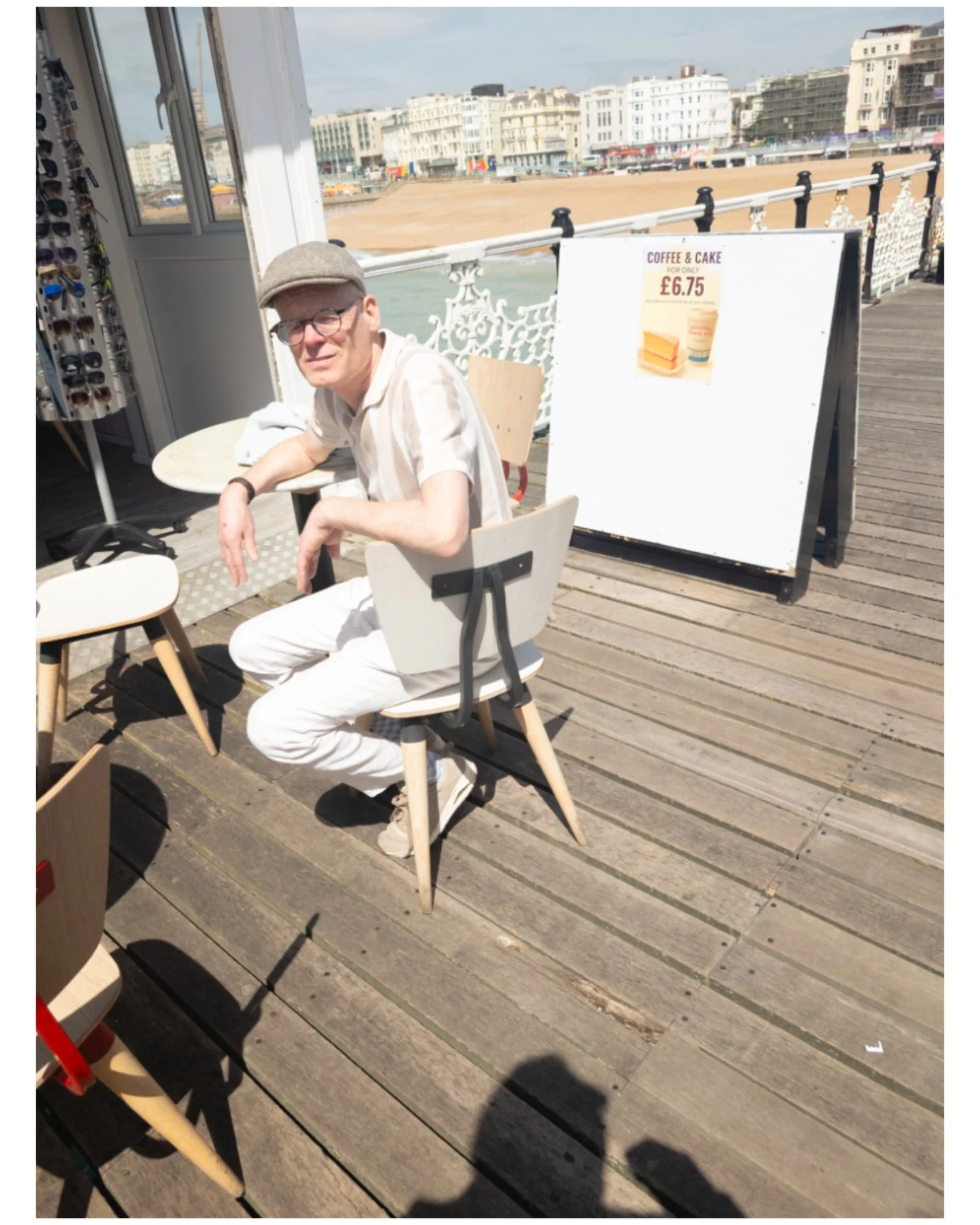
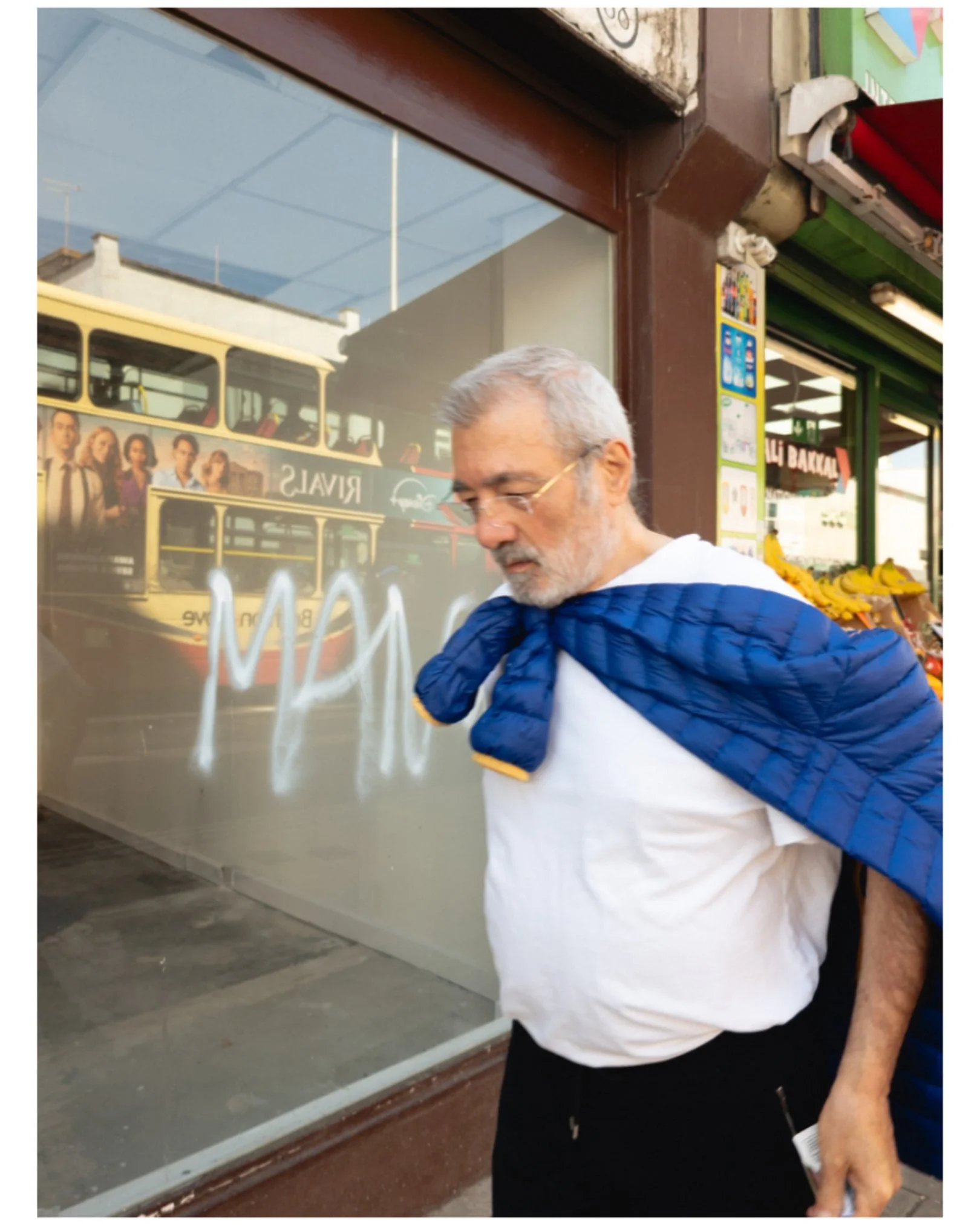
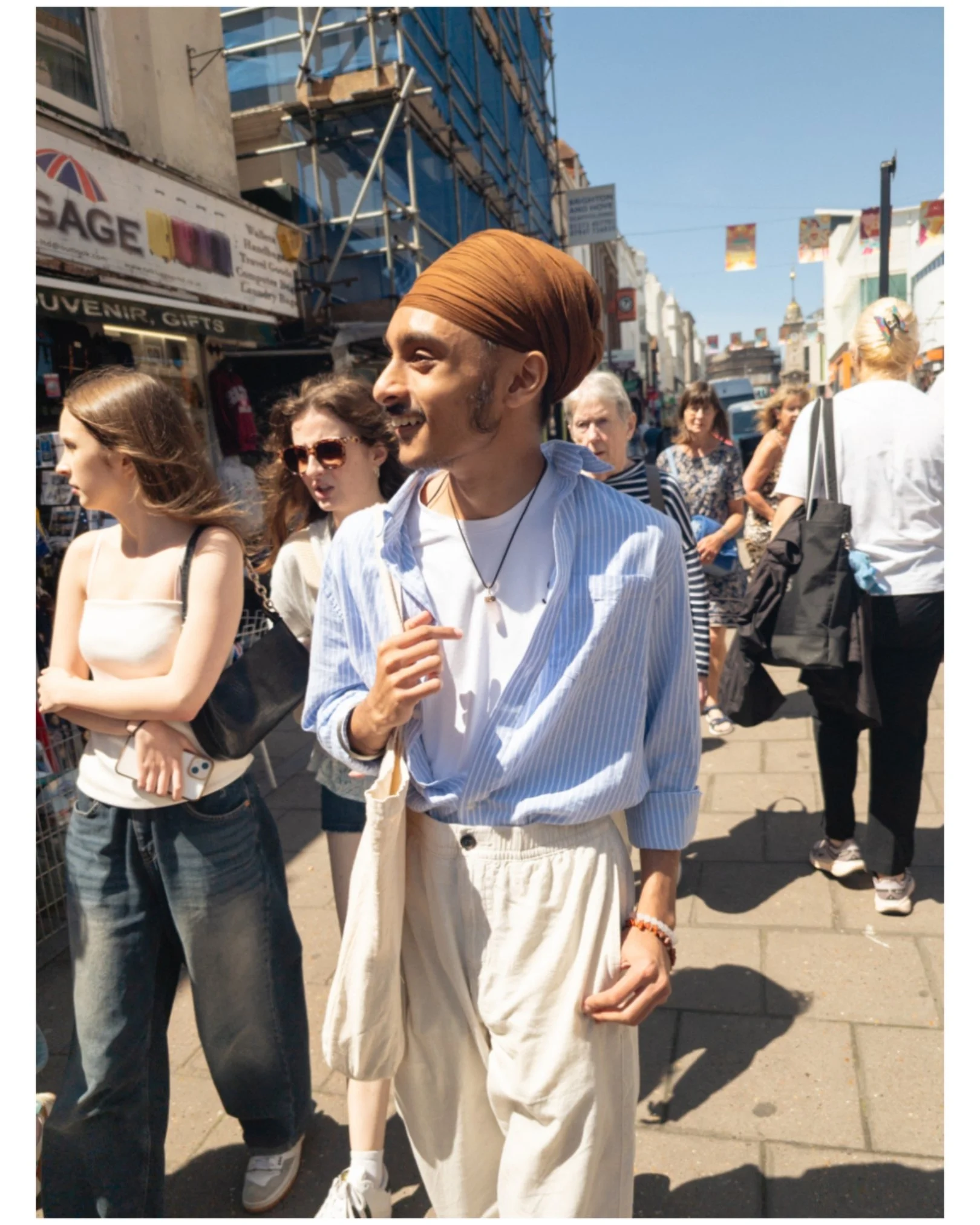
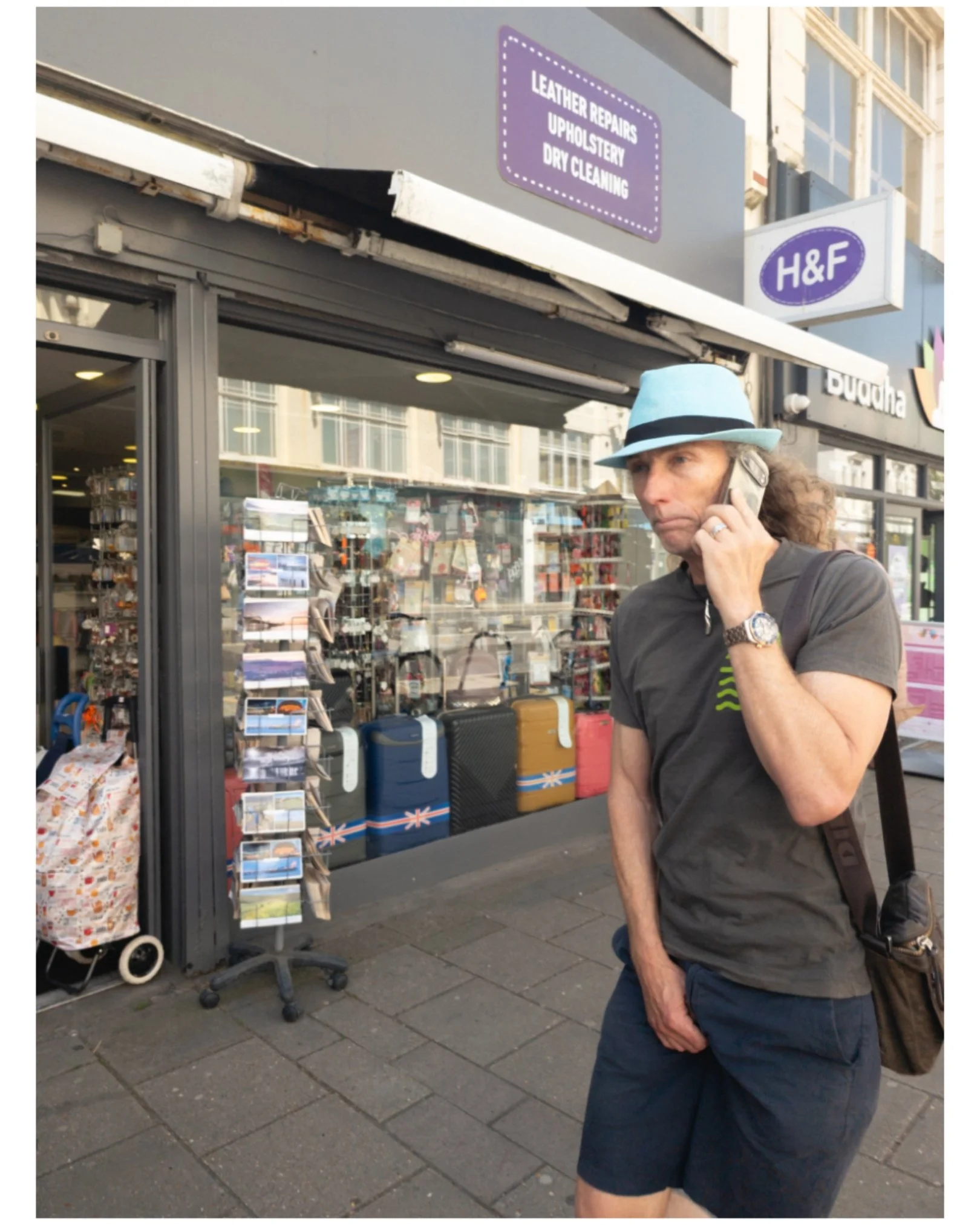
Walking through the bustling town center down toward the seafront, the city offered up an endless stream of visual stories. The Pixel’s quick responsiveness and superb HDR handling allowed me to seamlessly capture the stark contrasts of the day—from the sharp geometry of classic architecture framing a stylishly dressed couple, to the graphic punch of gritty, flyer-covered walls under scaffolding that perfectly timed a passerby's stride. Turning down the crowded shopping lanes, the camera beautifully rendered the rich textures of the urban landscape: a mix of colorful storefronts, postcard racks, and striking fashion choices like sky-blue fedoras and striped shirts, all while maintaining natural skin tones and rich shadow details. Even up on the wooden decking of the seafront, where the light softens against the historic cream-colored hotels, the phone effortlessly caught quiet, contemplative moments of people enjoying a coffee by the water.
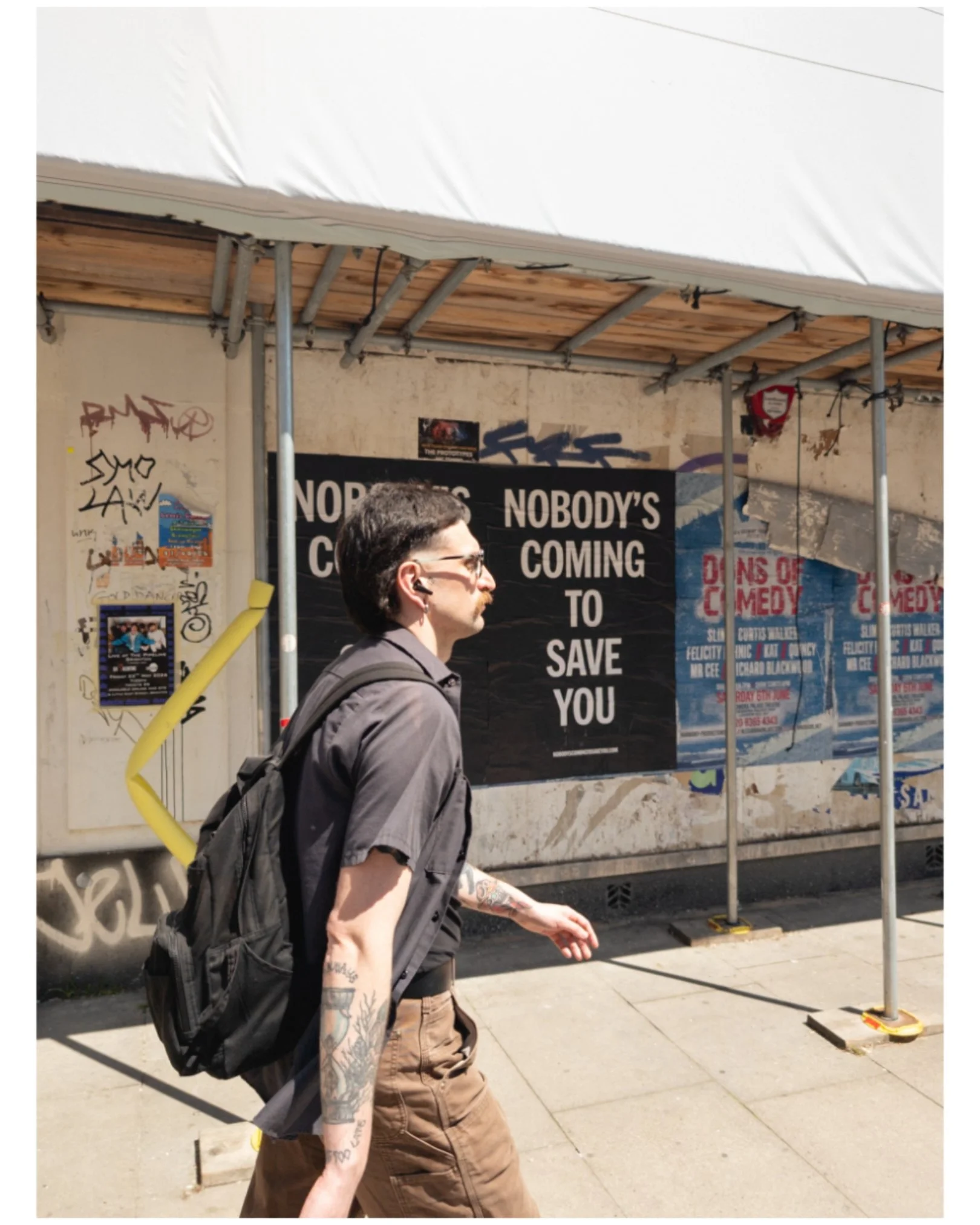
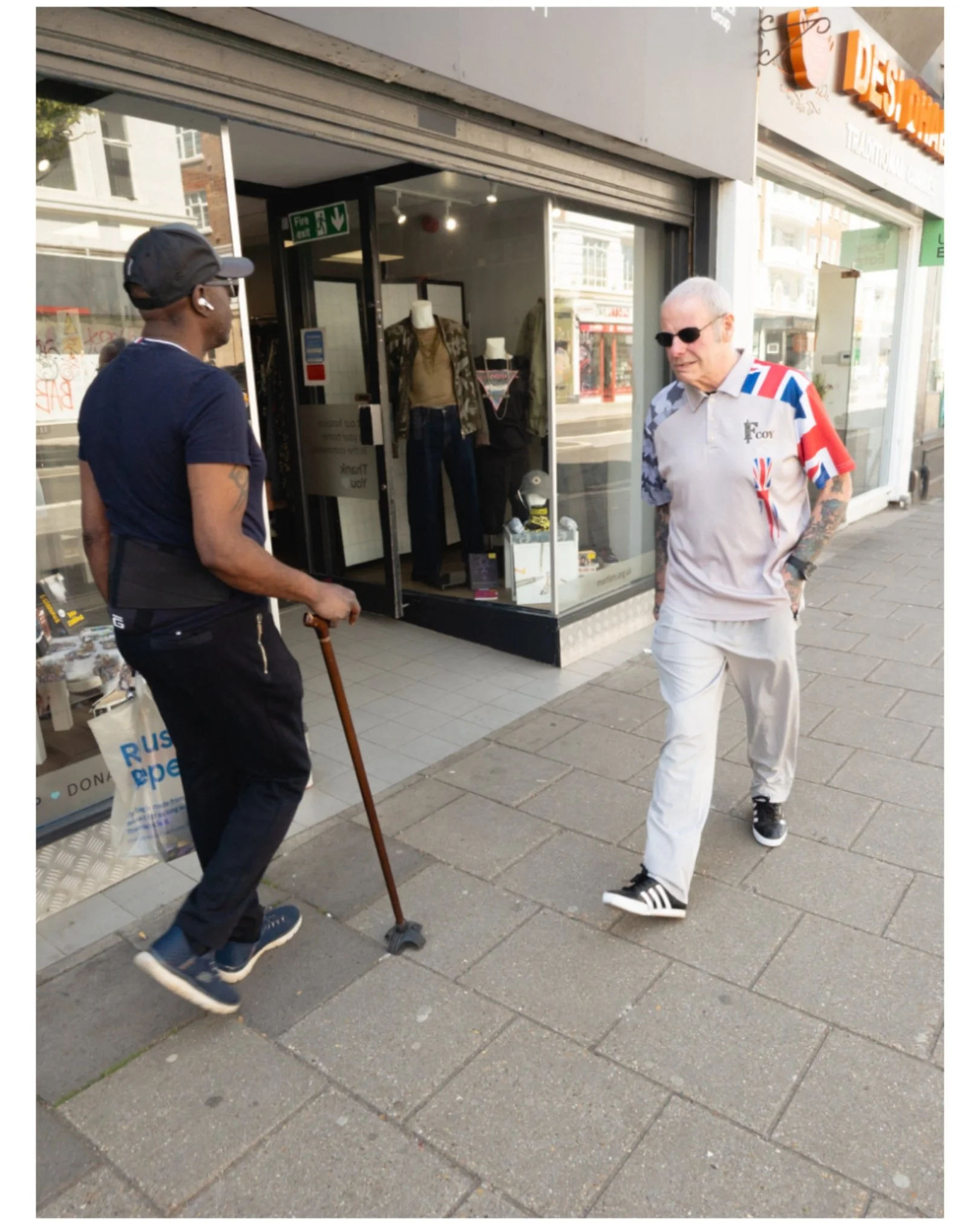
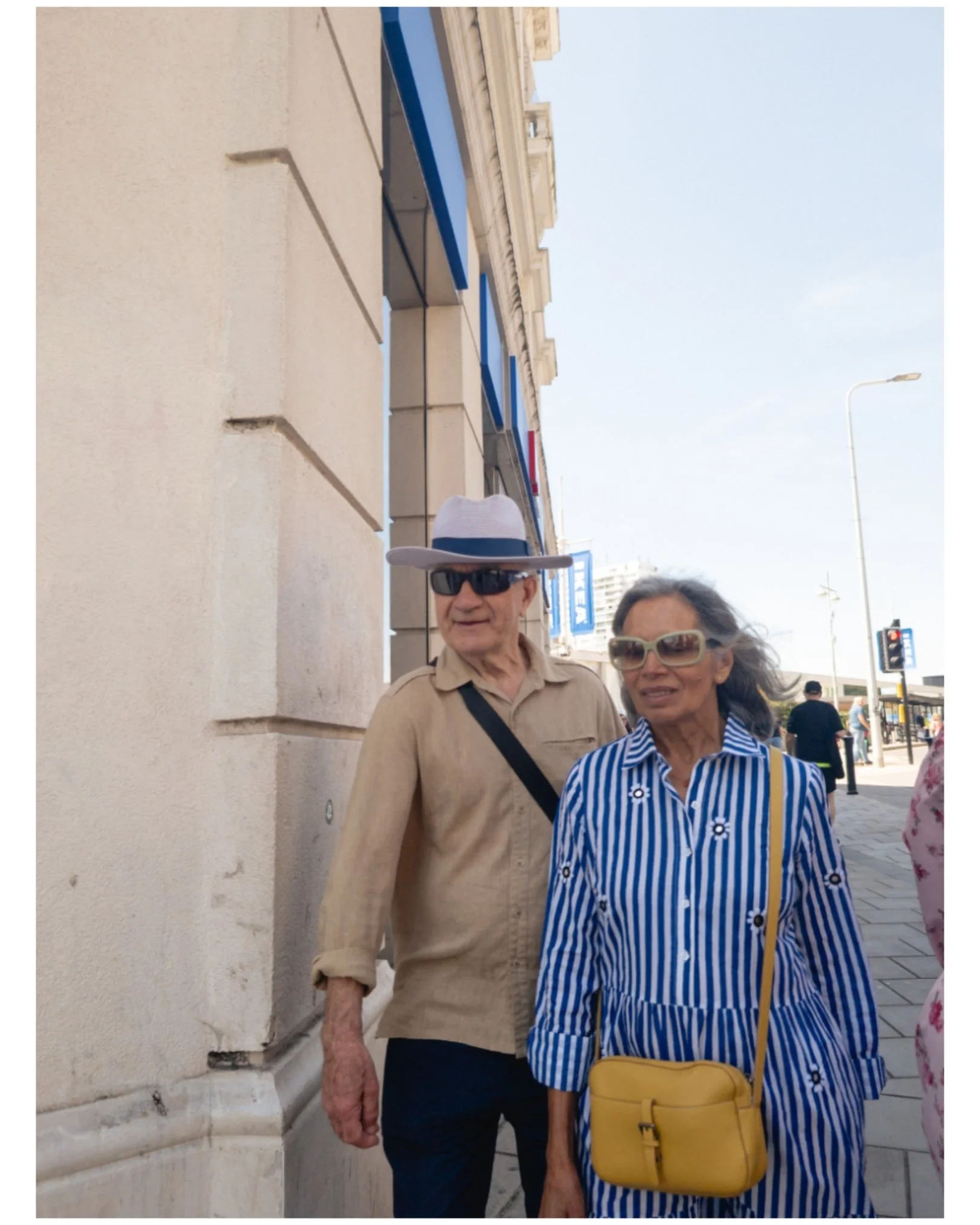
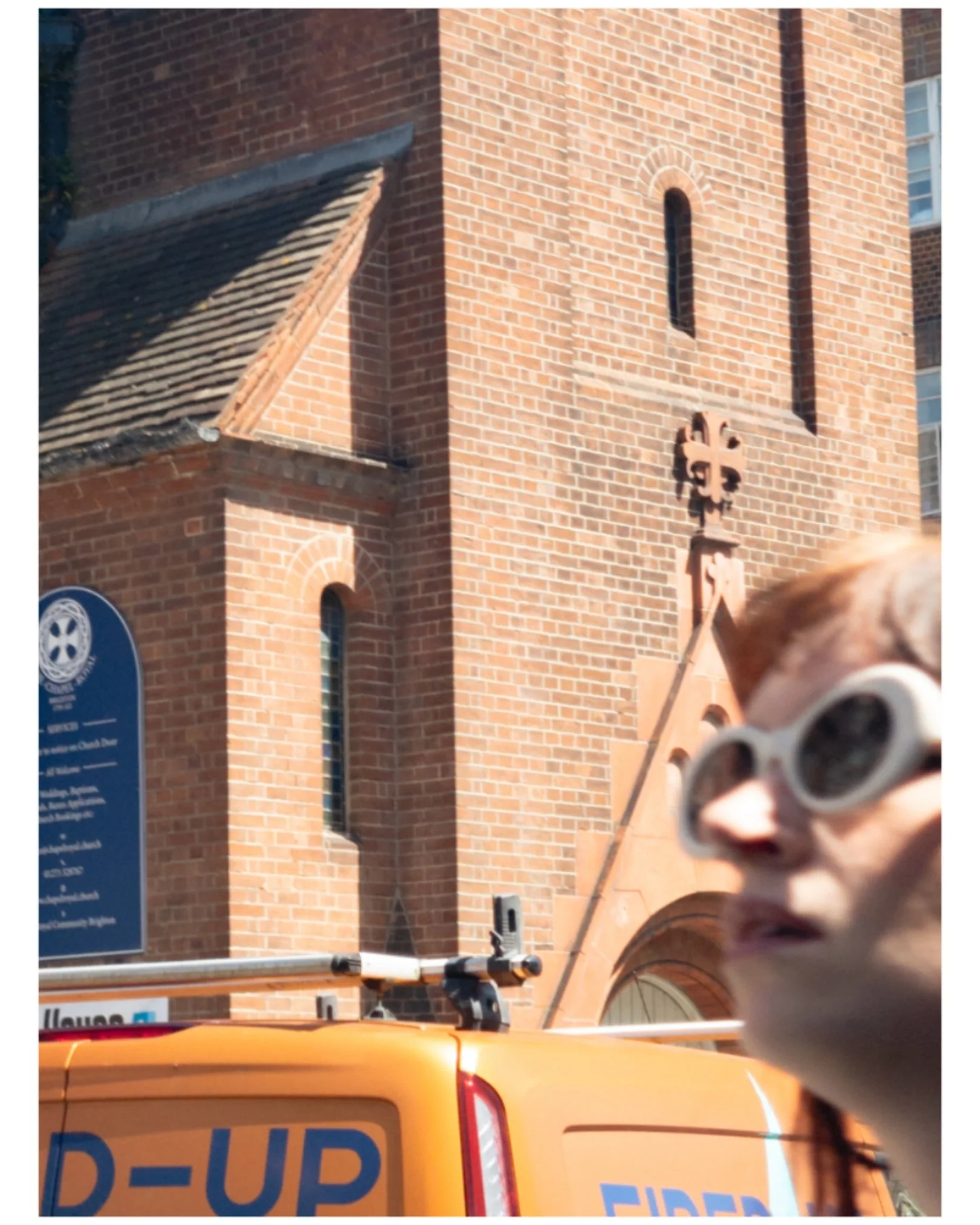
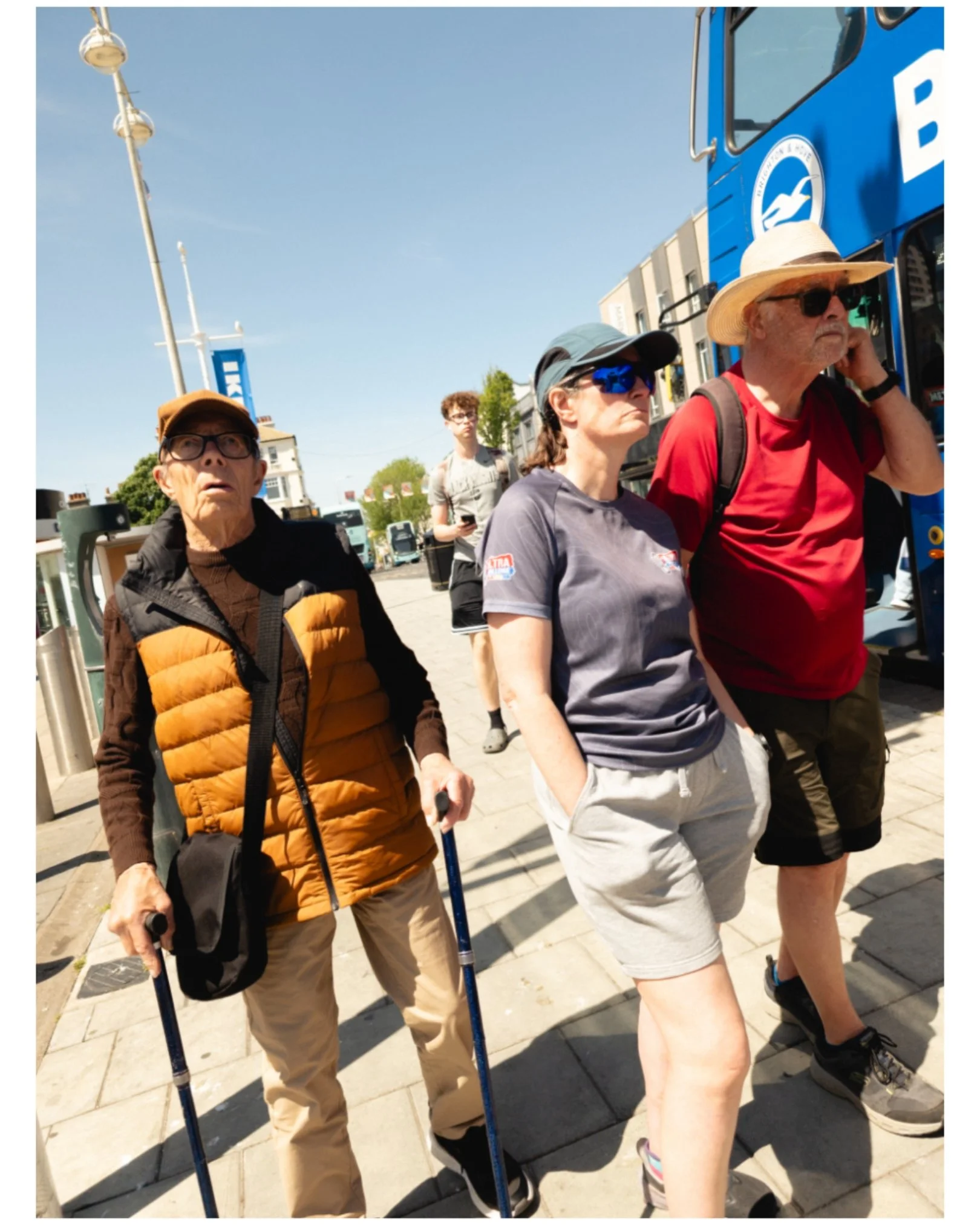
Ultimately, this walk proved exactly why a great smartphone is a street photographer's best weapon. It is entirely inconspicuous, incredibly fast, and keeps you light on your feet so you can focus on what matters most—observing the wonderful, fleeting poetry of everyday life.
Until next time, keep snapping

Two Sides of the Same Street
London on a grey Saturday has a particular energy. The streets fill early, the coffee shops run out of tables, and the city hums along in its usual organised chaos. But on 16 May 2026, there was something extra in the air — two separate marches, heading in different directions, each convinced they were speaking for the soul of the country.
On 16 May 2026, two very different versions of Britain took to the streets of London. I walked between them.
London on a grey Saturday has a particular energy. The streets fill early, the coffee shops run out of tables, and the city hums along in its usual organised chaos. But on 16 May 2026, there was something extra in the air — two separate marches, heading in different directions, each convinced they were speaking for the soul of the country.
I spent the day moving between both. Camera up, opinions mostly down. What I found was more complicated, and more human, than either side's loudest voices would suggest.
Nakba 78.
The Pro Palestine March, was a United front against Tommy Robinson & the far right. This had its own kind of plural — anti-racism groups, Palestine solidarity marchers, trade unionists, and a handful of people who looked like they'd wandered in from towns and cities across the UK (Bristol, Portsmouth was evident in Trade Union flags and I also met a photography Student from Barnseley. The energy was different: less of a march, more of a gathering, with people stopping to talk, to take photos, to debate gently amongst themselves.
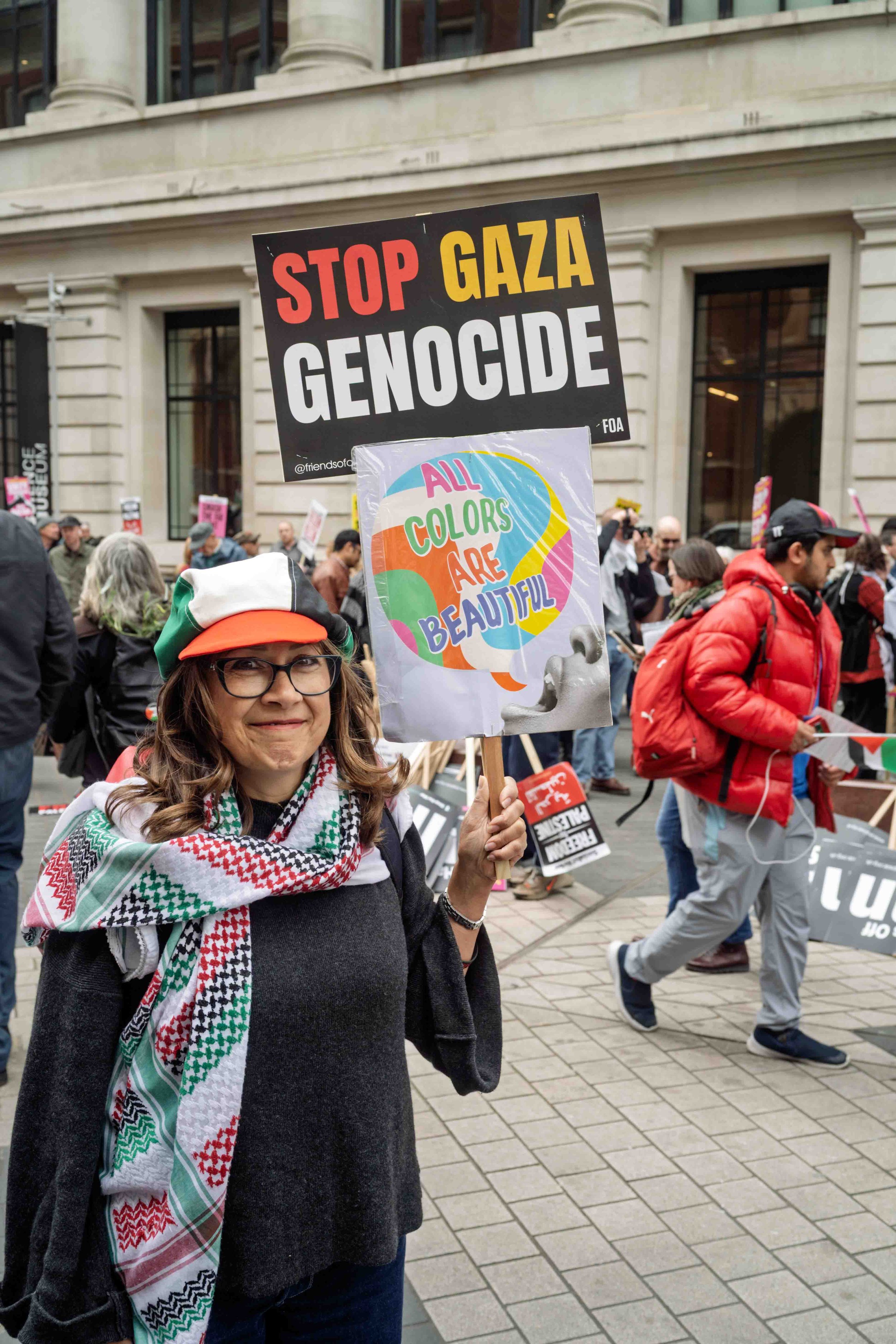
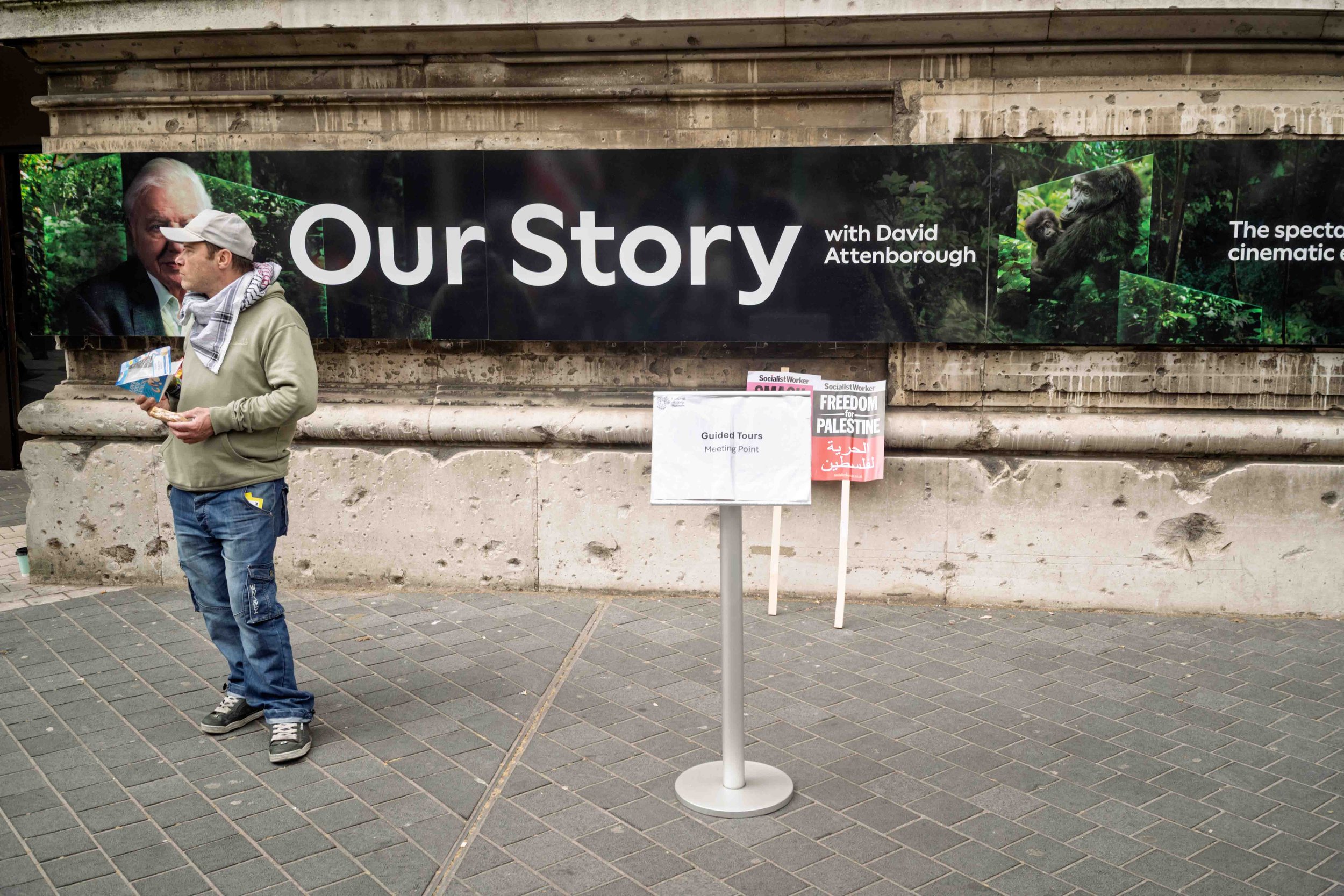
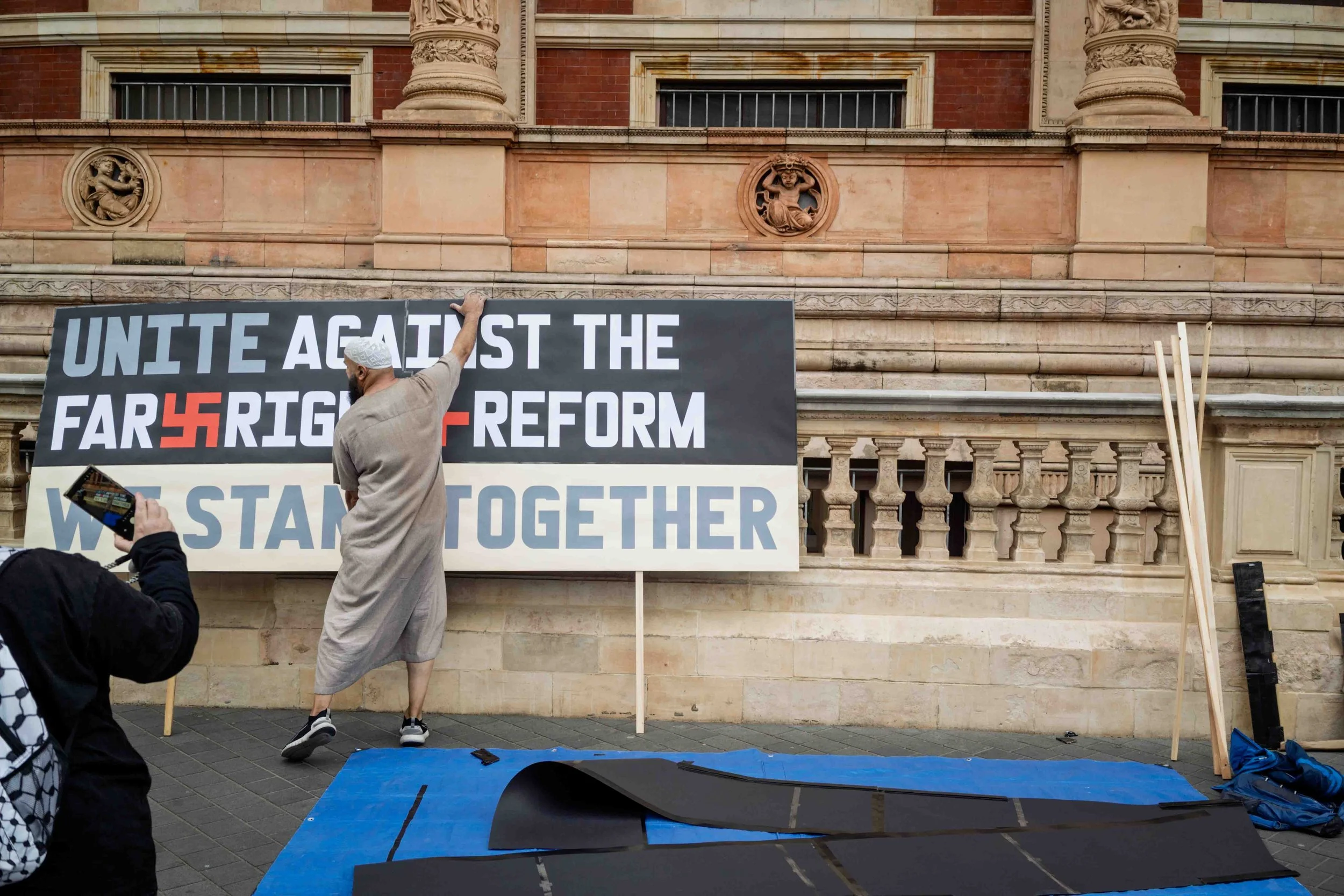
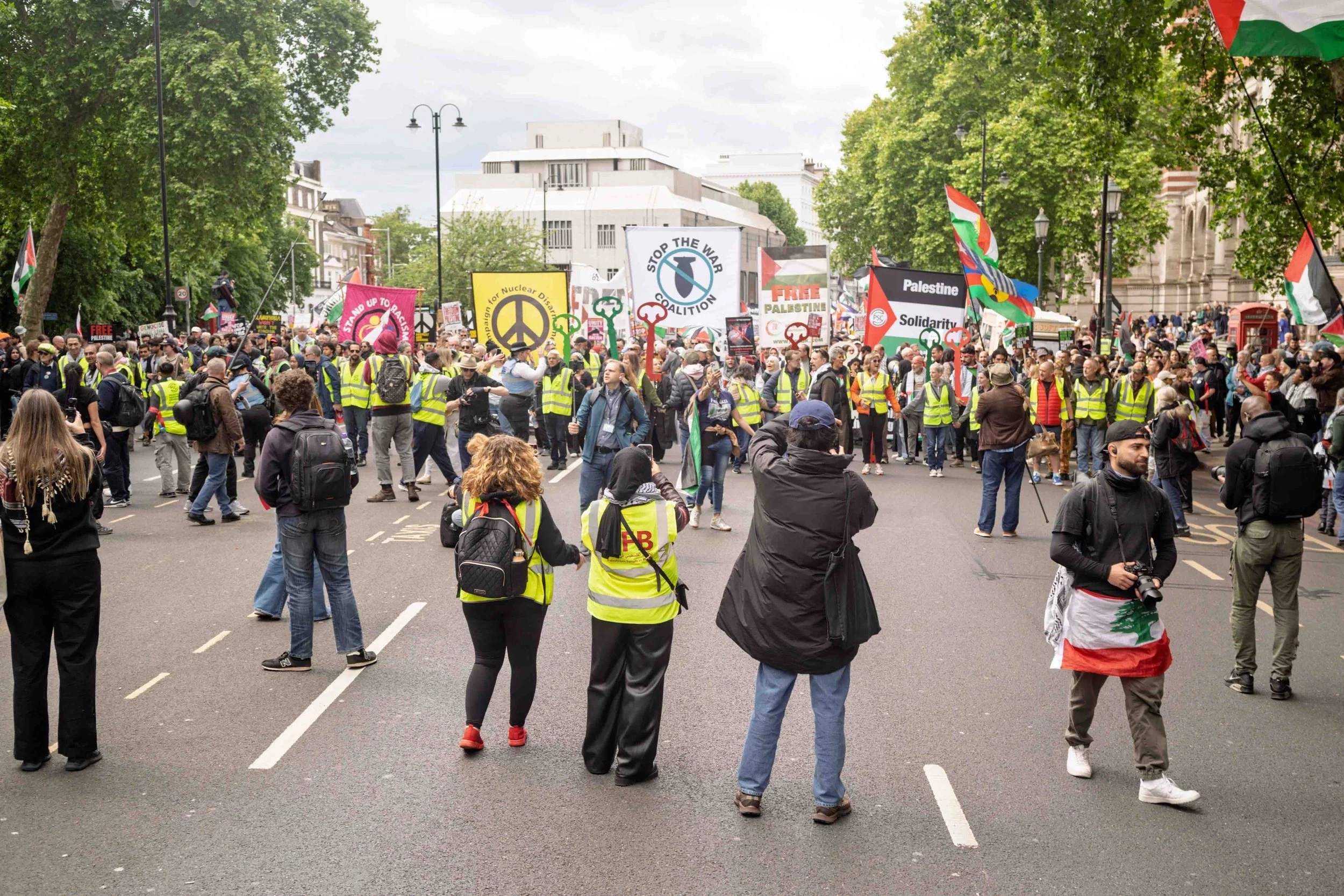
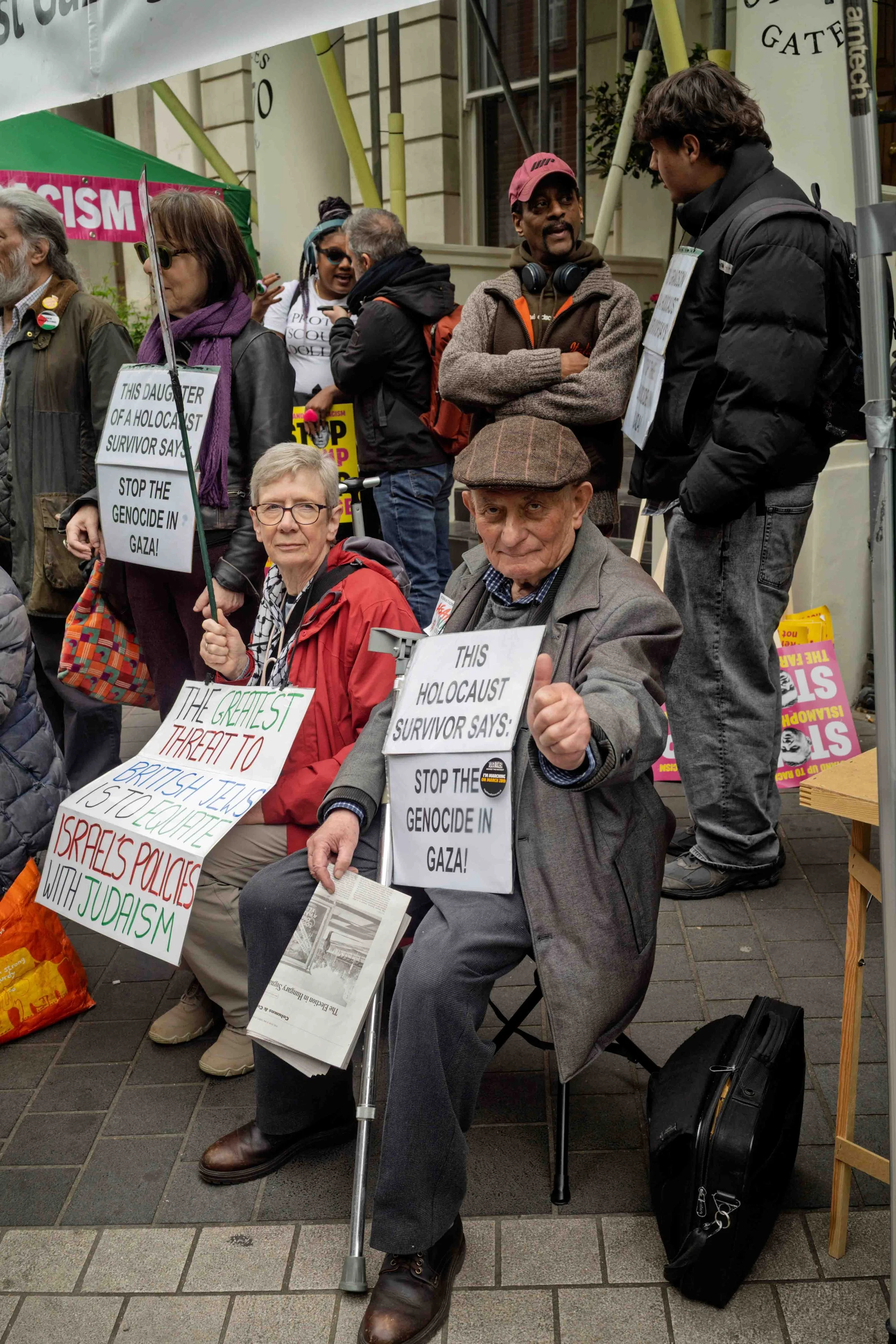
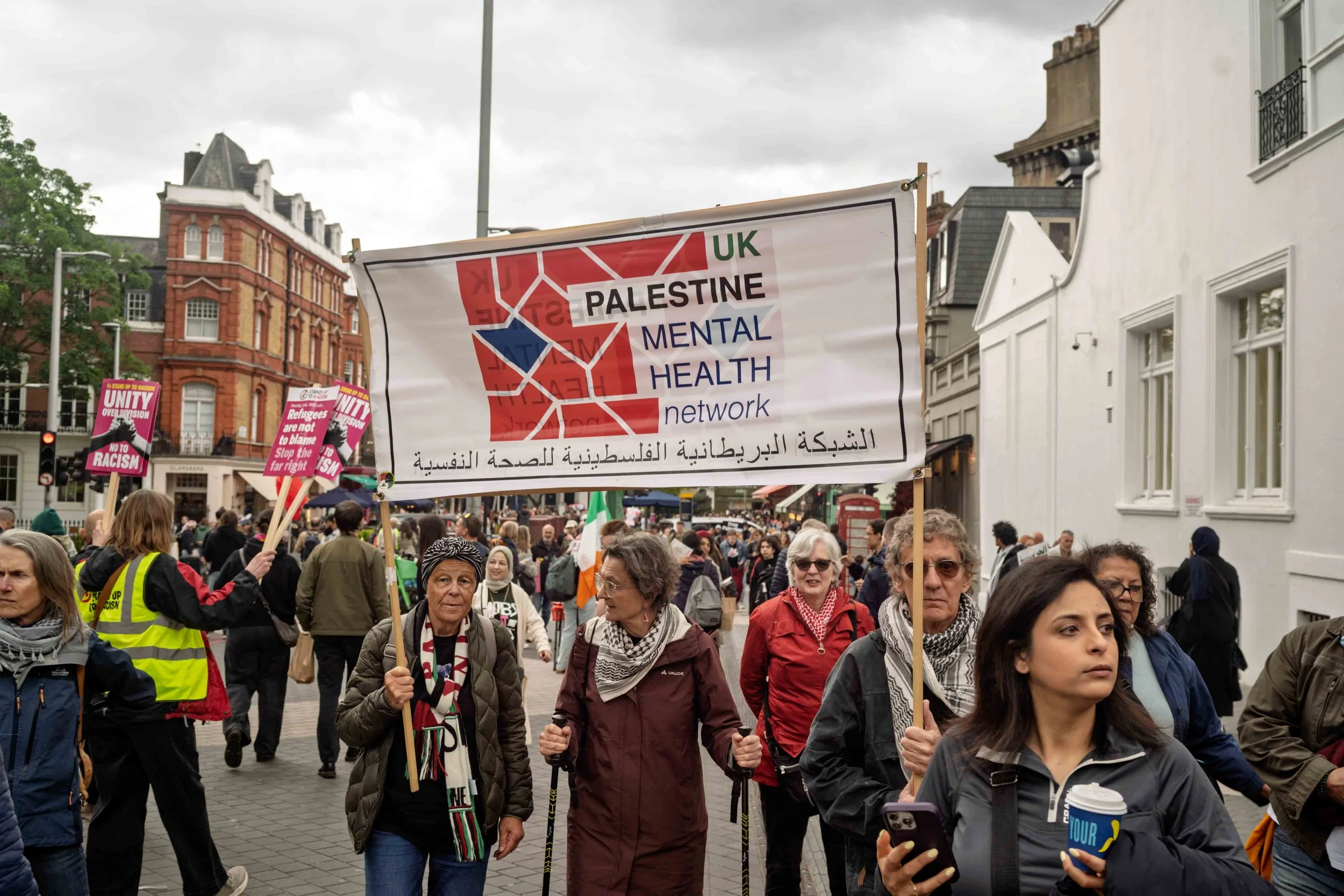
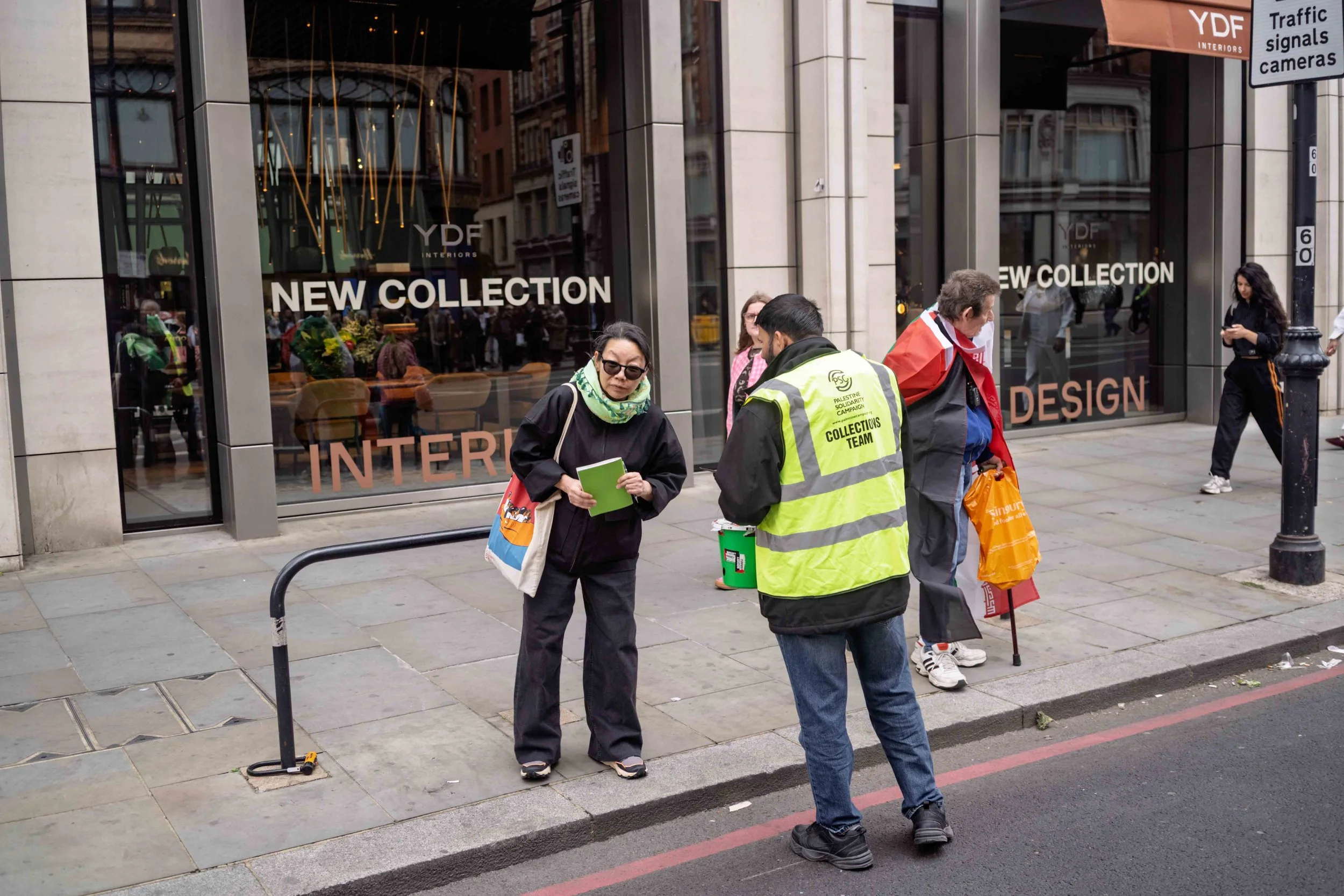
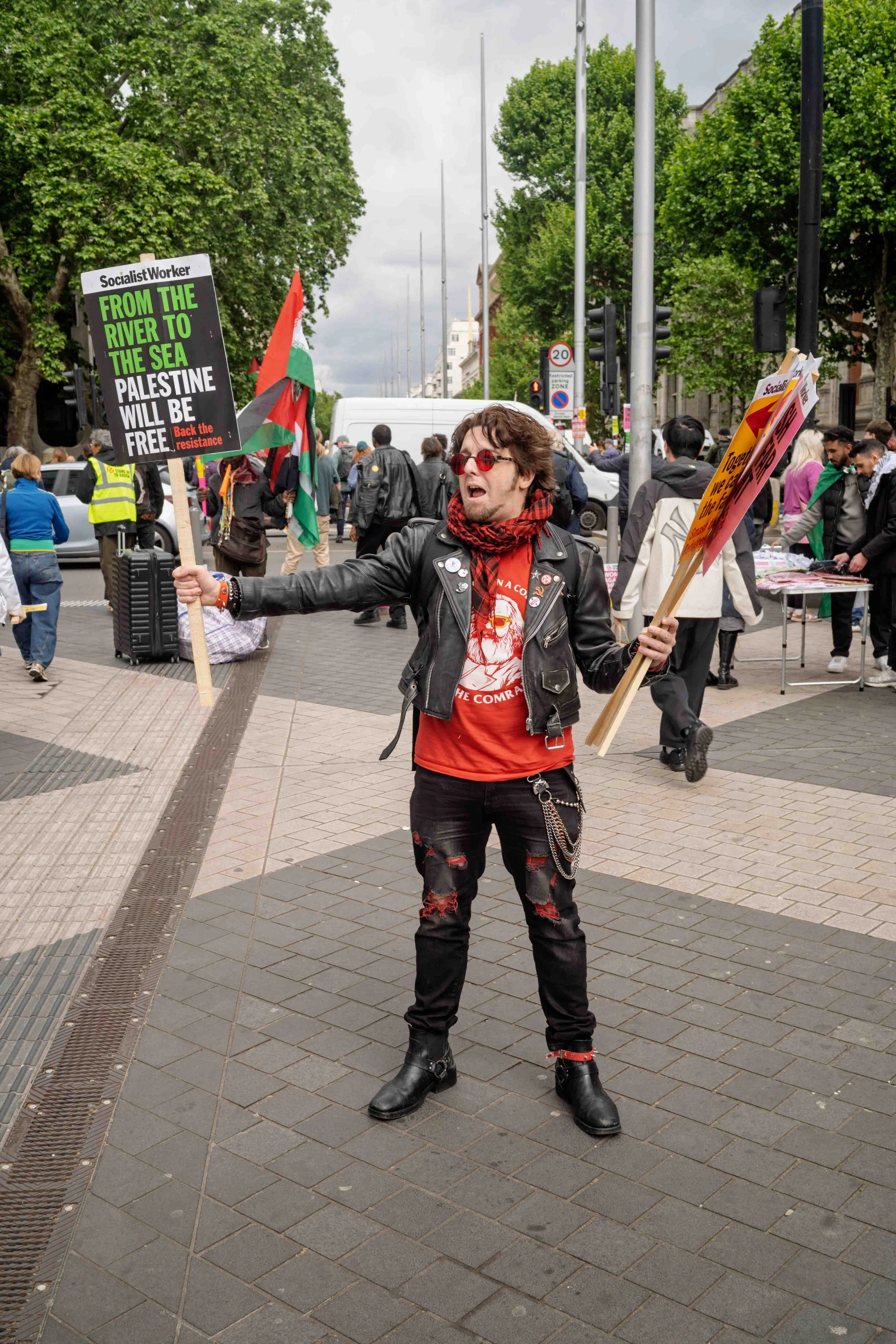
The signs here were varied. Some were polished and printed; others were handwritten on cardboard, the ink slightly smeared from the morning drizzle. A woman smiled at me holding a "Stop Gaza Genocide" sign in one hand and an "All Colors Are Beautiful" placard in the other — two very different registers of message, held by the same pair of hands, which felt like an accurate summary of the whole afternoon.
One moment stayed with me: two elderly people sitting quietly amid the noise — a Holocaust survivor with a thumbs-up and a calm smile, a woman beside him describing herself as a survivor's daughter. They weren't performing anything. They were just there, making their point in the most understated way possible.
Flags, Flags, Everywhere
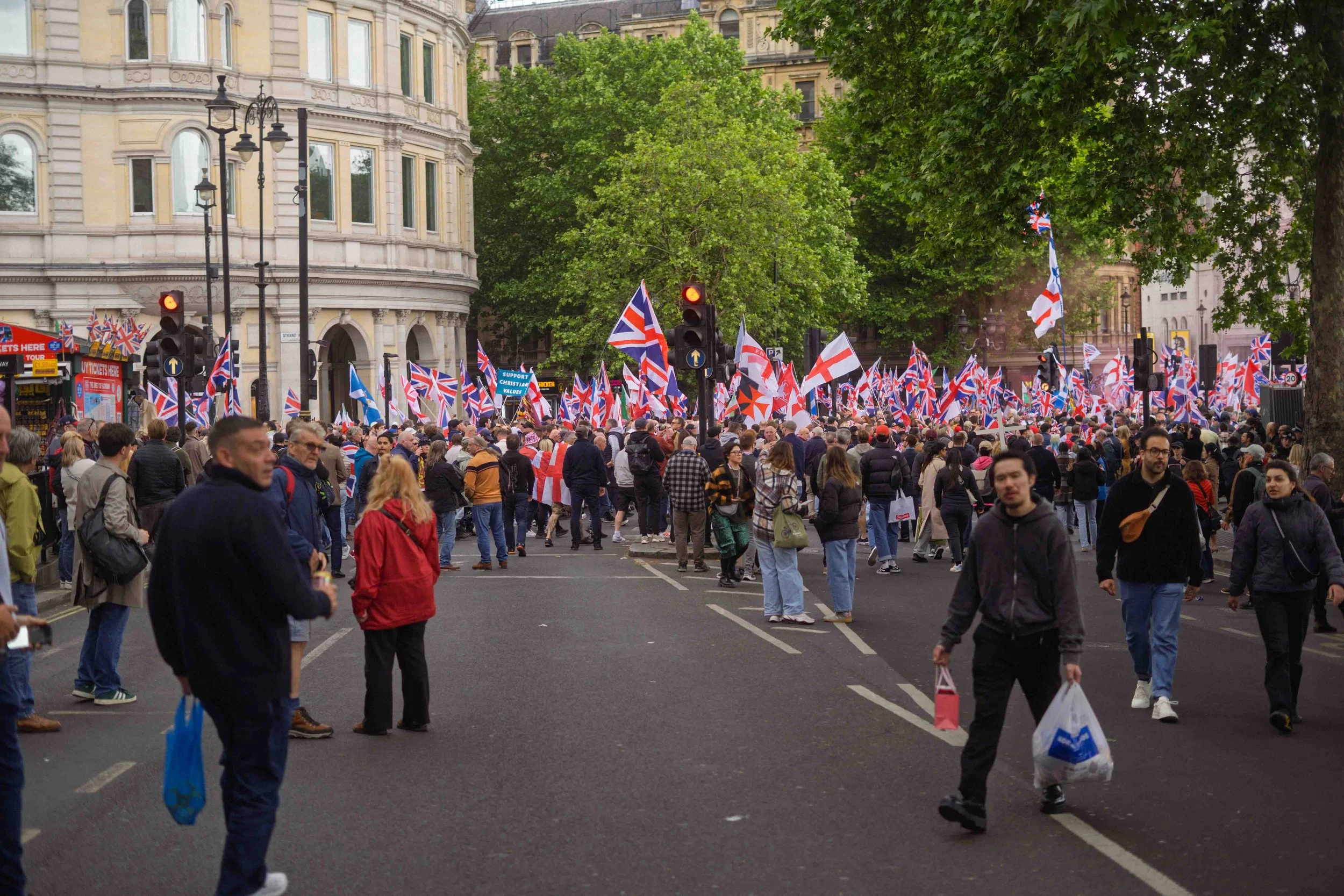
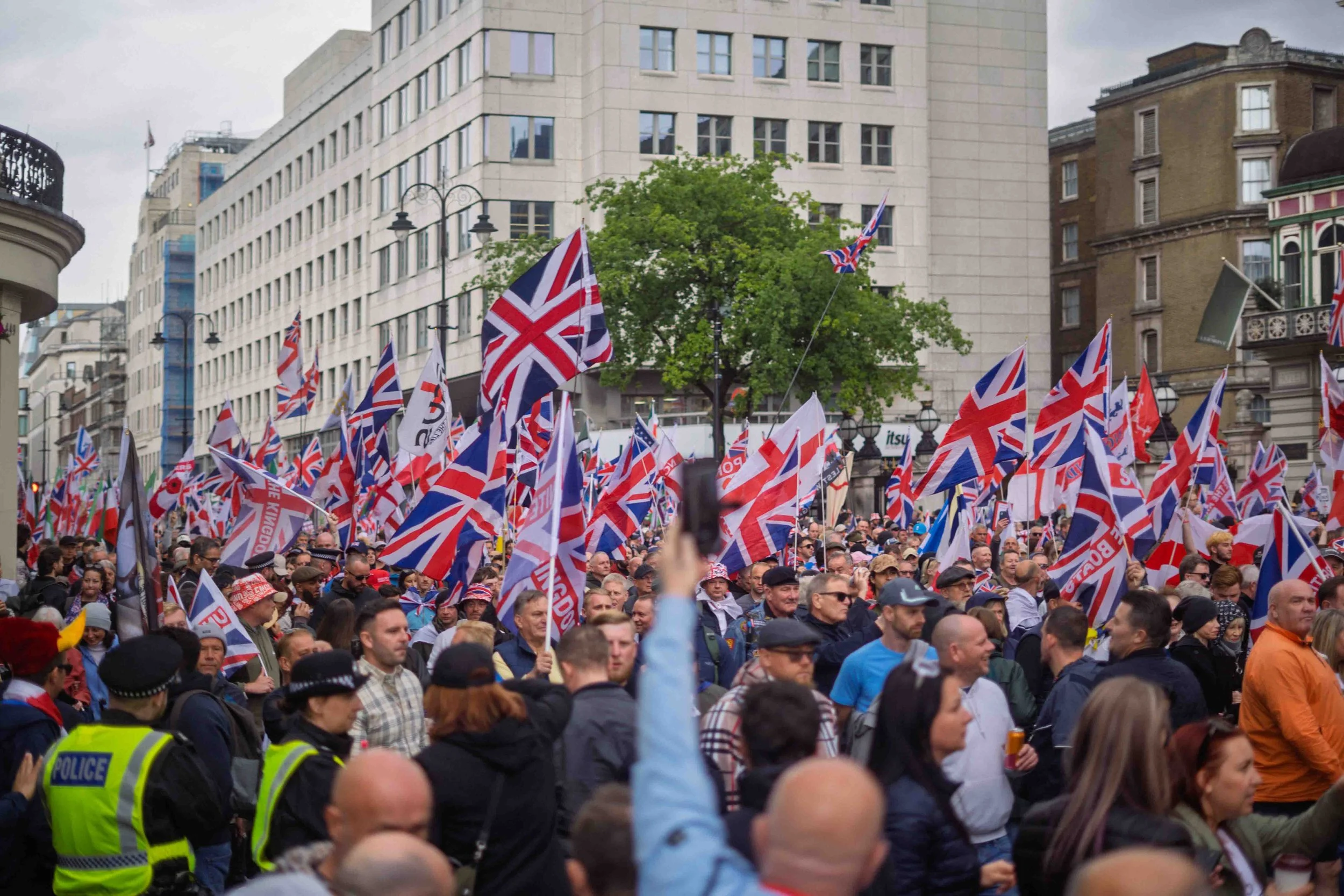
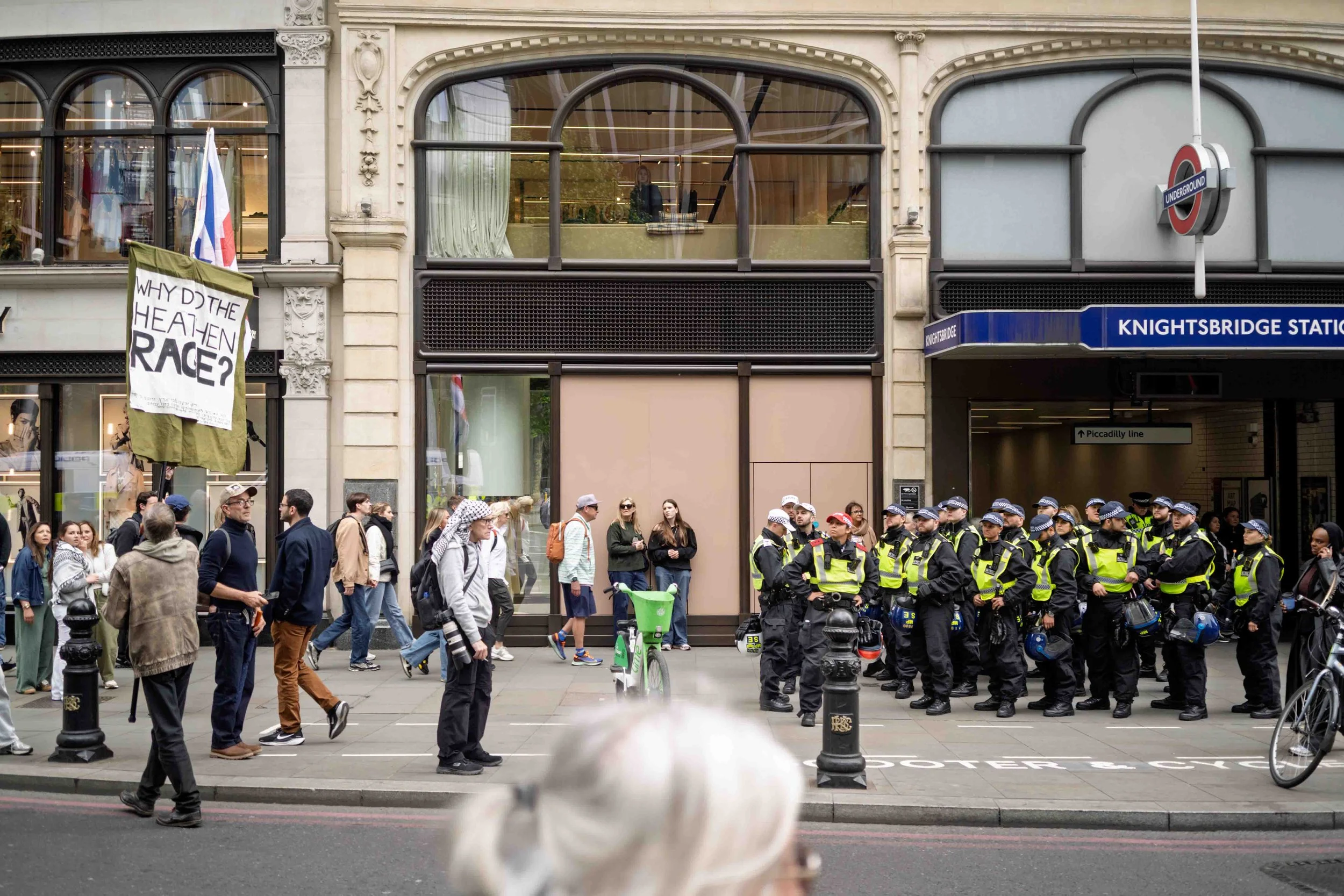
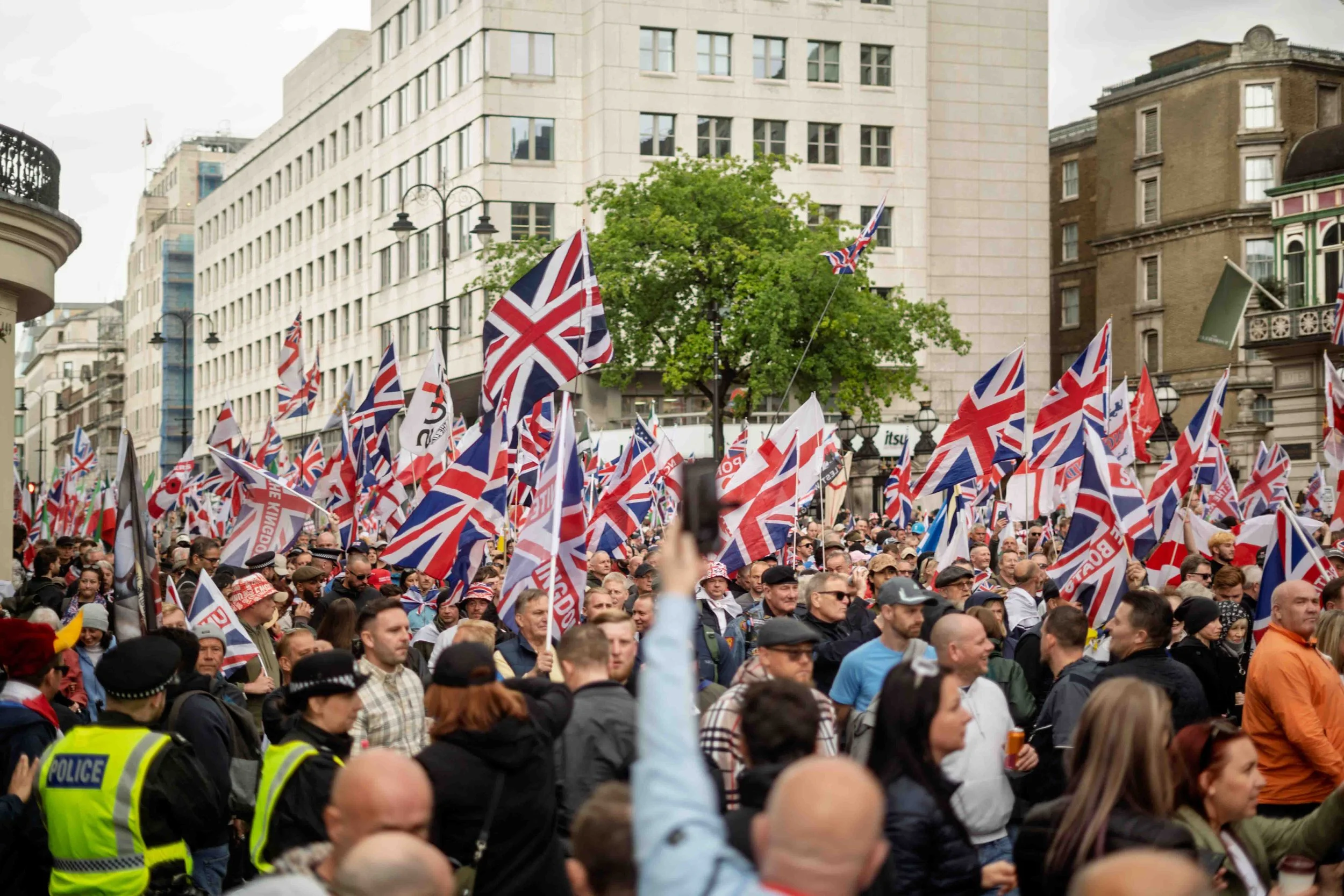
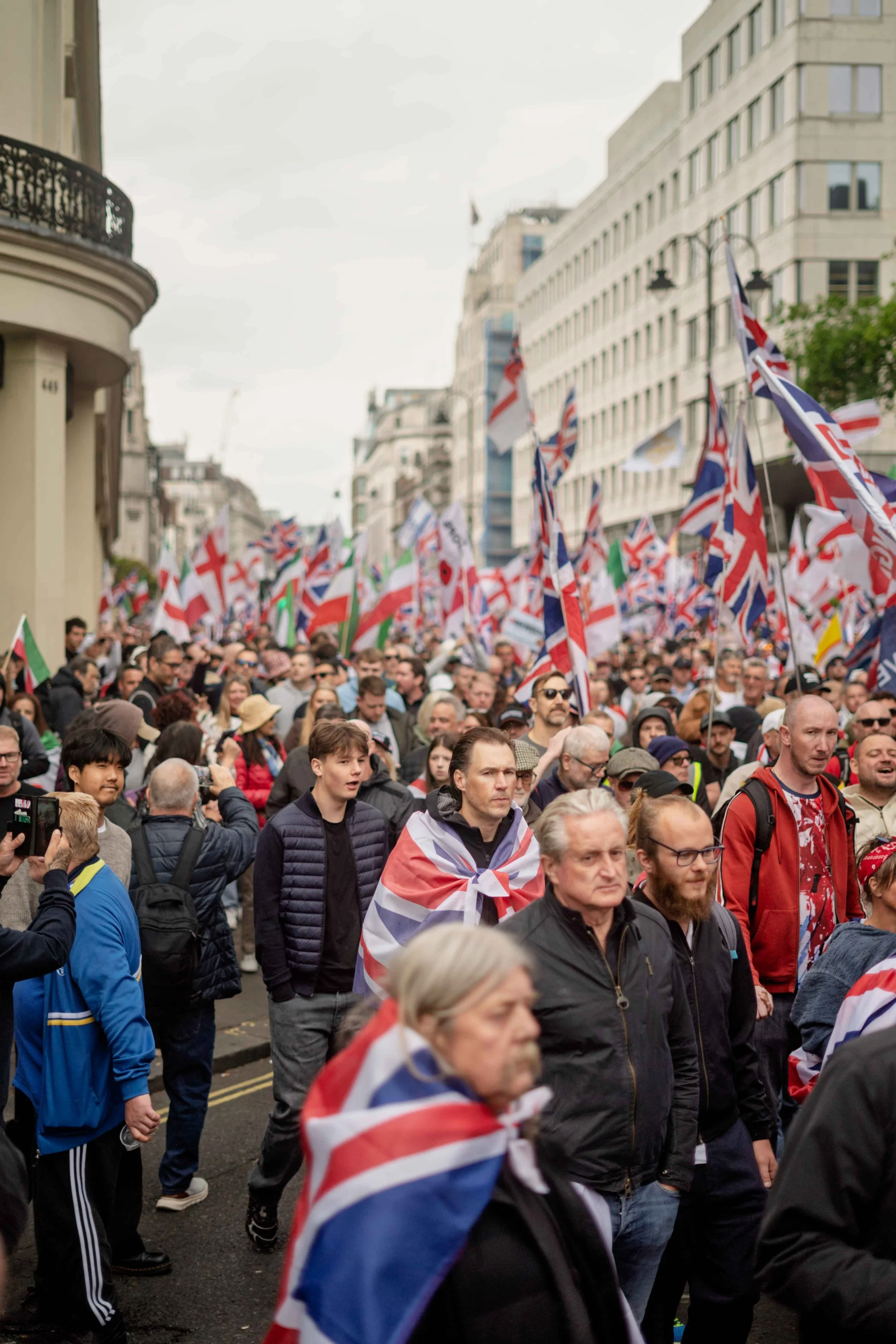
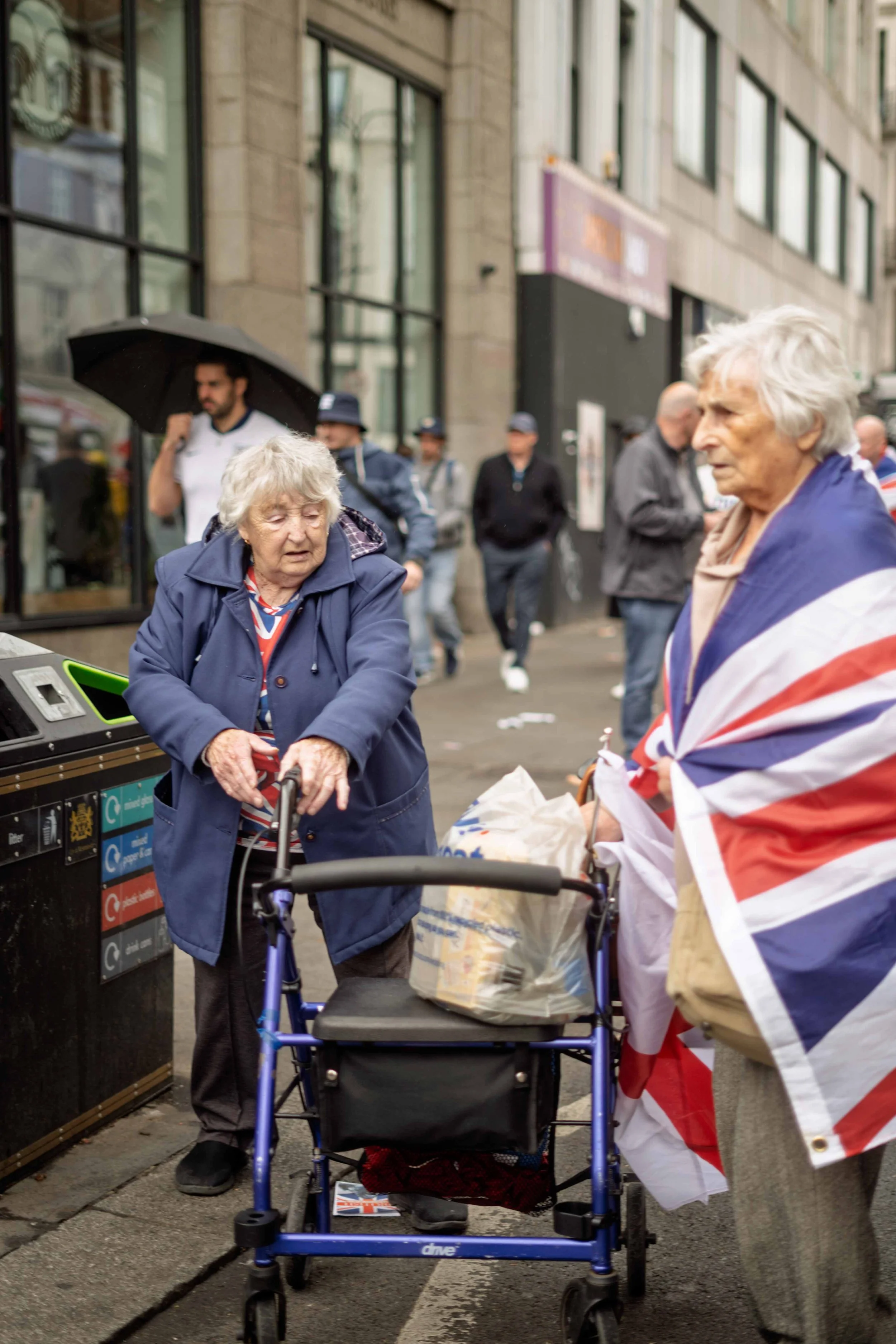
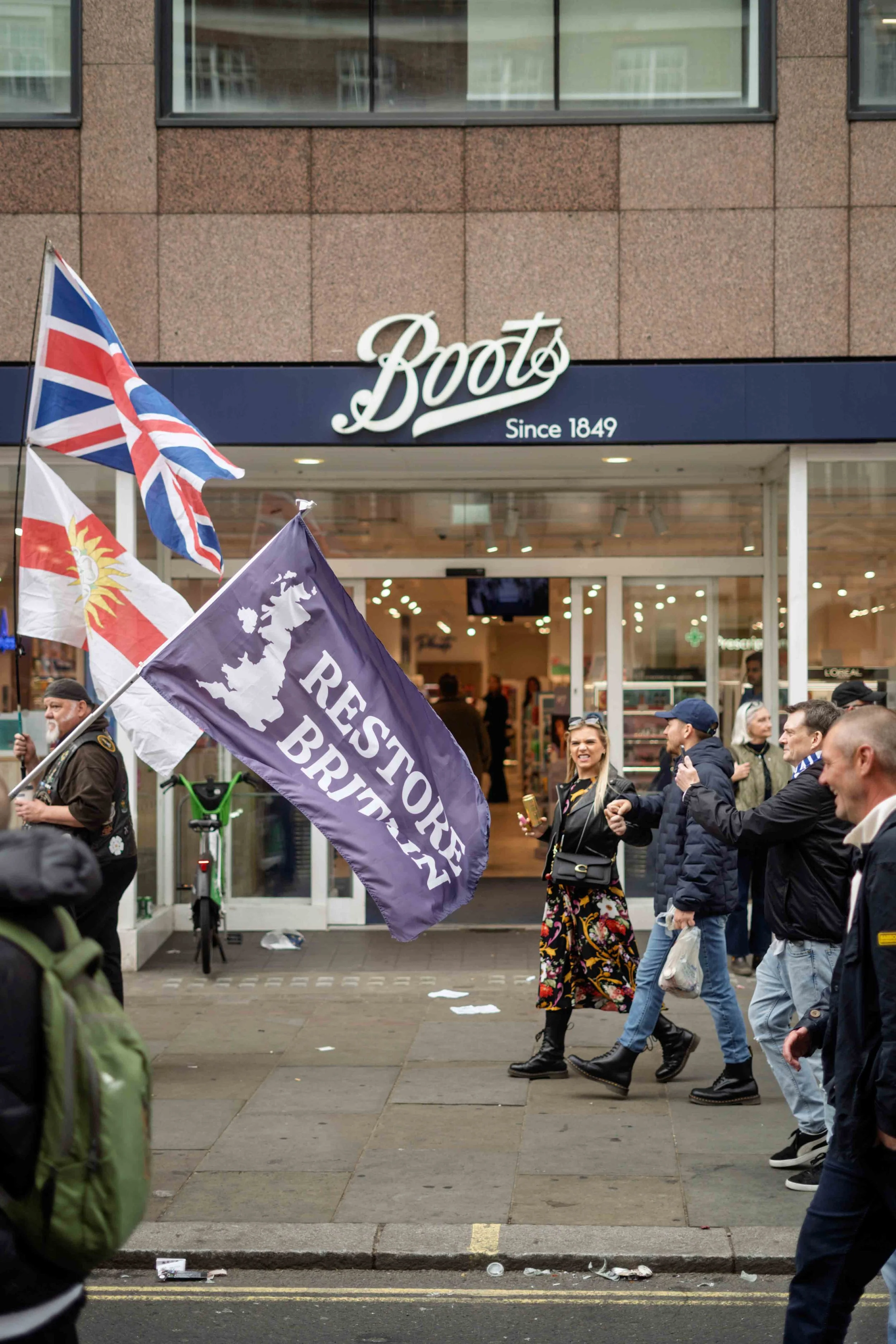
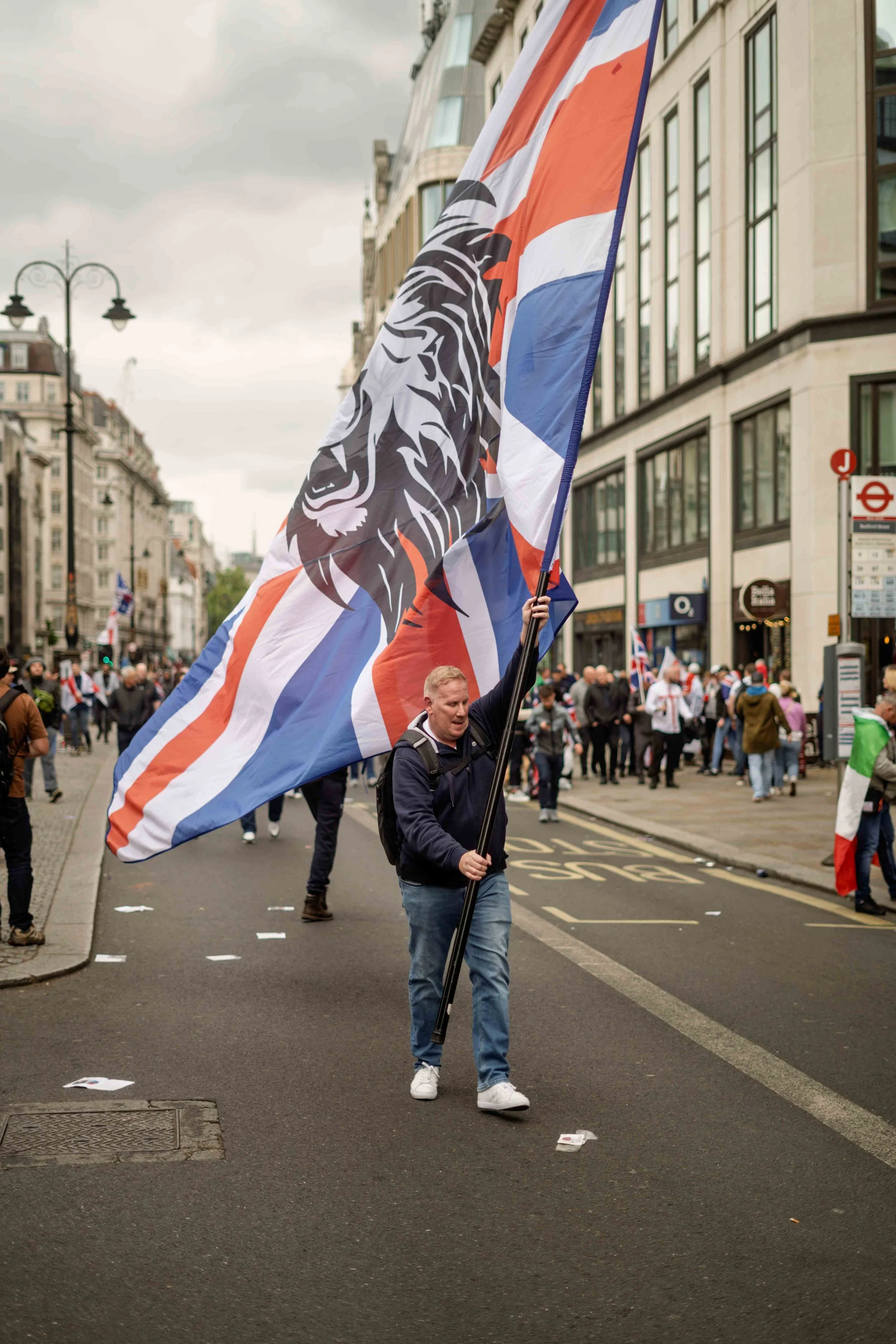
The Unite the Kingdom march was different. Union flags as far as you could see, filling The Strand from kerb to kerb. There was genuine energy here — people who were in attendance were locked like they hadn't been to a demonstration in decades, younger faces chanting alongside grandmothers draped in flags. Whatever you think of the politics, the turnout was real.
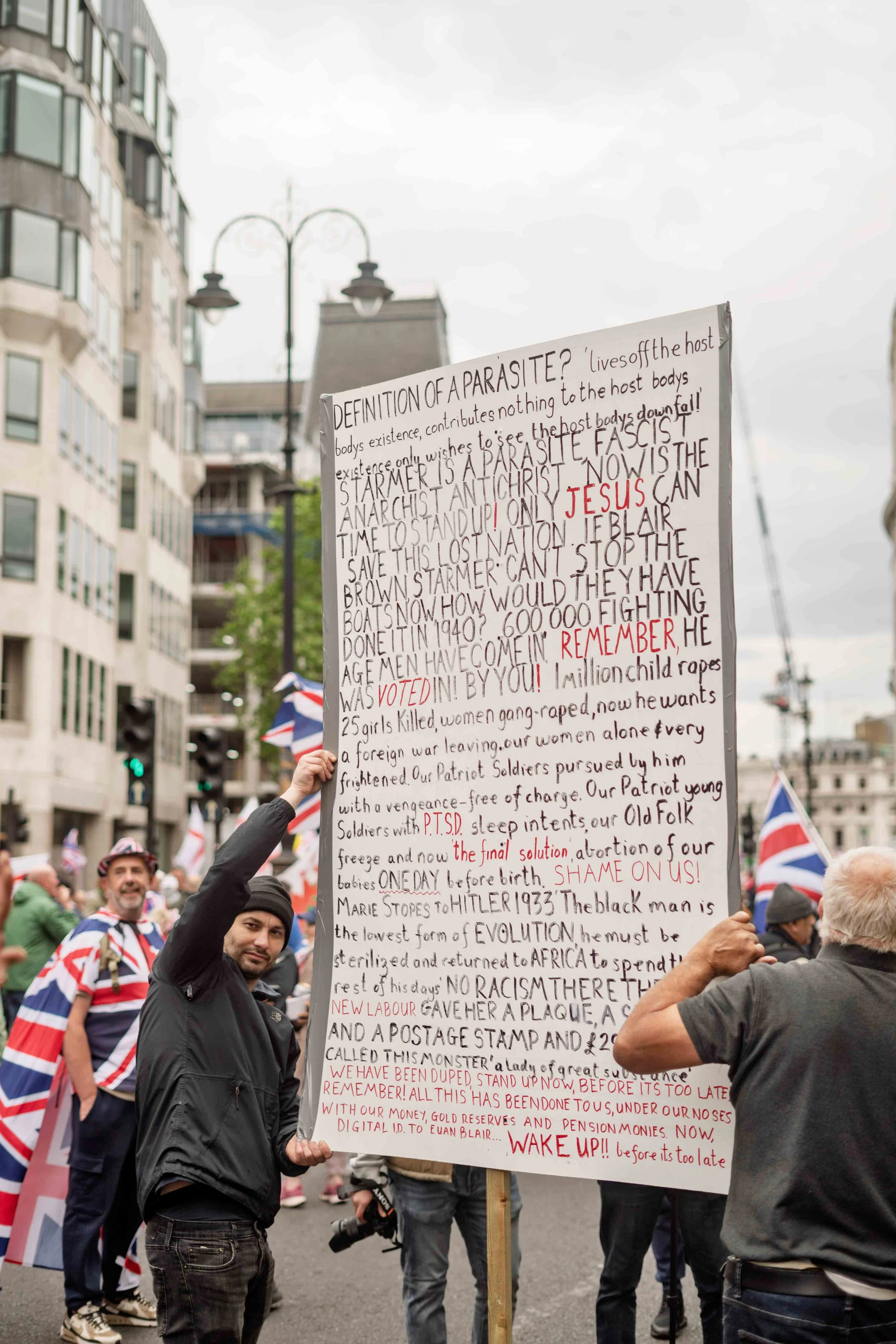
The mood ranged from festive to furious depending on where you stood. Near the front, people were singing. Further back, the signs got harder — some were the standard fare of any political march, slogans about sovereignty and borders; others veered somewhere darker. That's the honest picture: a crowd is never one thing, and this one wasn't either.
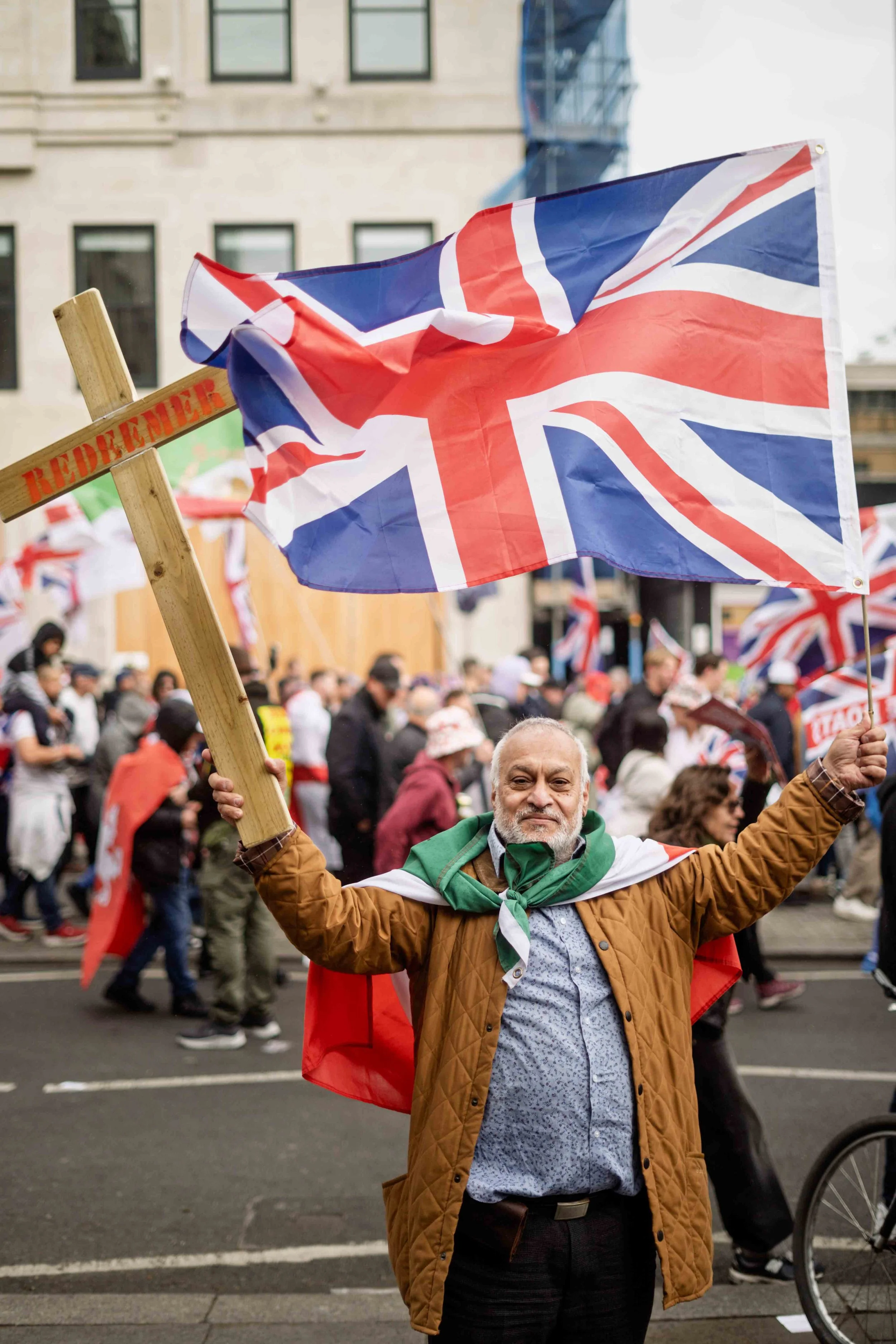
One image I kept coming back to: a man raising a wooden cross in one hand and a Union flag in the other, marching with real conviction.
Meanwhile, London Carried On
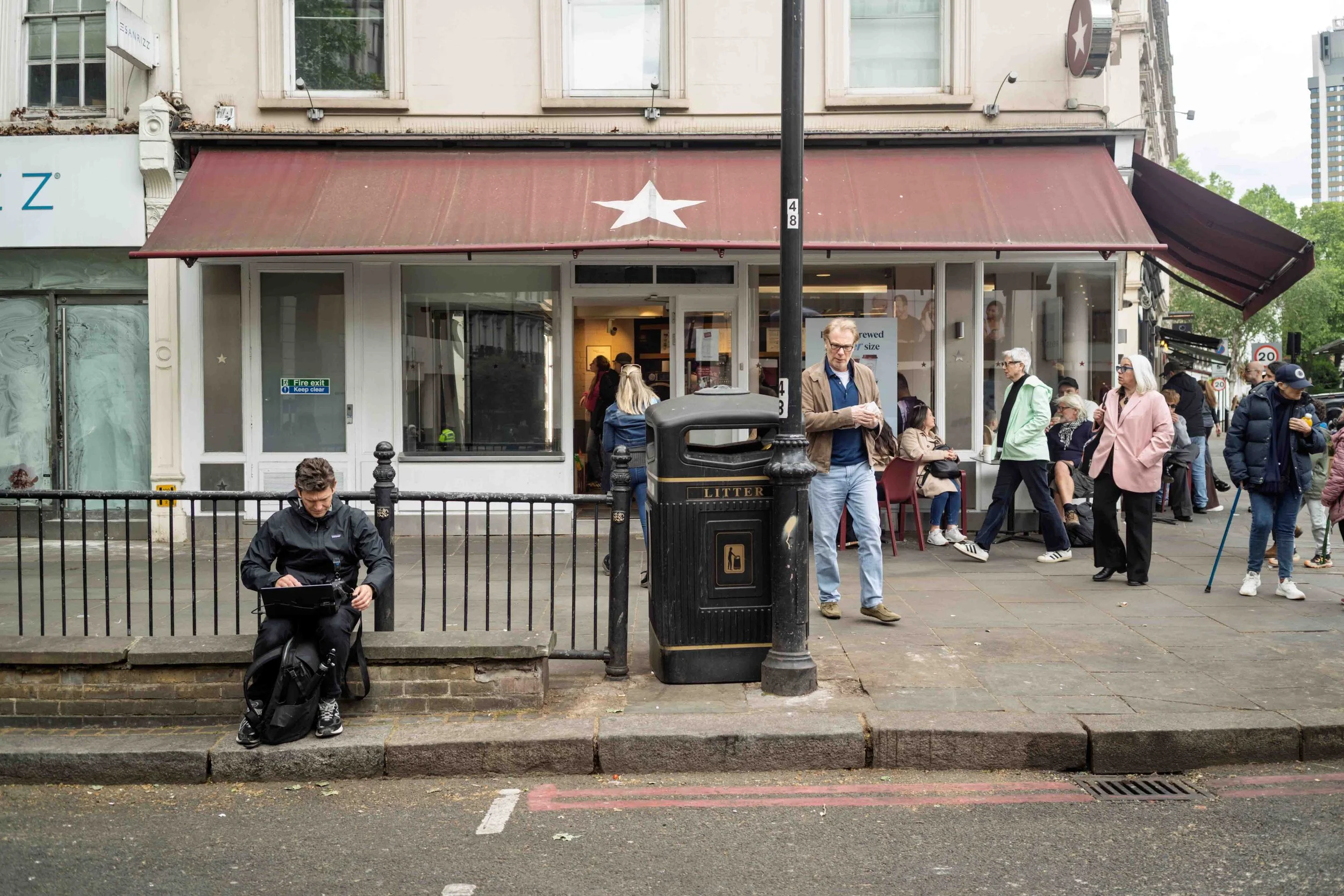
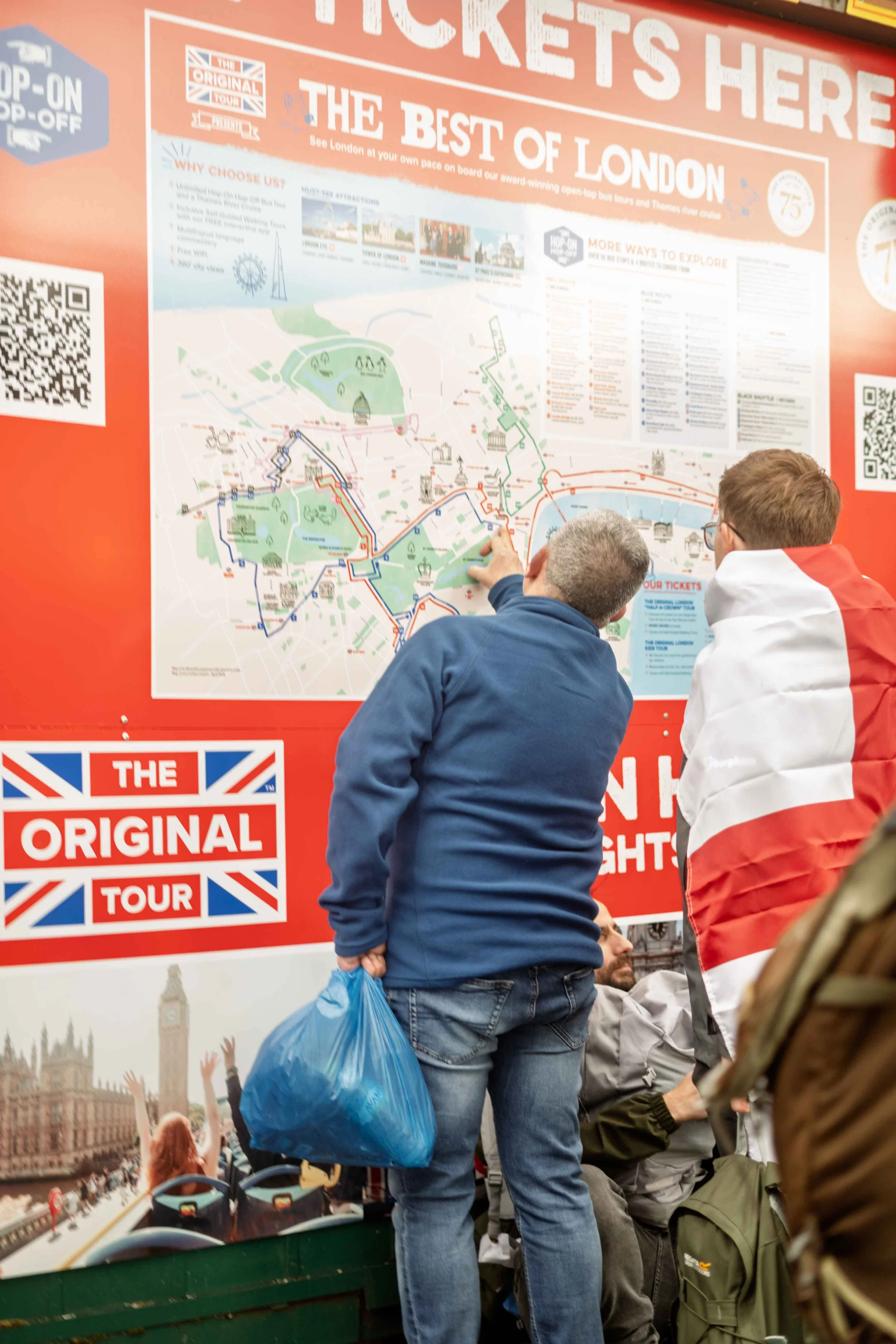
Here's the thing about London: it doesn't stop for its own arguments. Between the two marches, on the side streets and quieter stretches of pavement, the city was just getting on with it. A woman wrestled a pair of rose-gold number balloons around a corner, heading to someone's birthday. Two men in England flags squinted at a tourist map outside a hop-on hop-off bus stand. A photographer sat on a kerb outside a café editing on his laptop while a queue formed behind him.
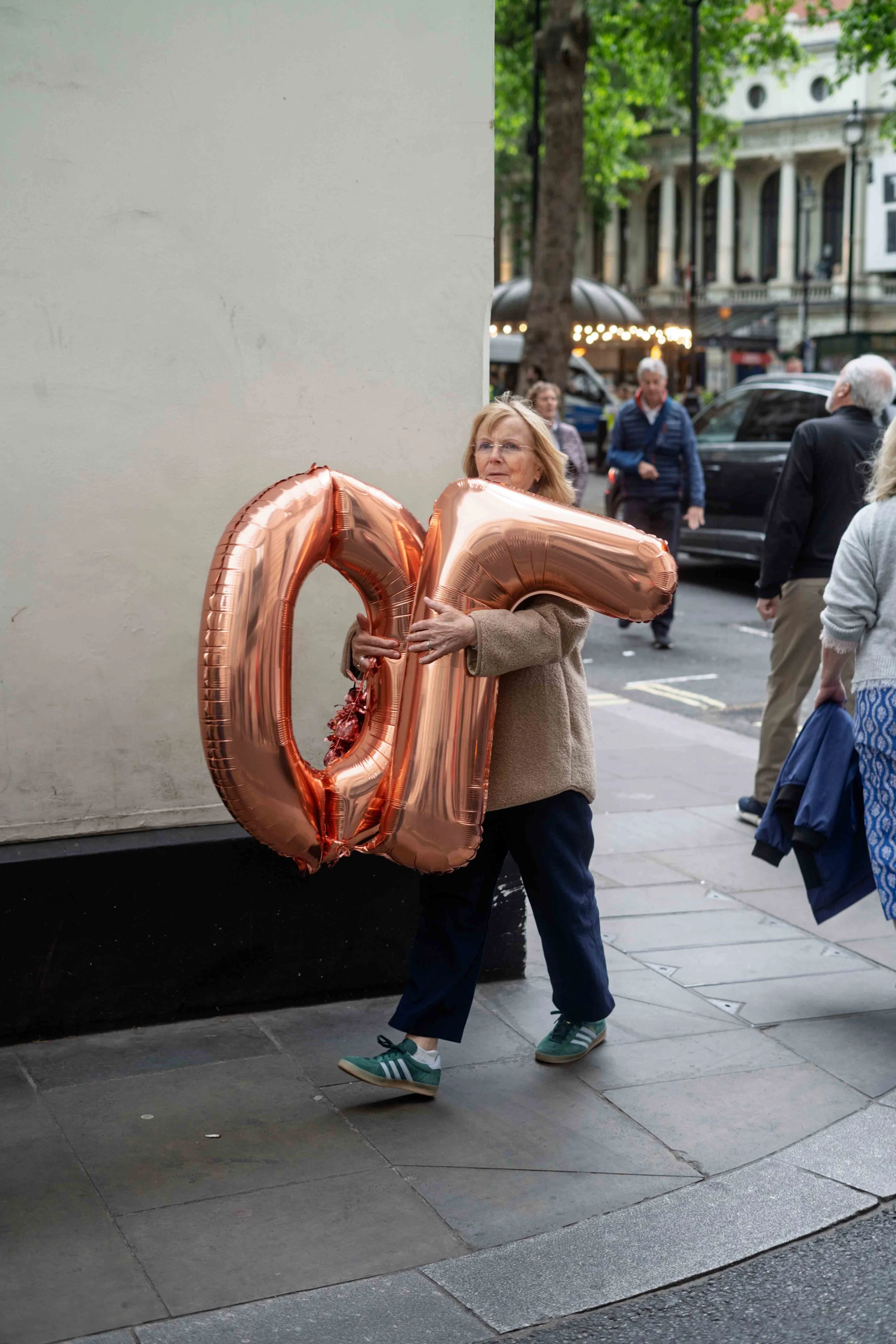
There was something grounding about that. The city has seen a lot of Saturdays like this one, and it will see more. The arguments change shape but they don't really change — who belongs, who gets to say so, whose version of Britain is the real one. And through all of it, London keeps absorbing, keeps changing, keeps being more complicated than any single march can capture.
The idea that London would be better off, more itself, by removing the people who have spent their lives building it is a harder argument to make when you're actually standing in the middle of it. This city has been shaped by wave after wave of people arriving from elsewhere, each generation initially viewed with suspicion, each eventually becoming the city itself. The cafés, the music, the NHS wards, the buses — that's all London too, and it didn't come from nowhere.
That doesn't mean there aren't real and complicated questions to have about immigration policy, community change, or what national identity means in 2026. There are. But those conversations happen in committee rooms and local council meetings and family kitchens — not really on the street, where the loudest voices tend to drown out the nuance on both sides.
I don't have a tidy conclusion to offer. These photographs are not an argument so much as a record — of a day, a city, a conversation that's been going on for a very long time and isn't close to finished. I hope they're worth sitting with.
Until next time, keep snapping.

Lines, Layers, and Nordic Light: A 60 - Hour Street Photography Guide to Copenhagen
There is a strange irony in modern travel.
Three times a week, I spend three hours a day commuting just to get to work and back. Yet, in just 90 minutes from London Gatwick, I found myself stepping off a plane and into a completely different visual universe. It’s a powerful reminder that sometimes the best inspiration isn't found in a longer journey, but a smarter one.
For this trip, I traveled solo, and I’ll be honest: I arrived with a touch of trepidation. As a street photographer, being alone in a foreign city can sometimes feel isolating, and I was initially concerned about how a solo traveler with a camera would be received. However, those worries evaporated the moment I hit the pavement. The famous openness of the Danes and the deep-rooted culture of Hygge welcomed me with open arms. I didn't feel like an outsider looking in; I felt like a guest invited to witness the rhythm of the city.
To understand the "why" behind the photos, you have to understand the city's bones. Copenhagen (or København—"Merchants' Harbor") has spent 800 years evolving from a tiny fishing village into a powerhouse of design. You see it in the architecture: the 17th-century Dutch Baroque houses of Christianshavn weren't just built for aesthetics; they were built as a fortified naval statement by King Christian IV. When you're walking through Nyboder — those iconic yellow naval barracks—you aren't just looking at a "pretty street." You’re looking at some of the world's first planned social housing, dating back to 1631. This history of care and community leads directly into the modern mindset of Hygge. We often think of it as a winter concept—candles and wool socks—but in the spring, it manifests as a communal openness.
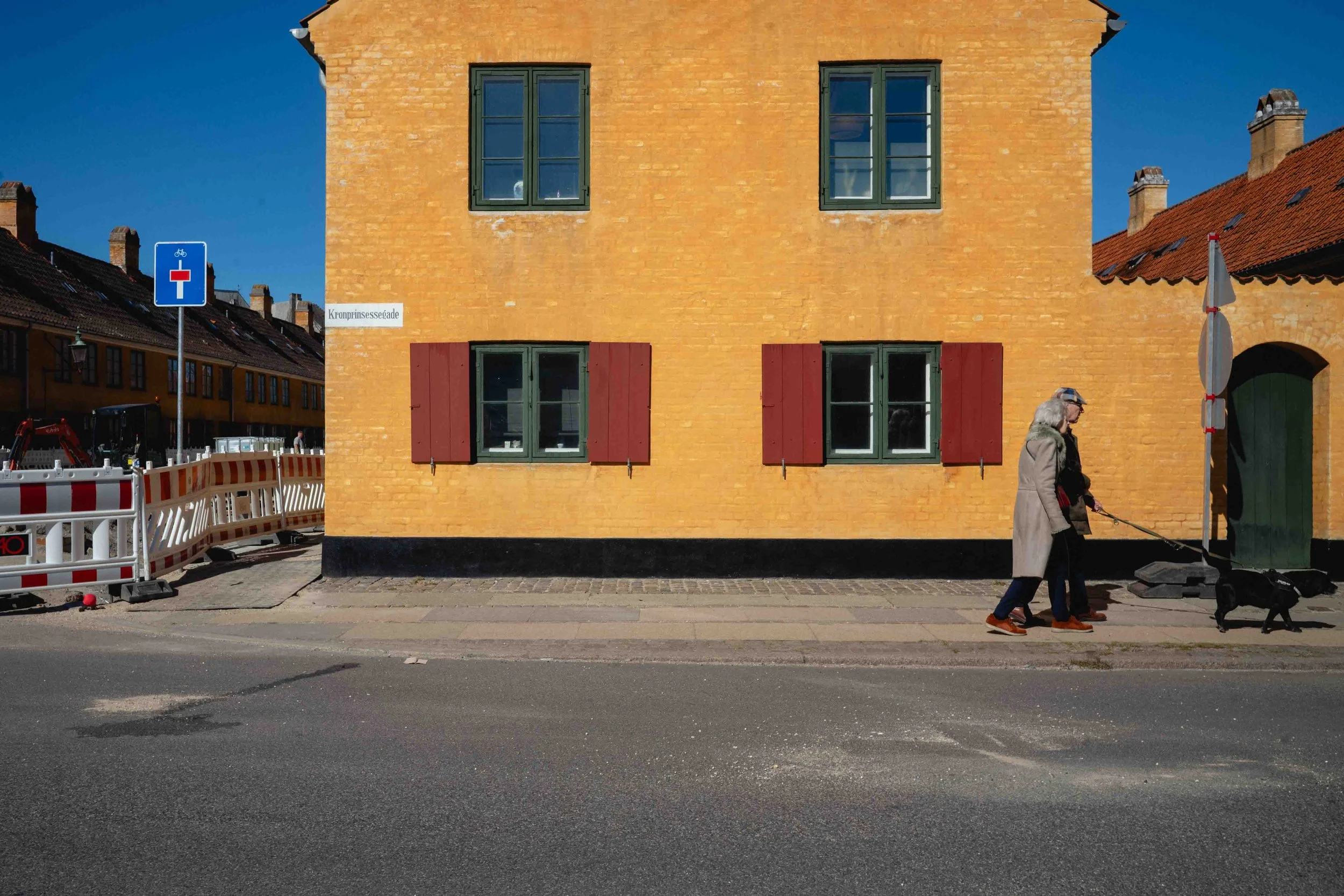
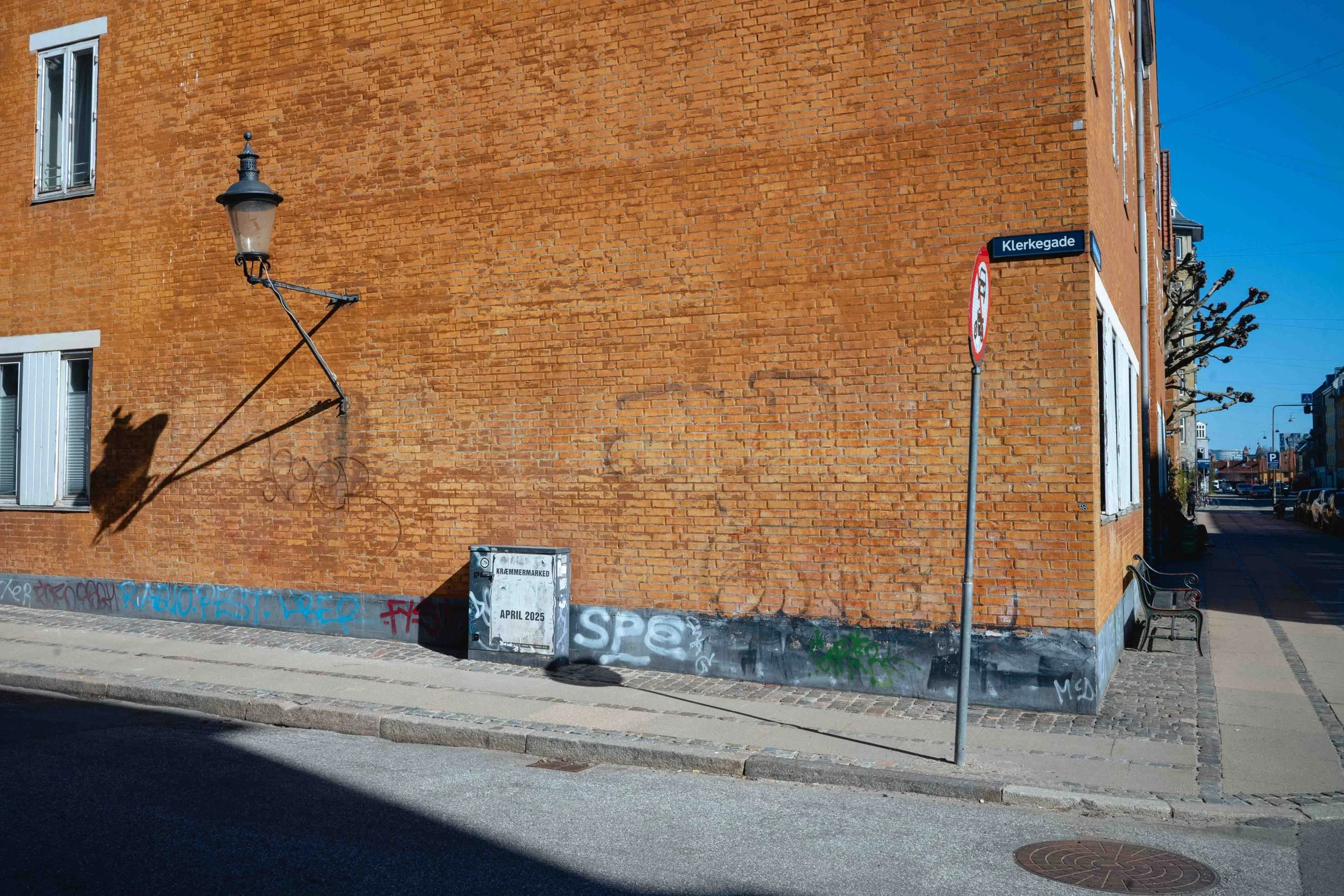
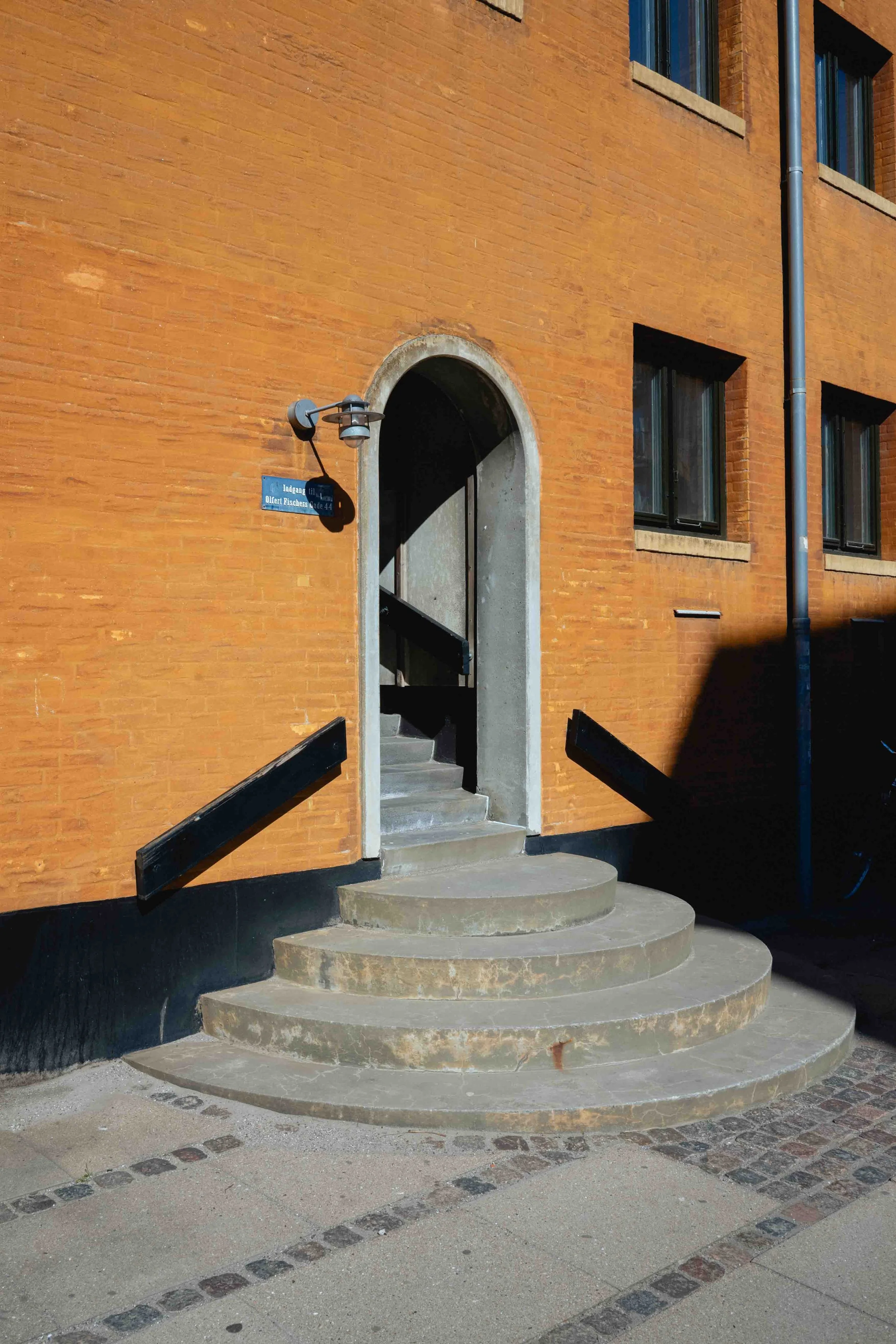
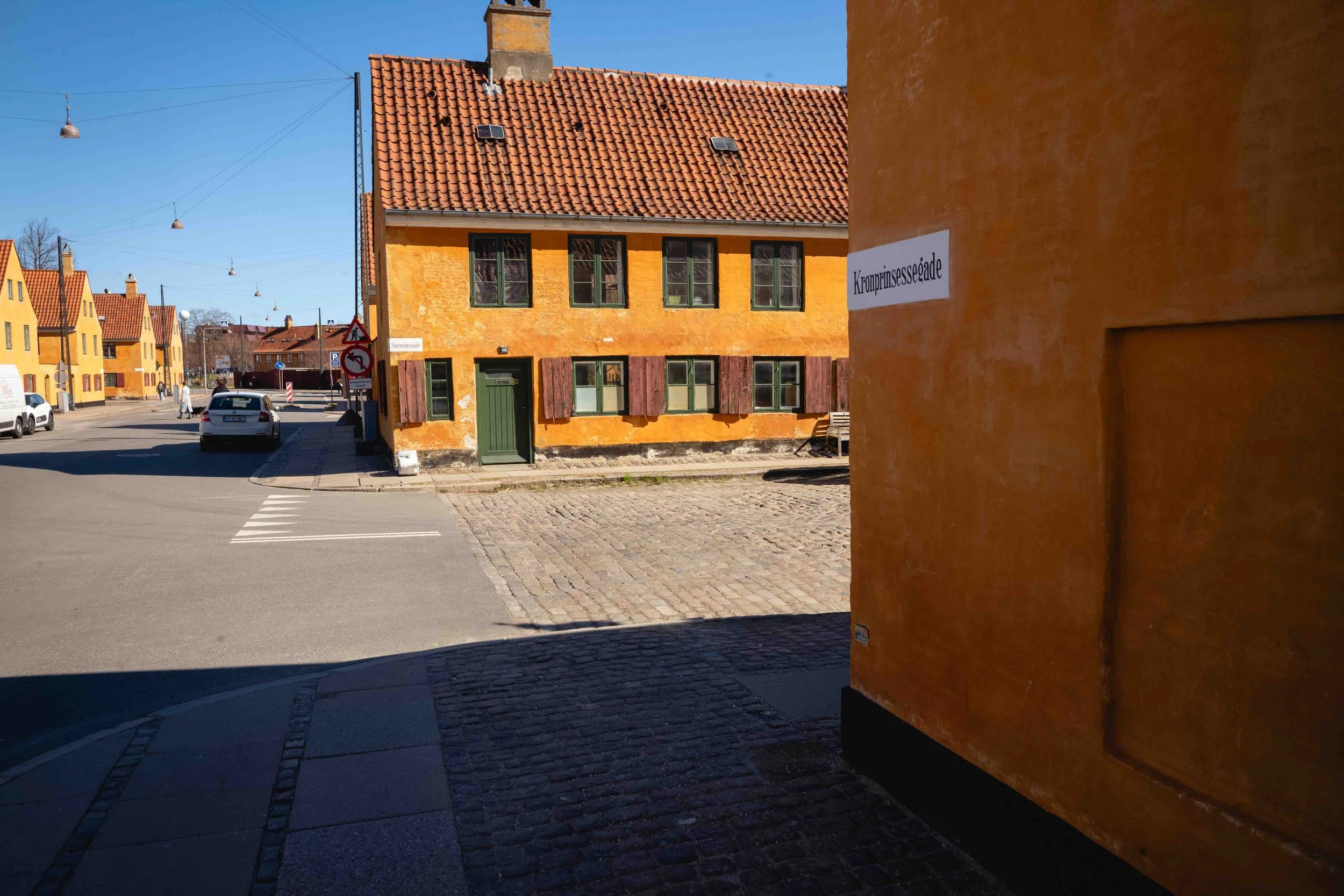
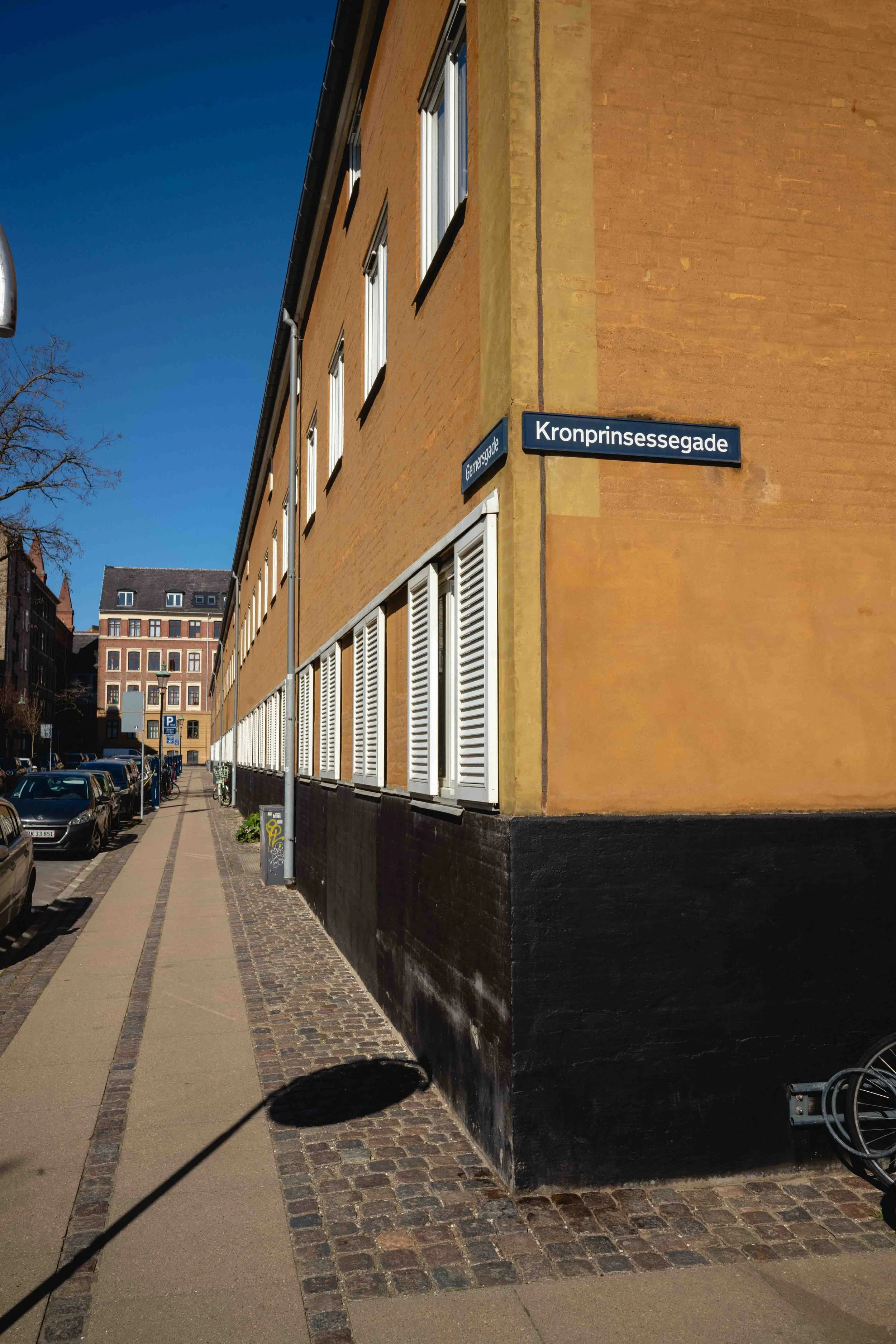
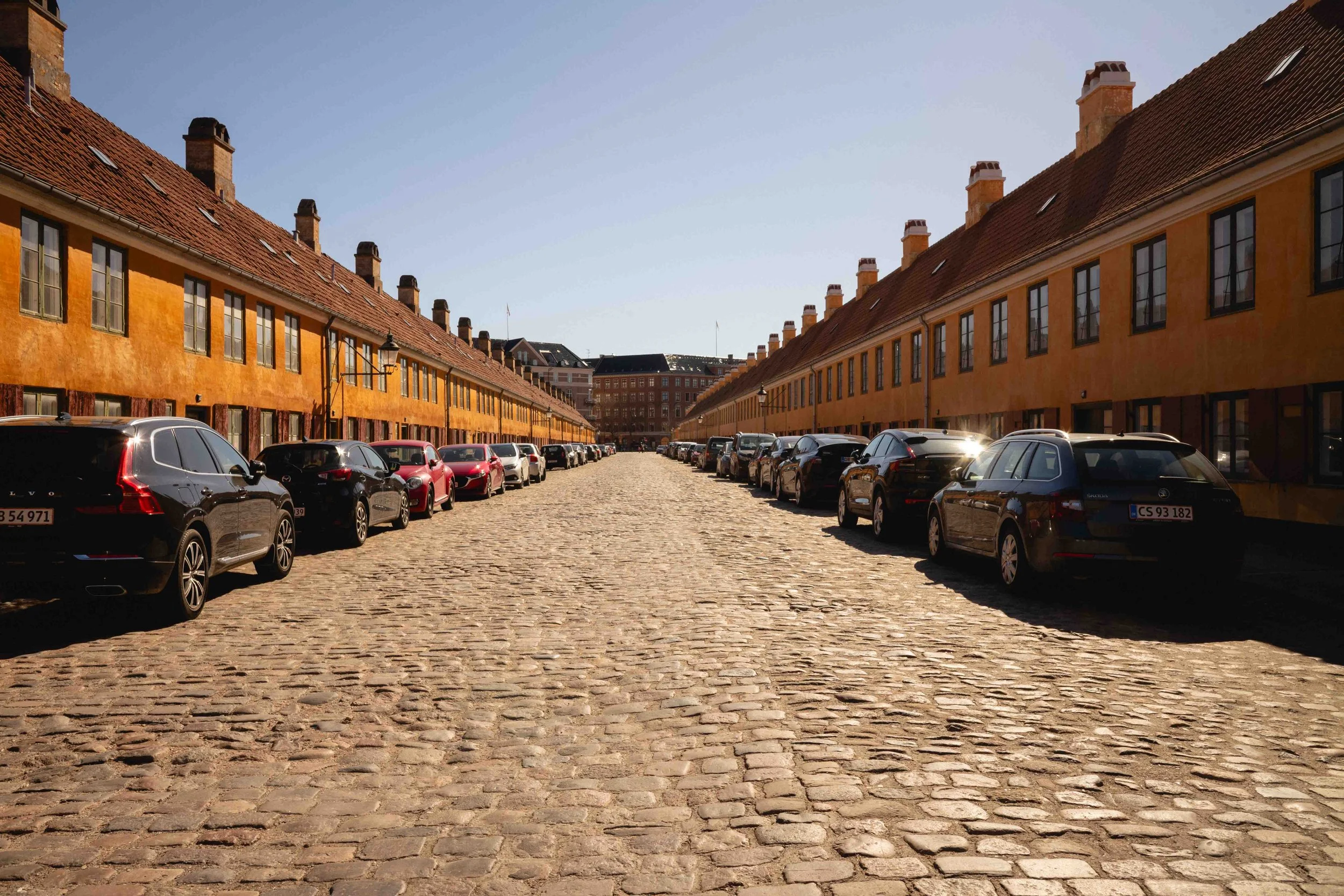
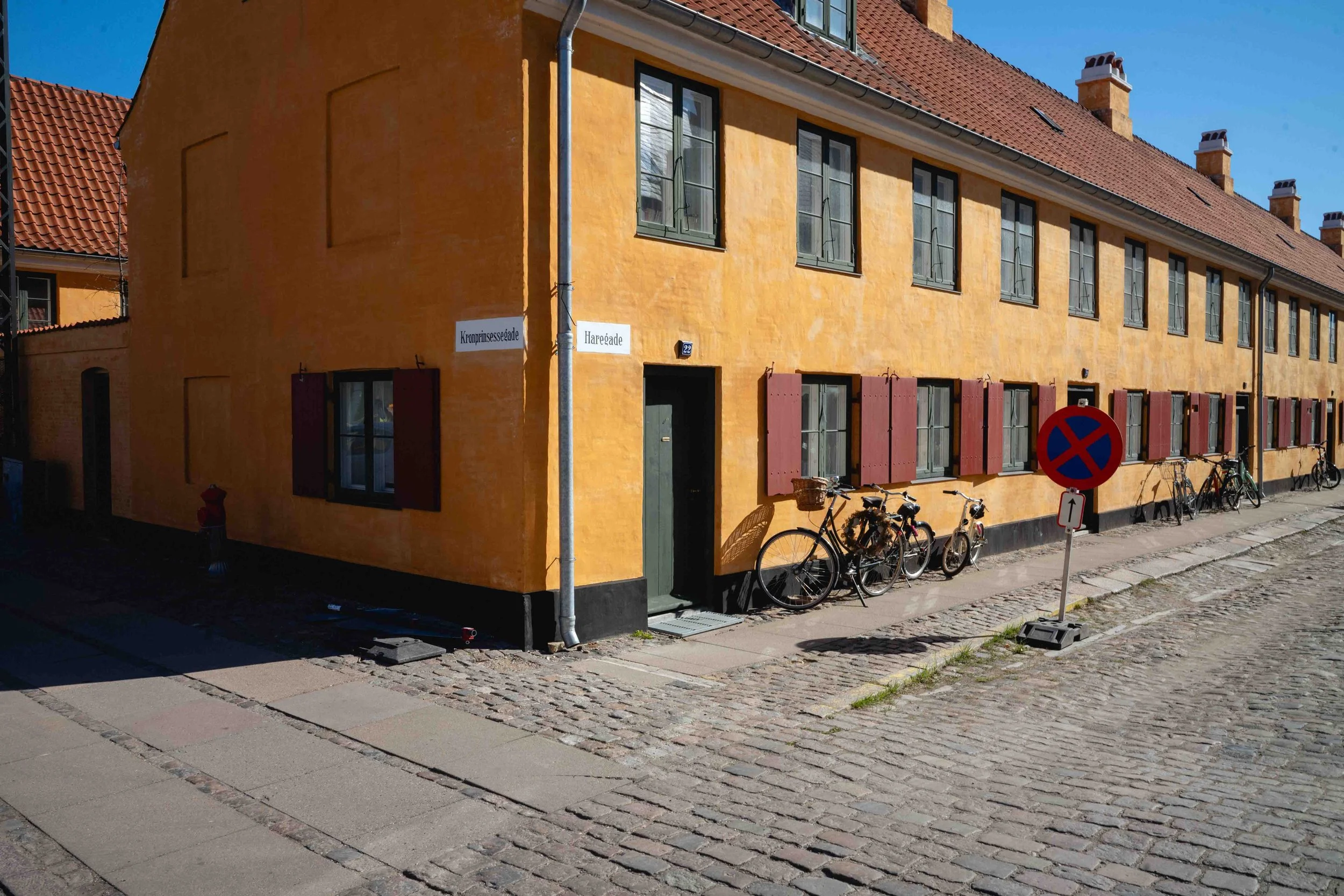
It’s the "urban hygge" of people sharing a coffee on the curbside in Jægersborggade or a craft beer in the Meatpacking District. As a solo photographer, this mindset is a gift. There is a sense of trust and "live and let live" here that makes you feel incredibly safe. The locals are remarkably open to being part of a frame; as long as you are respectful, the city feels like a collaborative studio. The light plays its part, too. The Northern latitude in April provides a "blue hour" that feels like it lasts for three, and a soft, diffused sun that makes even the grittiest alleyway in Nørrebro look cinematic.
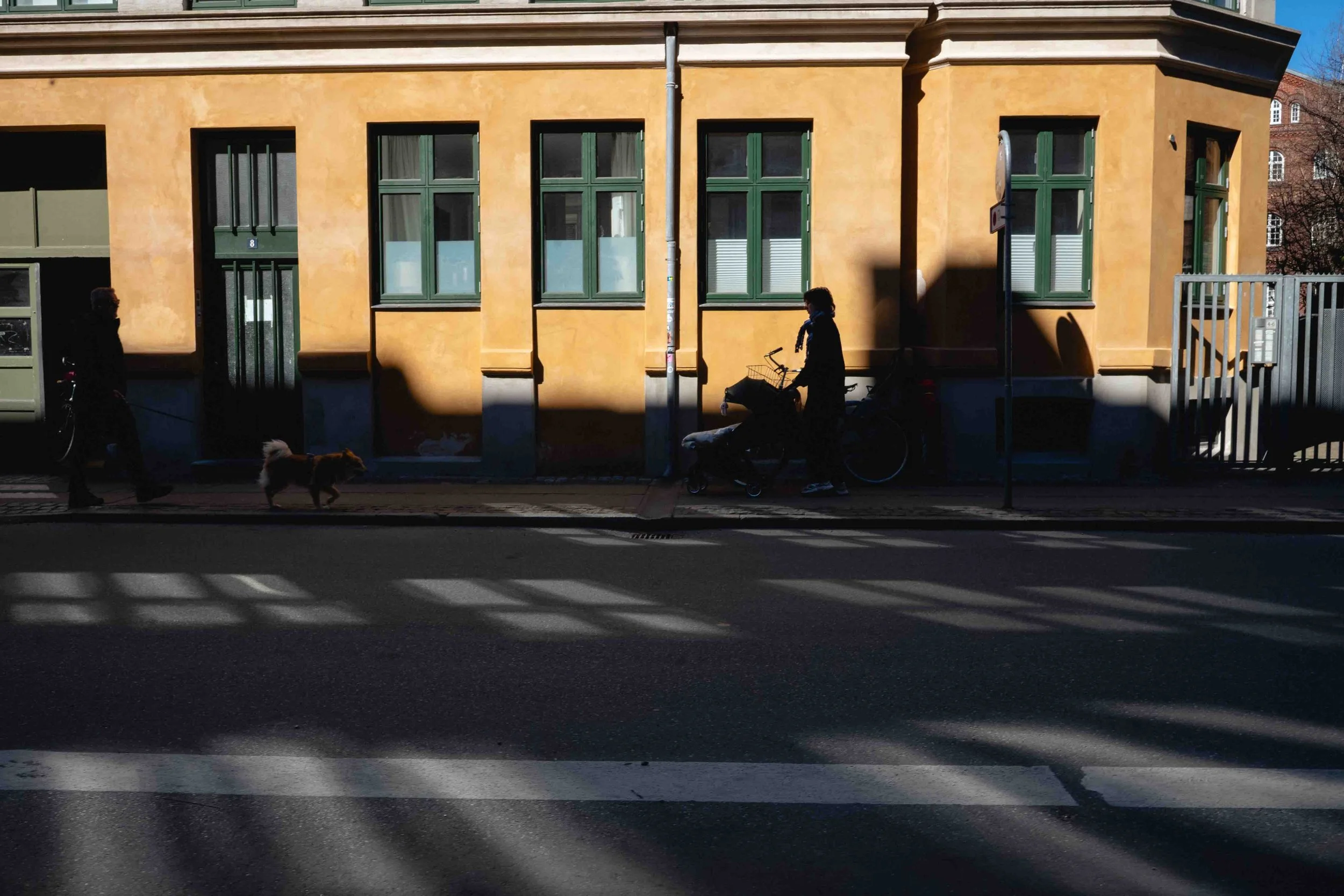
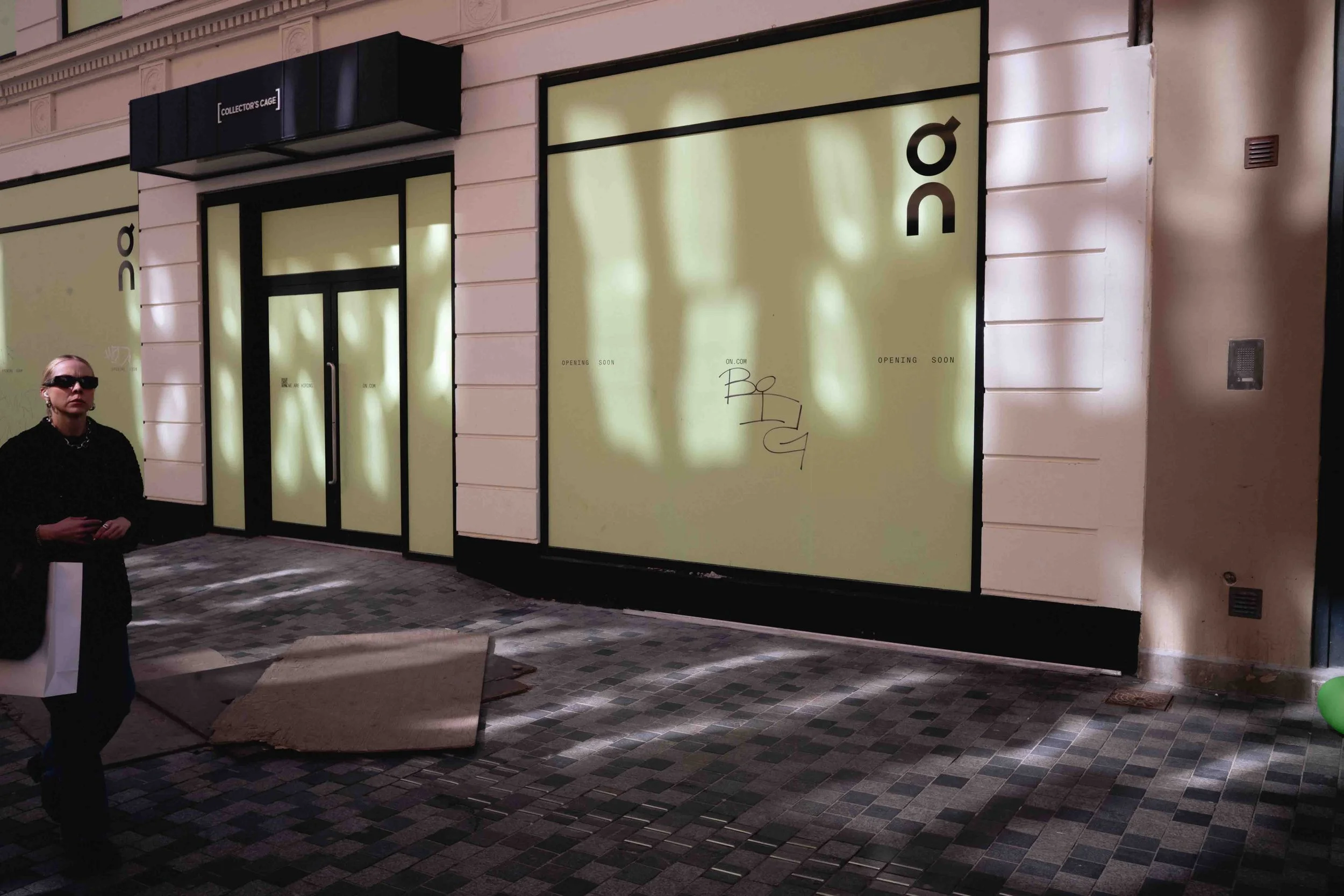
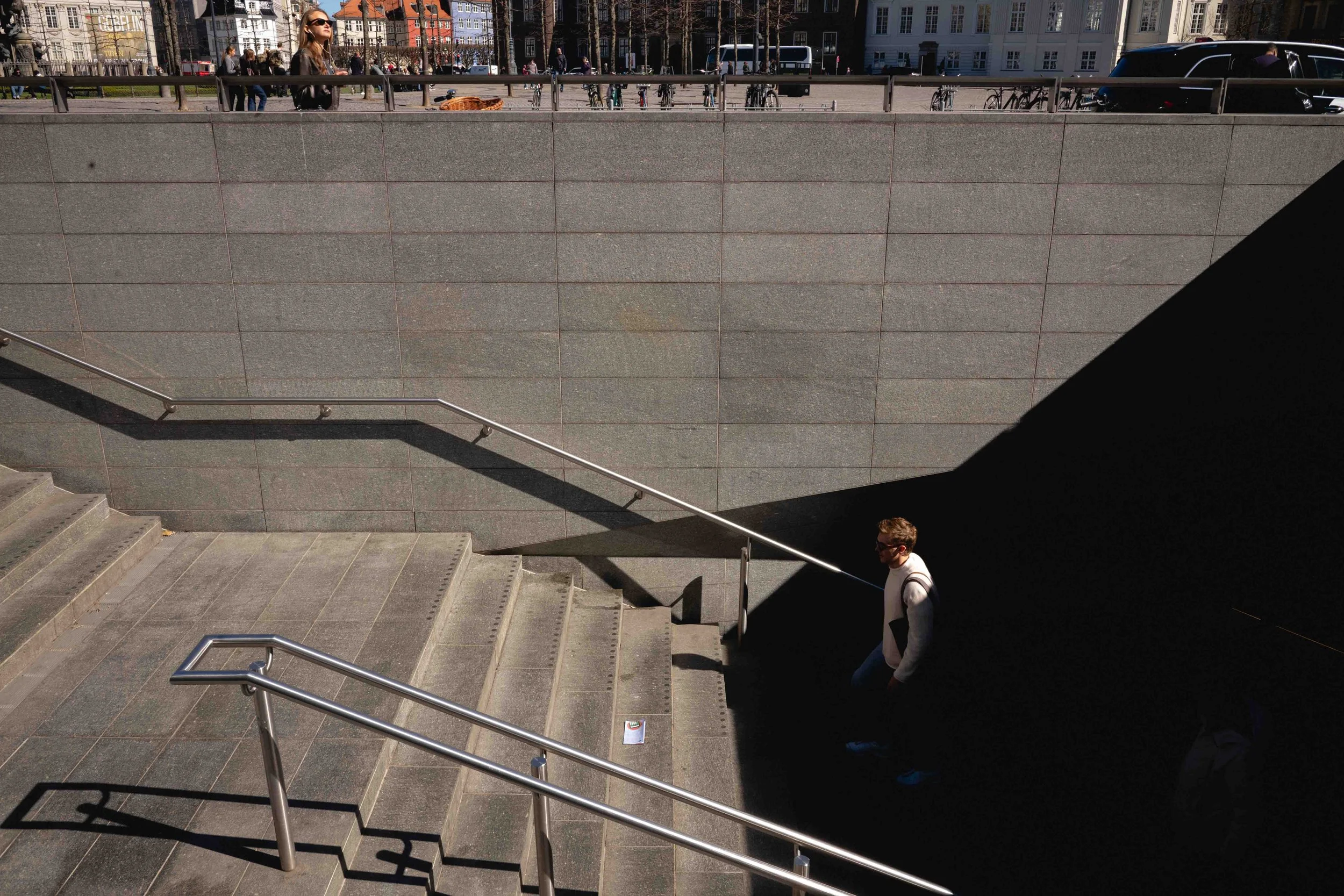
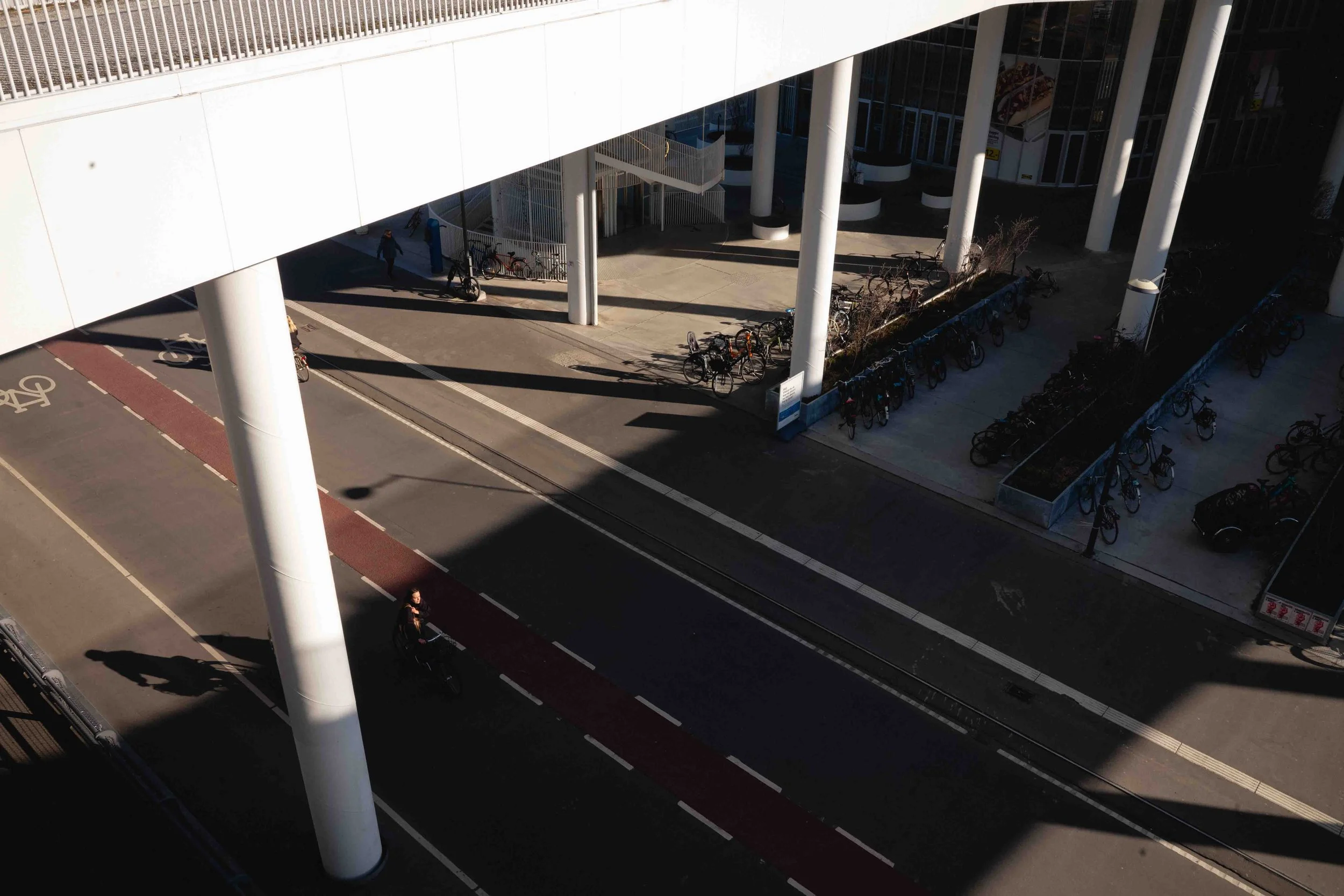
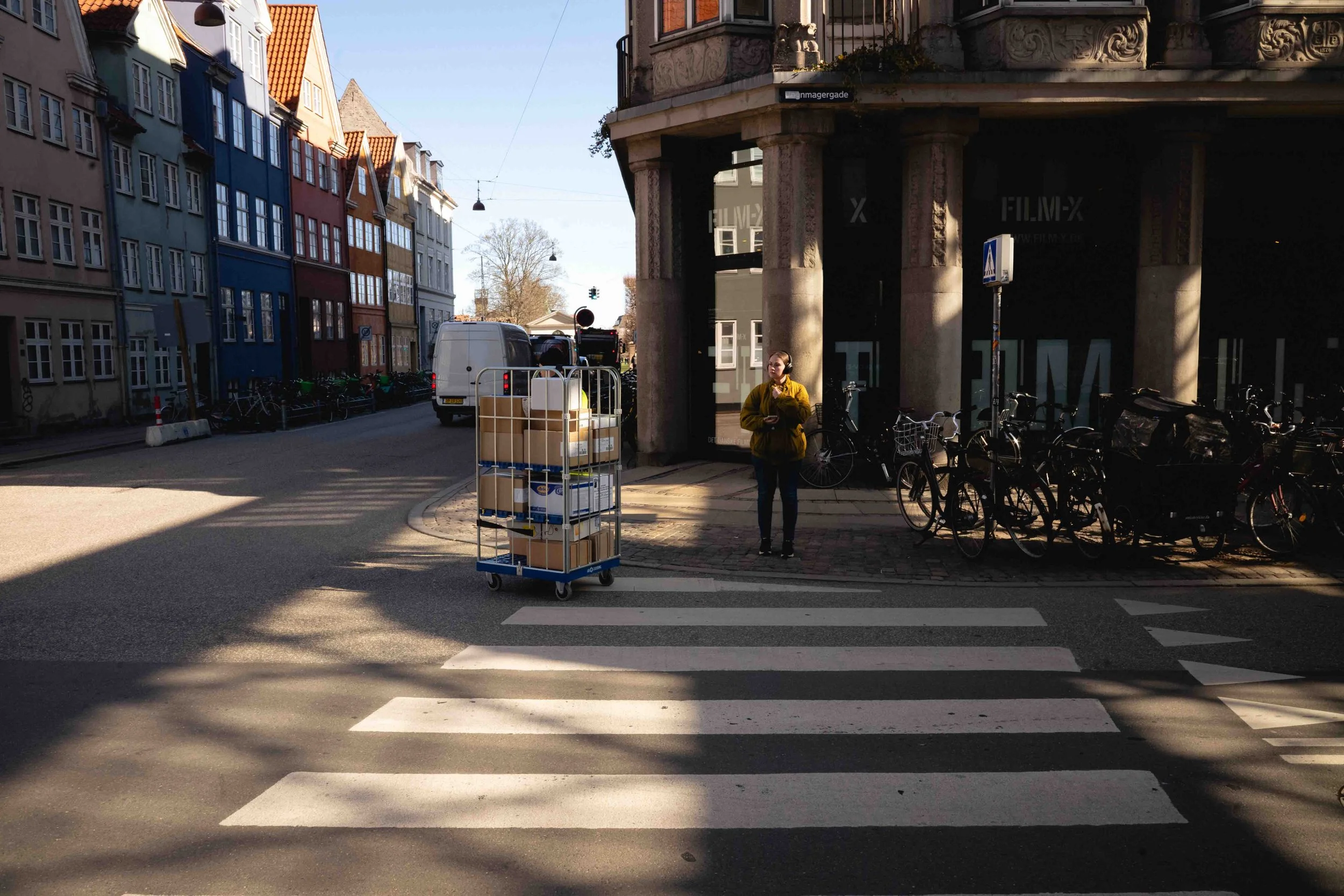
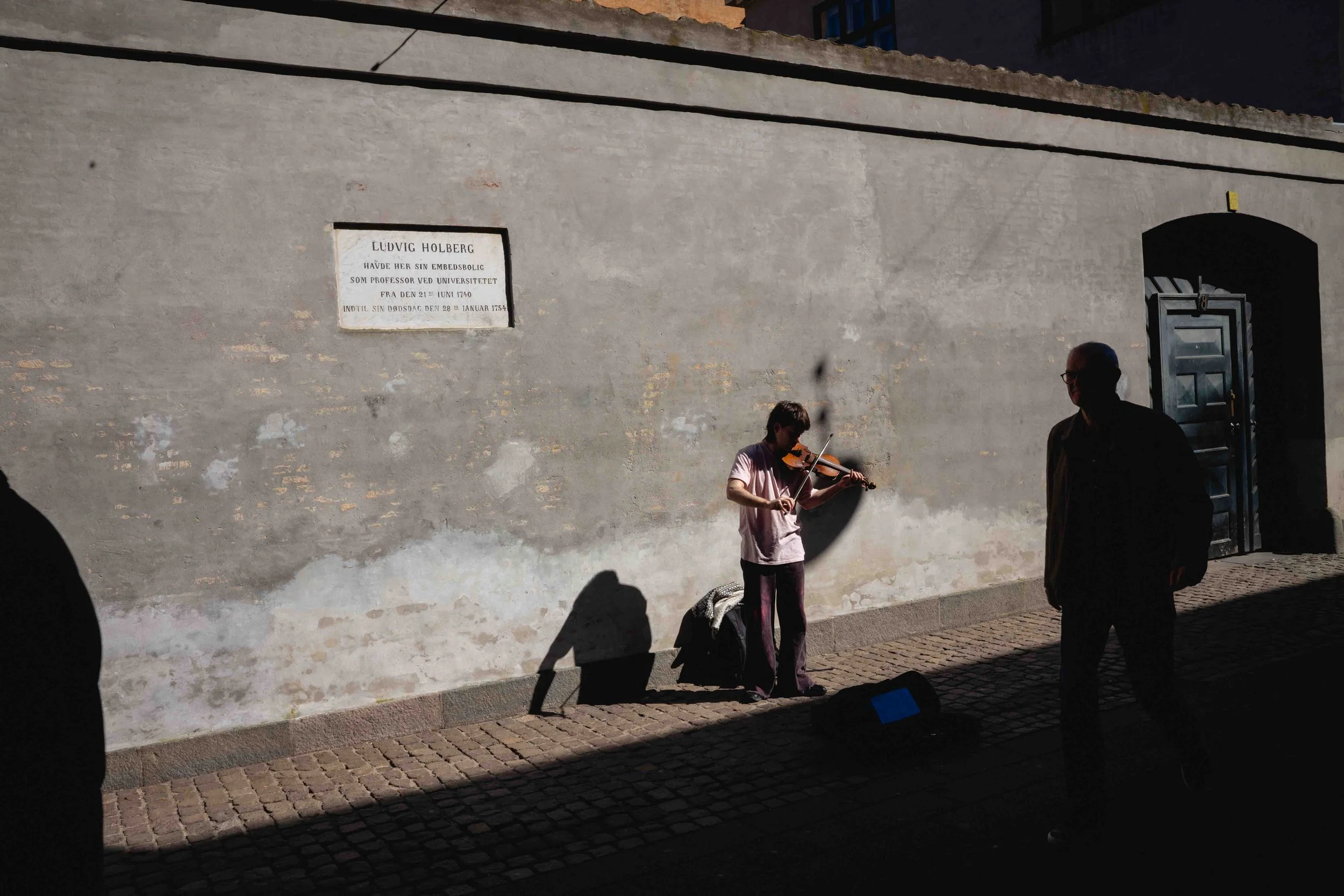
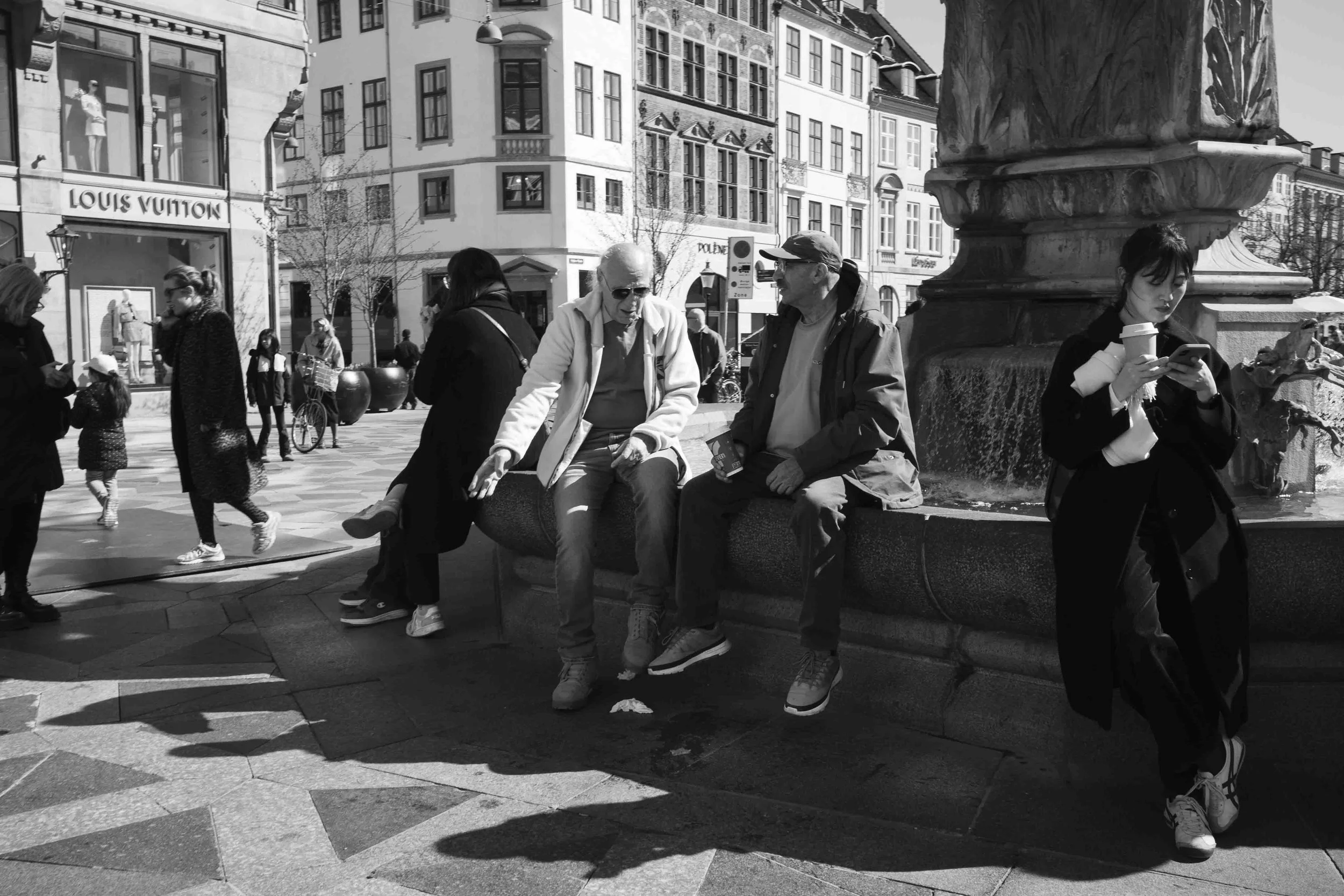
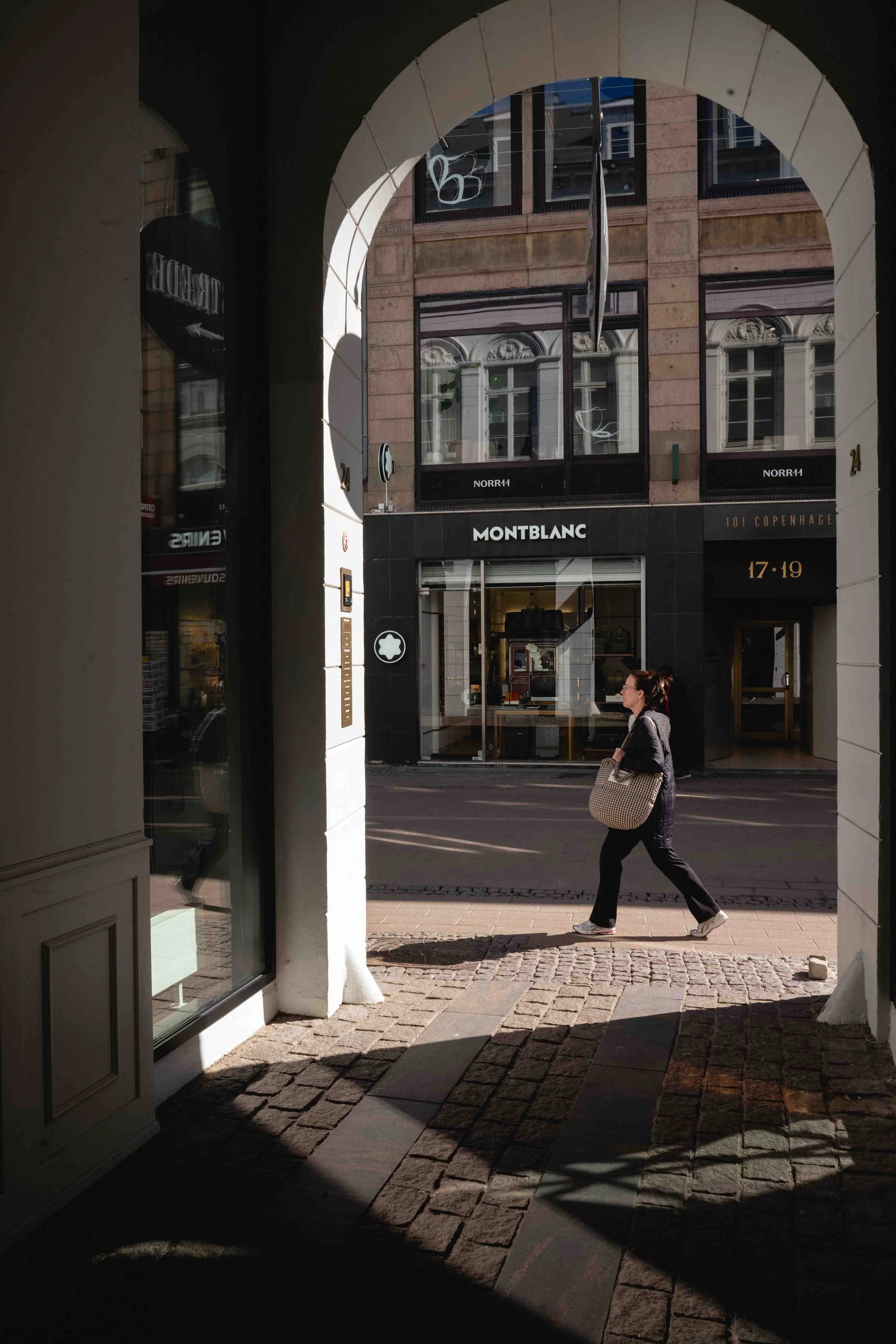
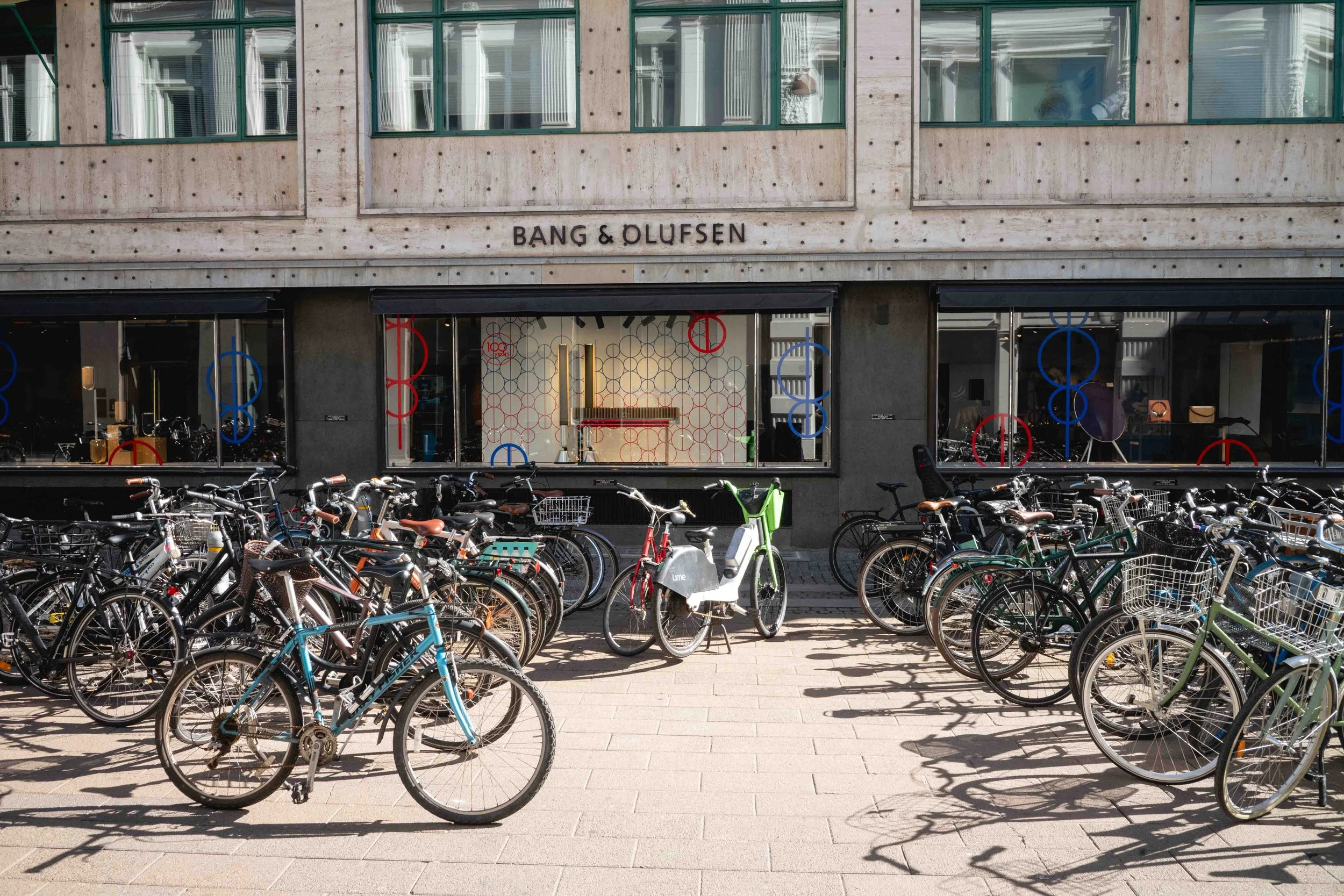
When it comes to navigating this photographer's playground, you generally have three options: walking, the seamless Metro, or joining the local masses with a bike hire. I elected mainly to walk, covering 22 miles of pavement on foot over two days. While biking is the Danish way, walking gives you the unique ability to see the "underbelly" of the city—the peeling posters in a Nørrebro side street or the way the light hits a specific doorway that you’d miss if you were whizzing past on two wheels. That said, accessibility is effortless here. I found the City Pass Small to be an excellent investment; it covers the Metro, buses, and harbor scouts perfectly, making the transit to and from the airport a total breeze.
My first day focused on the transition from Nørrebro’s graphic textures to the harbor's edge. I started at Grundtvig’s Kirke, a masterclass in symmetry. Its towering yellow brickwork is a rare example of Expressionist architecture, feeling more like a giant pipe organ than a traditional church. From there, I transitioned into the vibrant, striped chaos of Superkilen Park, where the white "zebra" asphalt lines are a playground for composition. I spent the afternoon weaving through the quiet, dappled light of Assistens Cemetery (the final resting place of Hans Christian Andersen) and the boutique-heavy streets of Elmegade and Ravnsborggade. After grabbing some incredible street food at Hanoi Alley, I hit TorvehallerneKBH for some candid shots of the local food scene. I ended the daylight hours by climbing The Round Tower for a rooftop sprawl, before catching the dusk glow at Nyhavn and crossing the Inderhavnsbroen toward the Danish Architecture Center.
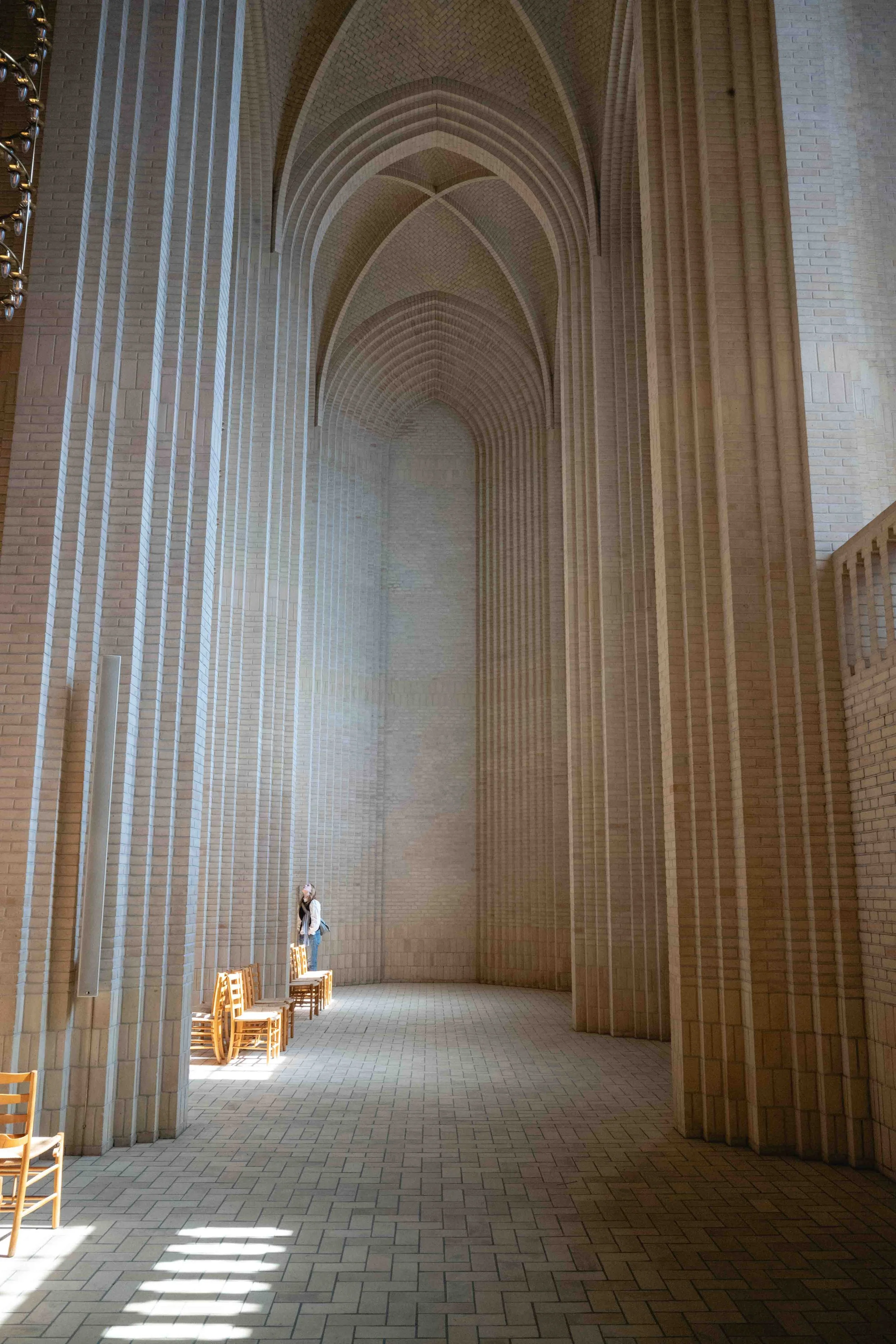
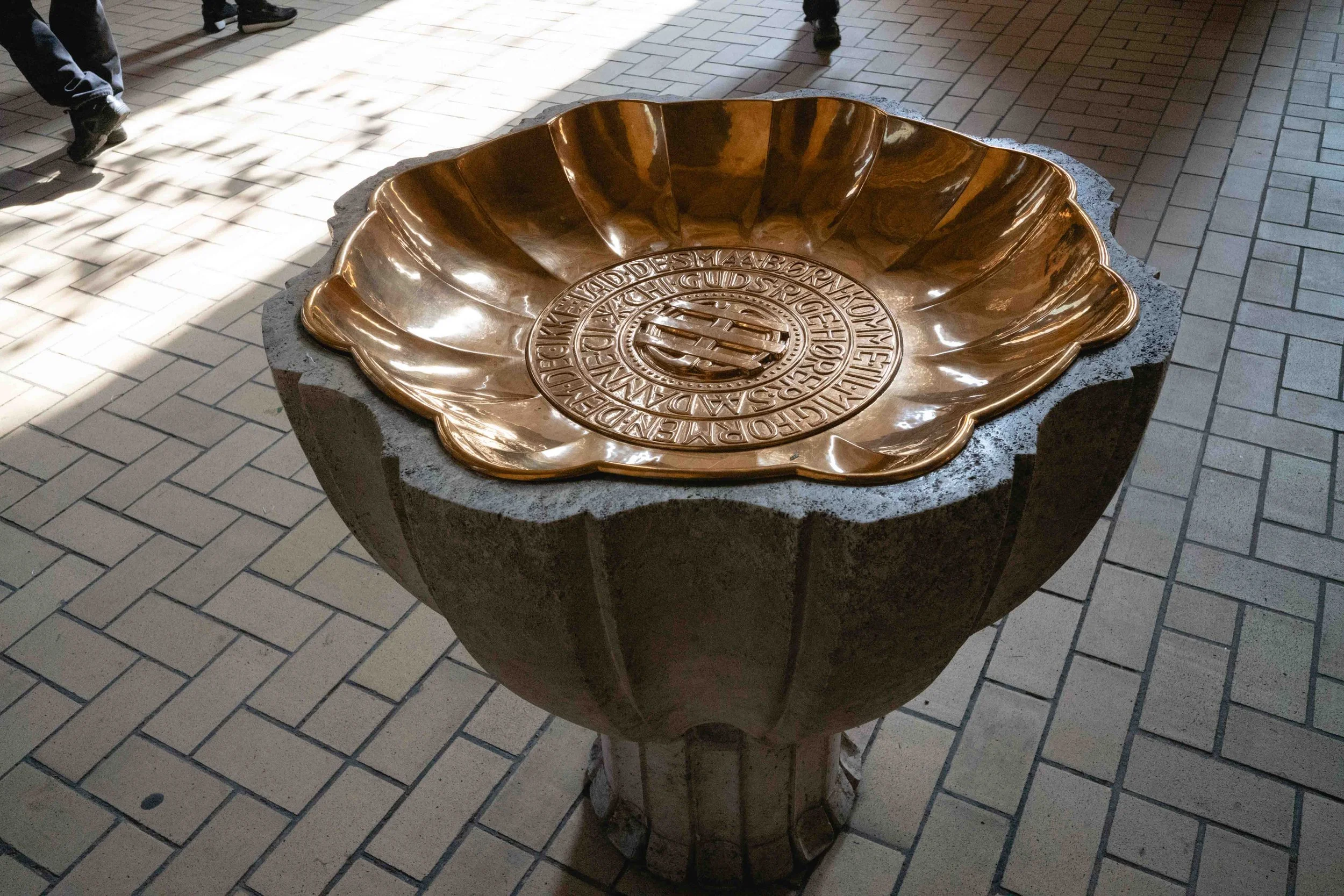
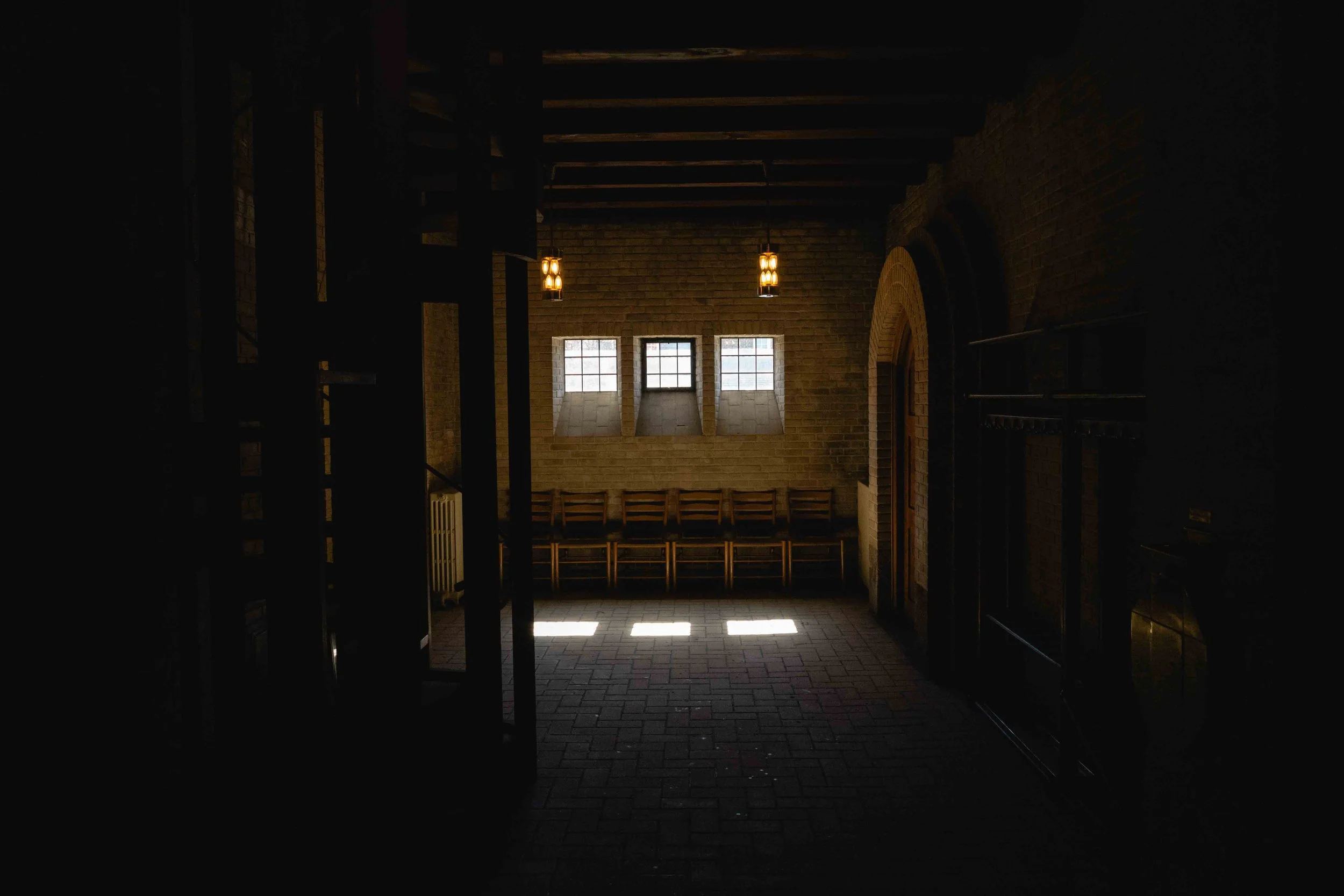
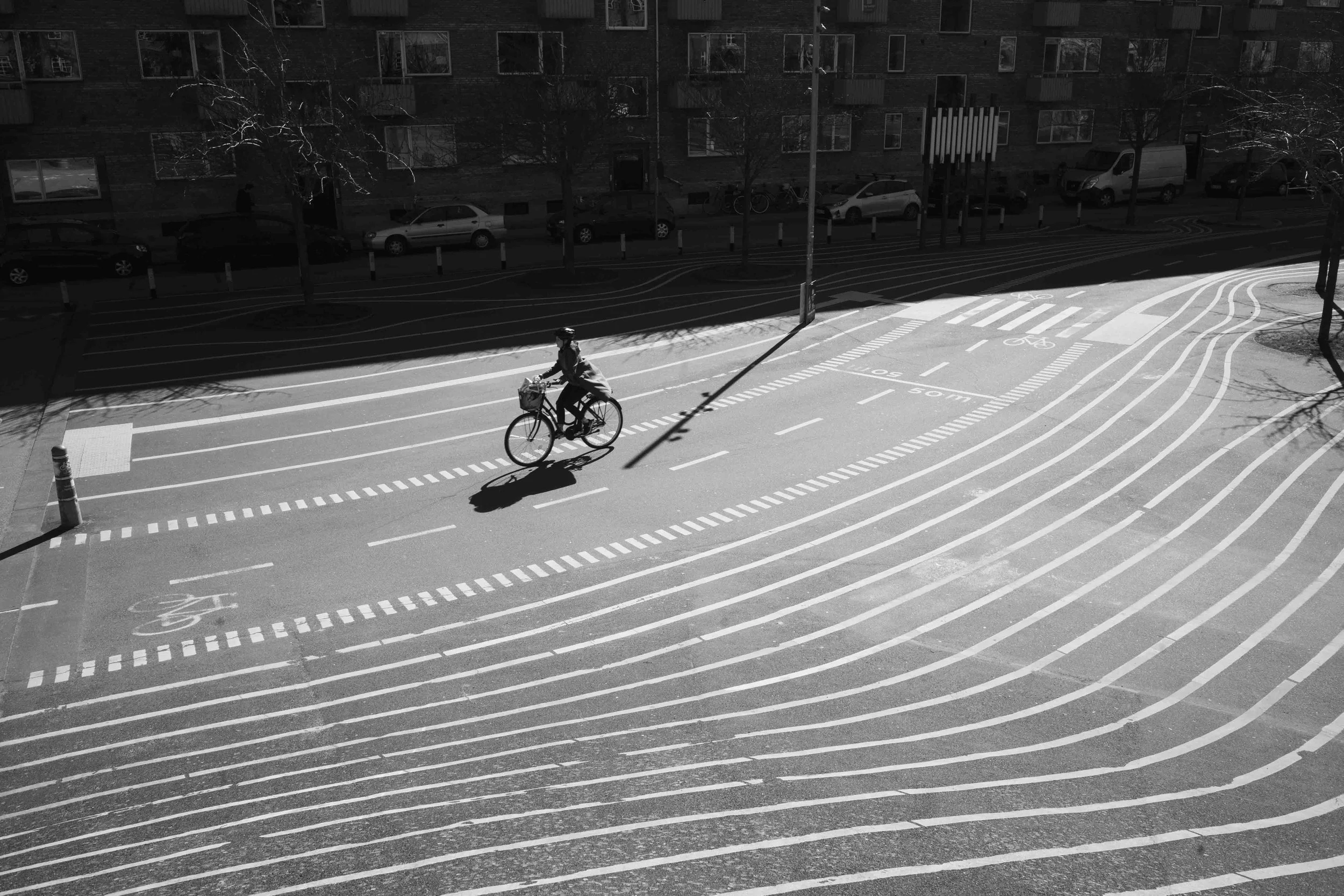
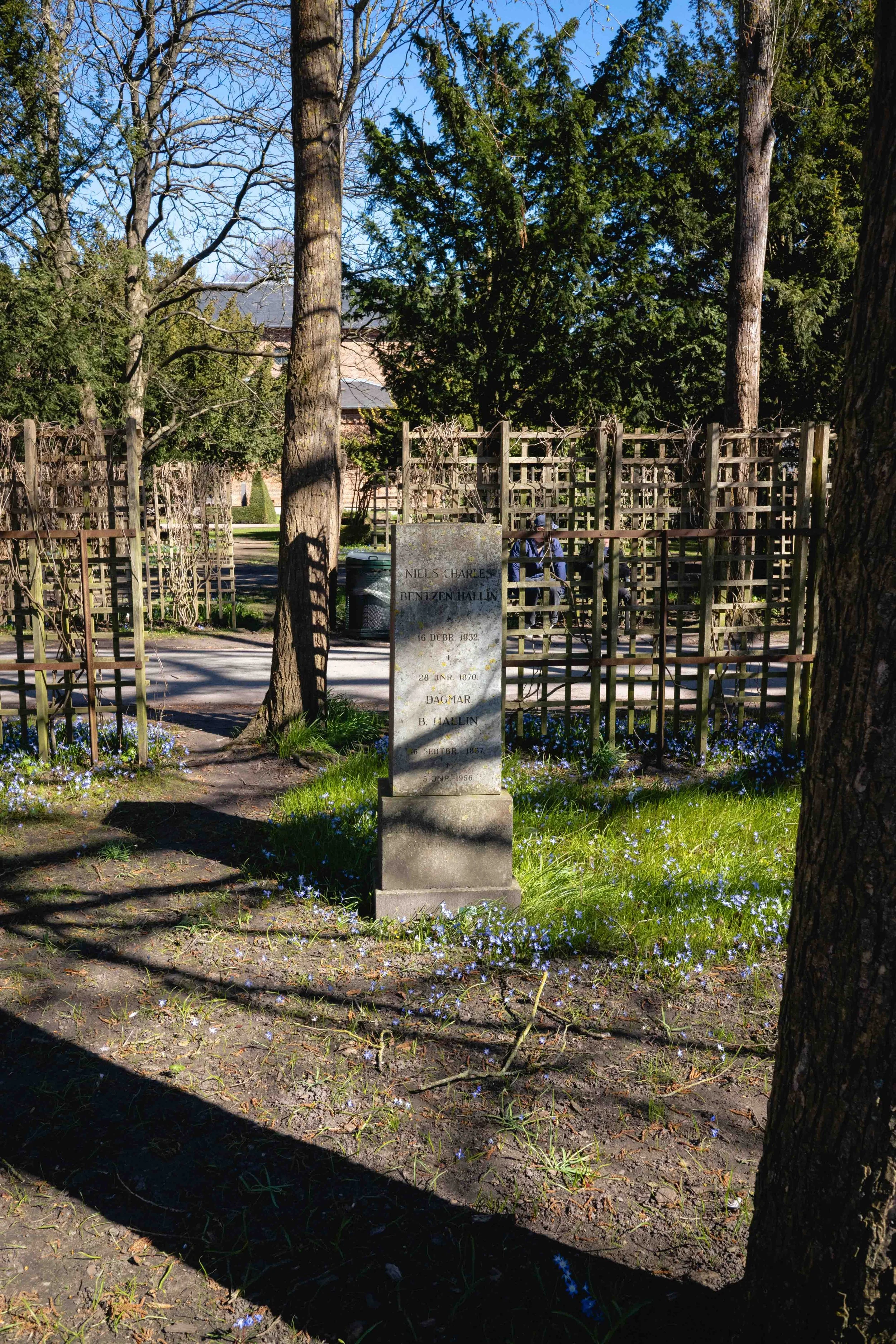
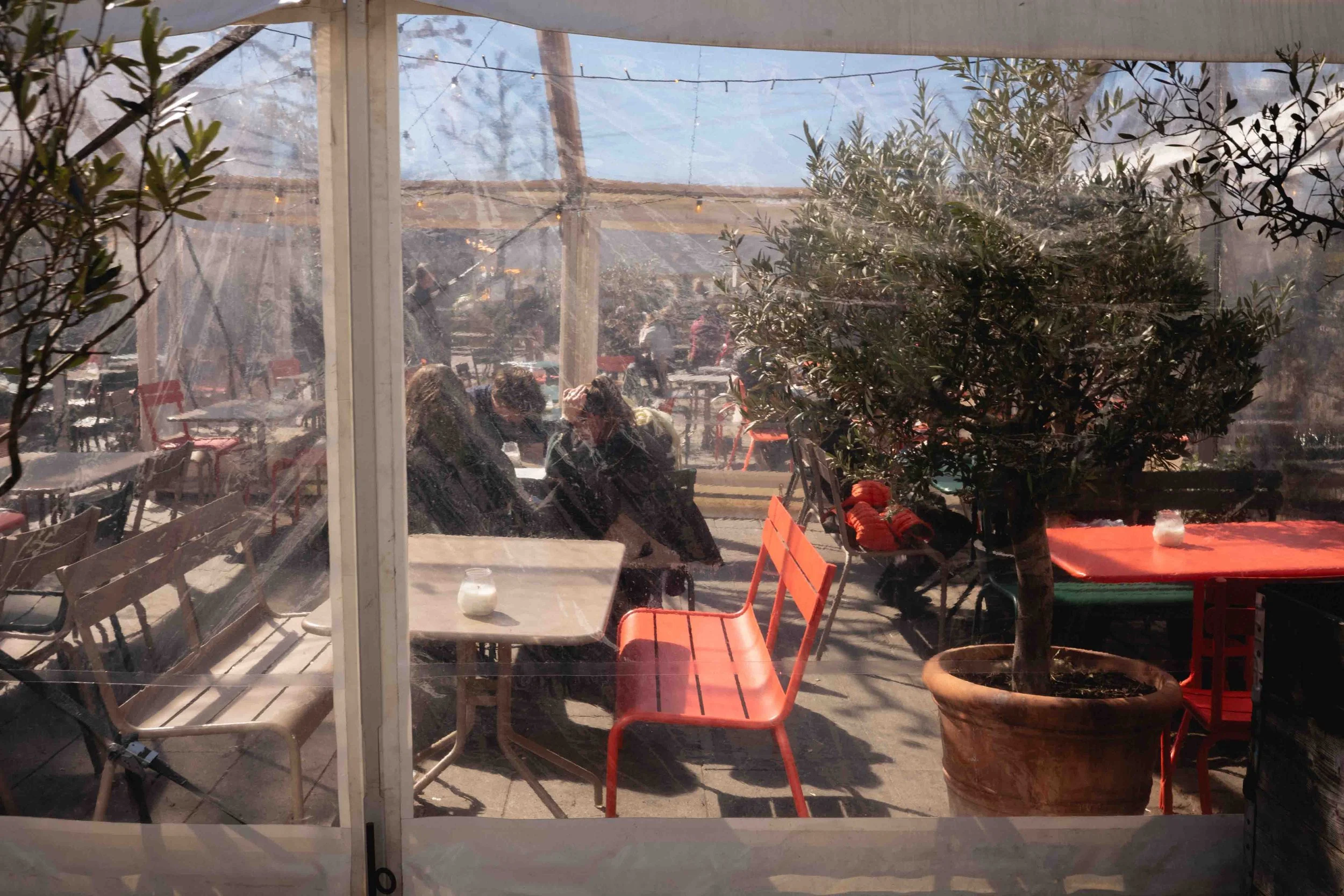
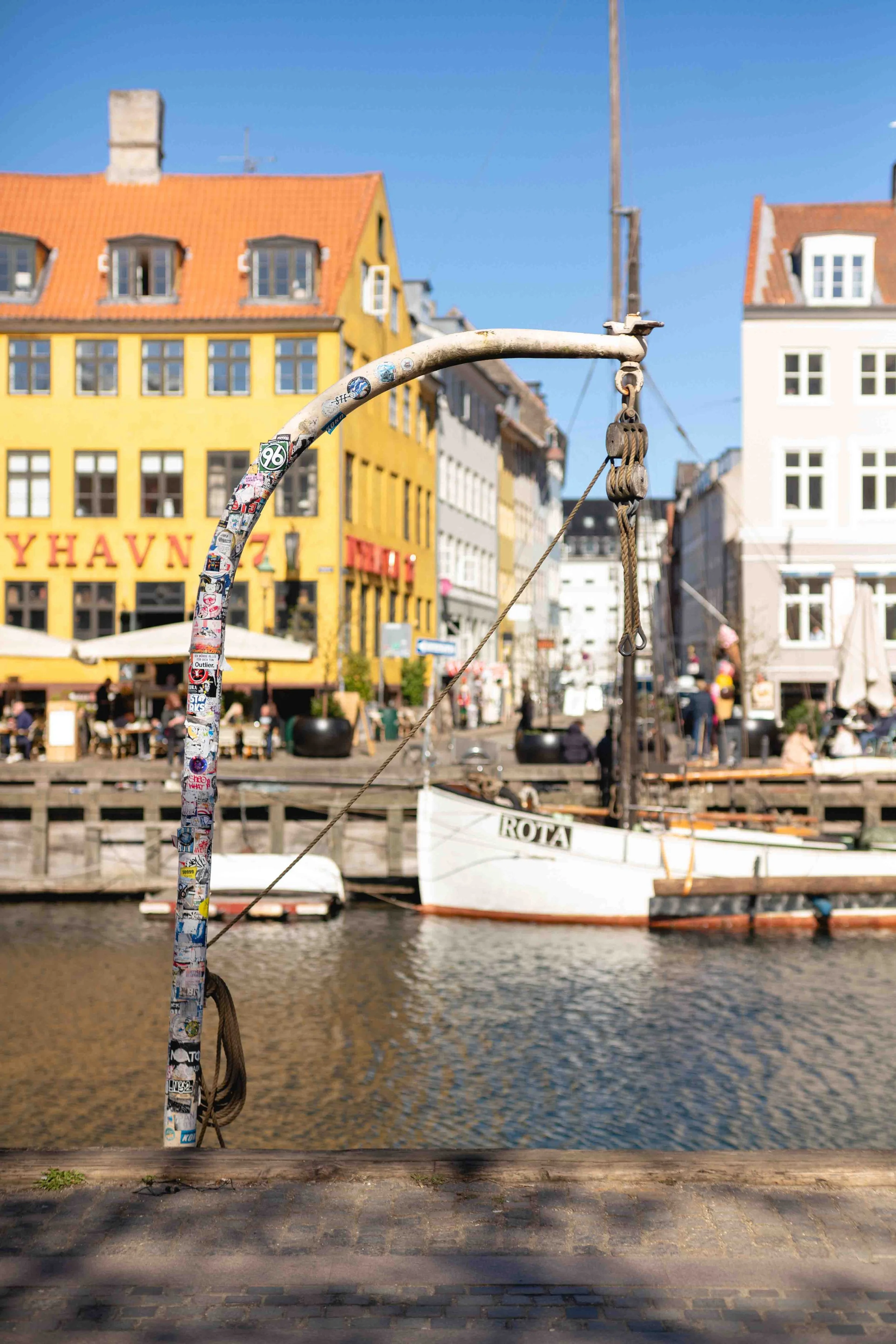
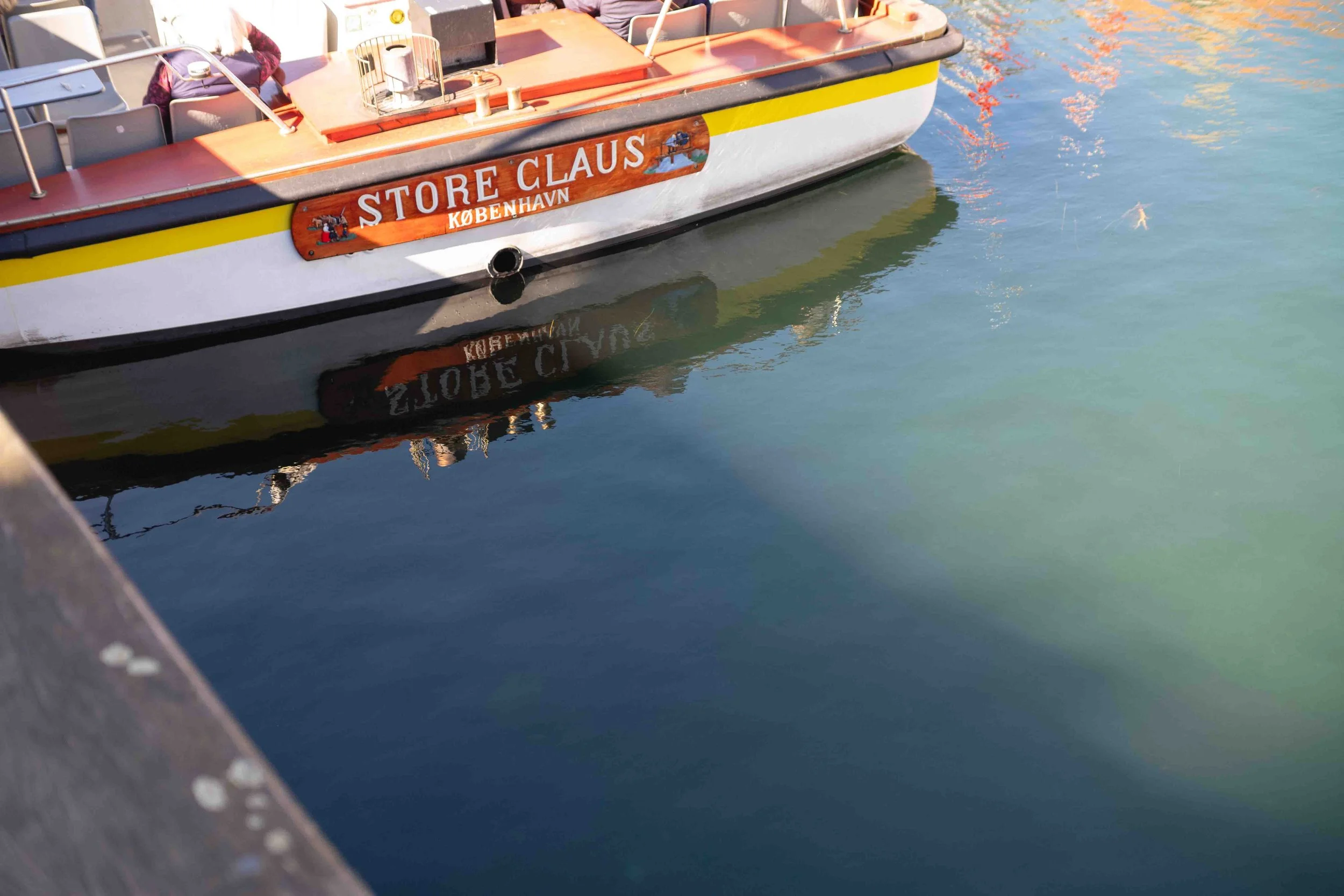
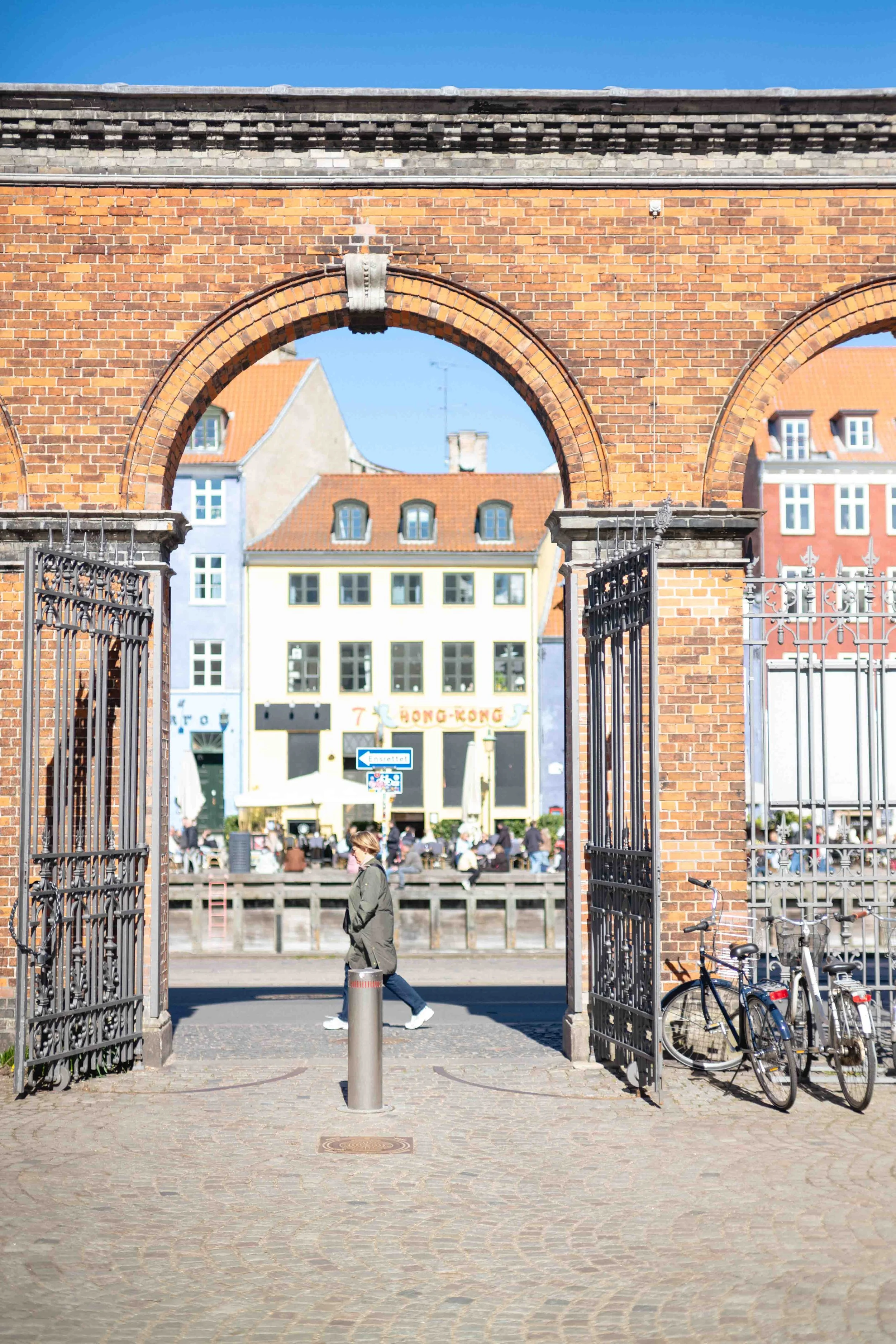
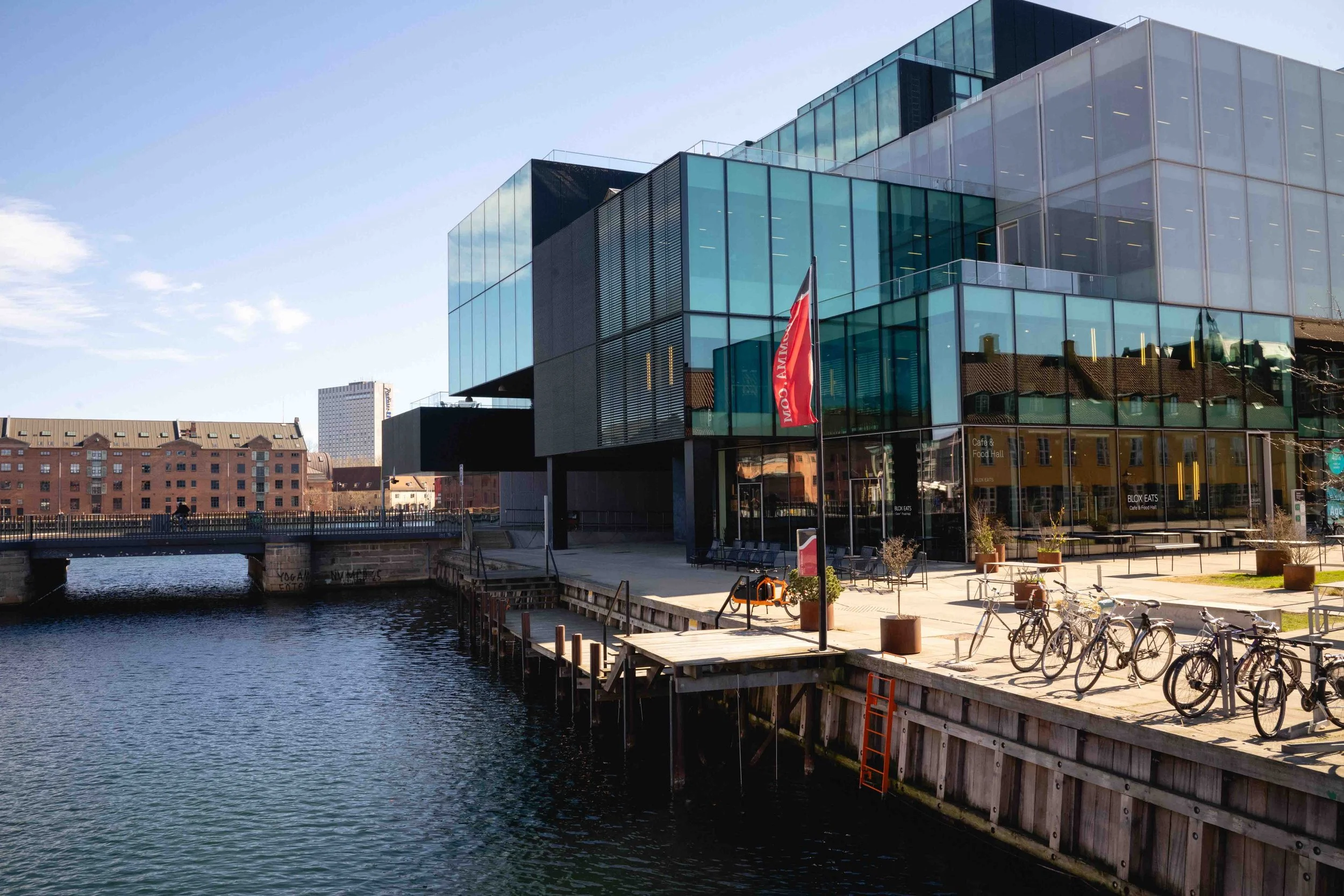
Day two was all about the evolution of the city. I kicked off in the Meatpacking District (Kødbyen), where the white industrial buildings and teal window frames offer a stark, minimalist aesthetic. The route then became a "greatest hits" of modern geometry: the jagged, brutalist balconies of the Kaktus Towers, the iconic orange-bottomed Cykelslangen (The Bicycle Snake) path. I rounded out the trip back in Christianshavn, climbing the corkscrew spire of the Church of Our Saviour for a 360-degree view, followed by a walk through the raw, DIY textures of Freetown Christiania, and finally the historic, rhythmic lines of the Nyboder district.
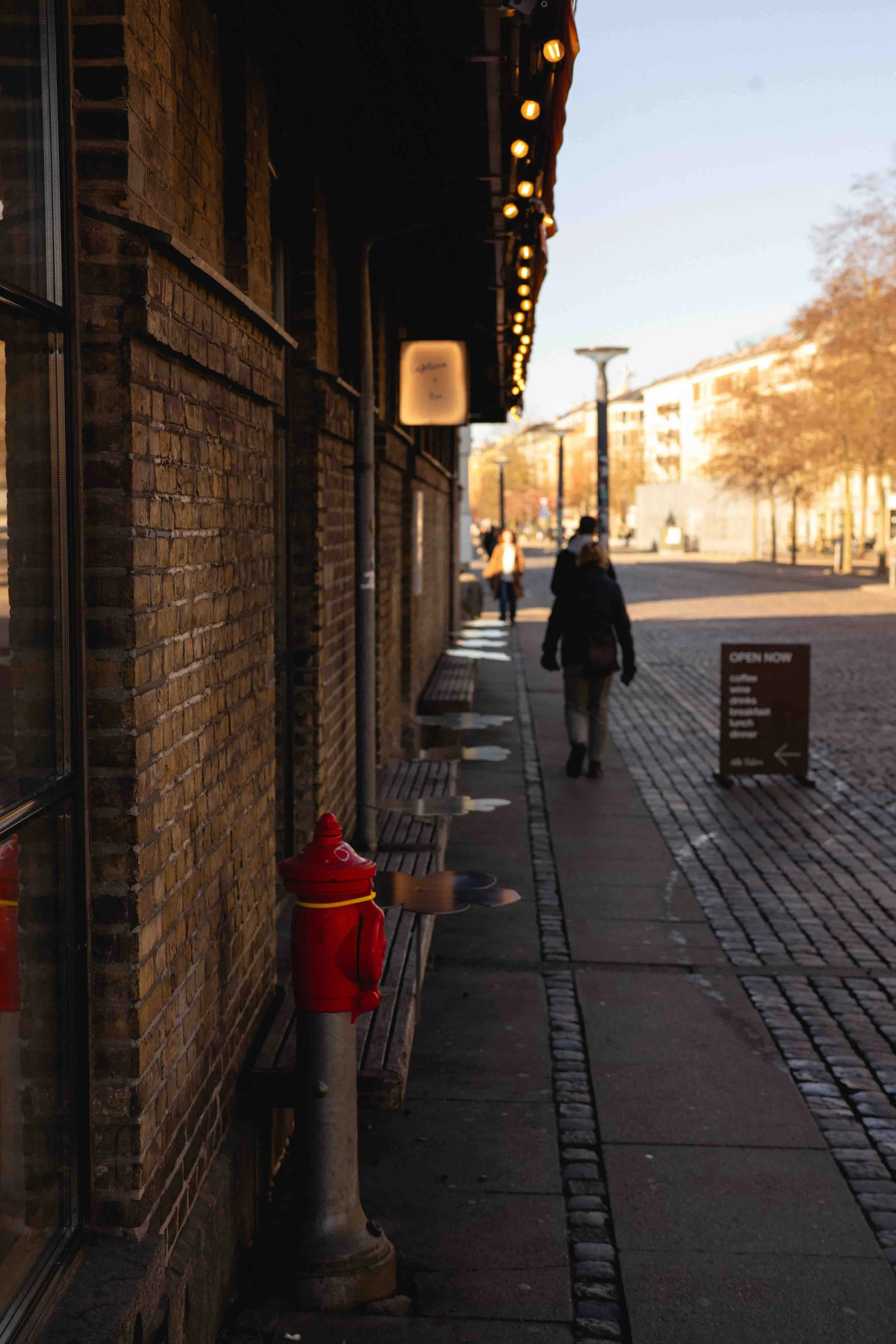
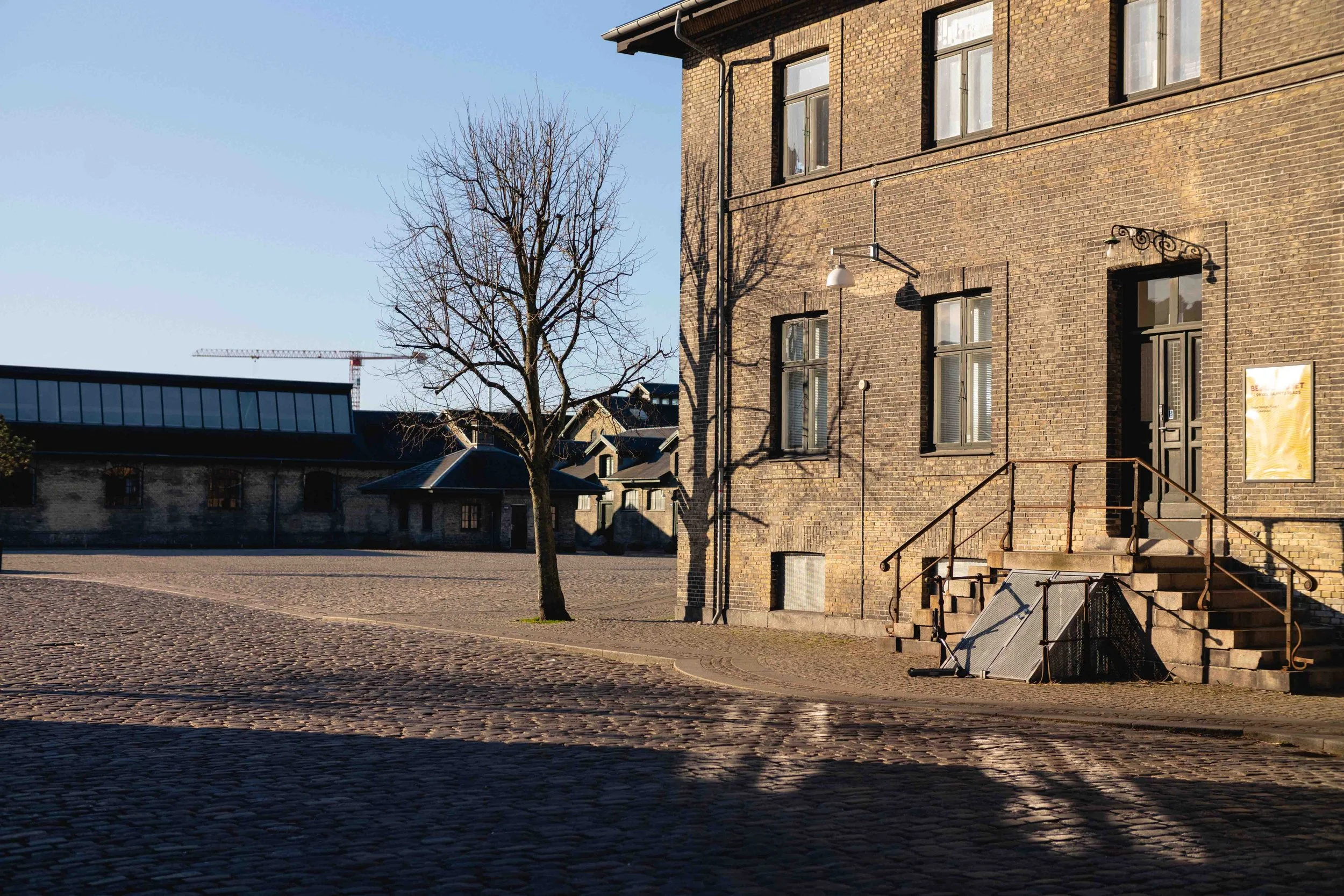
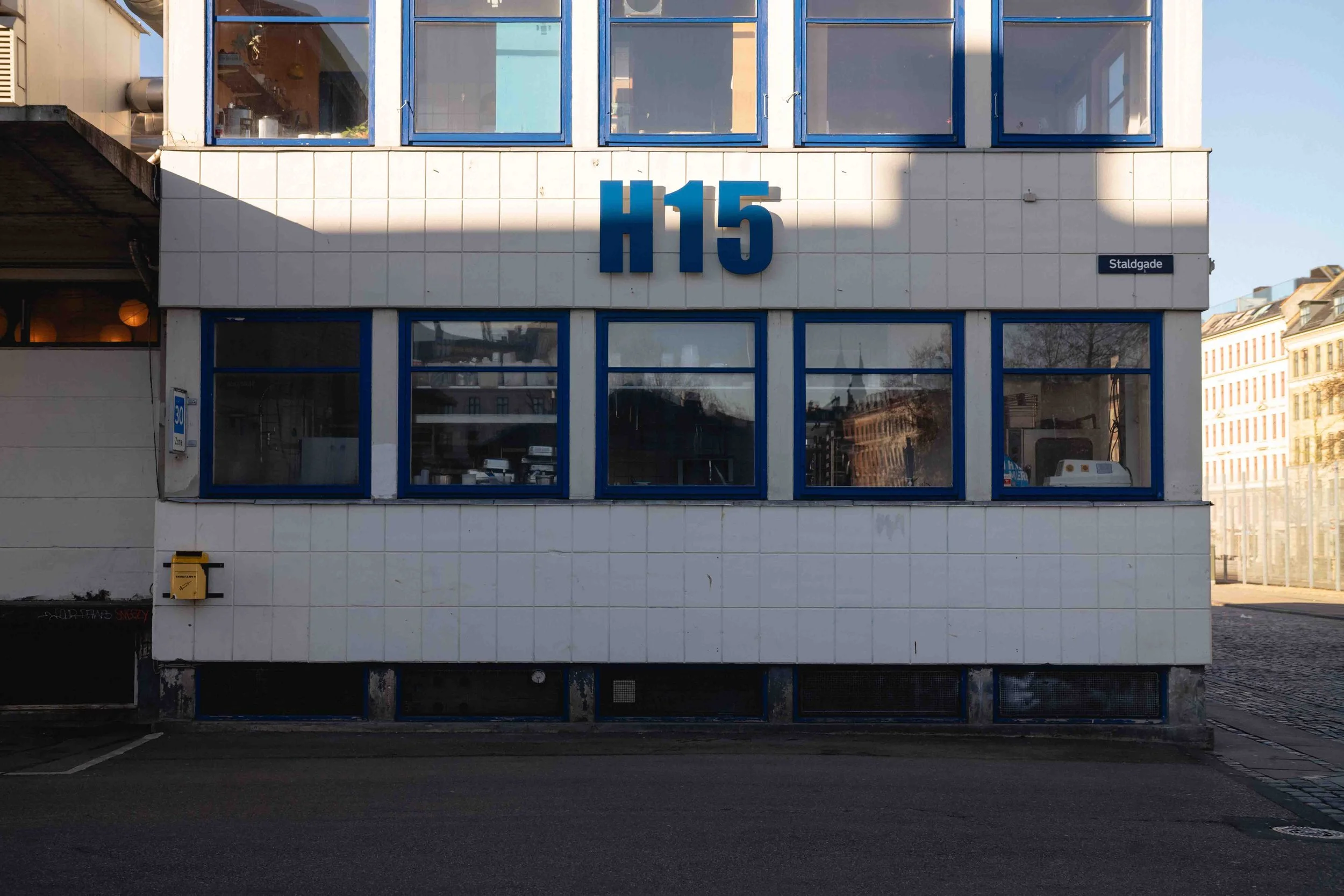
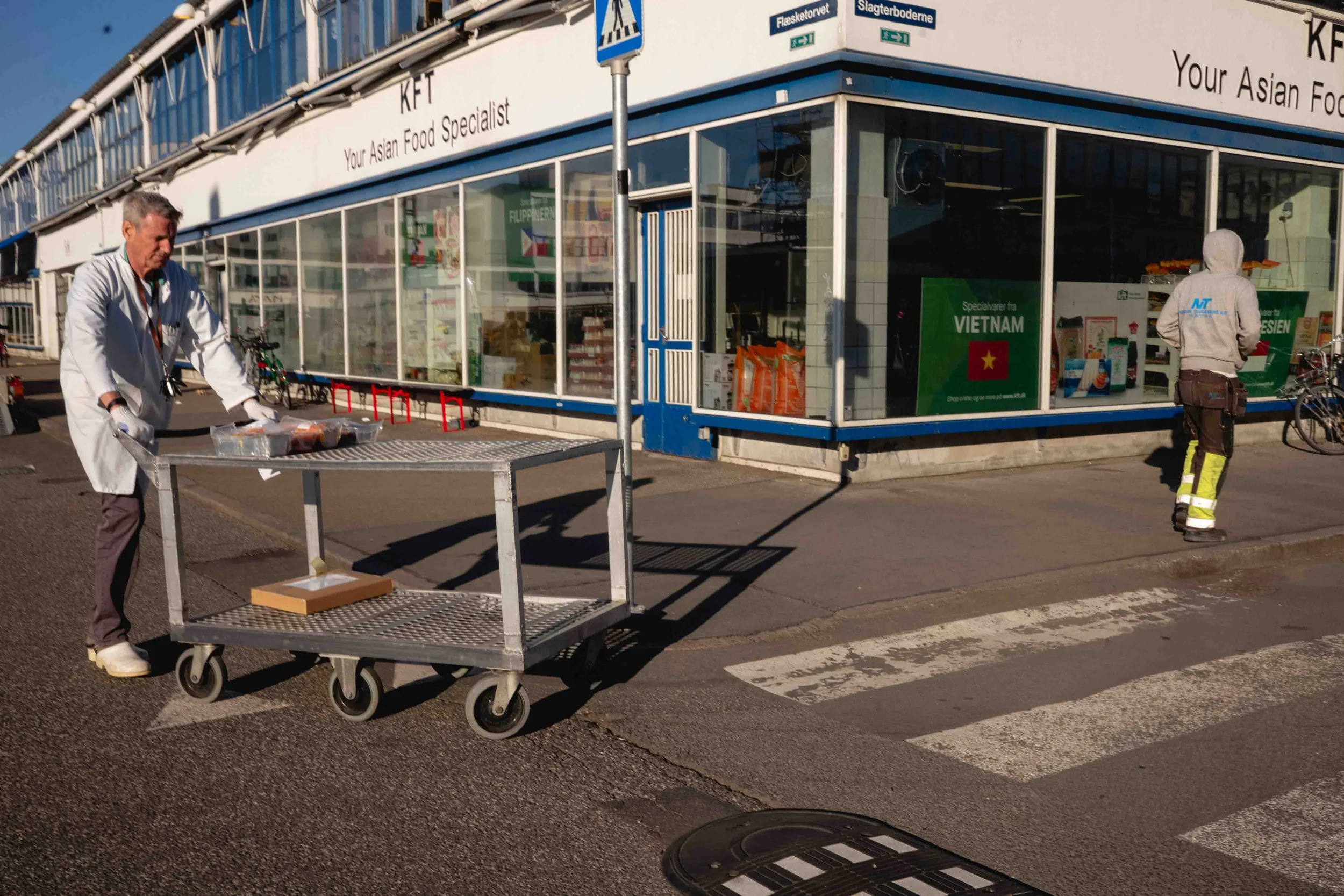
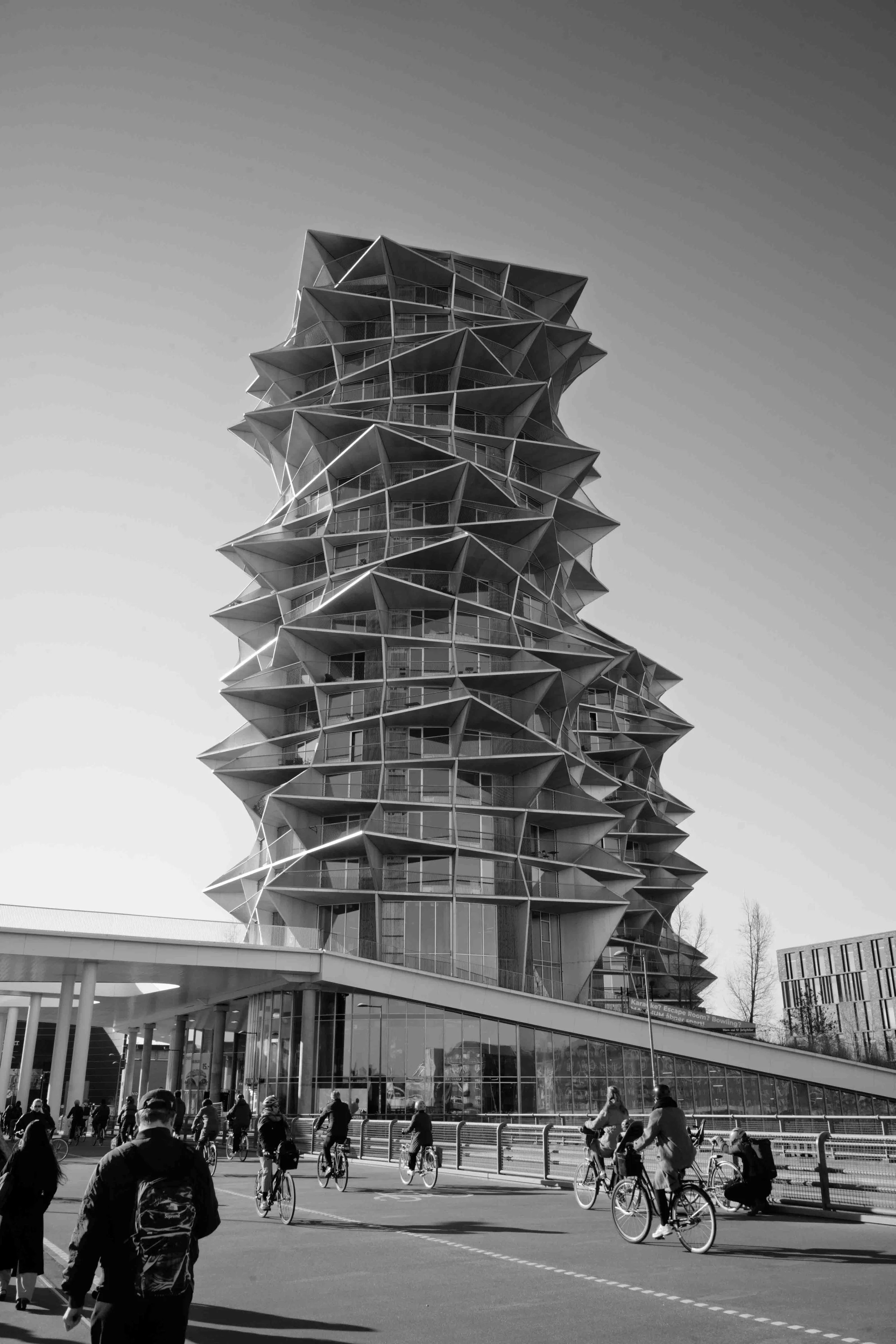
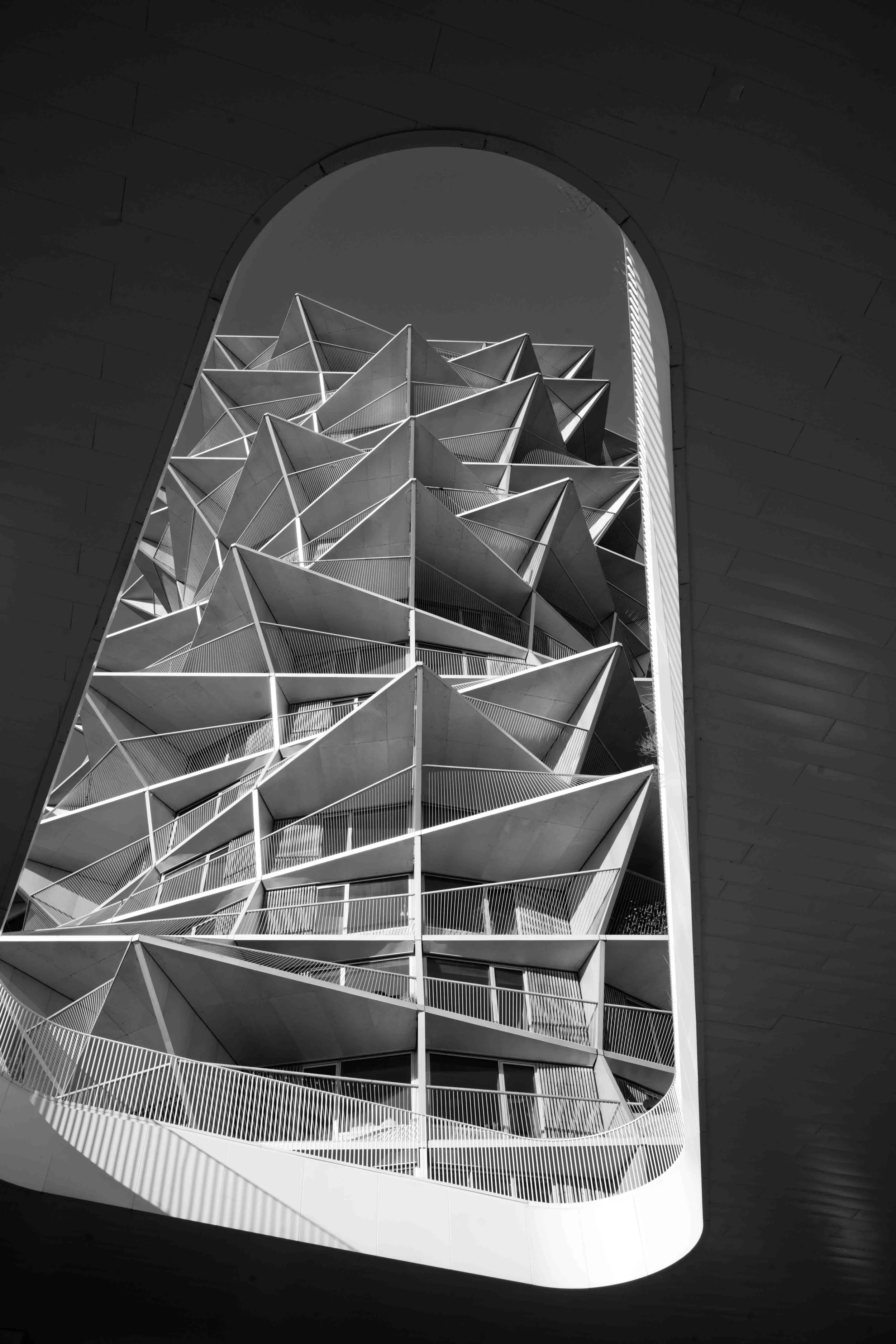
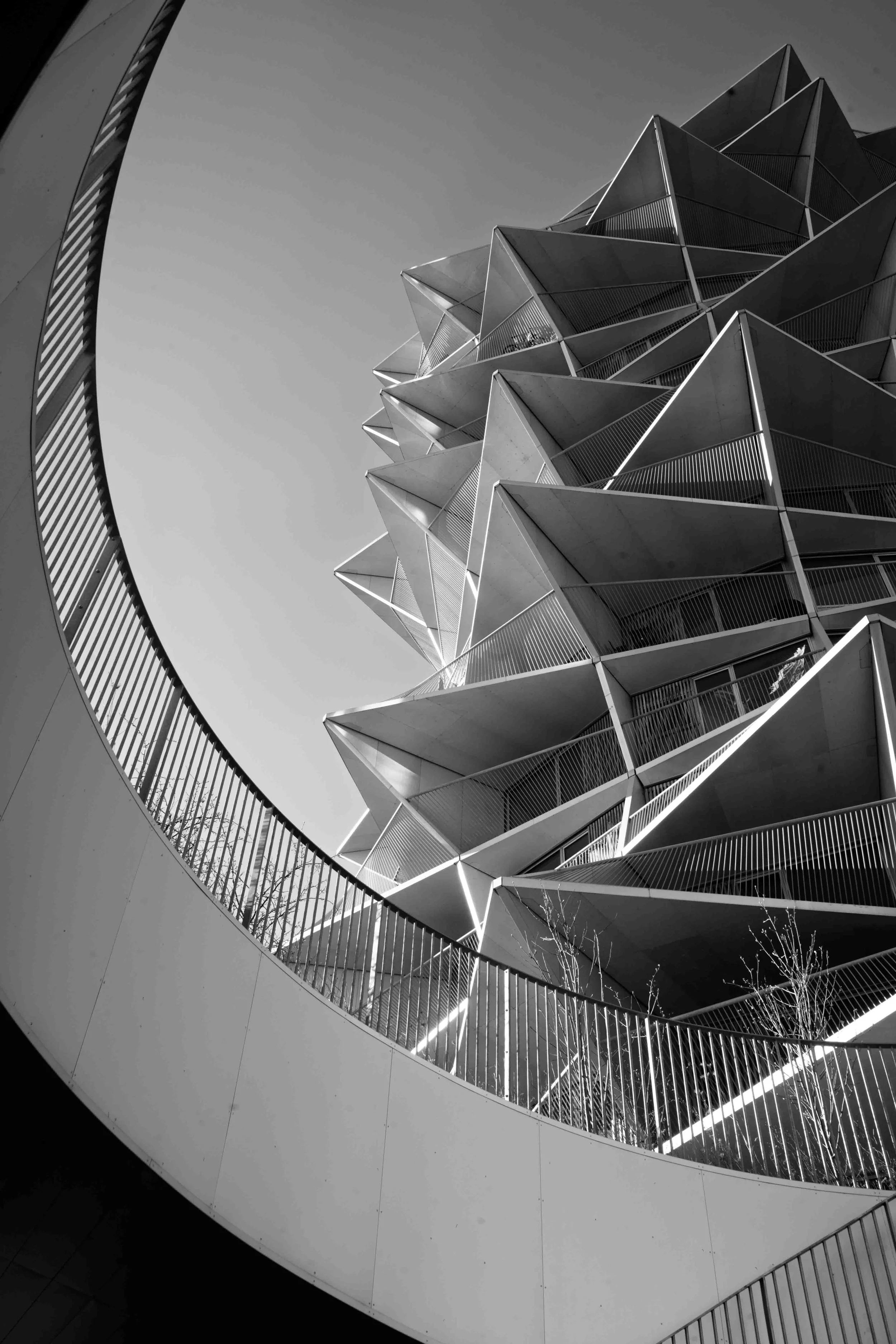
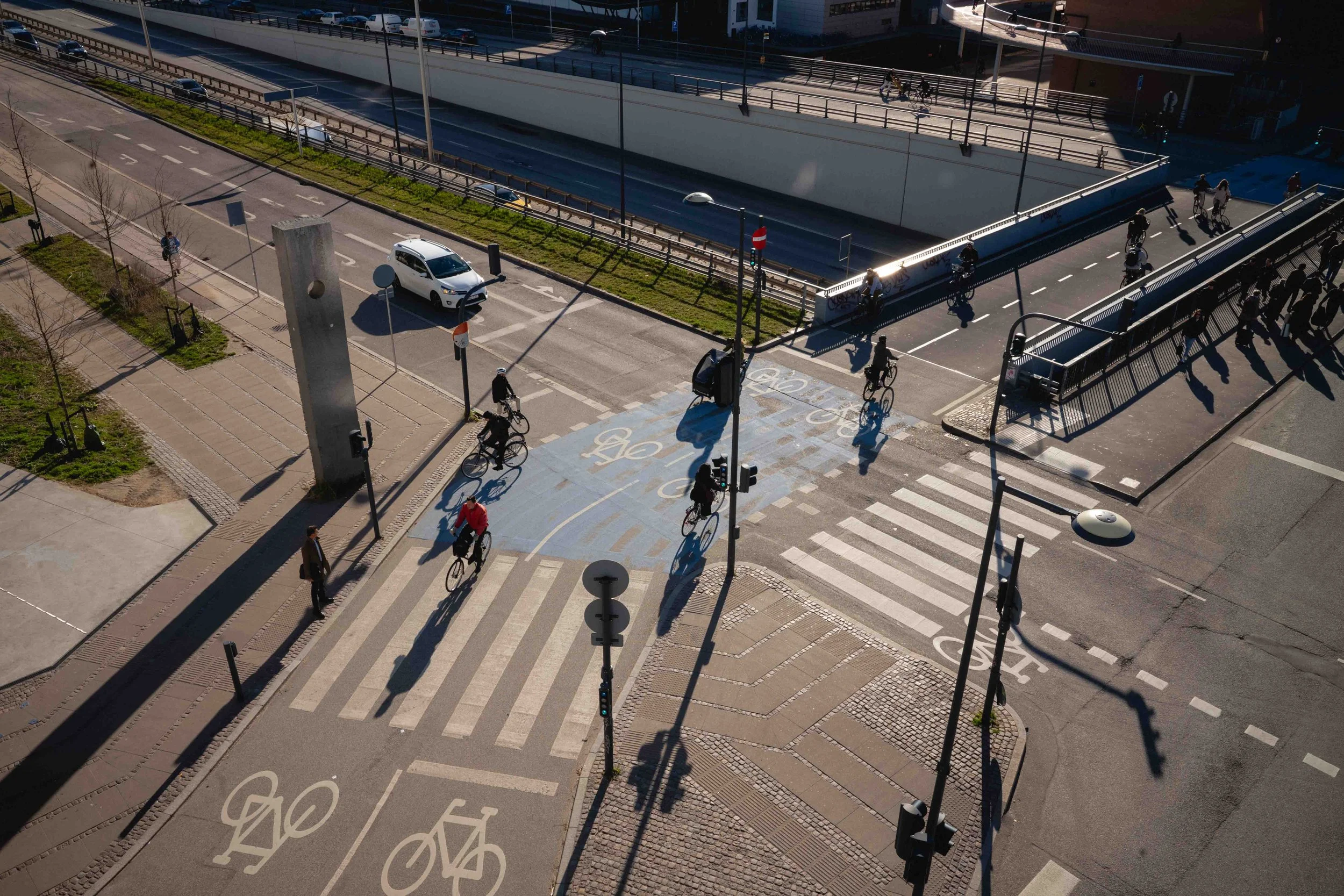
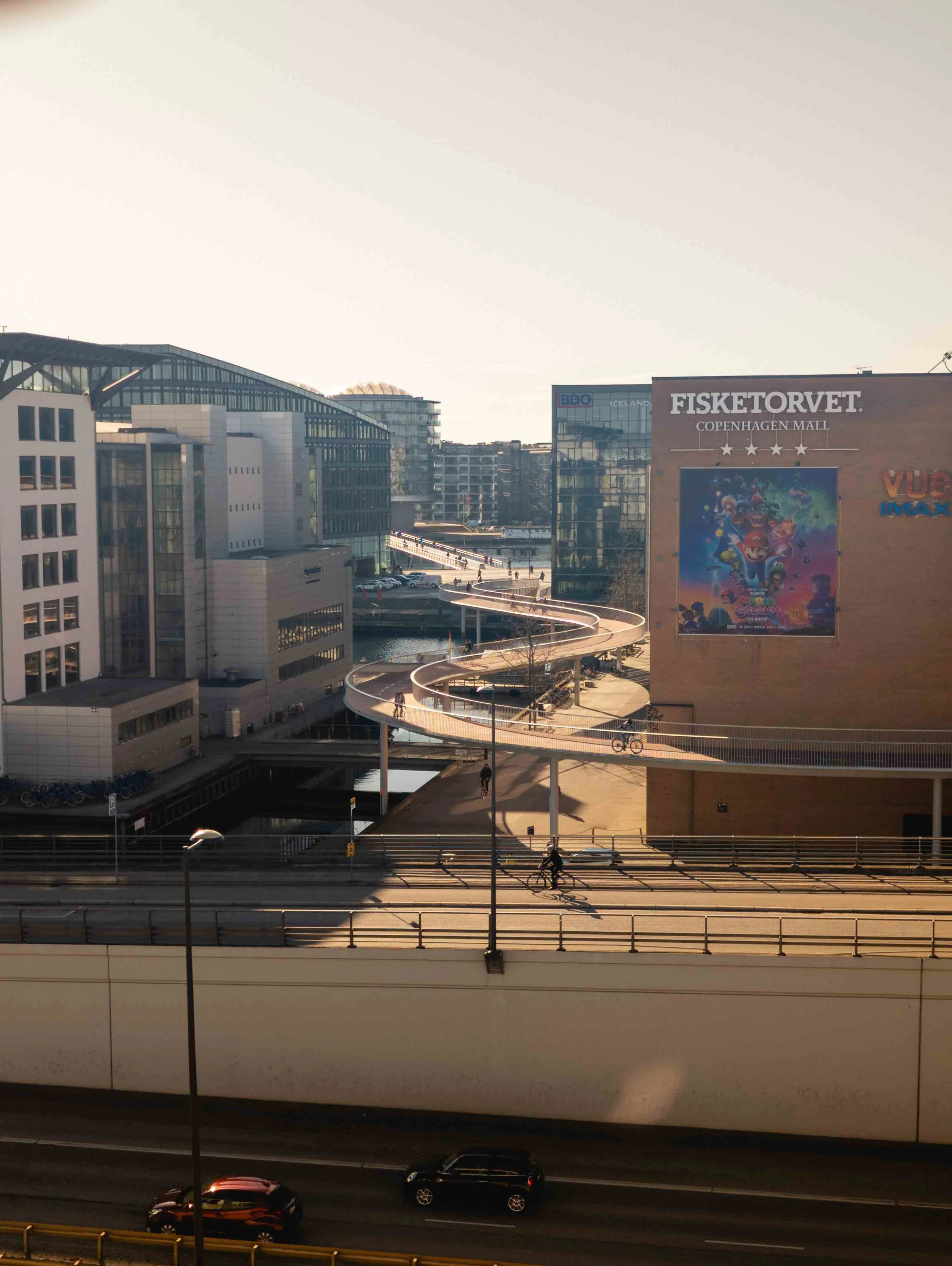
Before I went, everyone warned me about the cost. "Bring a second mortgage for a coffee," they said.
Honestly? It’s a myth. While you can spend a fortune in Michelin-starred spots, I found that if you eat like a local—hitting up spots like Hanoi Alley or grabbing a smørrebrød from a local deli—it’s no more expensive than a weekend in London or New York. In fact, because the city is so walkable and the public transport is flawless, I spent far less on "getting around" than I do on my daily three-hour commute back home. Copenhagen doesn't just ask to be photographed; it demands it. It’s a city that values the "small things"—and as photographers, that’s exactly what we’re looking for.
Want to see the full high-res set? Check out my latest prints in the shop or follow the journey on Instagram @frommylensphoto.
Until next time, keep snapping.

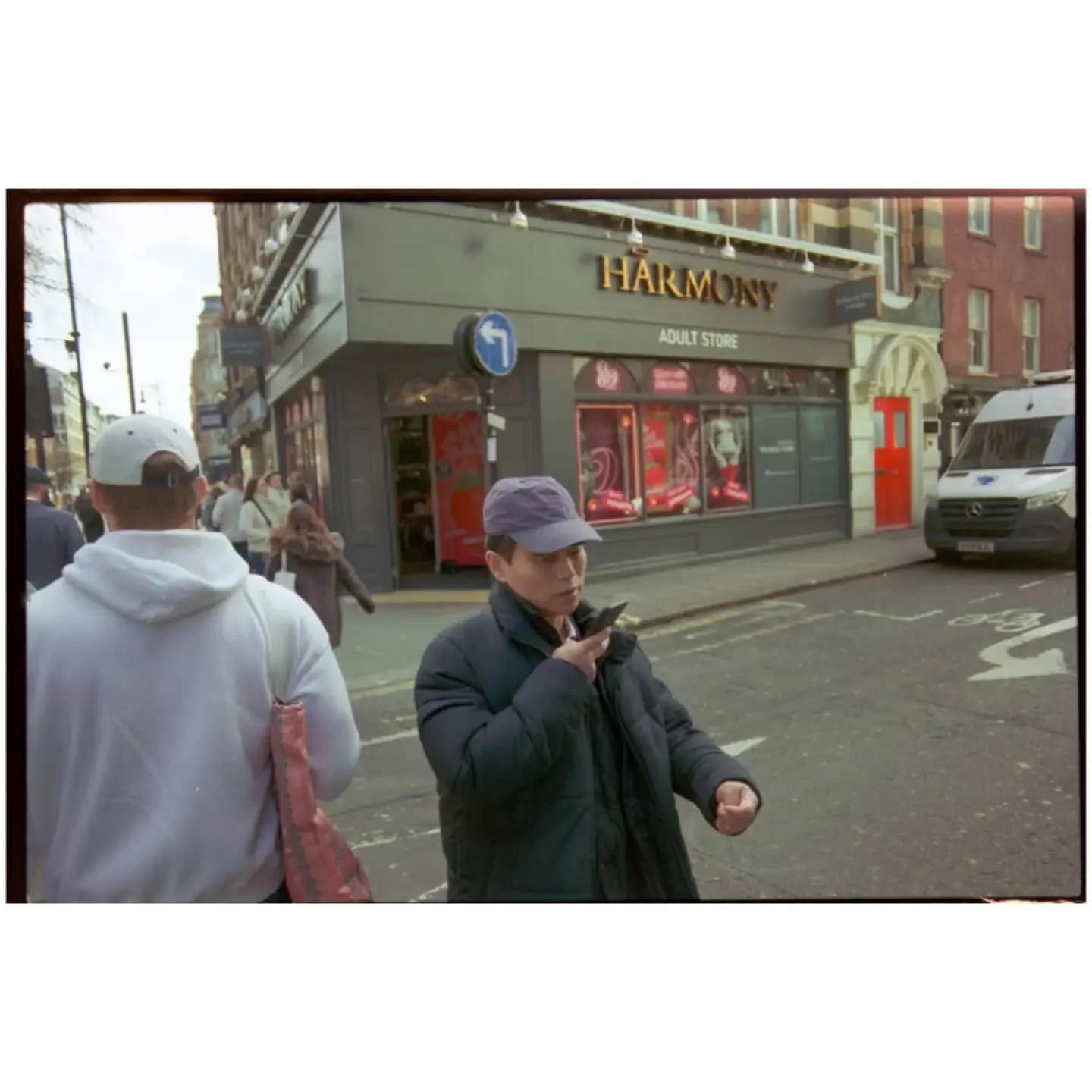
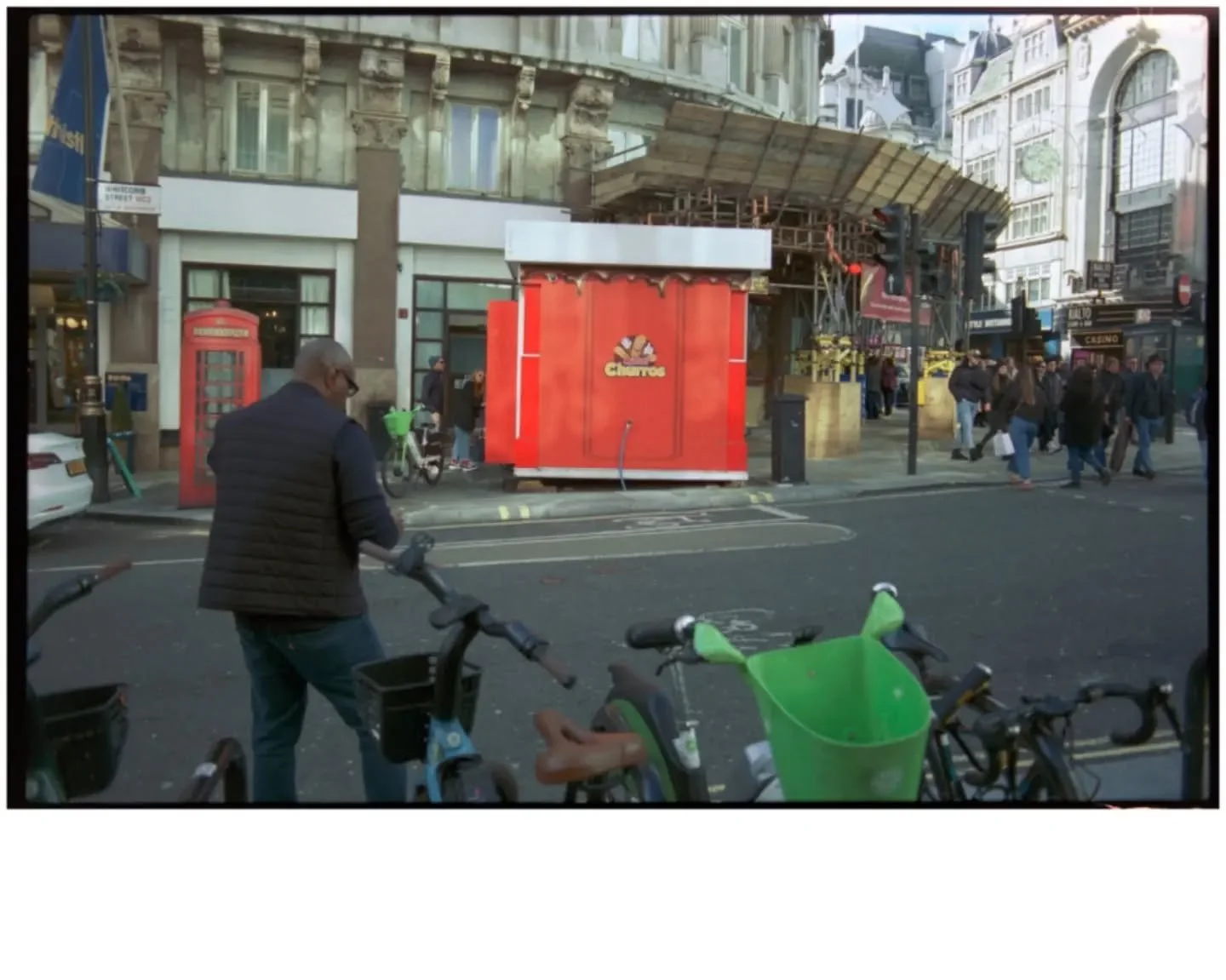
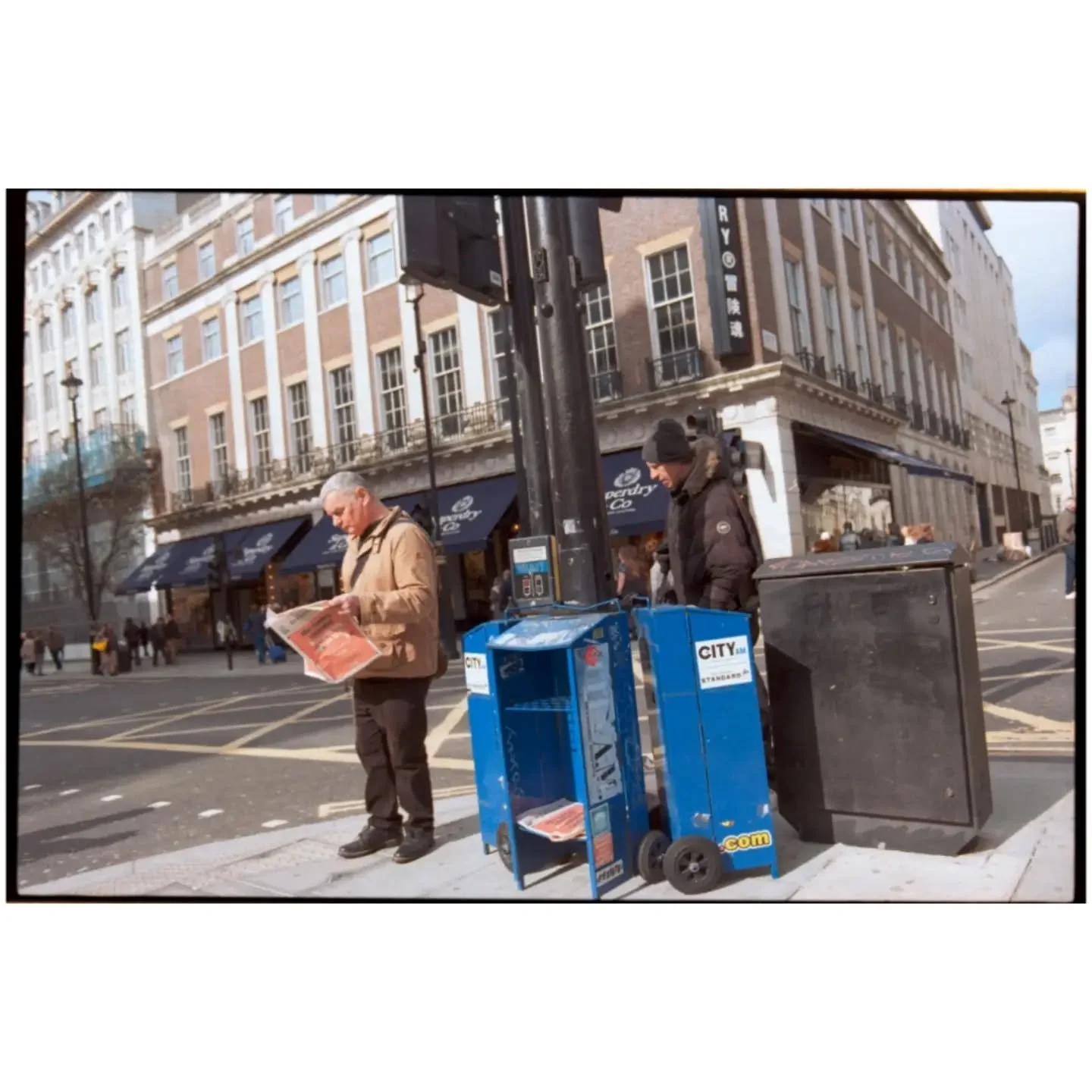
First Roll Loading Kodak Vision3 250D — and what Soho handed back
I've been shooting predominantly black and white for a period of time now of the 35mm film cameras. Years, really. Colour always felt like it needed a reason — a justification for the extra visual information it brings to a frame. Black and white strips a scene back to its essentials. Tone, texture, shadow, geometry. It's a clean way to work.
So loading up a roll of Kodak Vision3 250D AHU into the Nikon F80 felt like a deliberate step off familiar ground. This is a motion picture film stock — designed originally for cinema use in daylight conditions — and it's been building a serious following among still photographers. I'd read about it, seen other people's results, and kept putting it off. This time I just loaded it and went out.
I've been shooting predominantly black and white for a period of time now of the 35mm film cameras. Years, really. Colour always felt like it needed a reason — a justification for the extra visual information it brings to a frame. Black and white strips a scene back to its essentials. Tone, texture, shadow, geometry. It's a clean way to work.
So loading up a roll of Kodak Vision3 250D AHU into the Nikon F80 felt like a deliberate step off familiar ground. This is a motion picture film stock — designed originally for cinema use in daylight conditions — and it's been building a serious following among still photographers. I'd read about it, seen other people's results, and kept putting it off. This time I just loaded it and went out.
I headed into London a couple of weeks ago for an afternoon with no real plan beyond Soho and the West End. That's usually how the best days go. No agenda. Just walking, looking, reacting.
"I wasn't prepared for quite how warm it would be. Not warm in the pushed, processed way you can fake digitally — warm in the way afternoon light in London actually looks."
The film
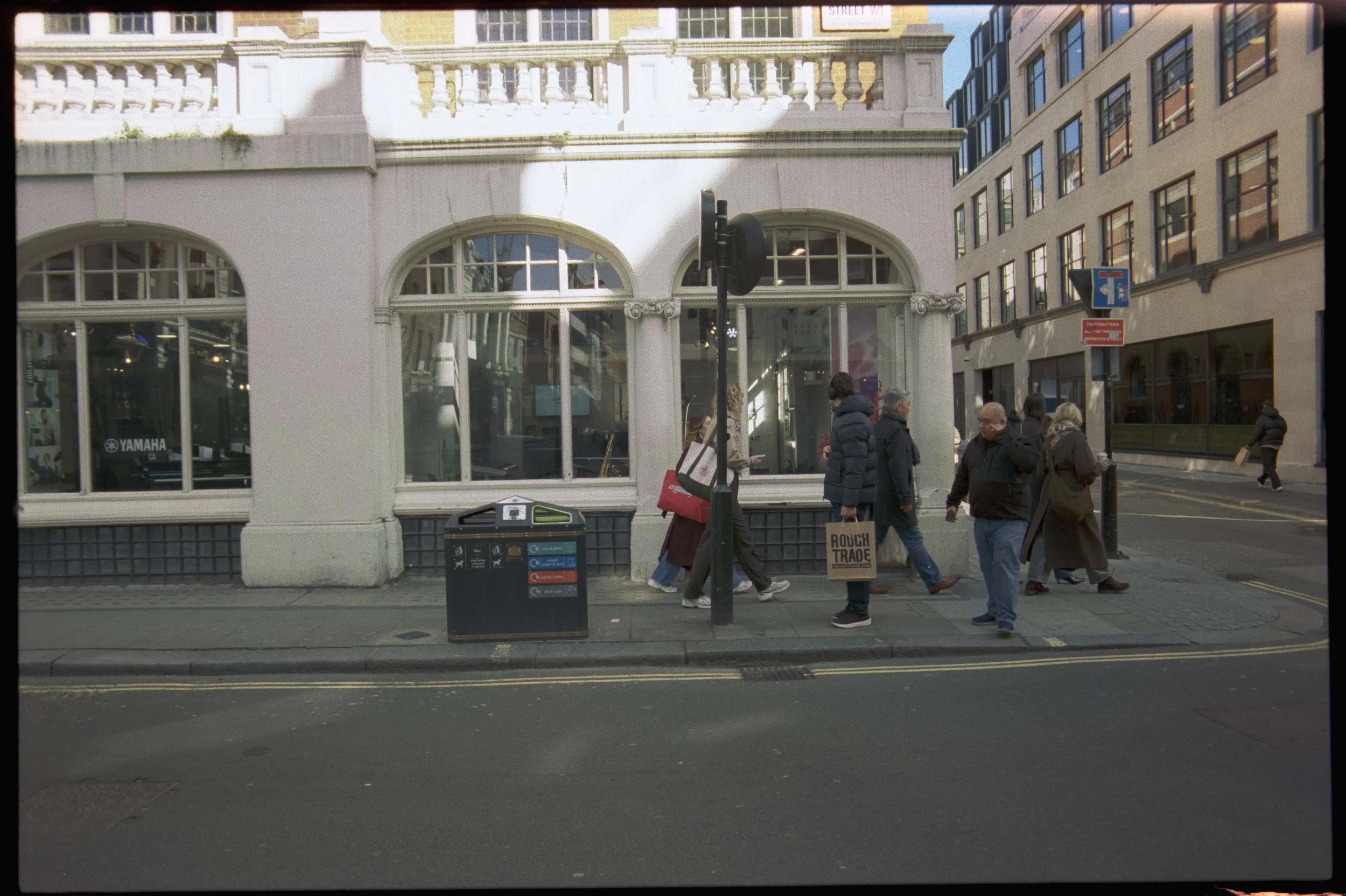
The warmth hit me the moment I got the processed film back. Vision3 250D AHU has a quality to its colour rendition that's difficult to articulate but immediately visible in the frames. It's not the oversaturated, high-contrast look of some colour negative stocks. It's quieter than that. More honest. The way light falls on a green café awning, or a pink coat, or an orange shopfront — it's rendered with a cinematic restraint that suits documentary street work perfectly.
The midtones are where it really earns its reputation. There's a richness in the middle of the tonal range that I haven't found in other stocks I've tried. Skin tones are warm without being ruddy. Shadows hold detail. Highlights — even in the direct afternoon sun I was shooting in — don't blow out catastrophically. For a daylight stock at ISO 250, it handles the contrast range of a busy London street remarkably well.
What Soho gave me
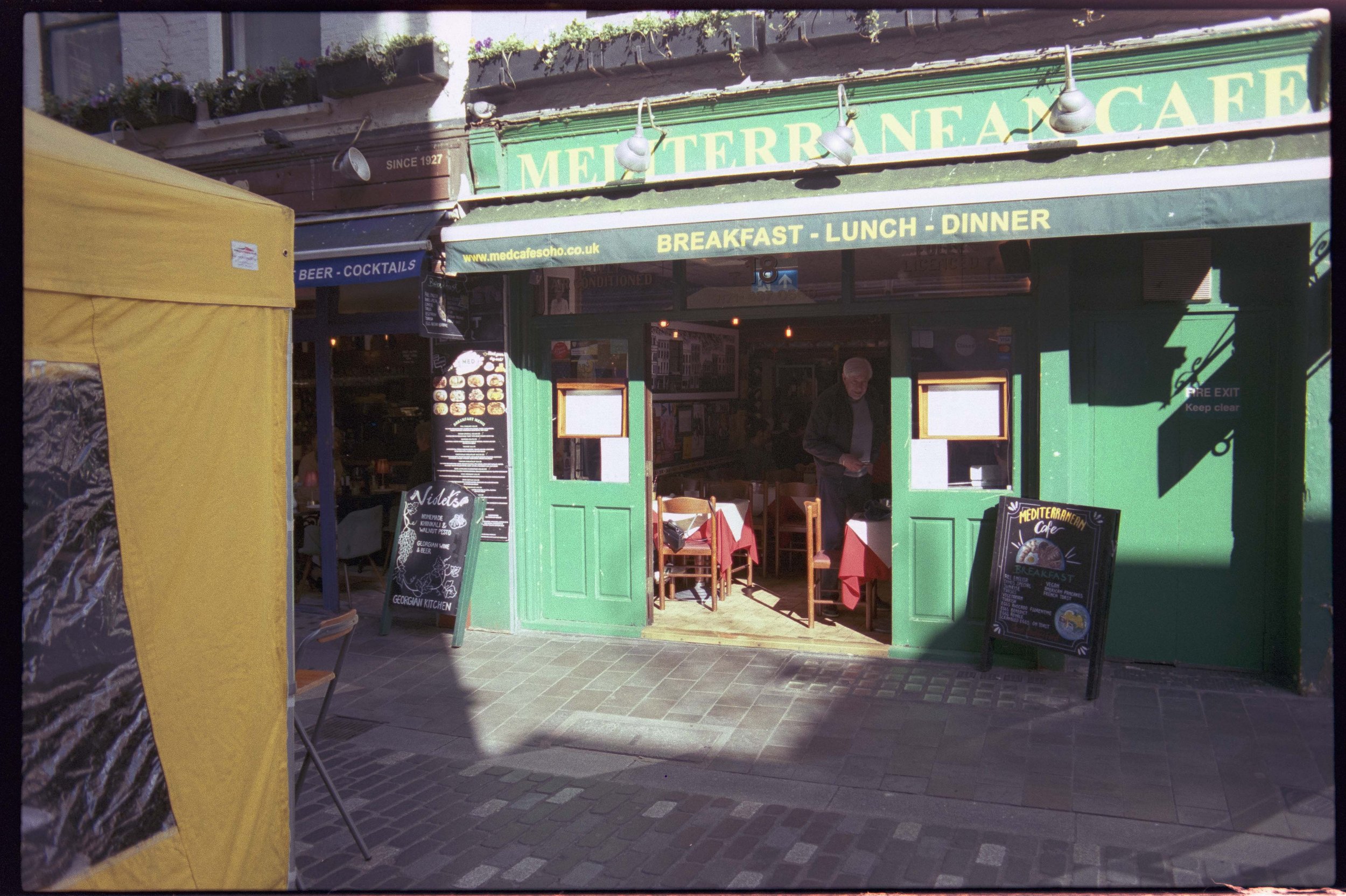
I started on the south end of Soho, working my way north through the afternoon. The Mediterranean Café on Old Compton Street stopped me almost immediately — a place that's been there since 1927, its deep green fascia catching the sun at an angle that Vision3 handled beautifully, the warm gold of the signage glowing against the paint. A man stood in the doorway, just watching the street. I got one frame and kept moving.
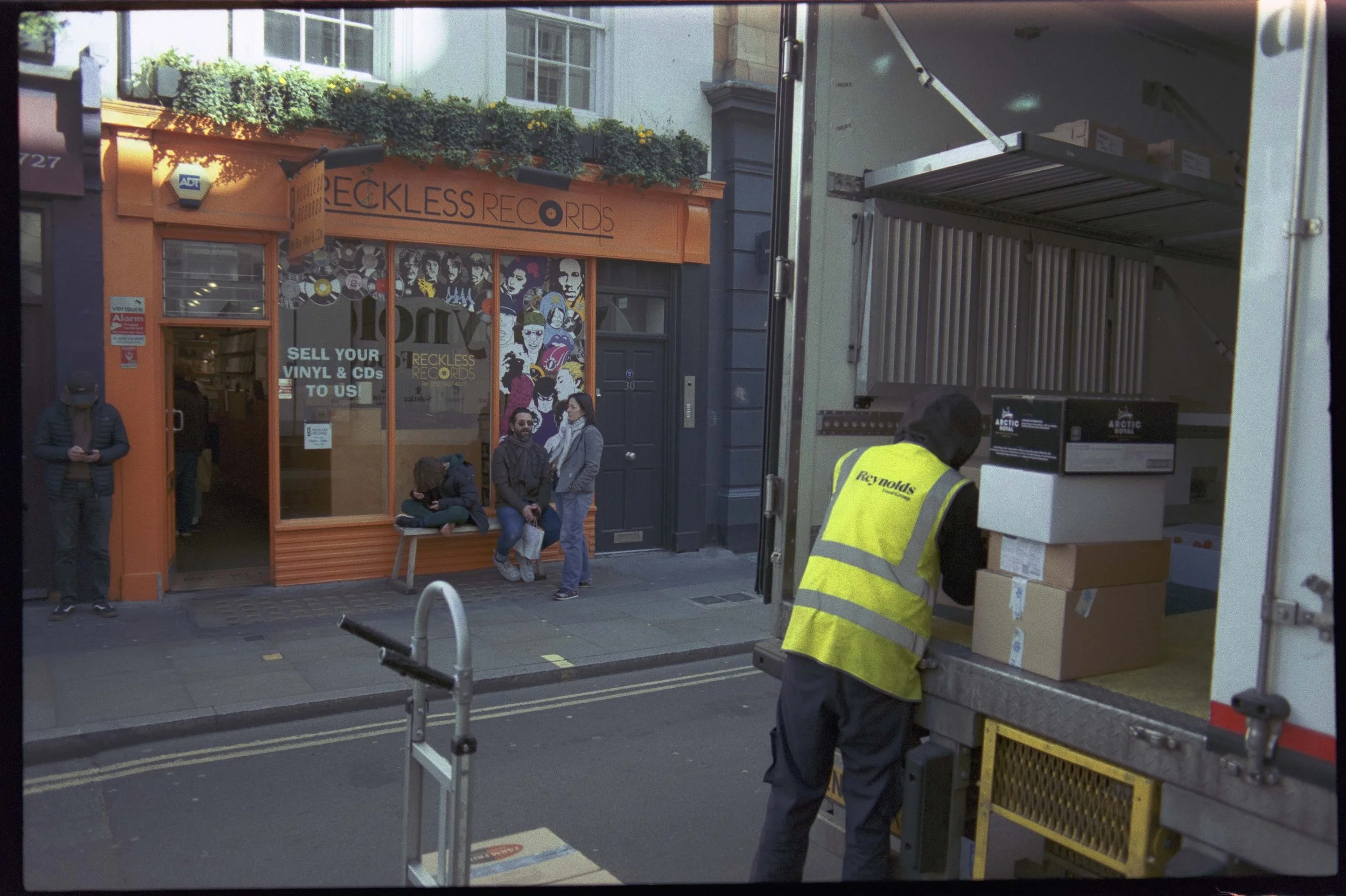
Around the corner, Reckless Records — that vivid orange shopfront with its illustrated window display of musicians — was being interrupted by a delivery driver in a hi-vis yellow jacket unloading boxes from a truck. The contrast of orange and yellow should have been too much. Vision3 made it work. That's one of its qualities: it handles colour density without letting things fight.
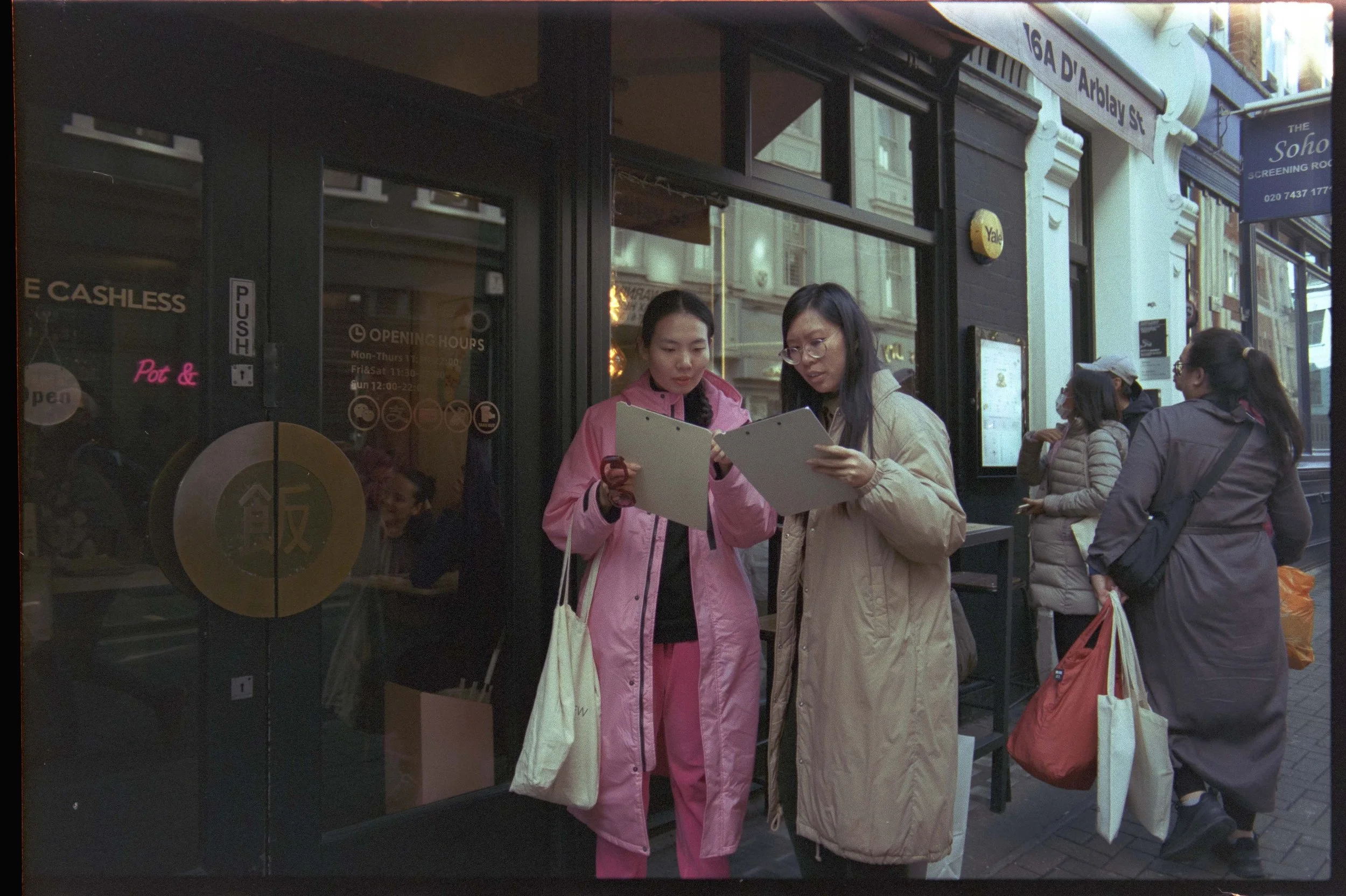
On D'Arblay Street I found two women in matching pink coats, both consulting clipboards outside a restaurant, deep in conversation. The warmth of those coats against the cooler tones of the street behind them is the kind of colour moment that simply doesn't exist in black and white. You don't get to choose that. The stock gives it to you.
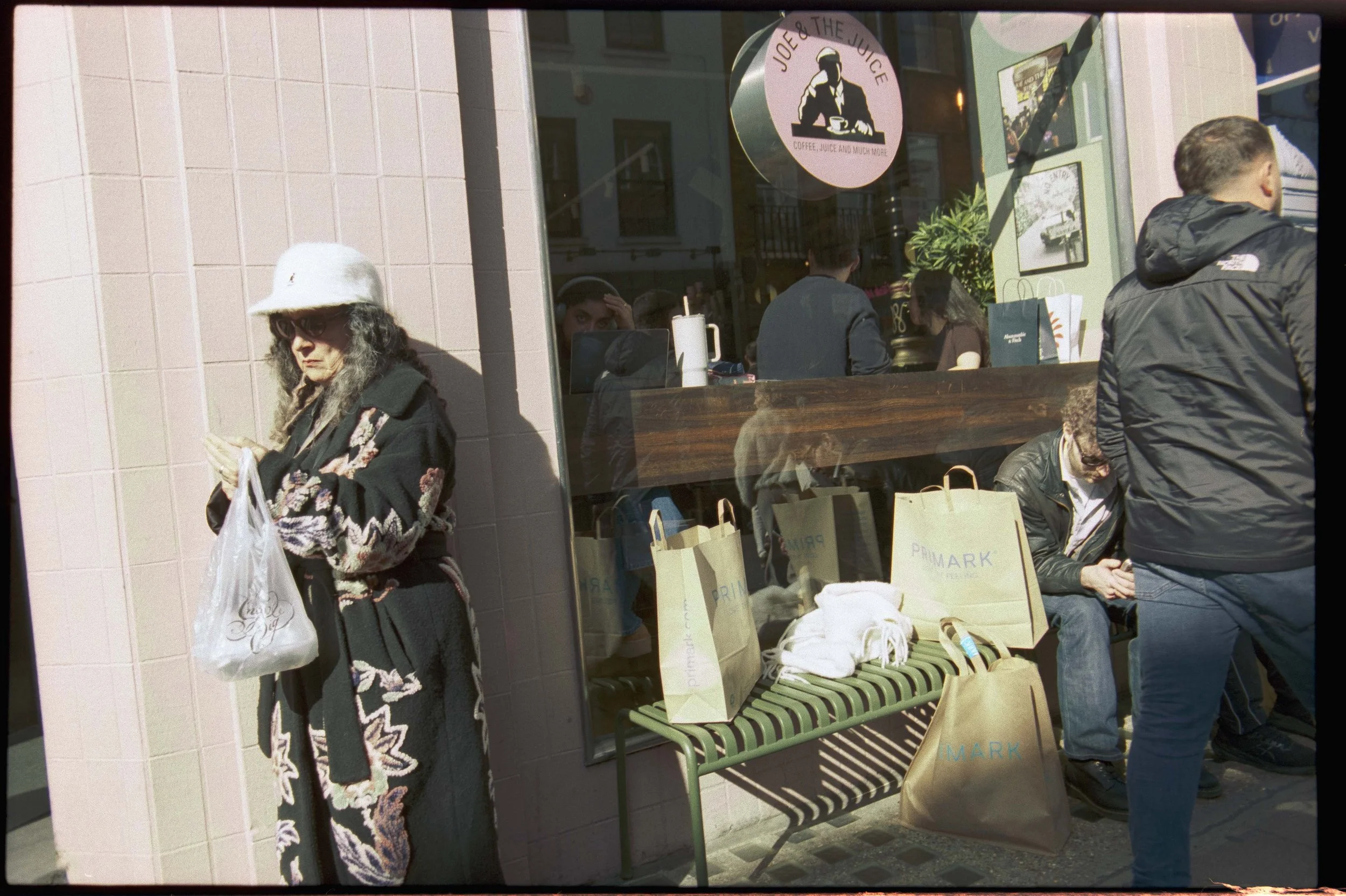
"Vision3 250D handles colour density without letting things fight. That's one of its qualities — and Soho tests it constantly."
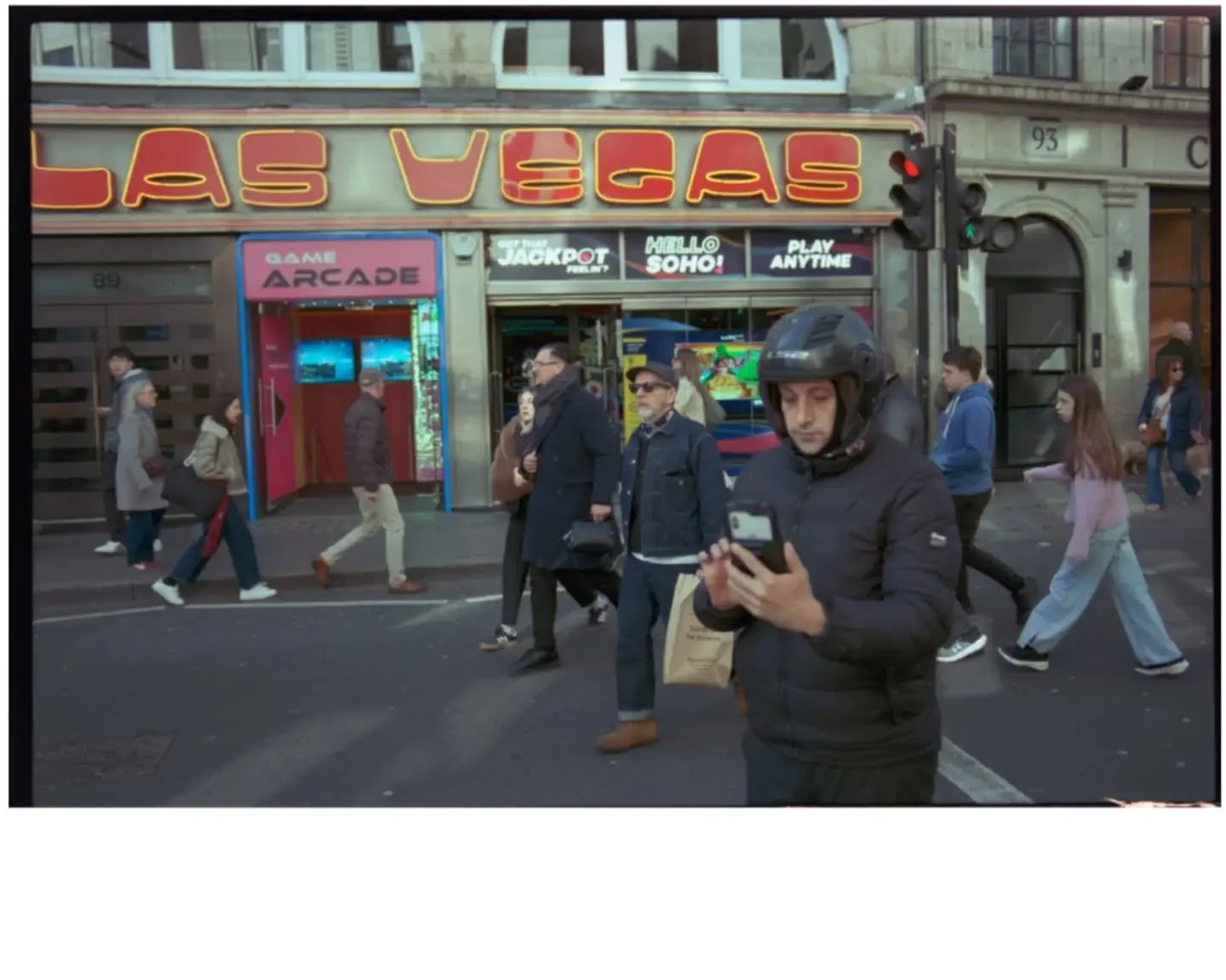
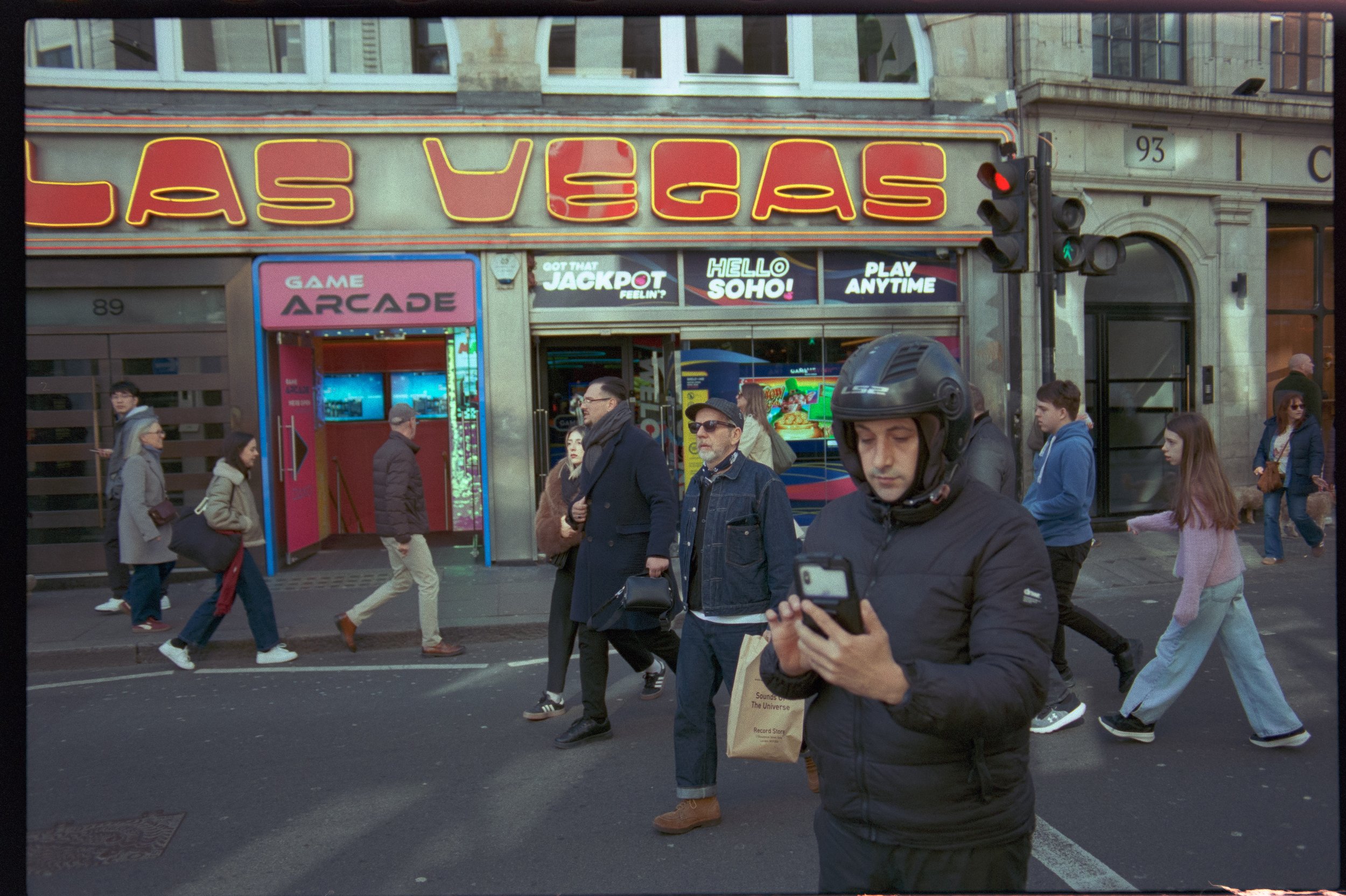
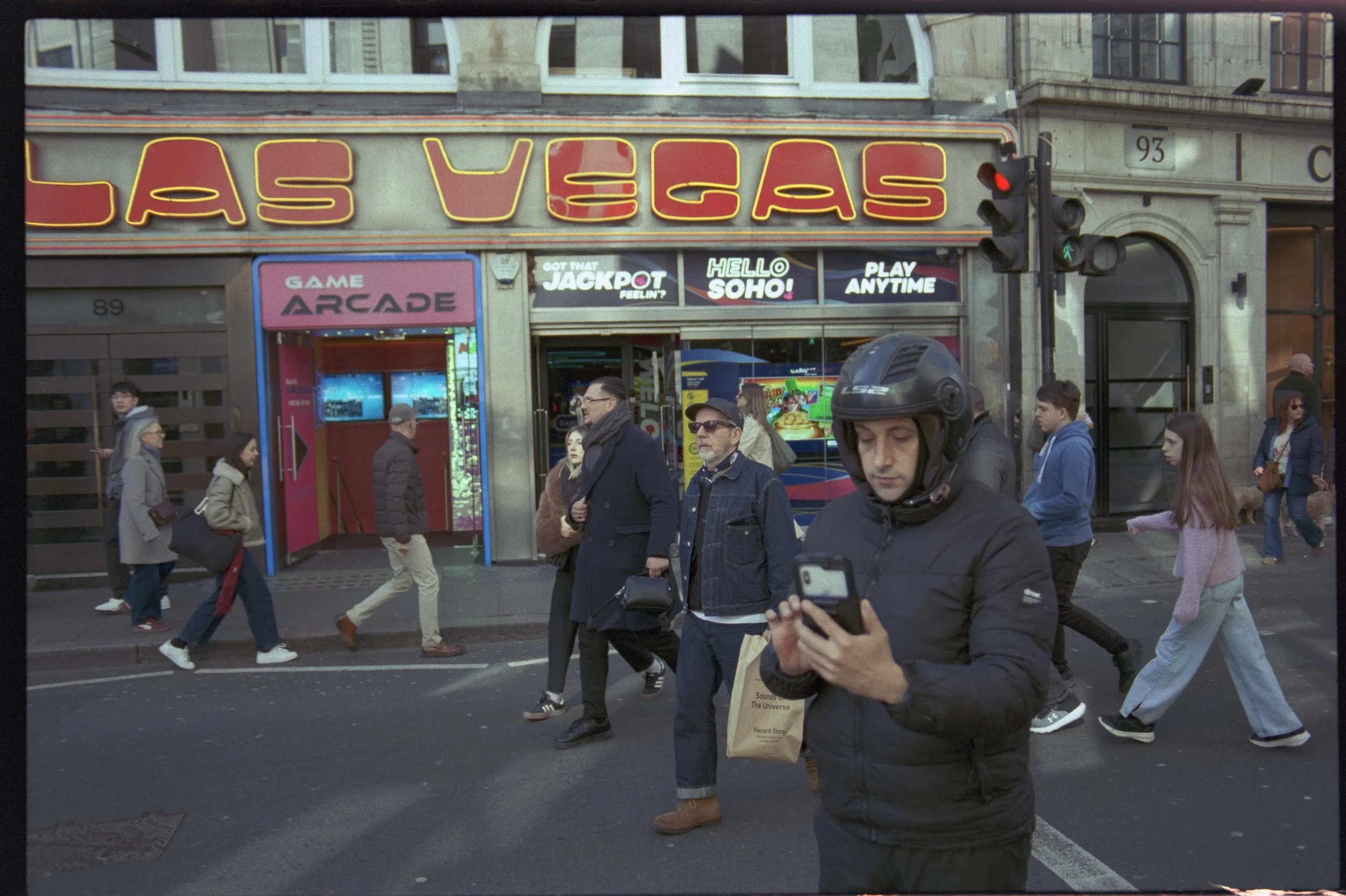
The Las Vegas arcade on what I think was Wardour Street gave me one of the more unexpected frames of the day — a motorcyclist in a full helmet standing at the crossing checking his phone, the enormous neon Las Vegas signage blazing behind him in red and gold, Hello Soho stencilled across the frontage. Vision3 renders neon brilliantly. The warmth of the sign, the cool blue of the afternoon sky in the upper corner of the frame — it's exactly what this stock was made for.
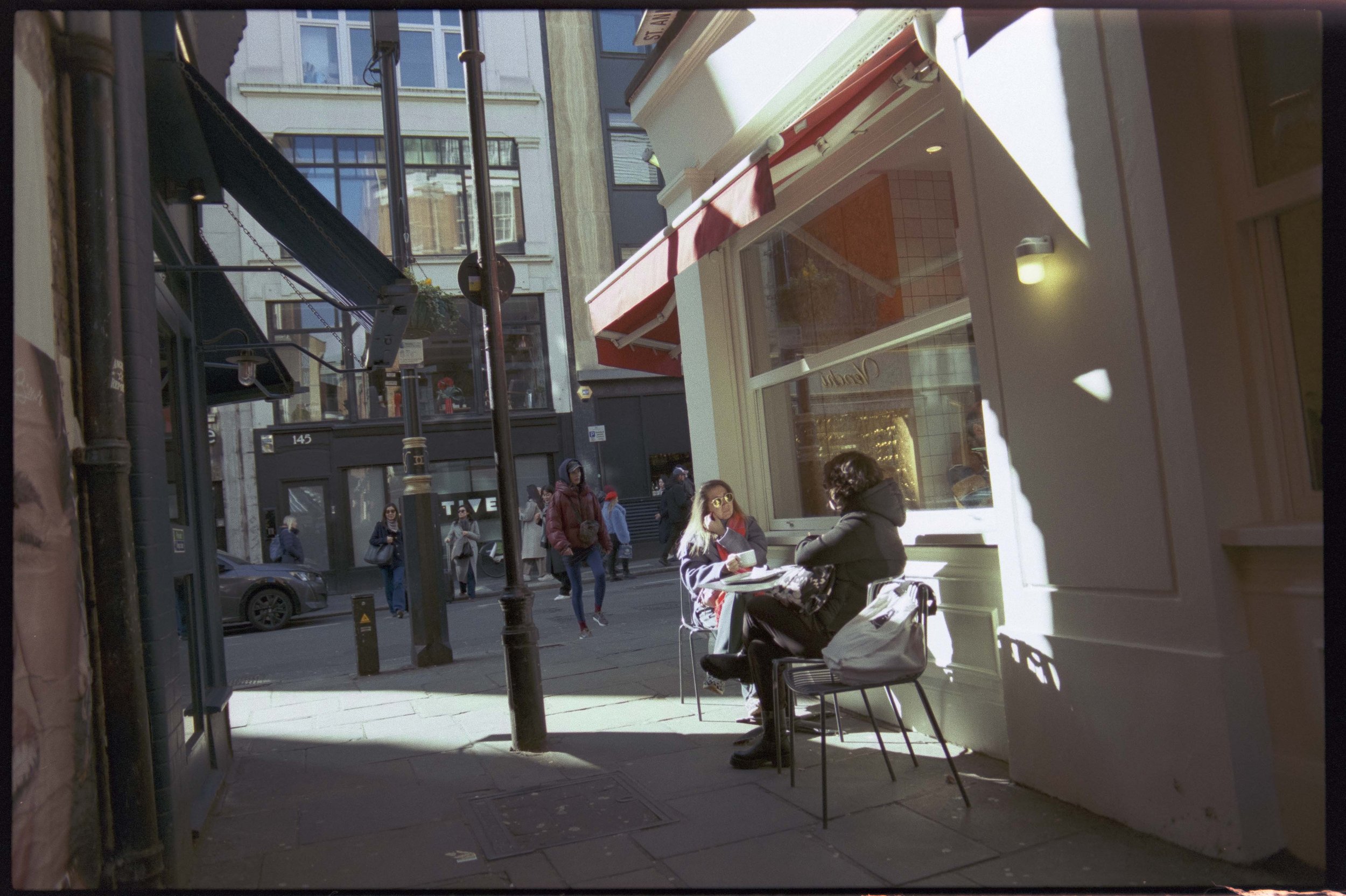
There was a quieter moment mid-roll that I keep coming back to: two women sitting outside a café in a narrow Soho alley, a red awning above them, dappled light falling across the table. No action. No joke. Just two people and an afternoon and the quality of light that Vision3 seems built to hold.
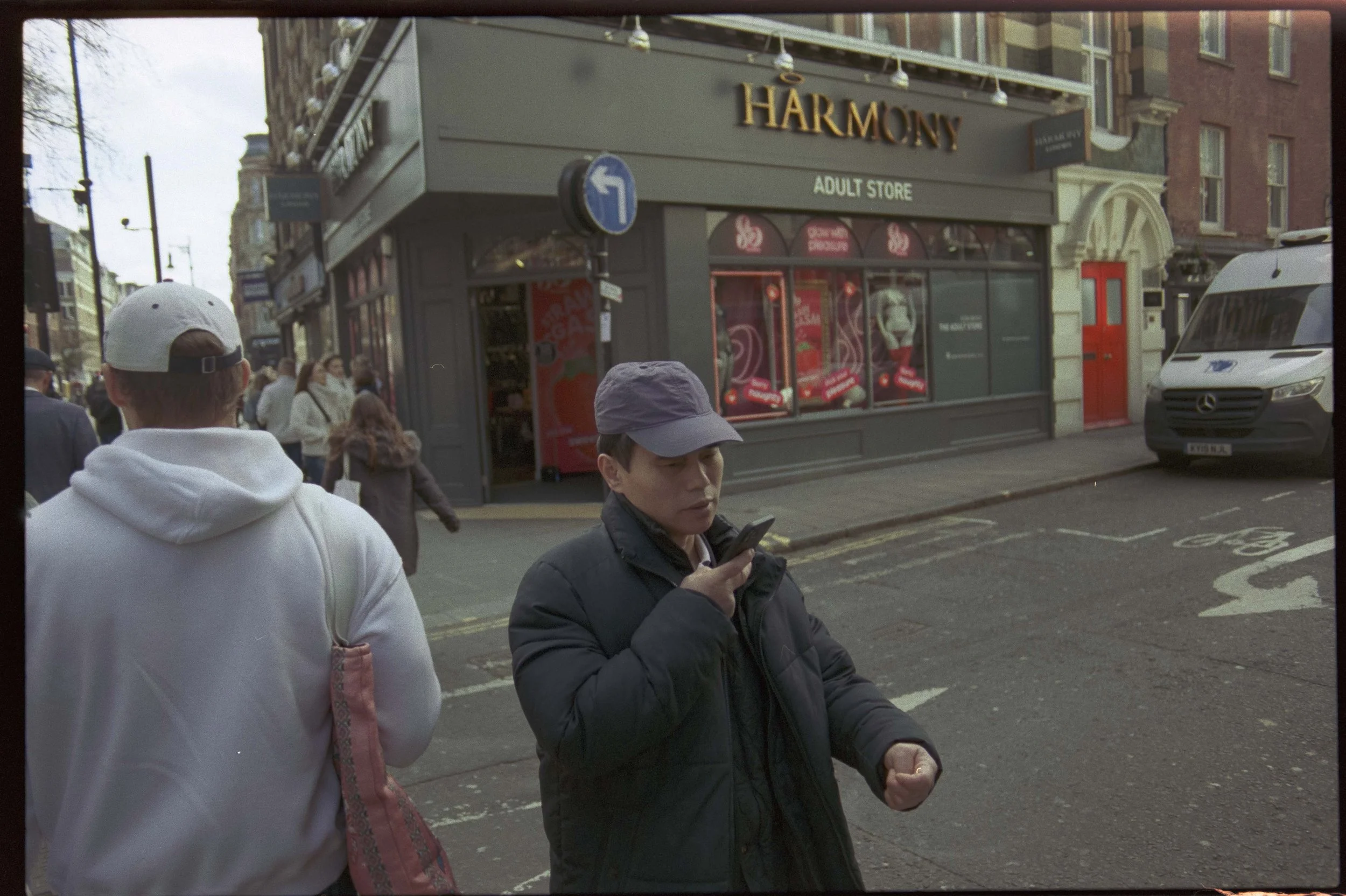
The three jokes
And then London started doing what London does.
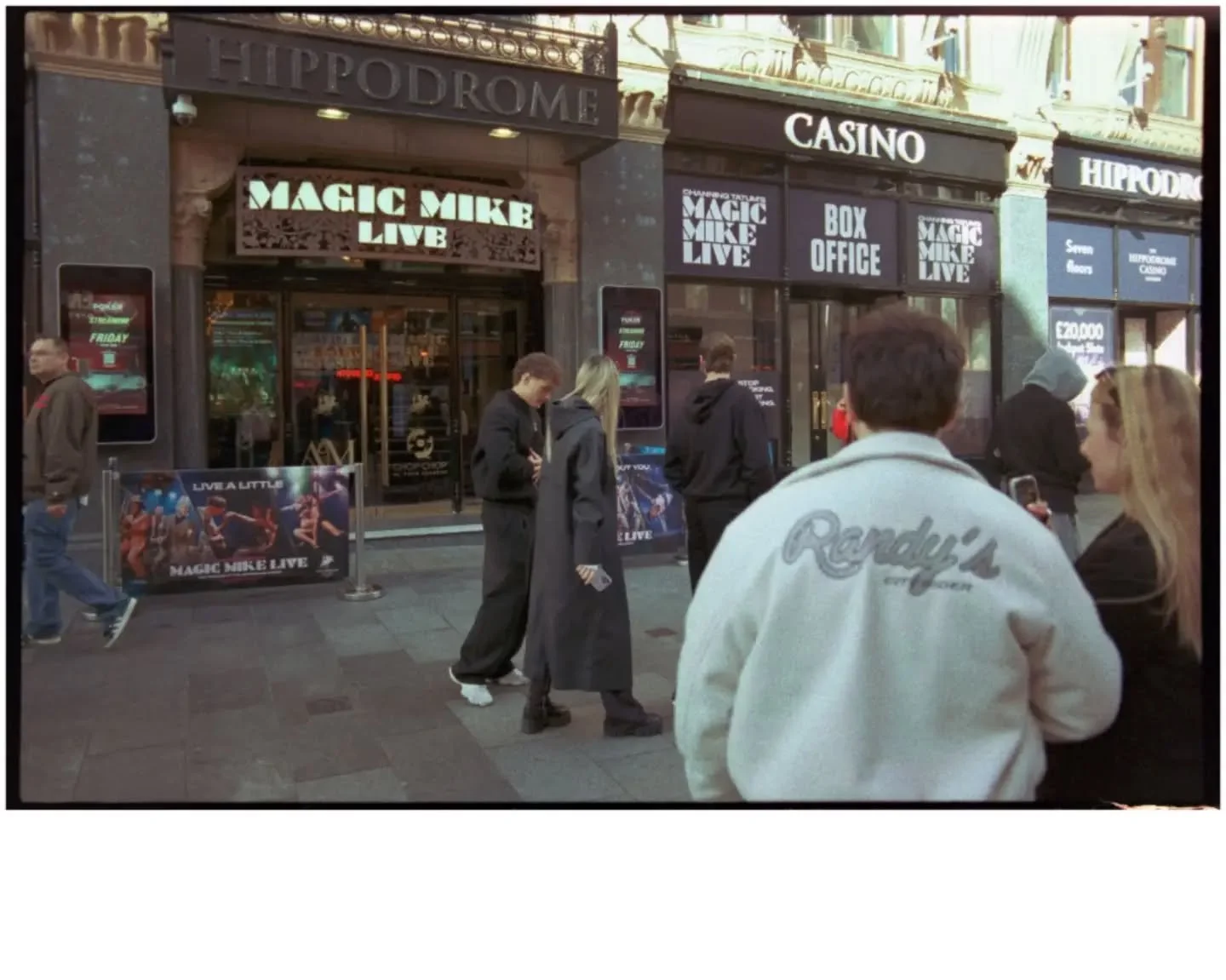
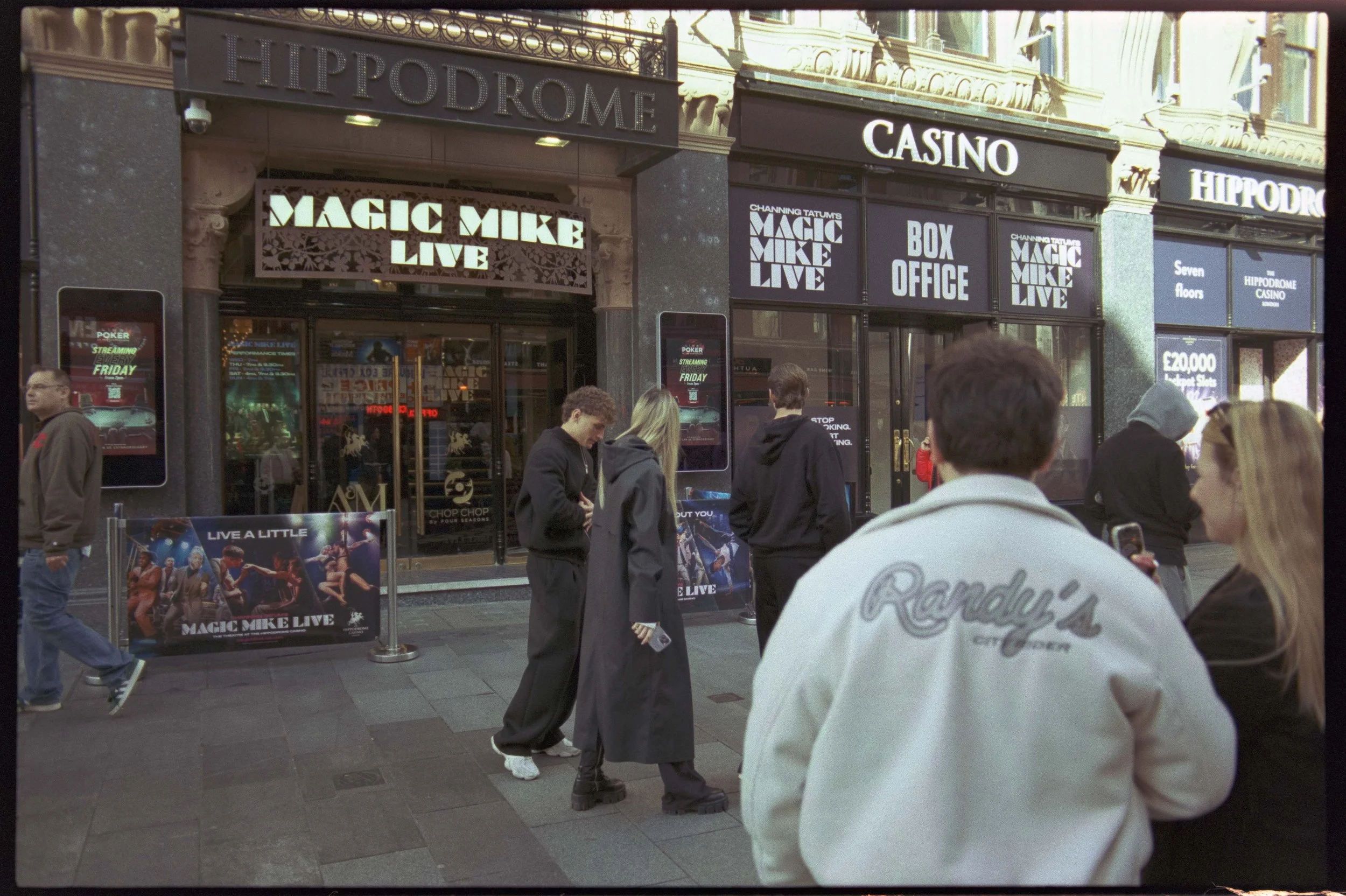
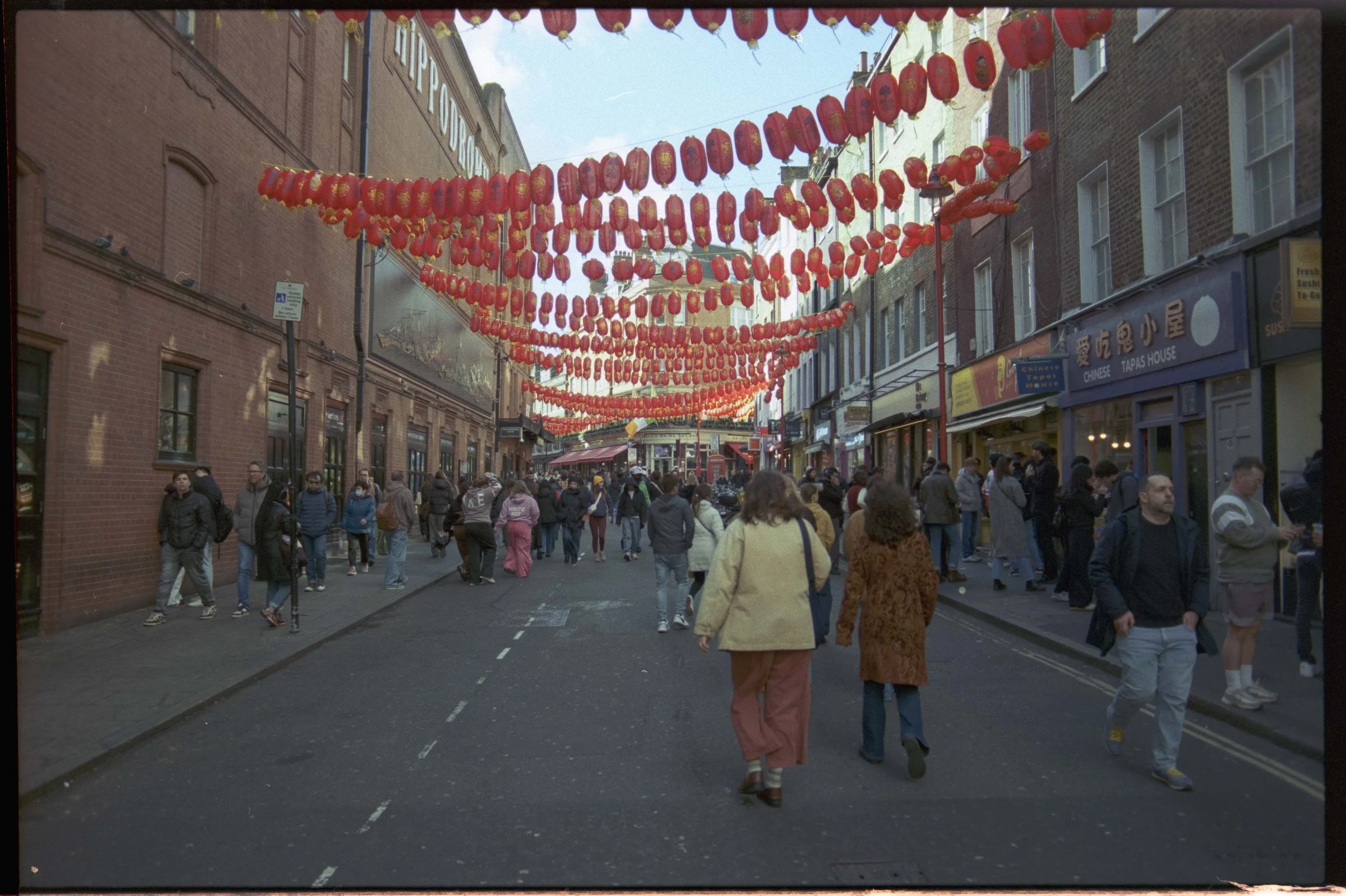
The first one I almost missed. I was walking past the Hippodrome on Cranbourn Street when I clocked it — a man standing on the pavement, back turned, the word Randy's written in large script across the back of his white jacket. Behind him, filling the entire frontage of the venue: Magic Mike Live. He had no idea. The street had assembled itself into a perfect joke and was waiting, with infinite patience, for someone to walk past with a camera.
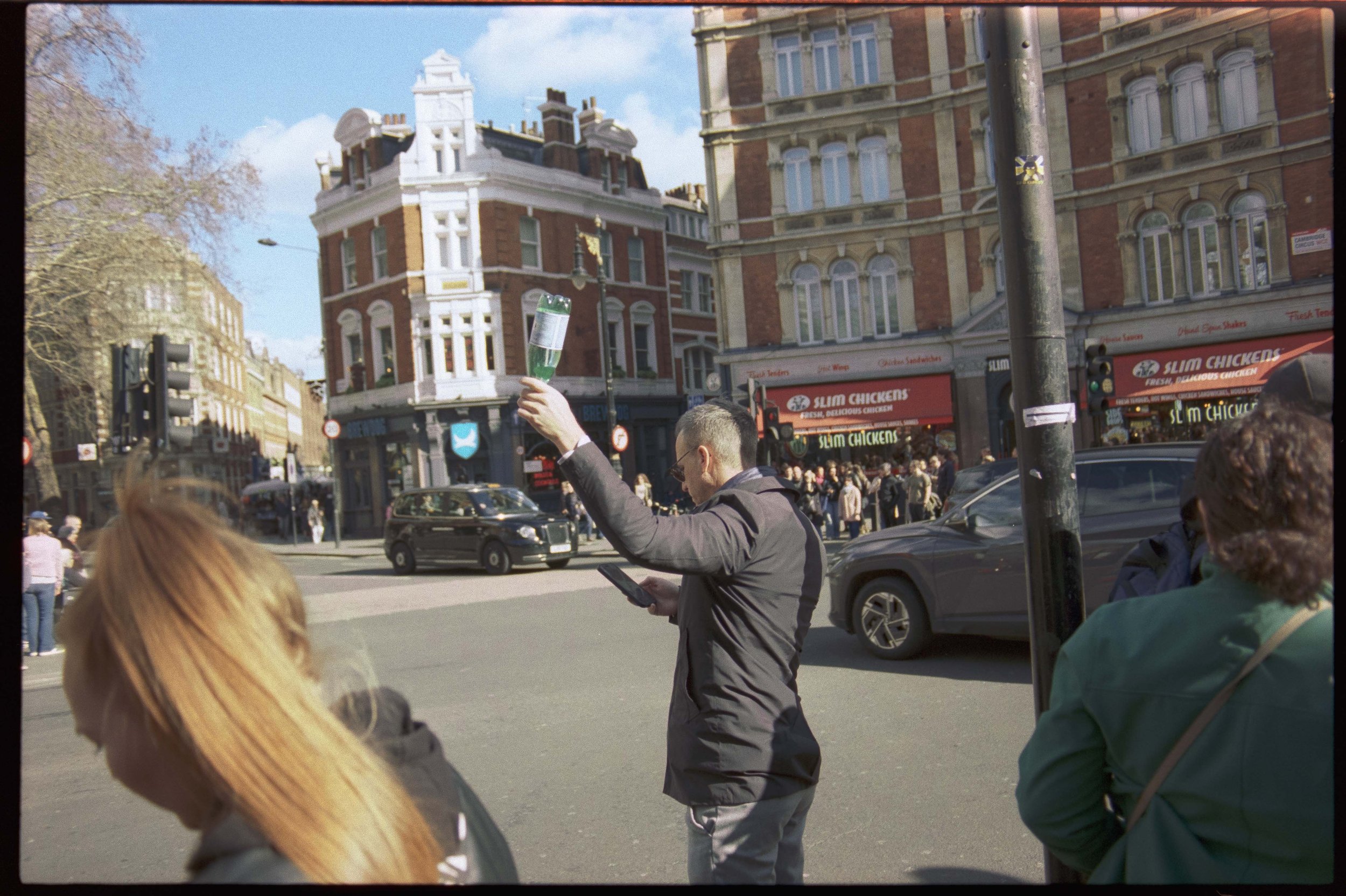
The second came at a crossing near the top of Charing Cross Road. A tour guide — grey hair, suit jacket, every inch the professional — was trying to marshal his group through the lunchtime traffic. His technique was to hold a green bottle above his head like a torch, a beacon for anyone who'd wandered off. He was checking his phone with the other hand. I pressed the shutter at the exact moment his arm went up. He was, without any doubt, leading them to the pub.
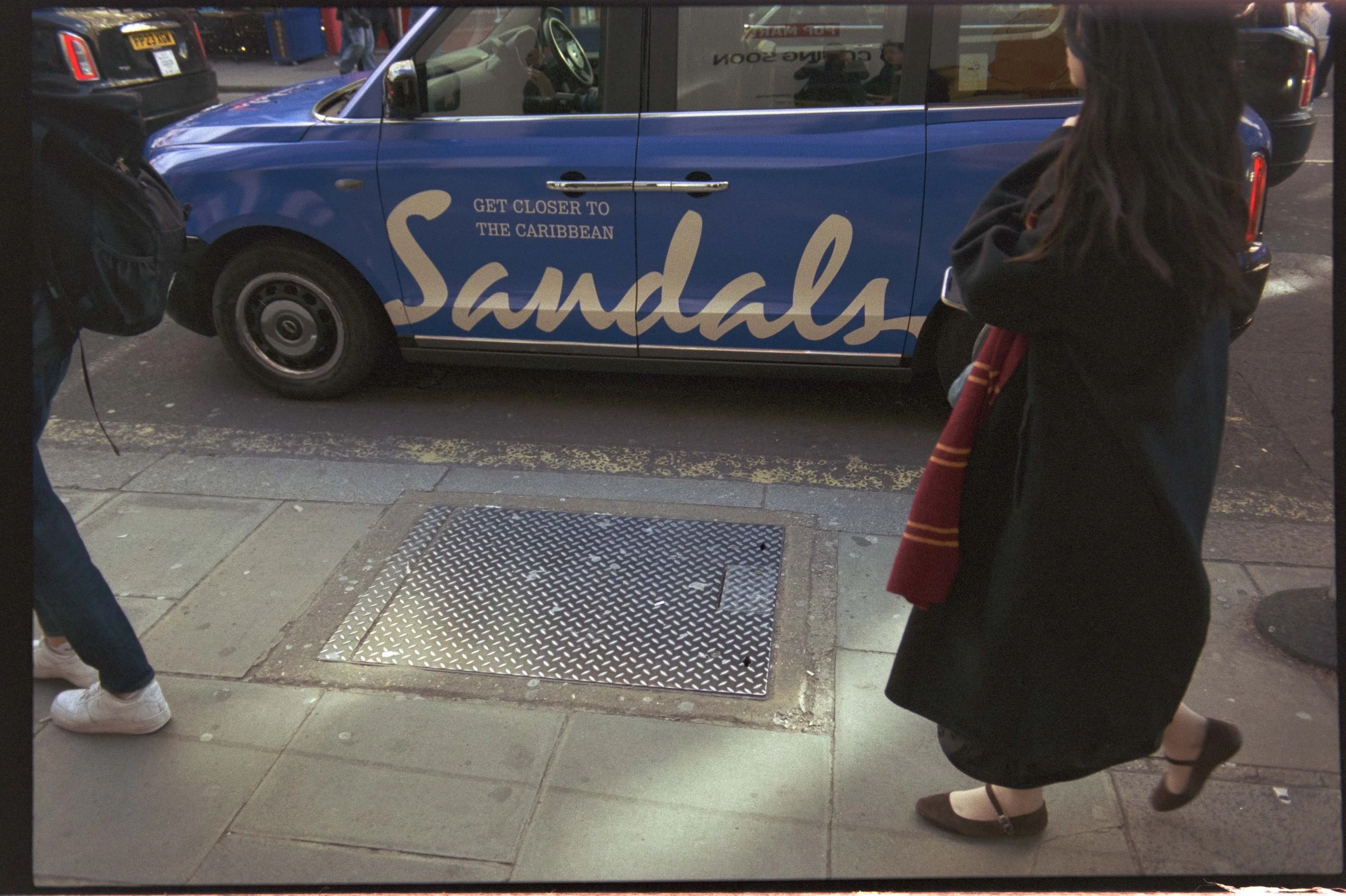
The third was the one I'm most pleased with. A London black cab, completely wrapped in the Sandals Caribbean holiday livery — blue bodywork, the Sandals script in cream, Get Closer to the Caribbean. Passing directly in front of it at that exact moment: a woman in a full Hogwarts Gryffindor robe, red and gold striped scarf trailing behind her. On her feet: sandals. She was heading somewhere else entirely, completely unbothered.
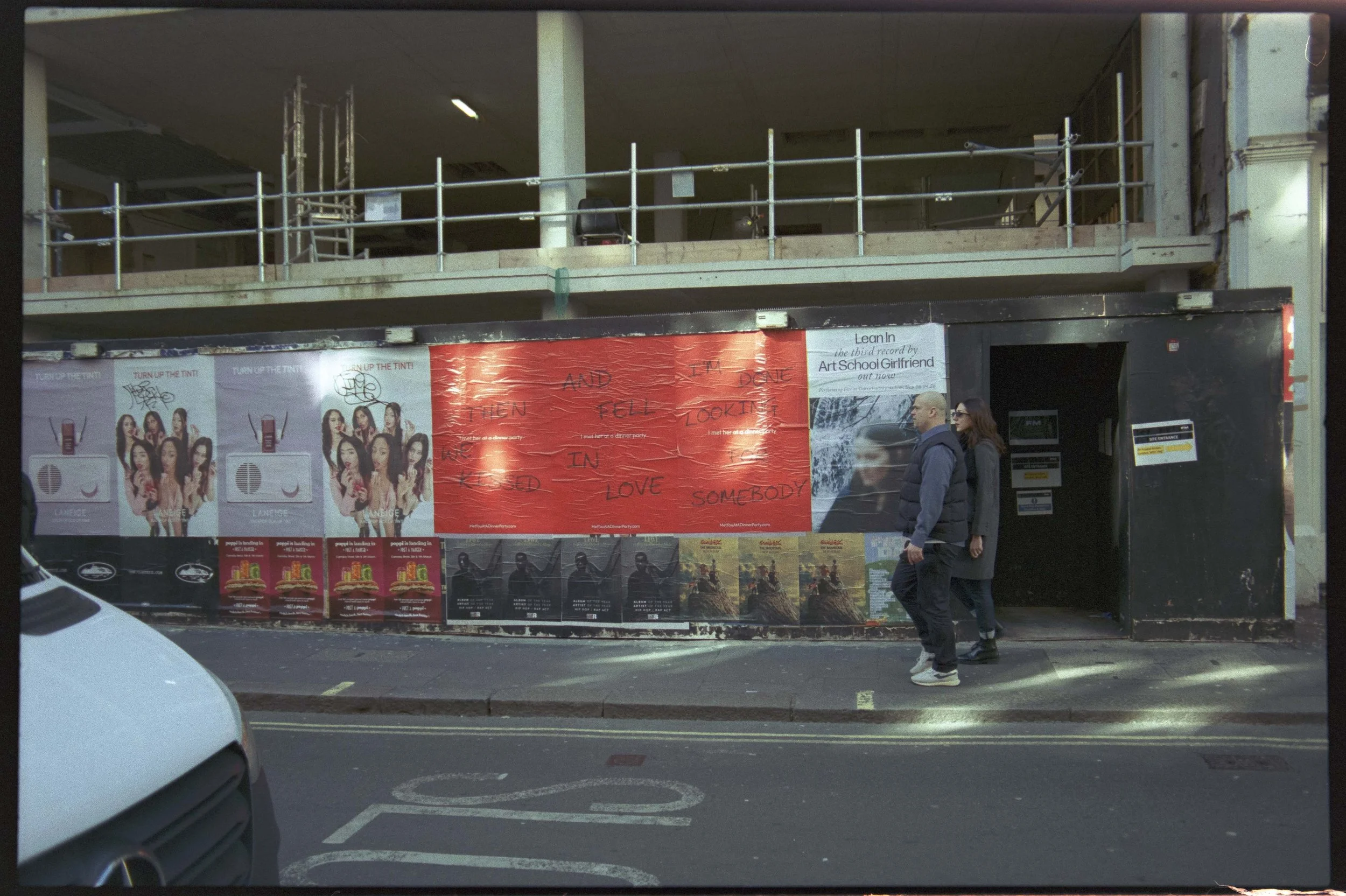
Three found jokes on one roll. Colour made all of them better. Black and white would have served the geometry. Vision3 gave you the blue cab and the red scarf and the warm pavement and the whole absurd London afternoon.
What comes next
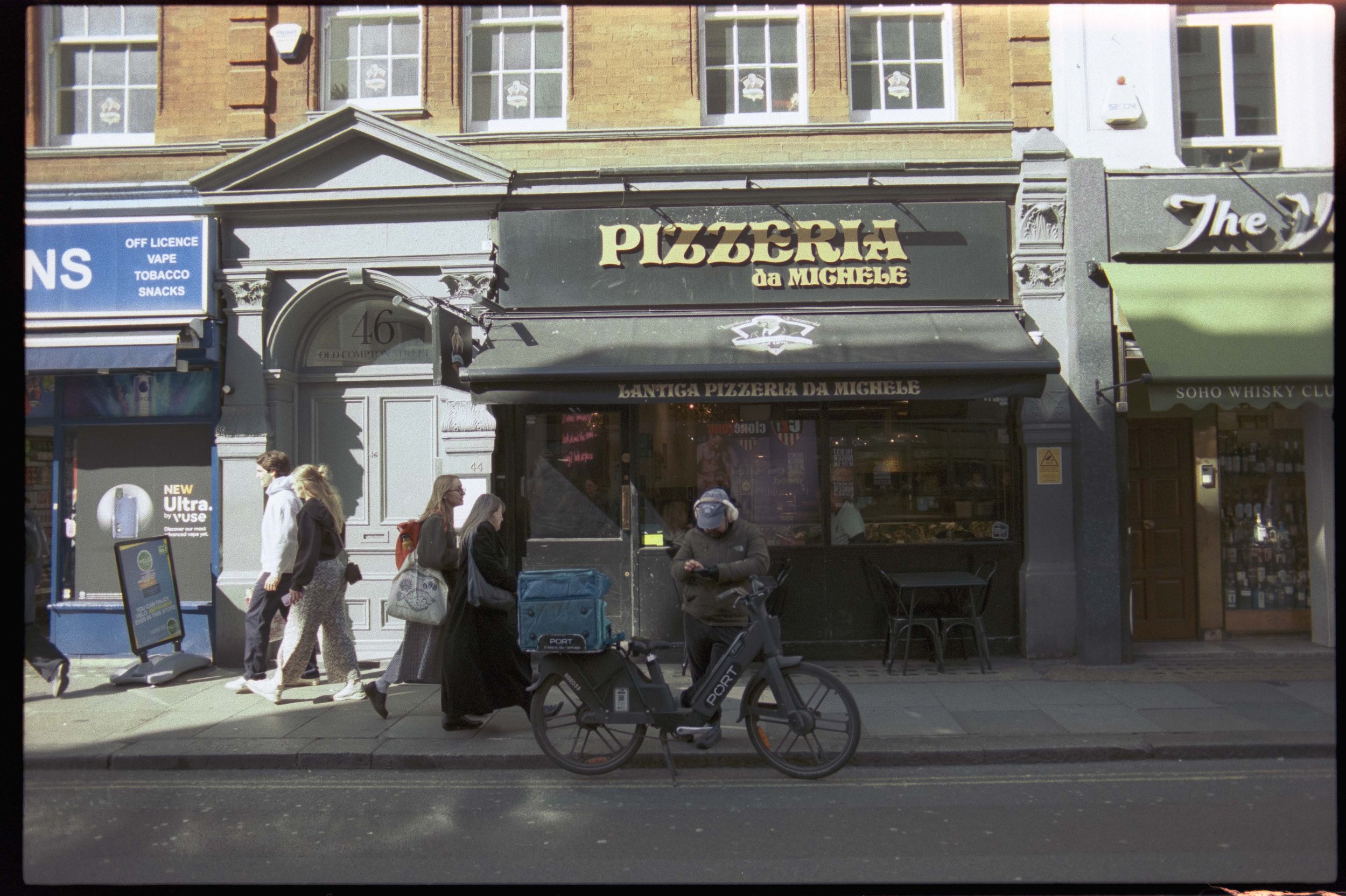
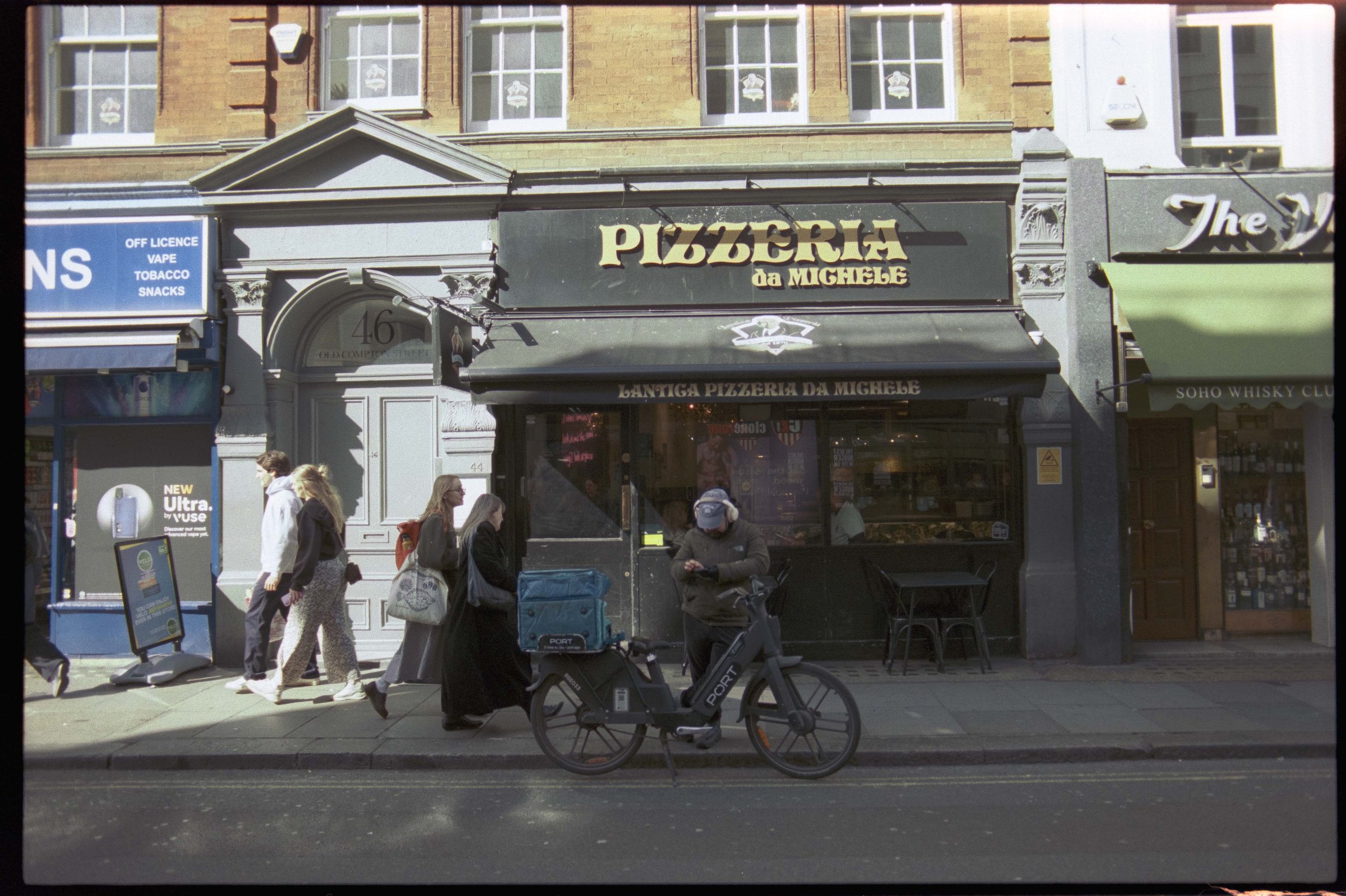
I finished the roll on Old Compton Street — a delivery rider on a PORT bike outside Pizzeria da Michele, checking his phone in the late afternoon light, the gold lettering of the restaurant sign warm above him. A good closer. Unhurried. The sort of frame that makes sense at the end of a day's shooting.
One roll is not enough to draw firm conclusions about a film stock. But it is enough to know whether you want to shoot another one, and the answer here is unambiguously yes. Vision3 250D asks you to work with colour rather than despite it — to look for the moments where the warmth of a late winter afternoon in London becomes part of the story rather than just the backdrop.
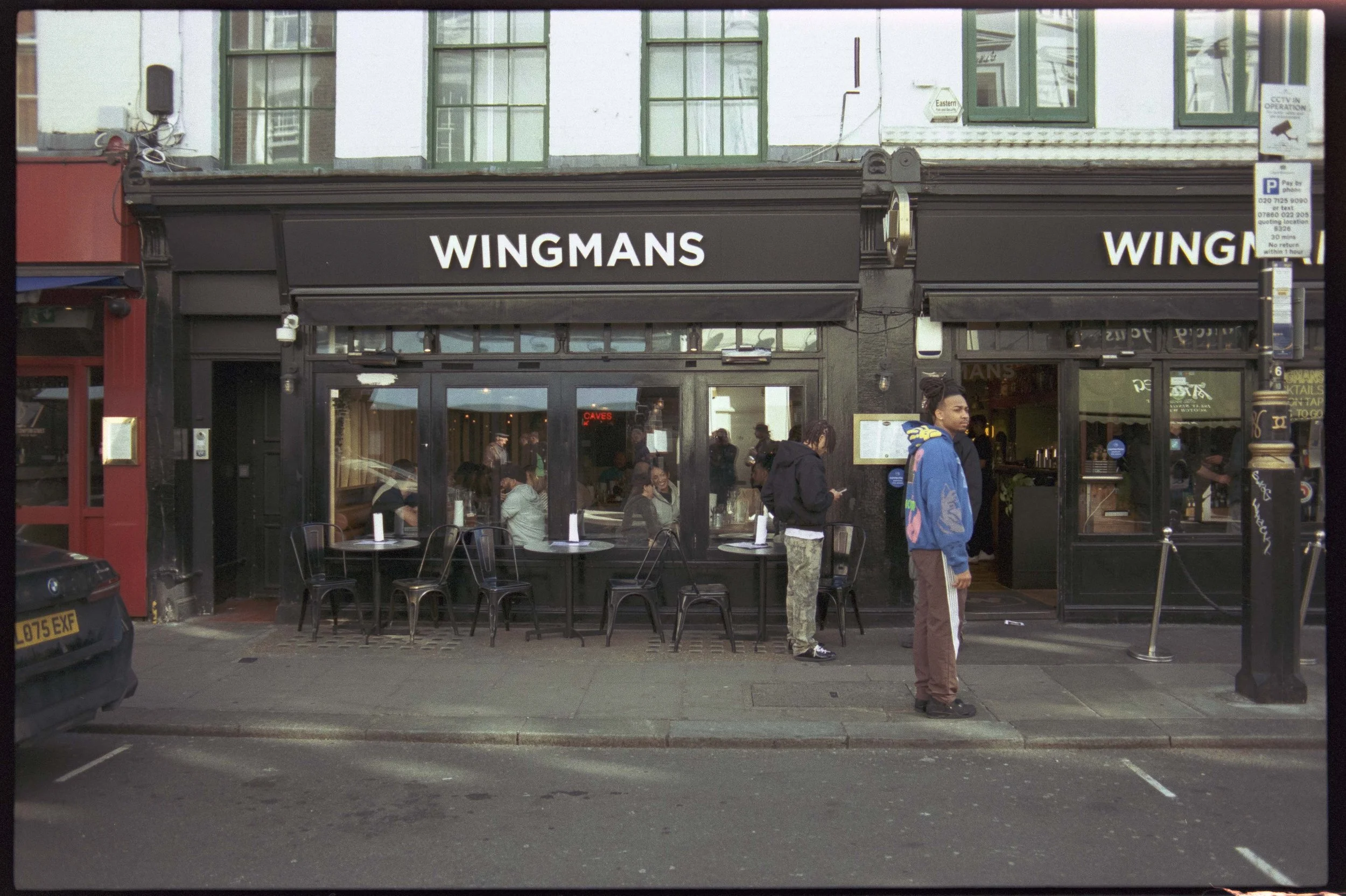
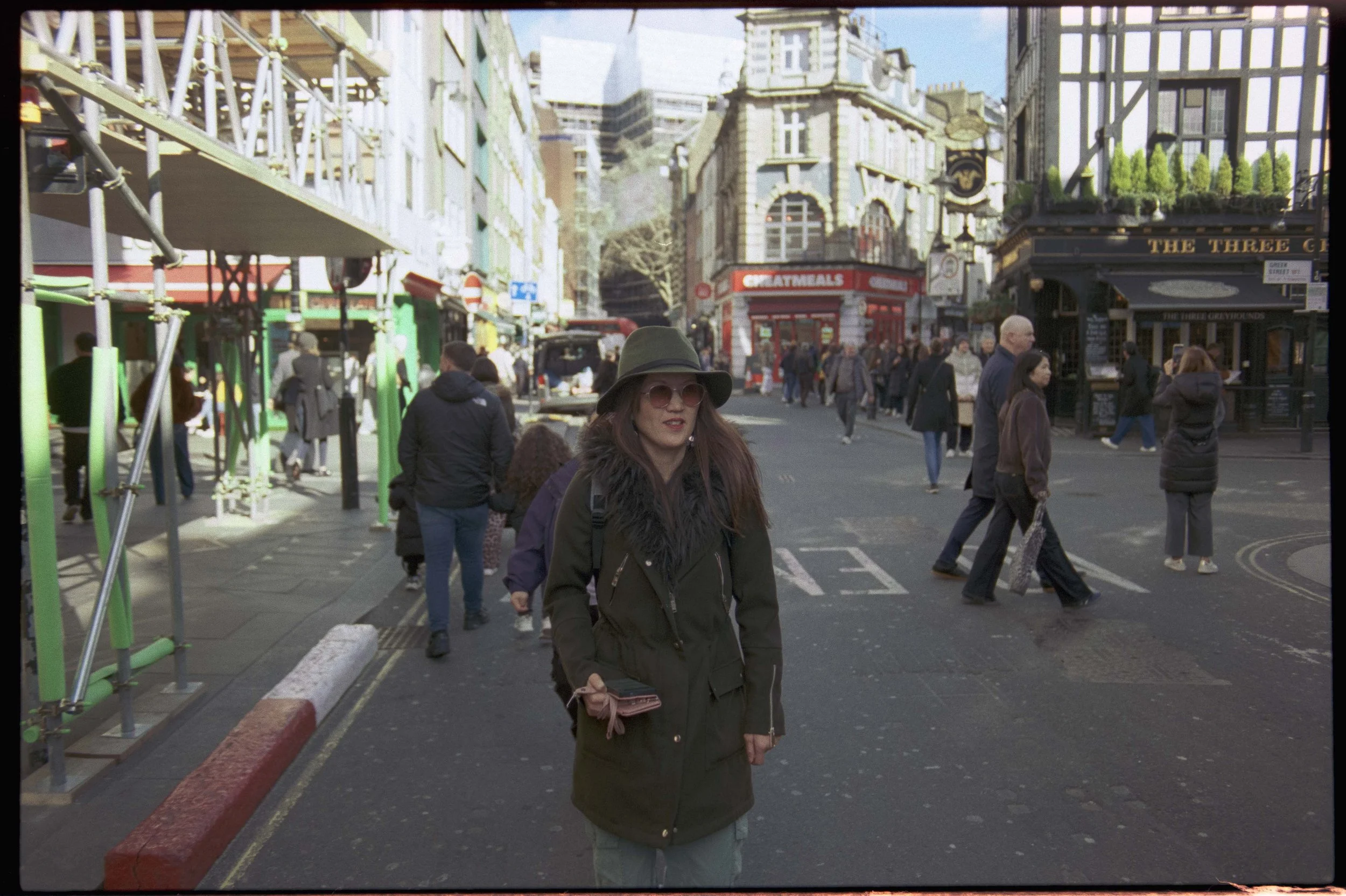
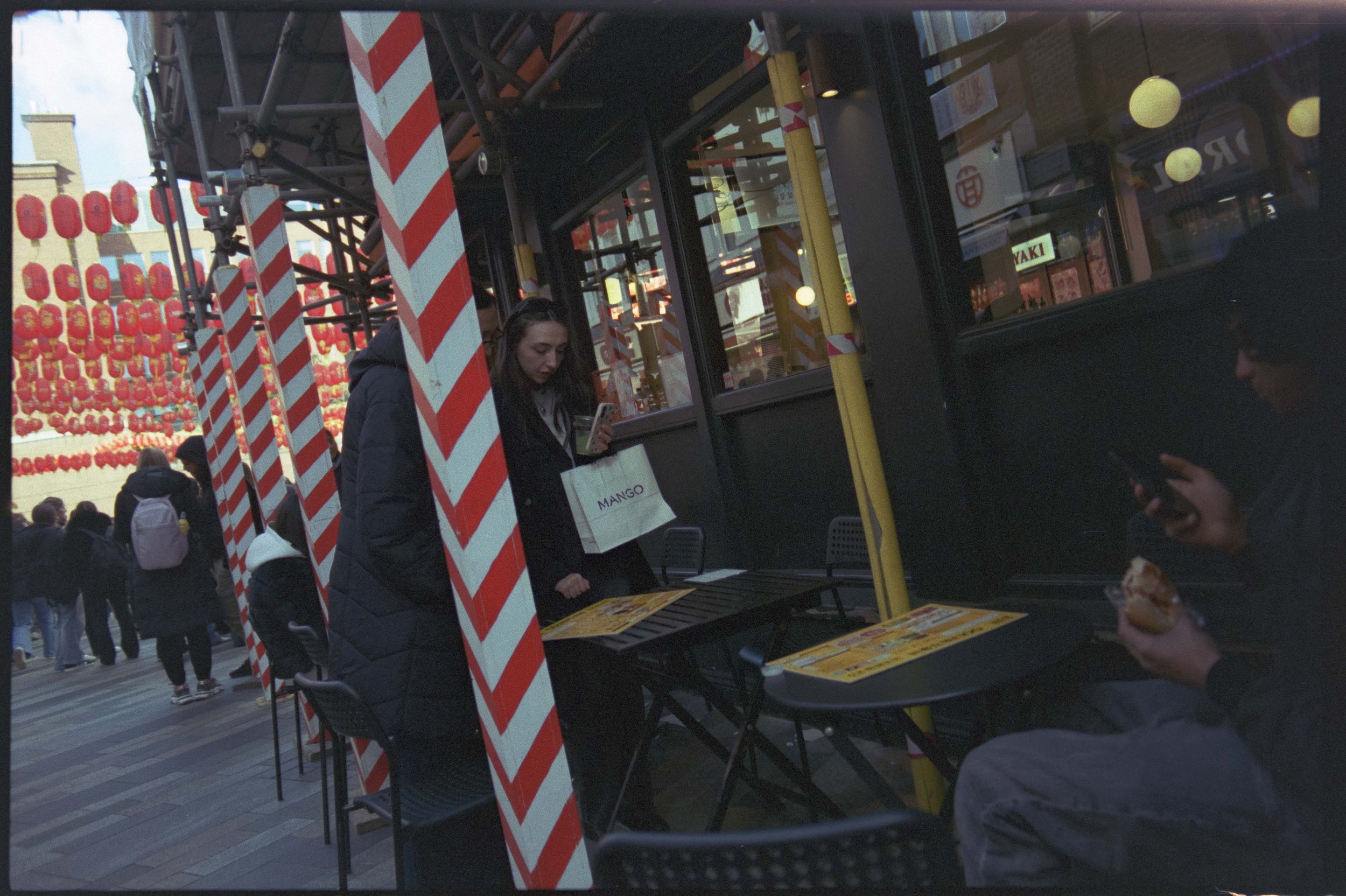
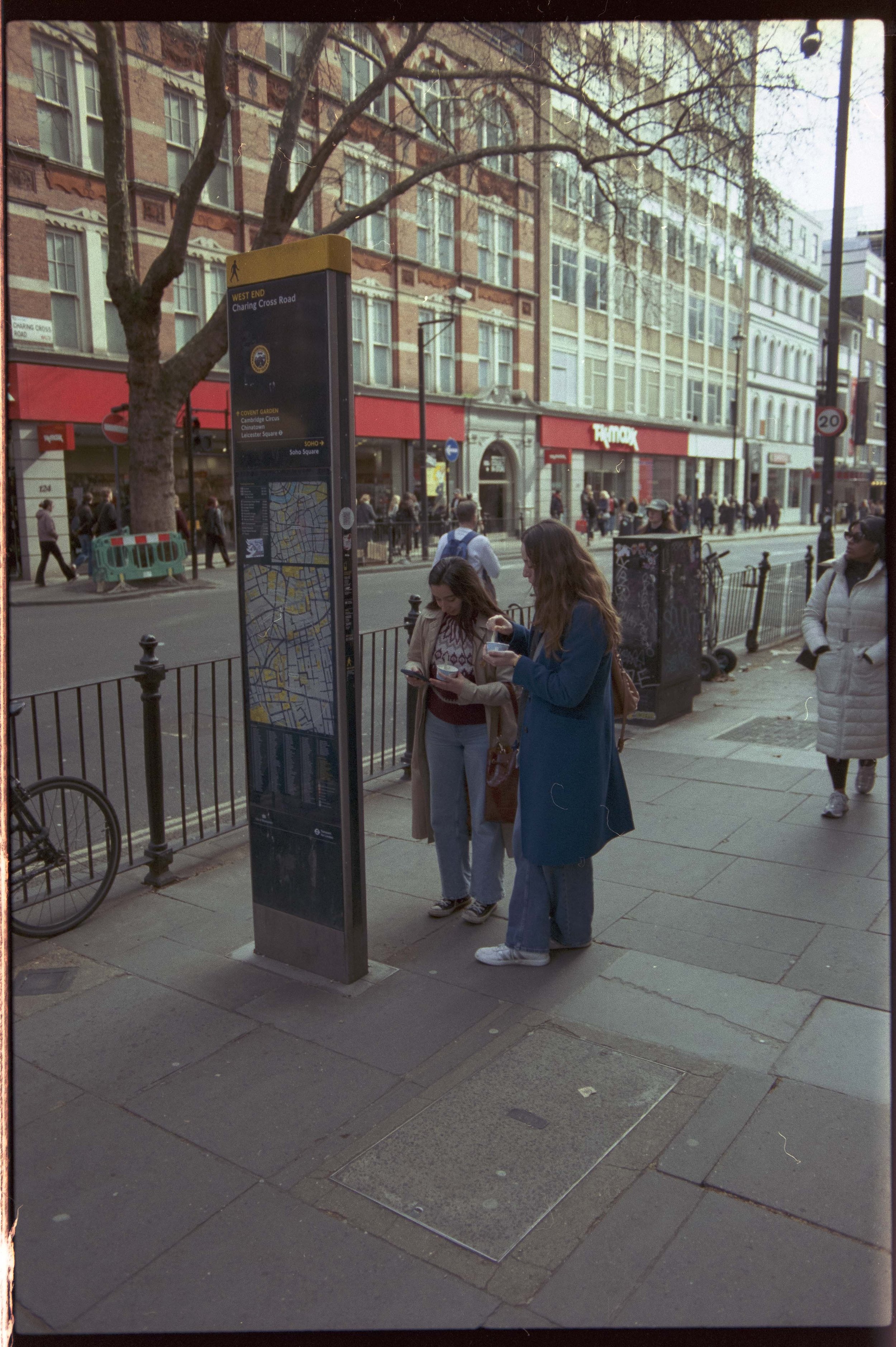
After years of reaching for black and white by default, that's a different kind of seeing. I'd been missing it without quite realising.
I've already ordered more rolls. Spring is coming, the light is getting longer, and the streets are filling up again. If the first outing with Vision3 250D is any indication, it's going to be a busy few months.
Black and white isn't going anywhere. But colour just made a very strong case for sharing the bag.
Until next time, keep snapping
Yes please, keep me posted when there’s a new blog
Instagram - Film