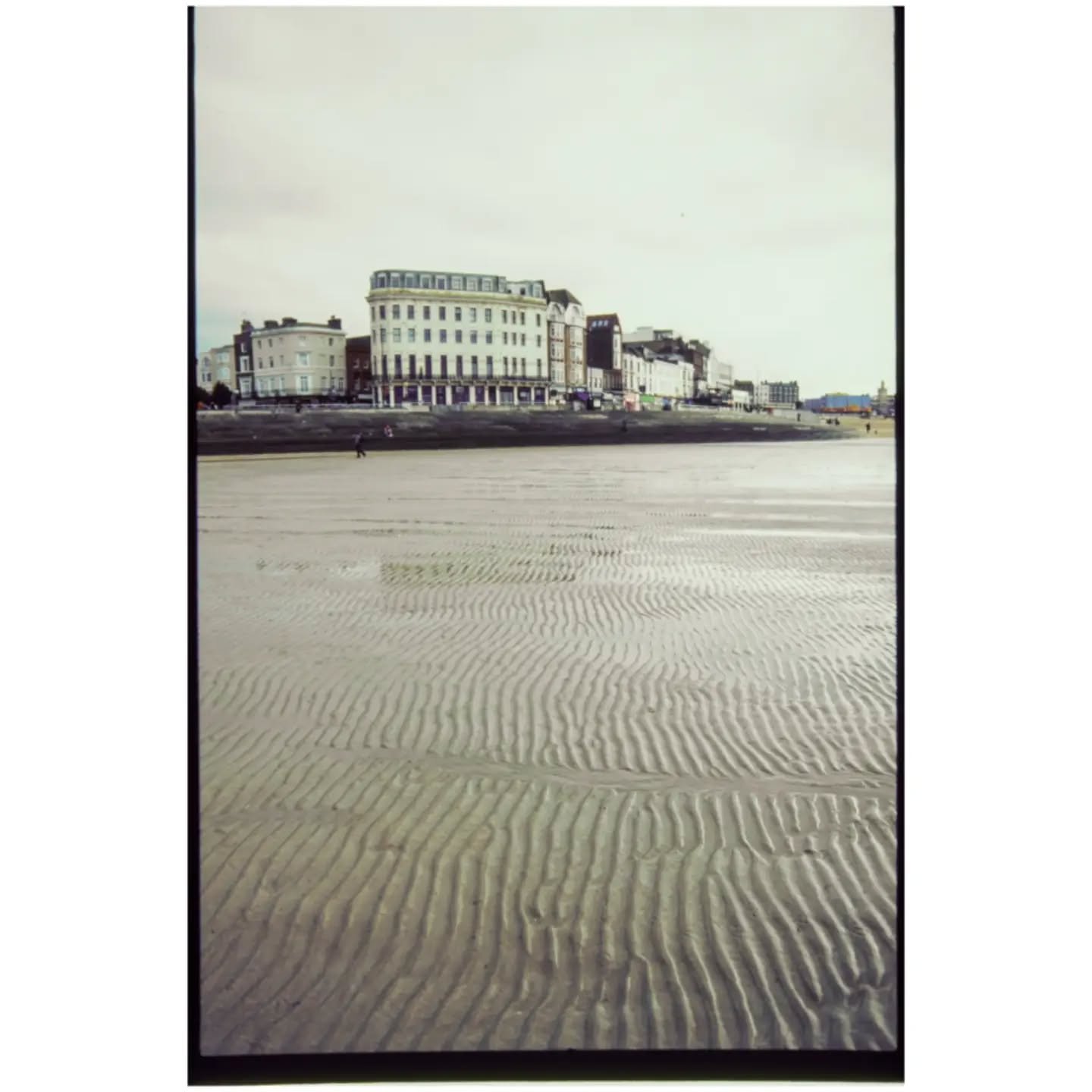
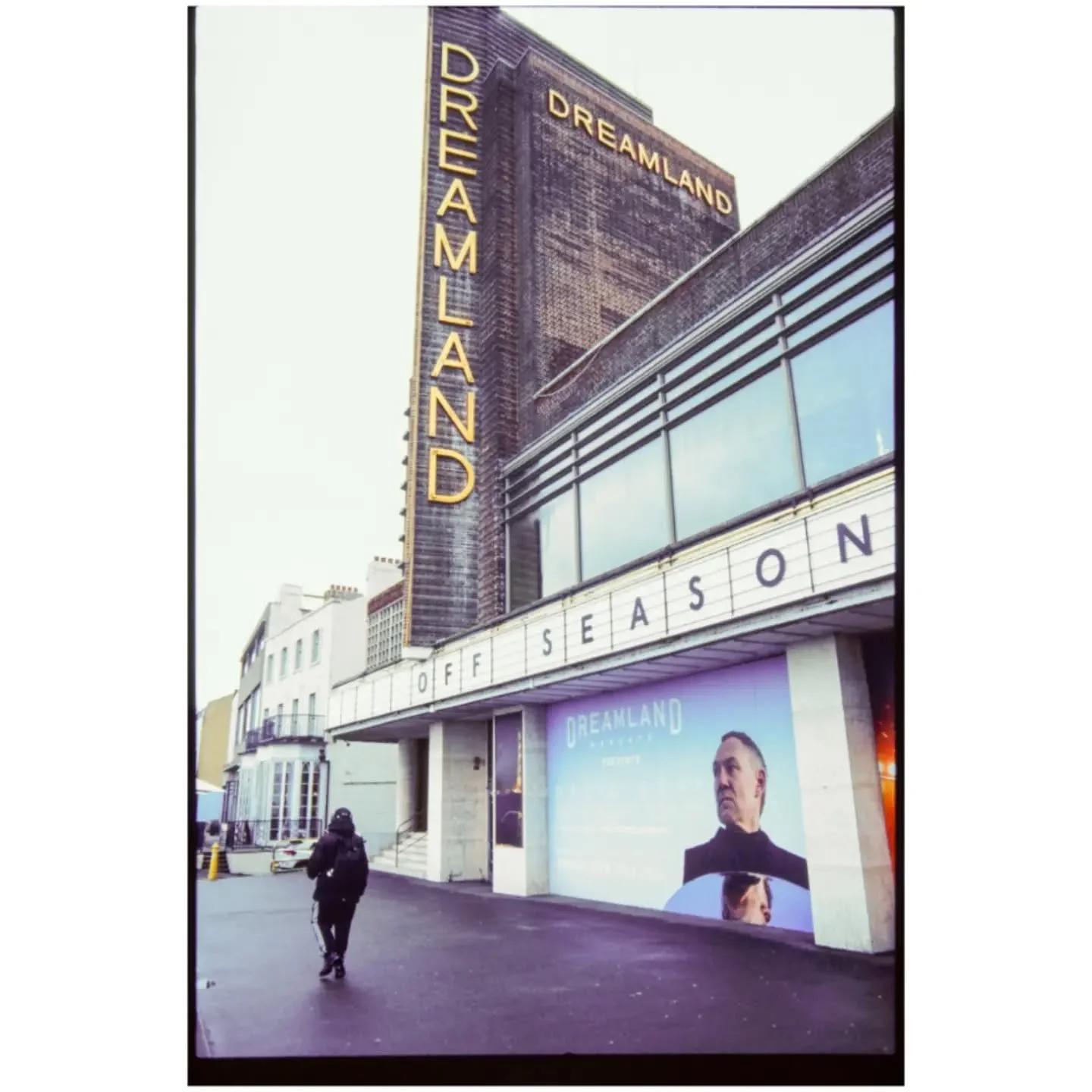
in the frame
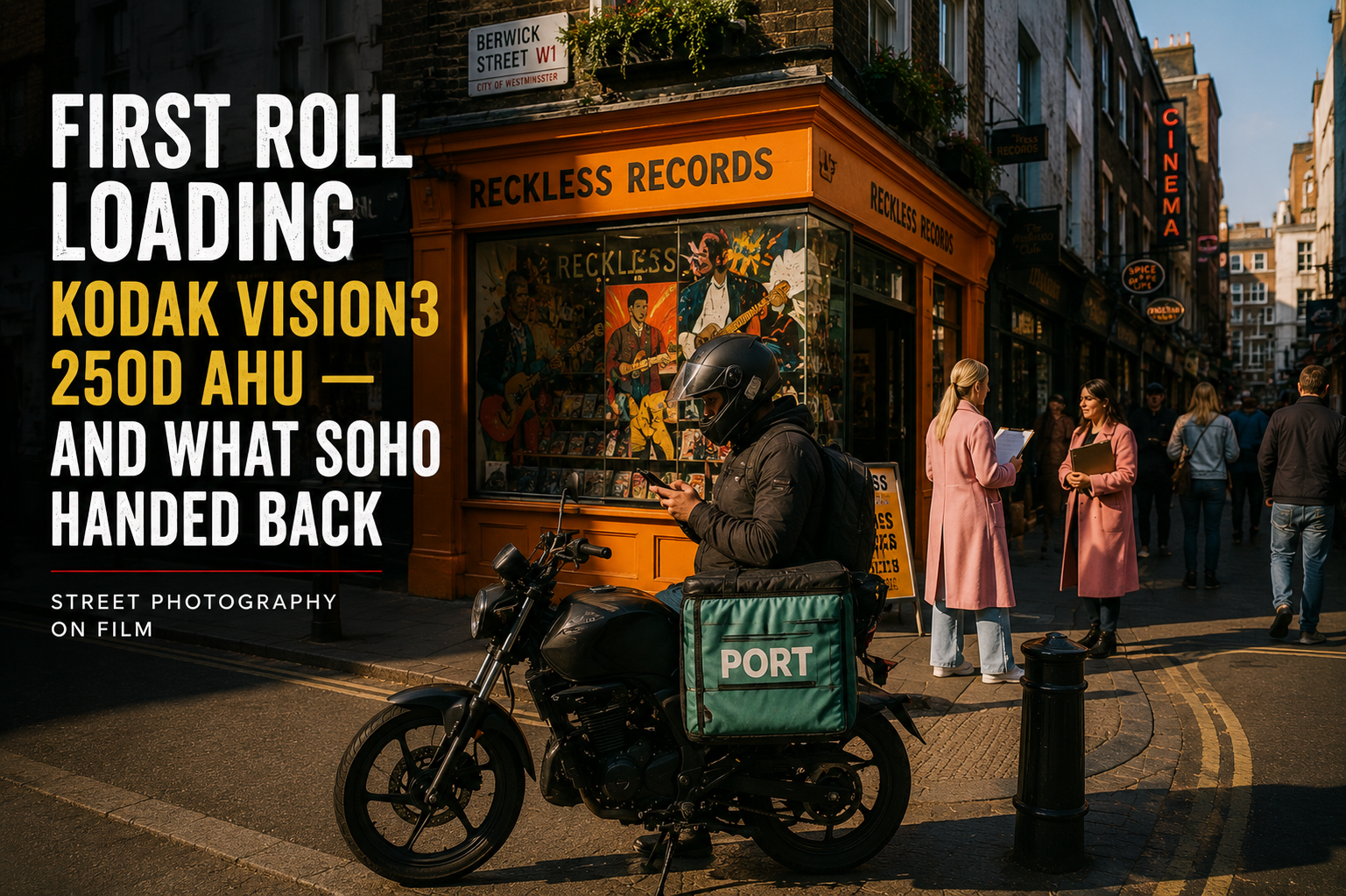
First Roll Loading Kodak Vision3 250D — and what Soho handed back
I've been shooting predominantly black and white for a period of time now of the 35mm film cameras. Years, really. Colour always felt like it needed a reason — a justification for the extra visual information it brings to a frame. Black and white strips a scene back to its essentials. Tone, texture, shadow, geometry. It's a clean way to work.
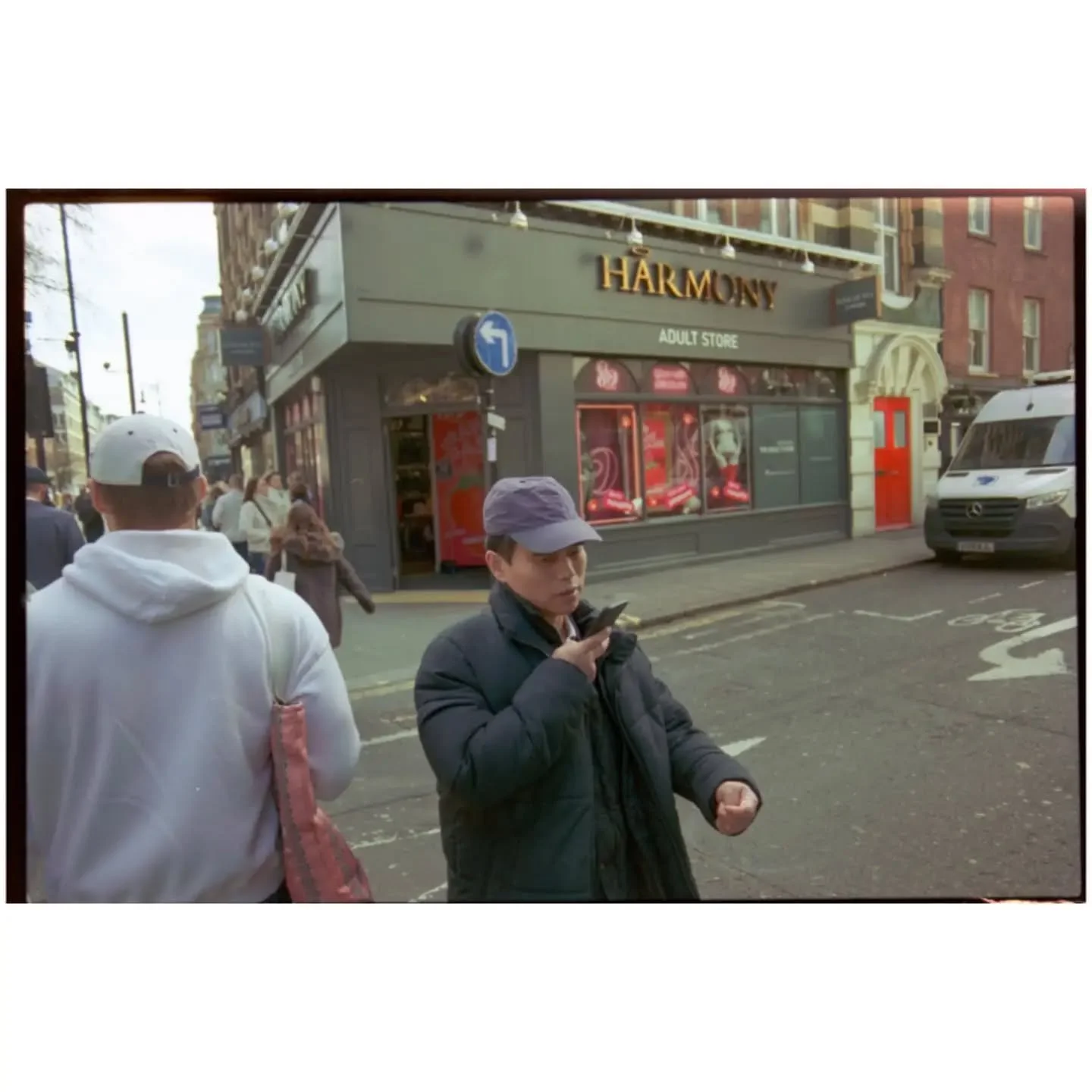
So loading up a roll of Kodak Vision3 250D AHU into the Nikon F80 felt like a deliberate step off familiar ground. This is a motion picture film stock — designed originally for cinema use in daylight conditions — and it's been building a serious following among still photographers. I'd read about it, seen other people's results, and kept putting it off. This time I just loaded it and went out.
I've been shooting predominantly black and white for a period of time now of the 35mm film cameras. Years, really. Colour always felt like it needed a reason — a justification for the extra visual information it brings to a frame. Black and white strips a scene back to its essentials. Tone, texture, shadow, geometry. It's a clean way to work.
So loading up a roll of Kodak Vision3 250D AHU into the Nikon F80 felt like a deliberate step off familiar ground. This is a motion picture film stock — designed originally for cinema use in daylight conditions — and it's been building a serious following among still photographers. I'd read about it, seen other people's results, and kept putting it off. This time I just loaded it and went out.
I headed into London a couple of weeks ago for an afternoon with no real plan beyond Soho and the West End. That's usually how the best days go. No agenda. Just walking, looking, reacting.
"I wasn't prepared for quite how warm it would be. Not warm in the pushed, processed way you can fake digitally — warm in the way afternoon light in London actually looks."
The film
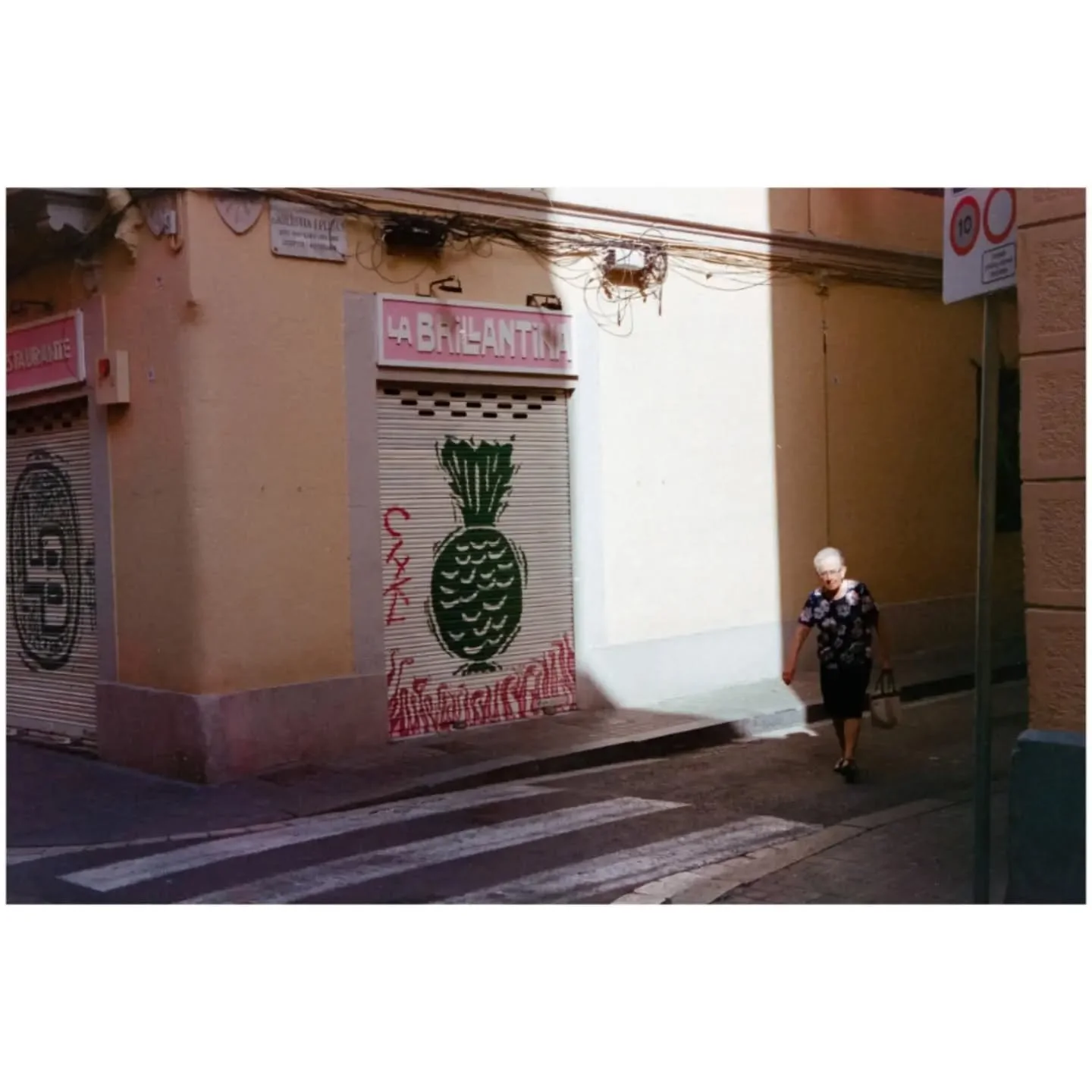
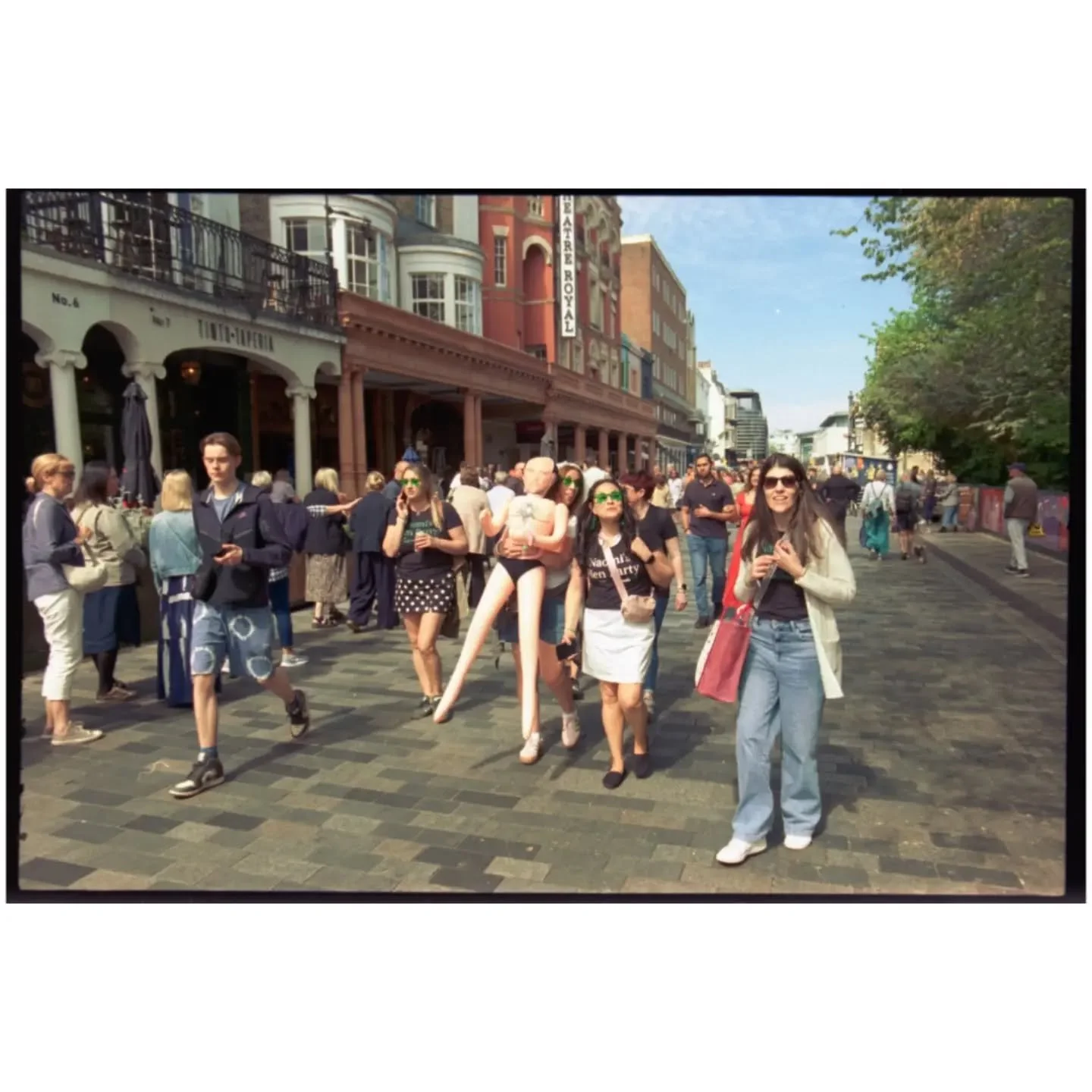
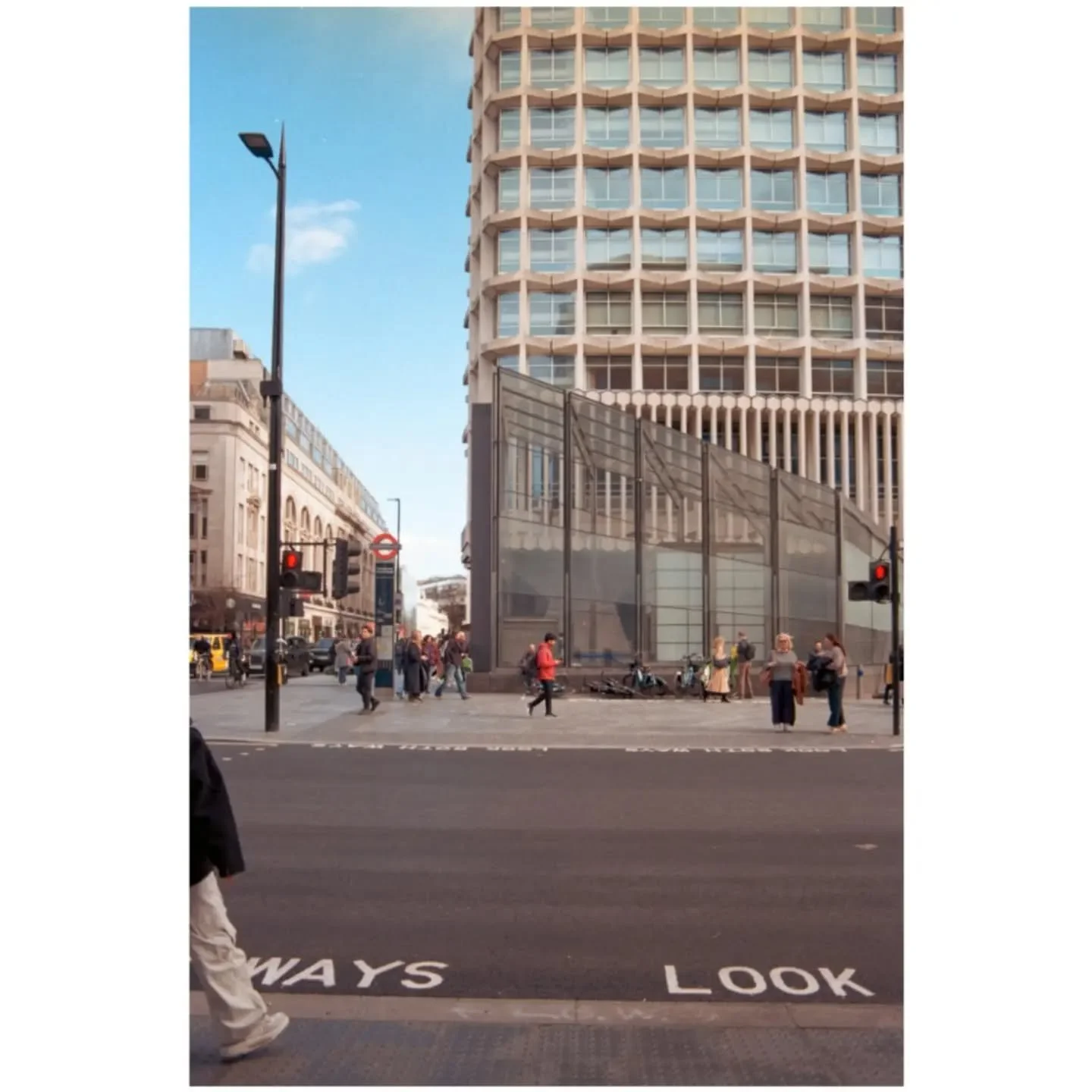
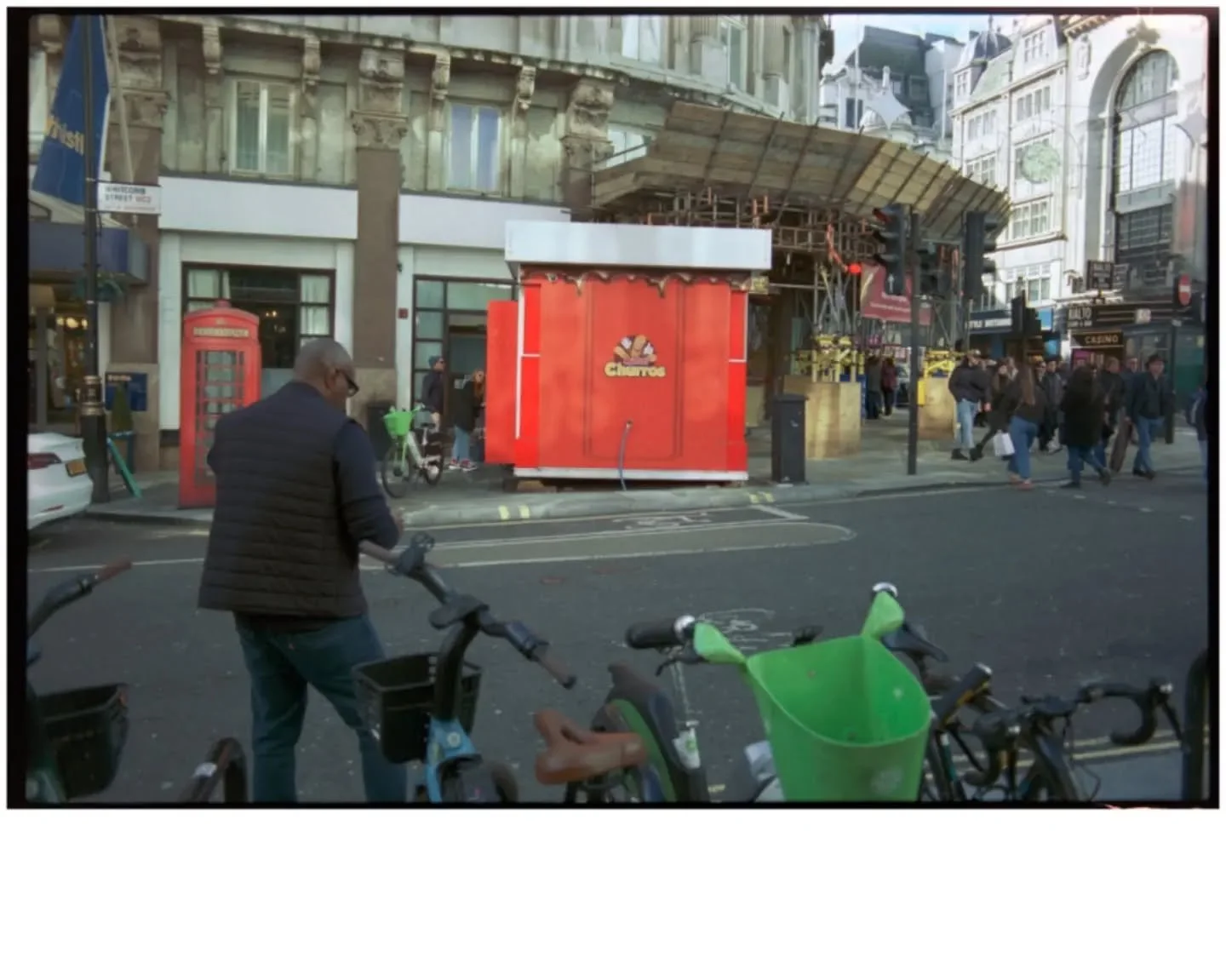
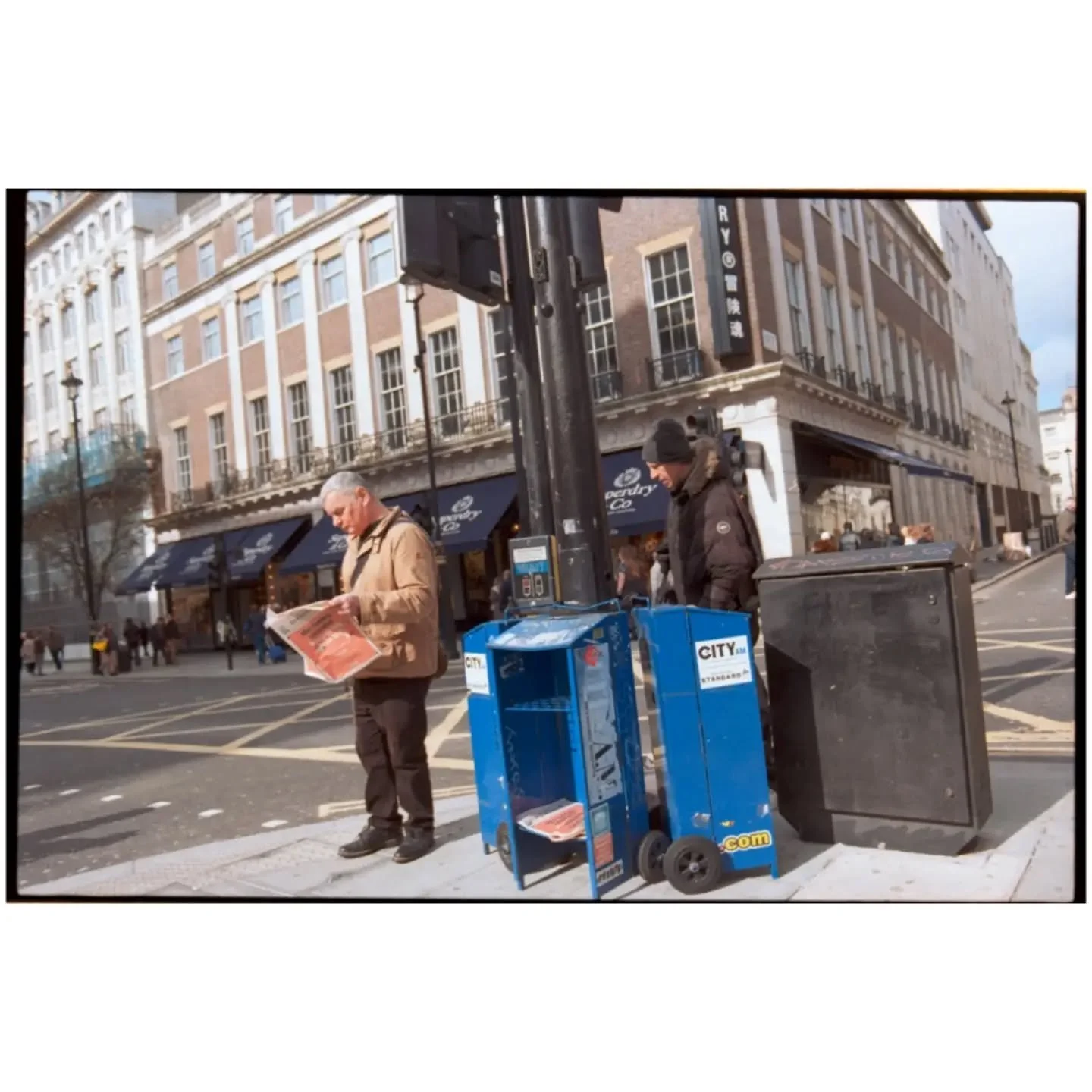
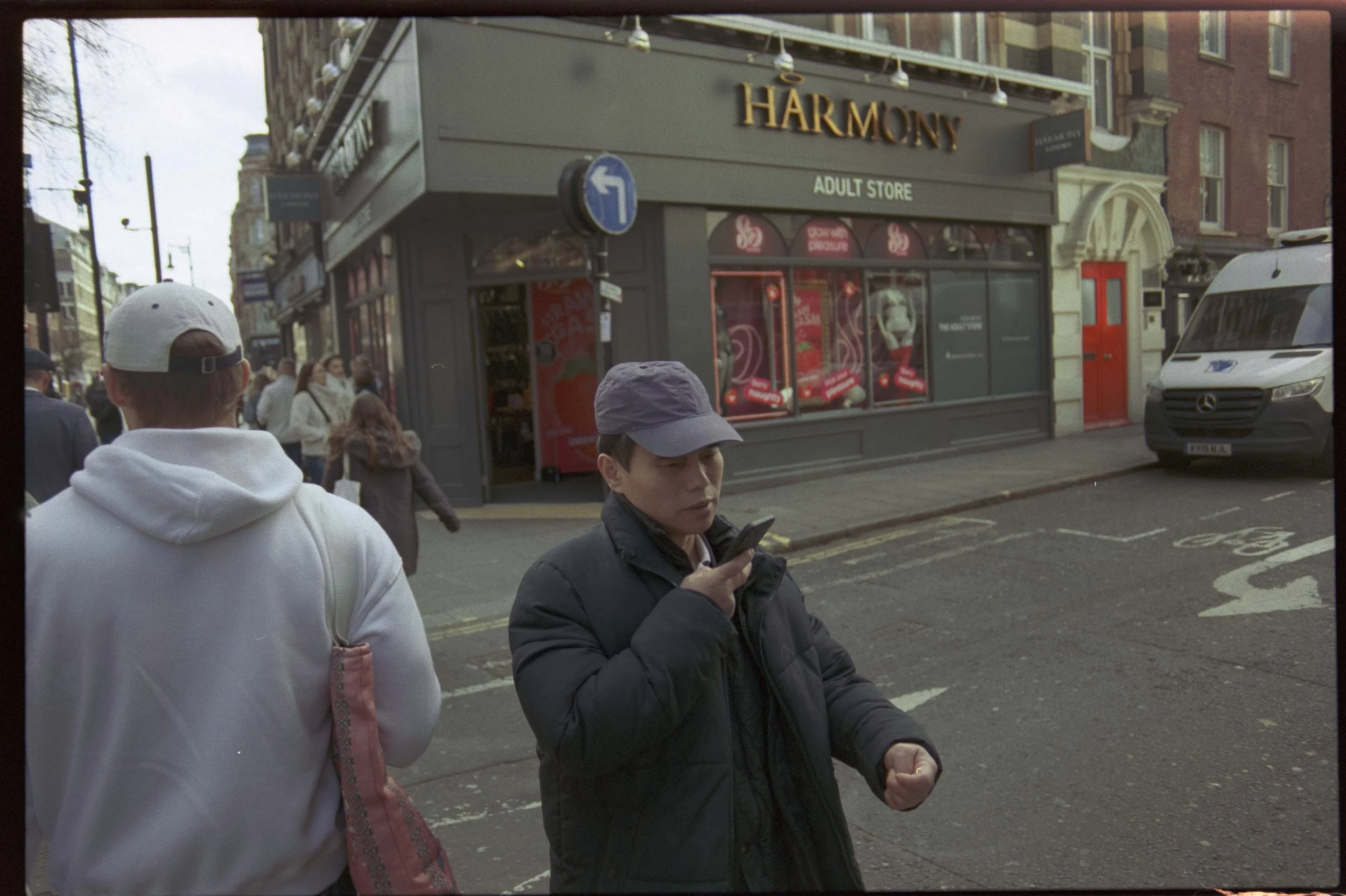
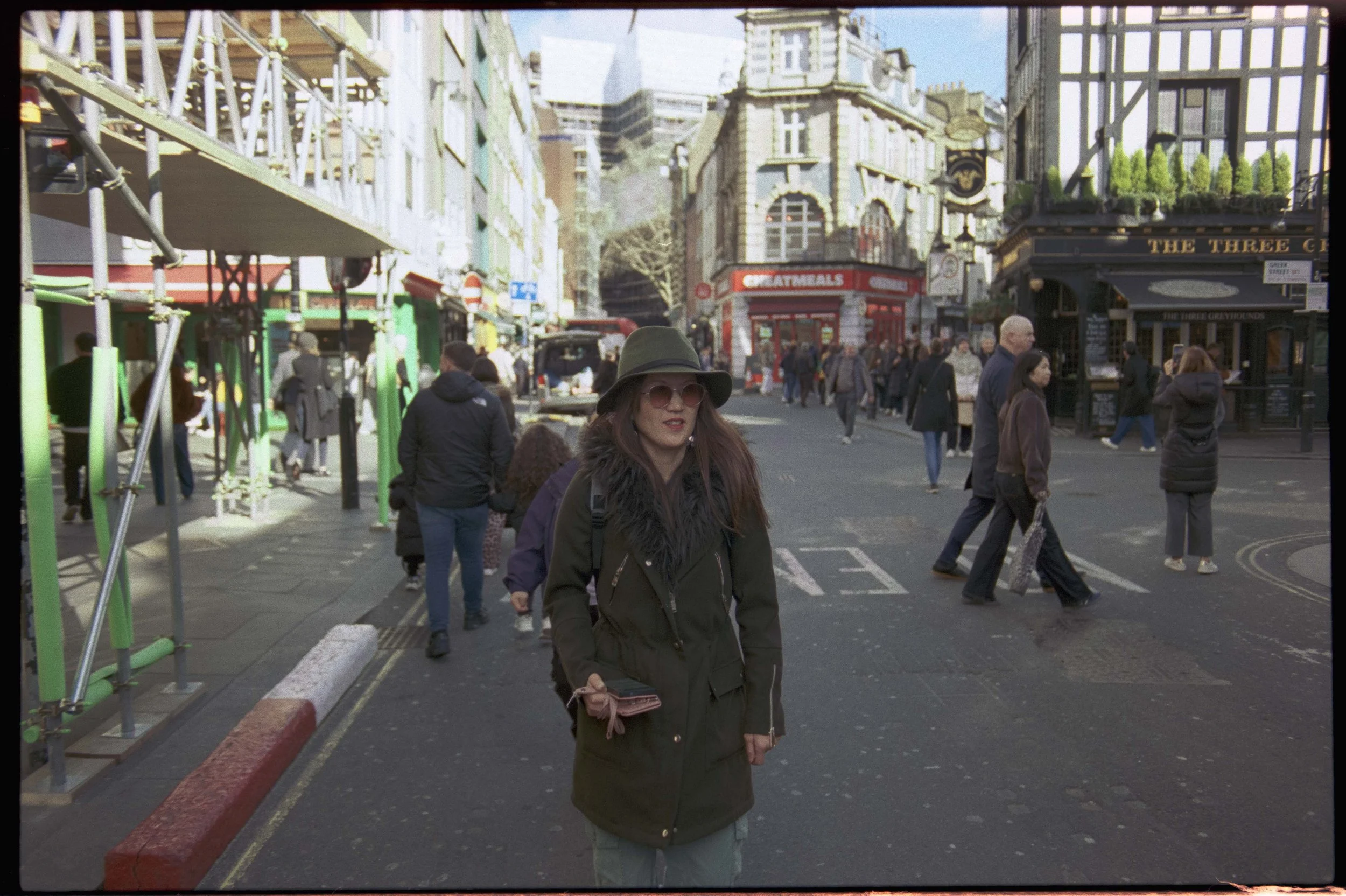
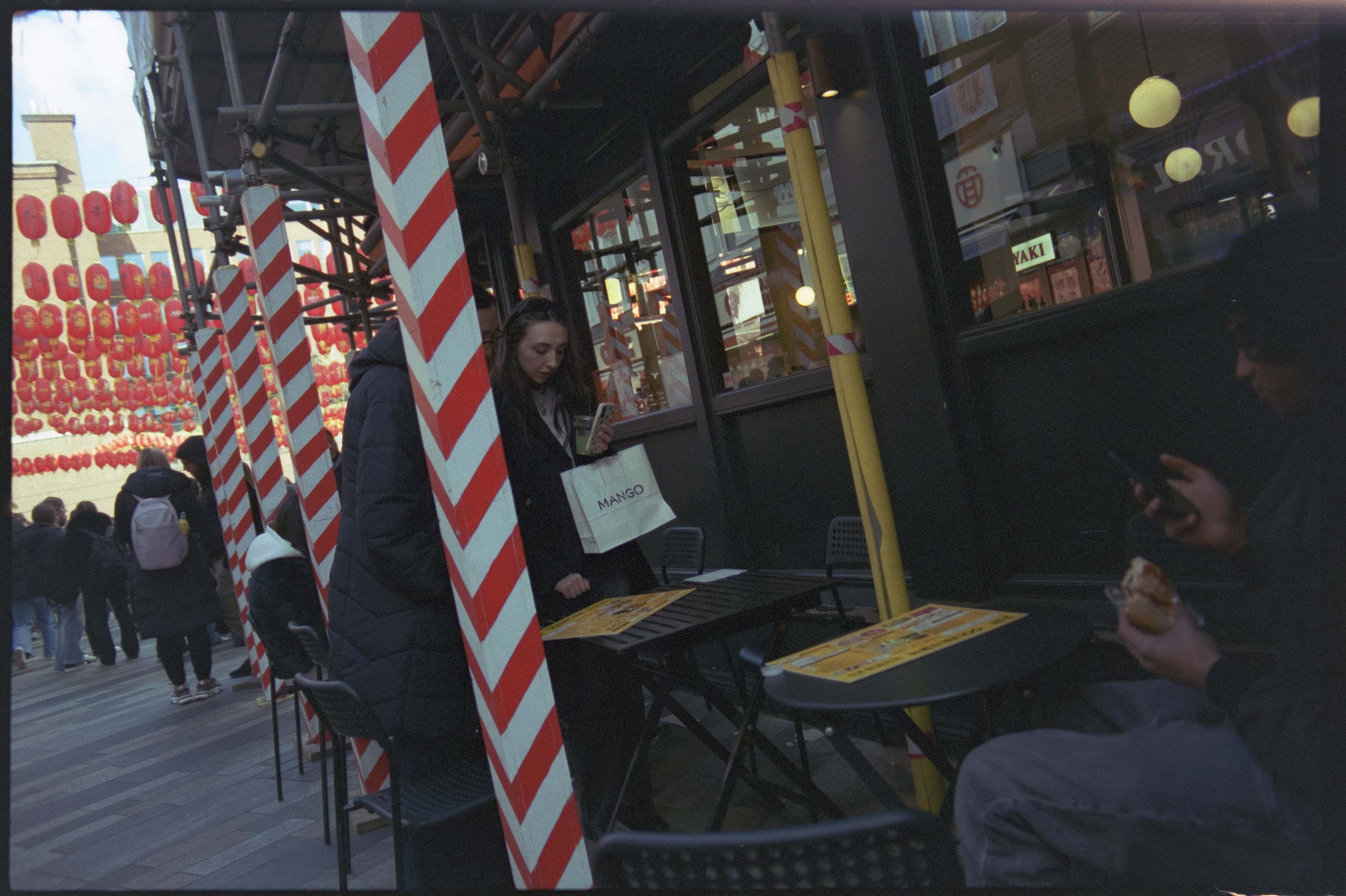
The warmth hit me the moment I got the processed film back. Vision3 250D AHU has a quality to its colour rendition that's difficult to articulate but immediately visible in the frames. It's not the oversaturated, high-contrast look of some colour negative stocks. It's quieter than that. More honest. The way light falls on a green café awning, or a pink coat, or an orange shopfront — it's rendered with a cinematic restraint that suits documentary street work perfectly.
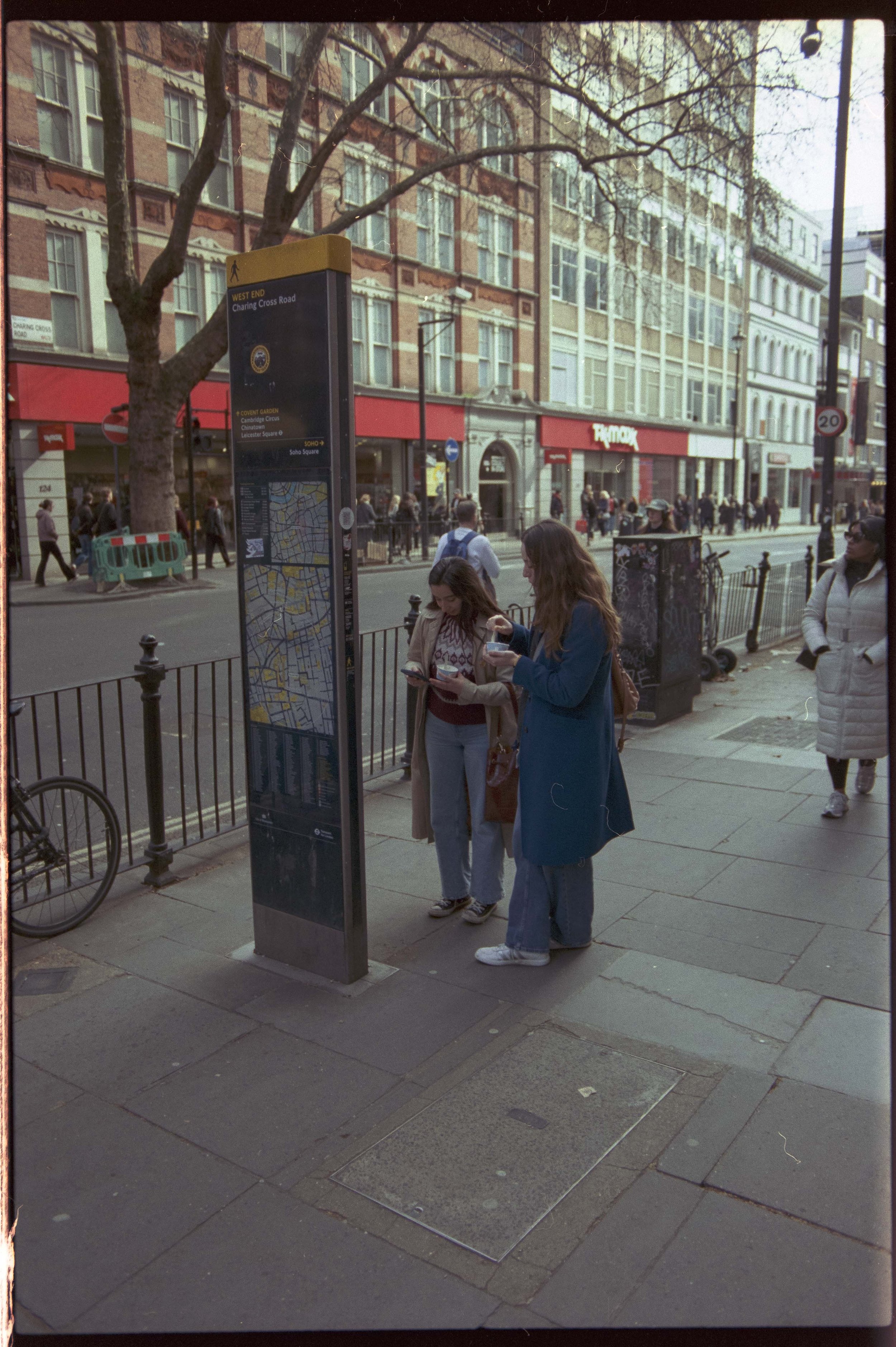
The midtones are where it really earns its reputation. There's a richness in the middle of the tonal range that I haven't found in other stocks I've tried. Skin tones are warm without being ruddy. Shadows hold detail. Highlights — even in the direct afternoon sun I was shooting in — don't blow out catastrophically. For a daylight stock at ISO 250, it handles the contrast range of a busy London street remarkably well.
What Soho gave me
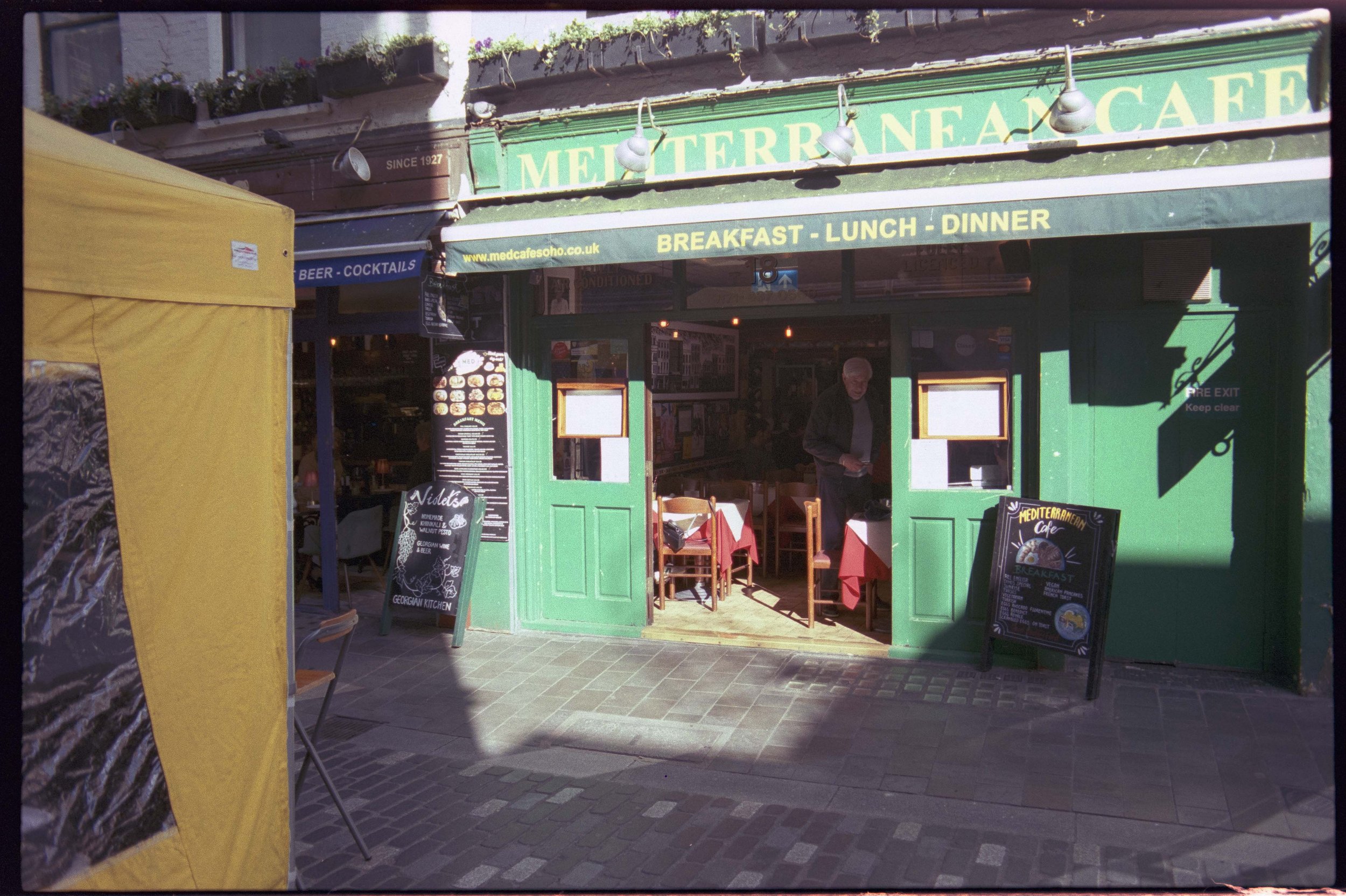
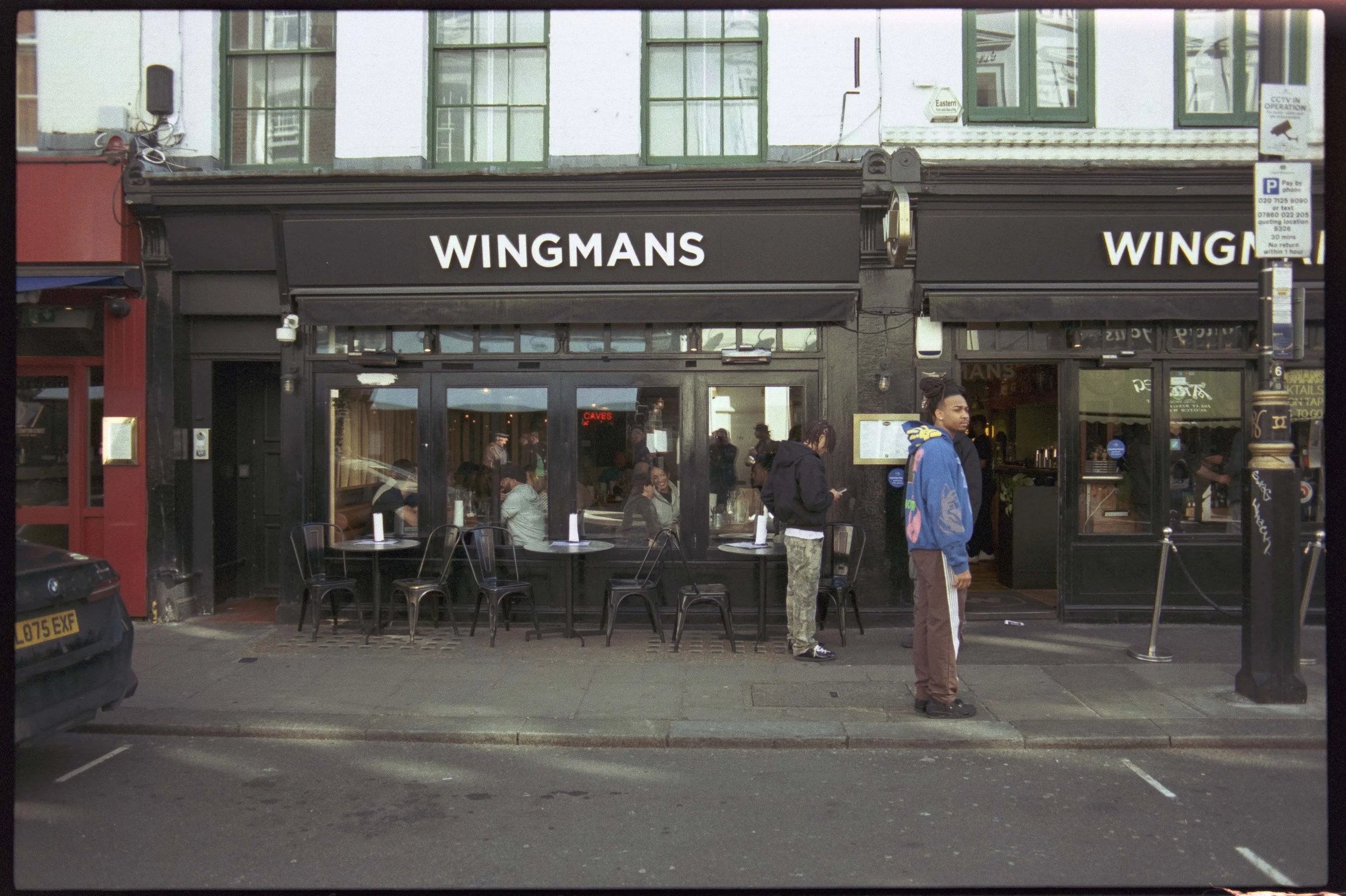
I started on the south end of Soho, working my way north through the afternoon. The Mediterranean Café on Old Compton Street stopped me almost immediately — a place that's been there since 1927, its deep green fascia catching the sun at an angle that Vision3 handled beautifully, the warm gold of the signage glowing against the paint. A man stood in the doorway, just watching the street. I got one frame and kept moving.
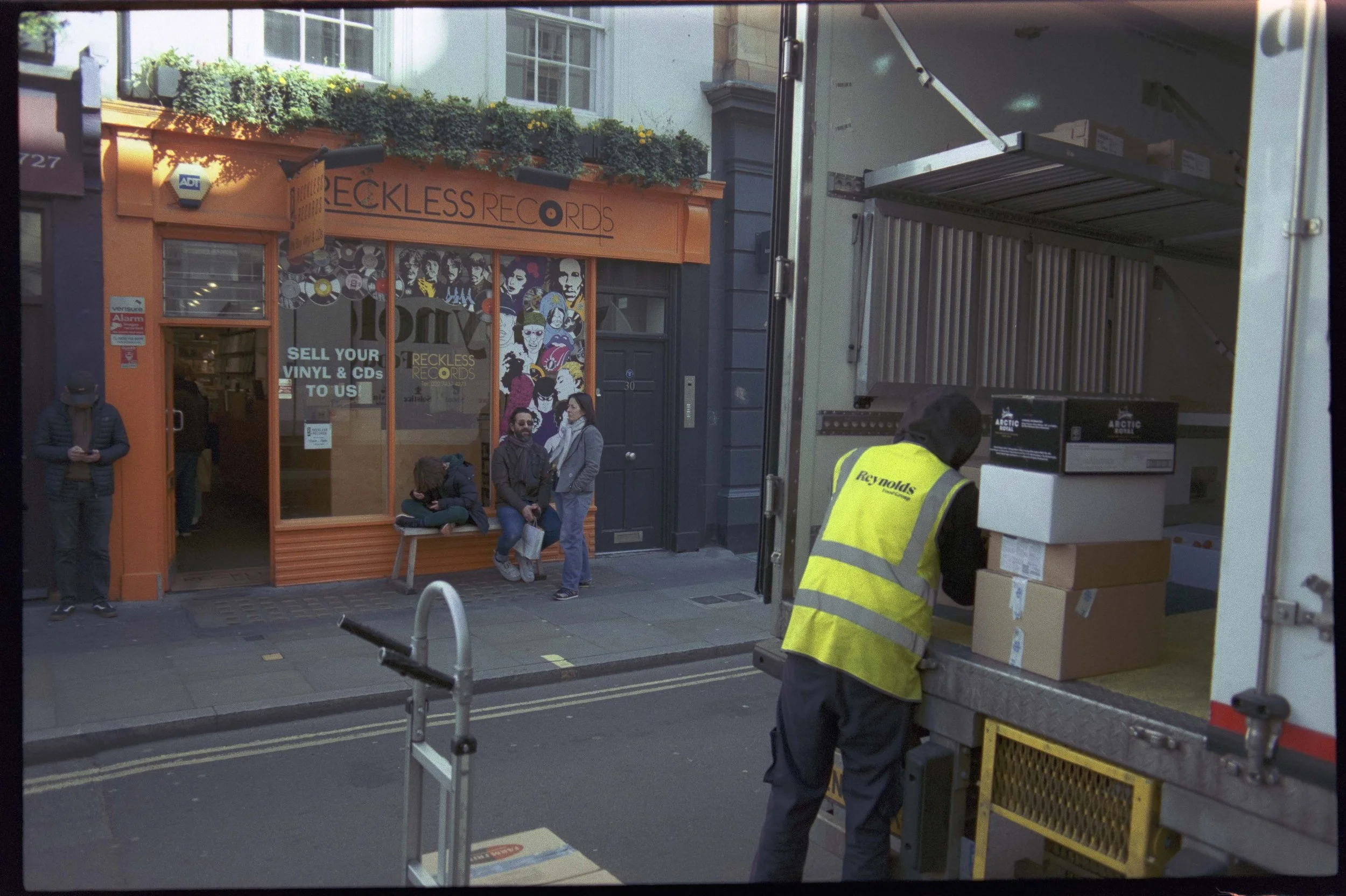
Around the corner, Reckless Records — that vivid orange shopfront with its illustrated window display of musicians — was being interrupted by a delivery driver in a hi-vis yellow jacket unloading boxes from a truck. The contrast of orange and yellow should have been too much. Vision3 made it work. That's one of its qualities: it handles colour density without letting things fight.
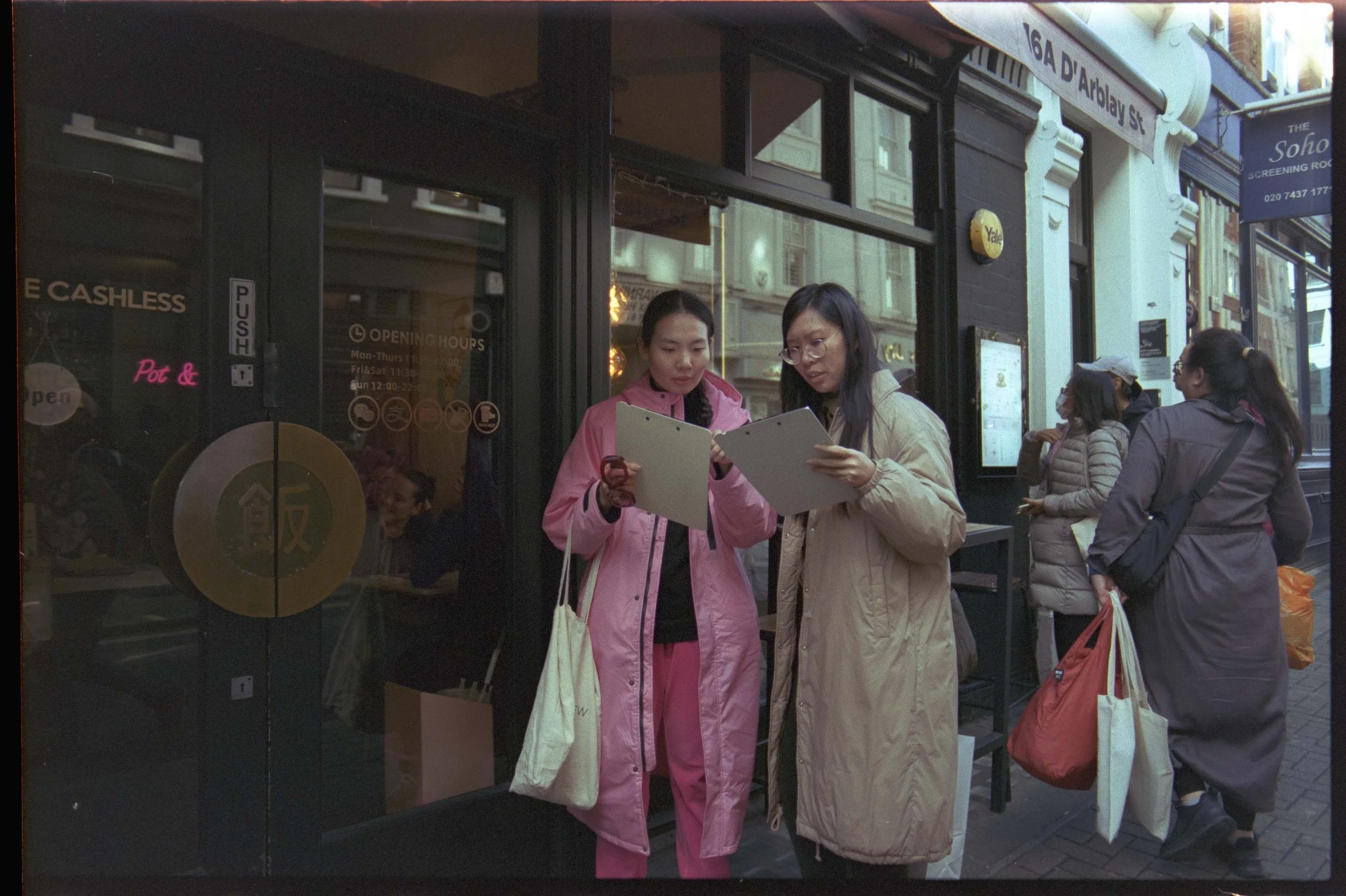
On D'Arblay Street I found two women in matching pink coats, both consulting clipboards outside a restaurant, deep in conversation. The warmth of those coats against the cooler tones of the street behind them is the kind of colour moment that simply doesn't exist in black and white. You don't get to choose that. The stock gives it to you.
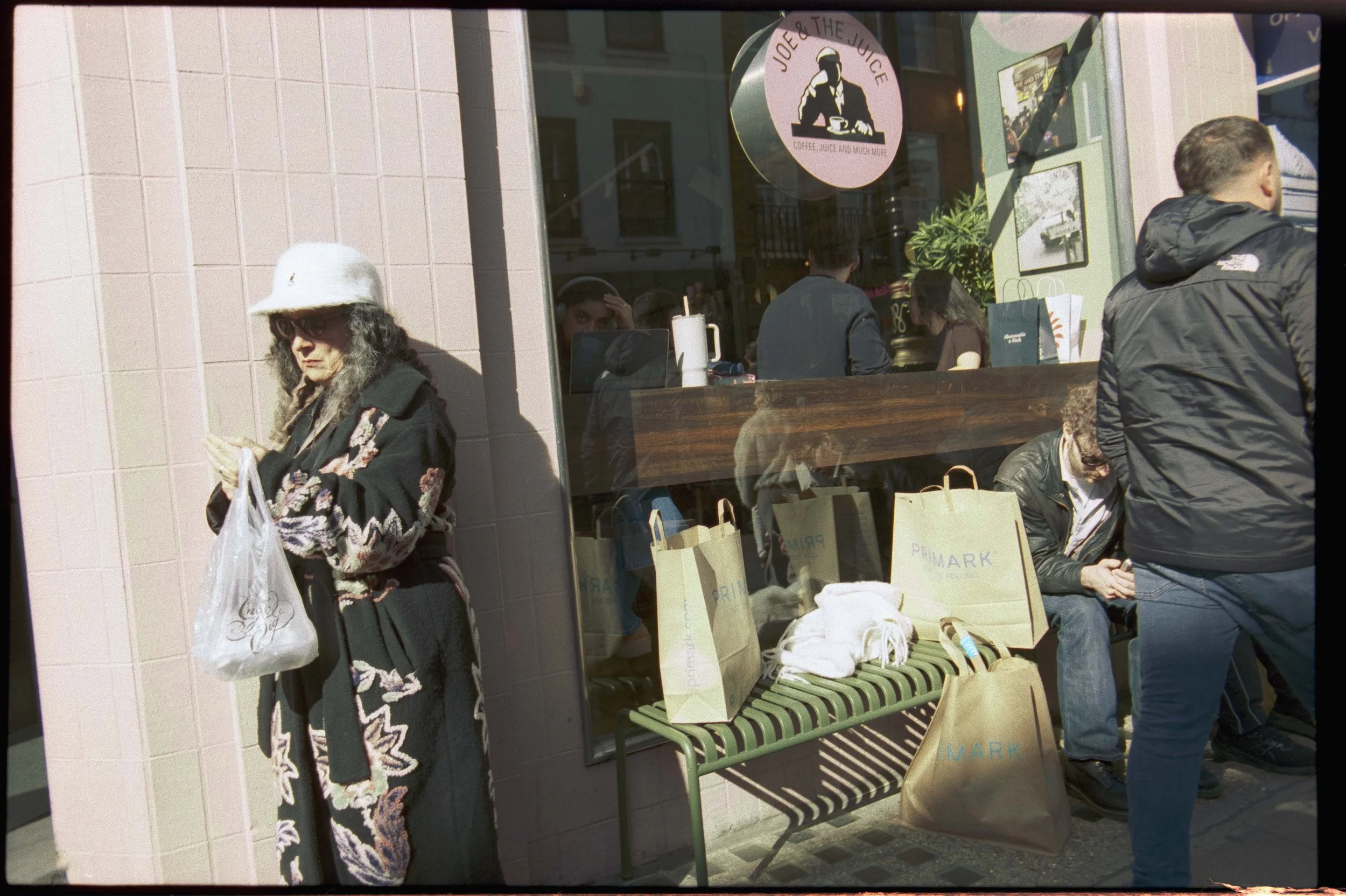
"Vision3 250D handles colour density without letting things fight. That's one of its qualities — and Soho tests it constantly."
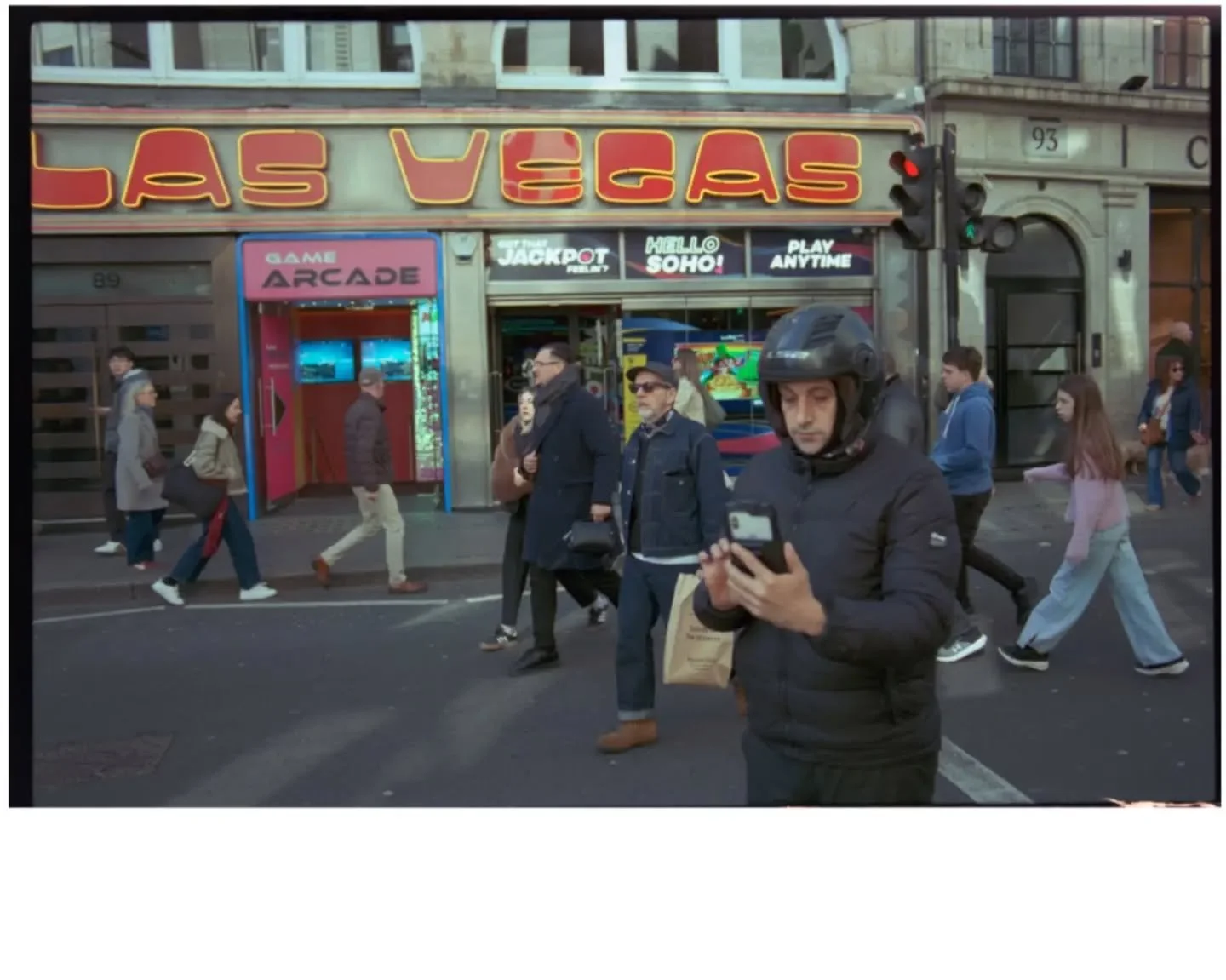
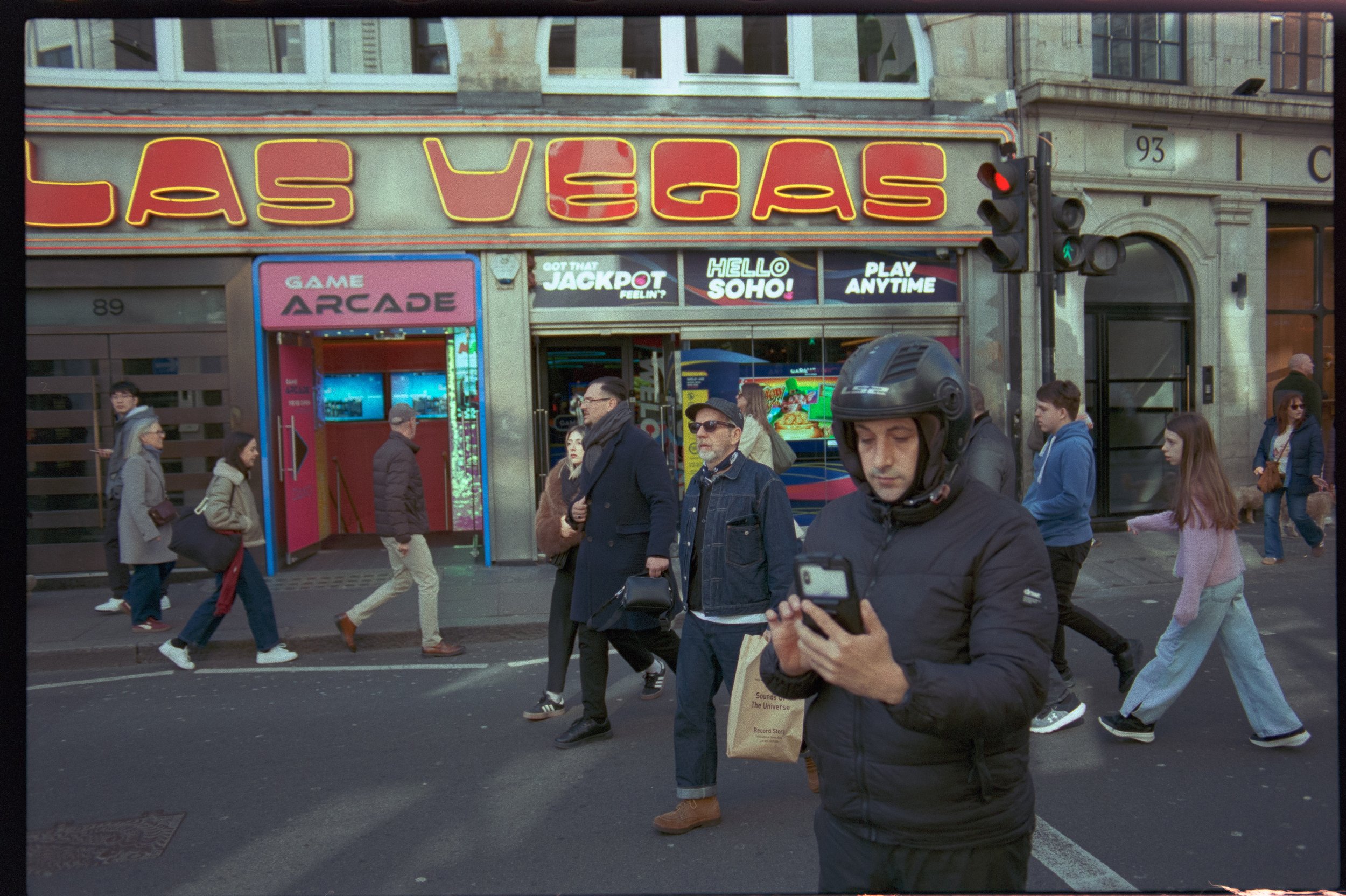
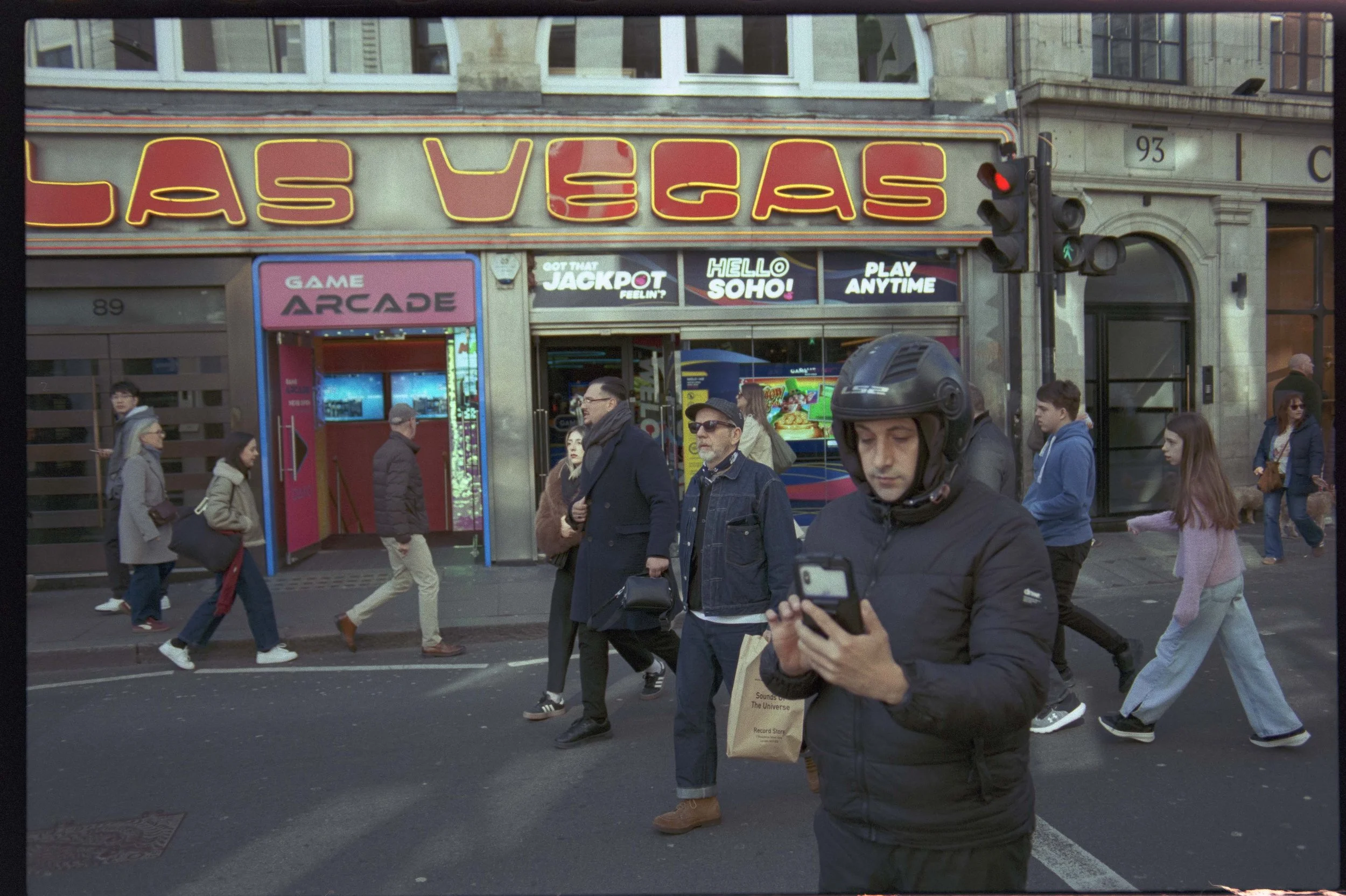
The Las Vegas arcade on what I think was Wardour Street gave me one of the more unexpected frames of the day — a motorcyclist in a full helmet standing at the crossing checking his phone, the enormous neon Las Vegas signage blazing behind him in red and gold, Hello Soho stencilled across the frontage. Vision3 renders neon brilliantly. The warmth of the sign, the cool blue of the afternoon sky in the upper corner of the frame — it's exactly what this stock was made for.
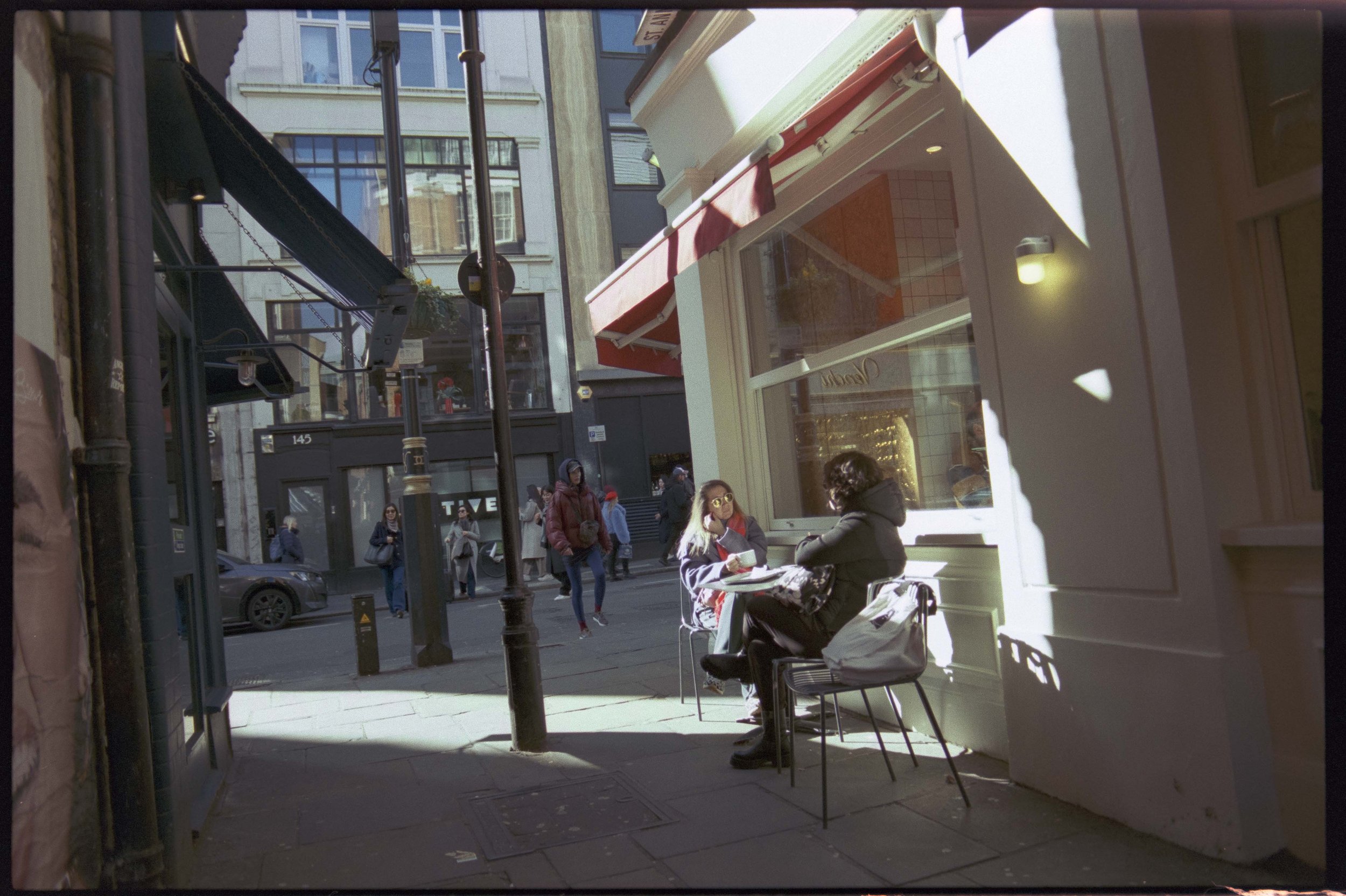
There was a quieter moment mid-roll that I keep coming back to: two women sitting outside a café in a narrow Soho alley, a red awning above them, dappled light falling across the table. No action. No joke. Just two people and an afternoon and the quality of light that Vision3 seems built to hold.
The three jokes
And then London started doing what London does.
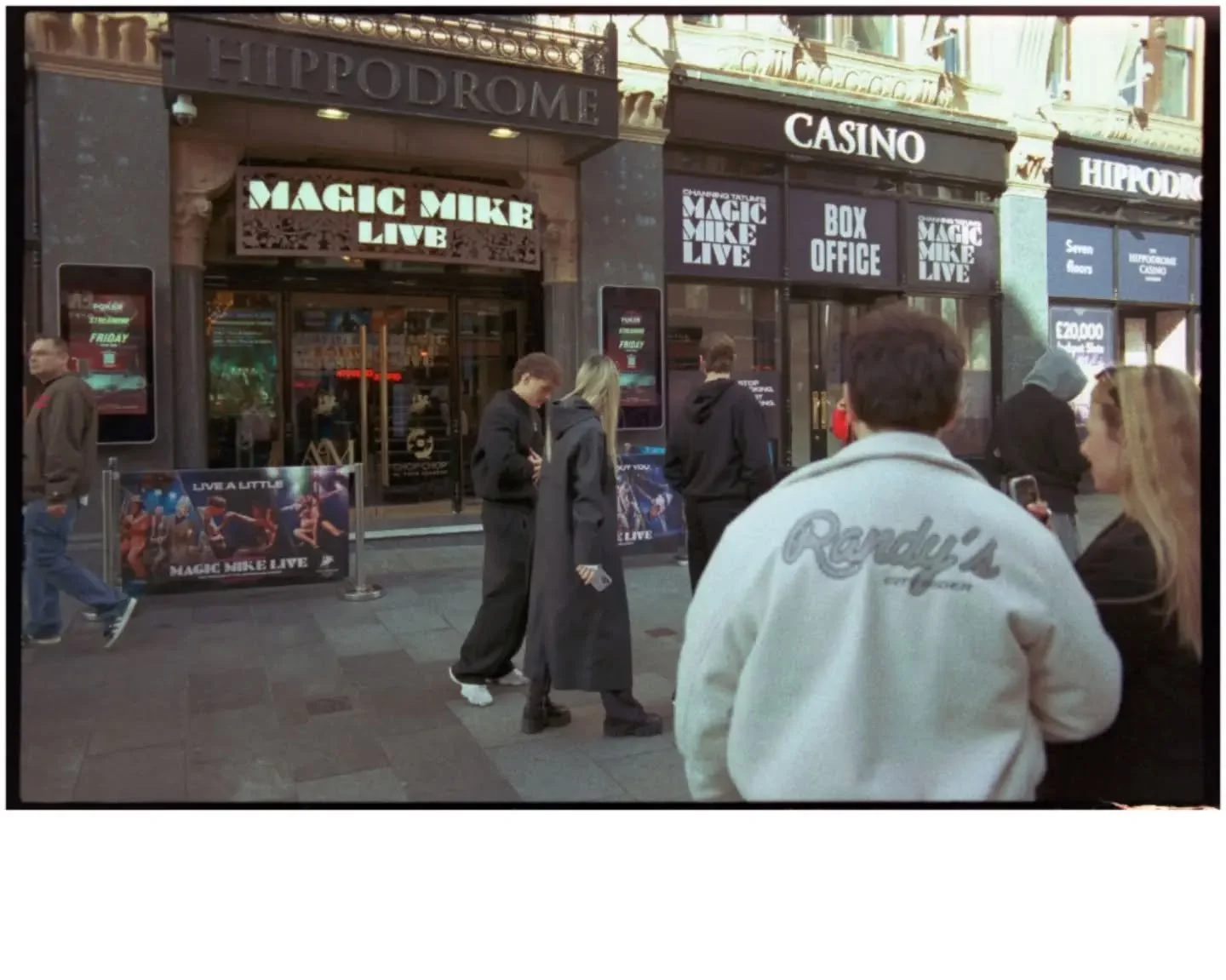
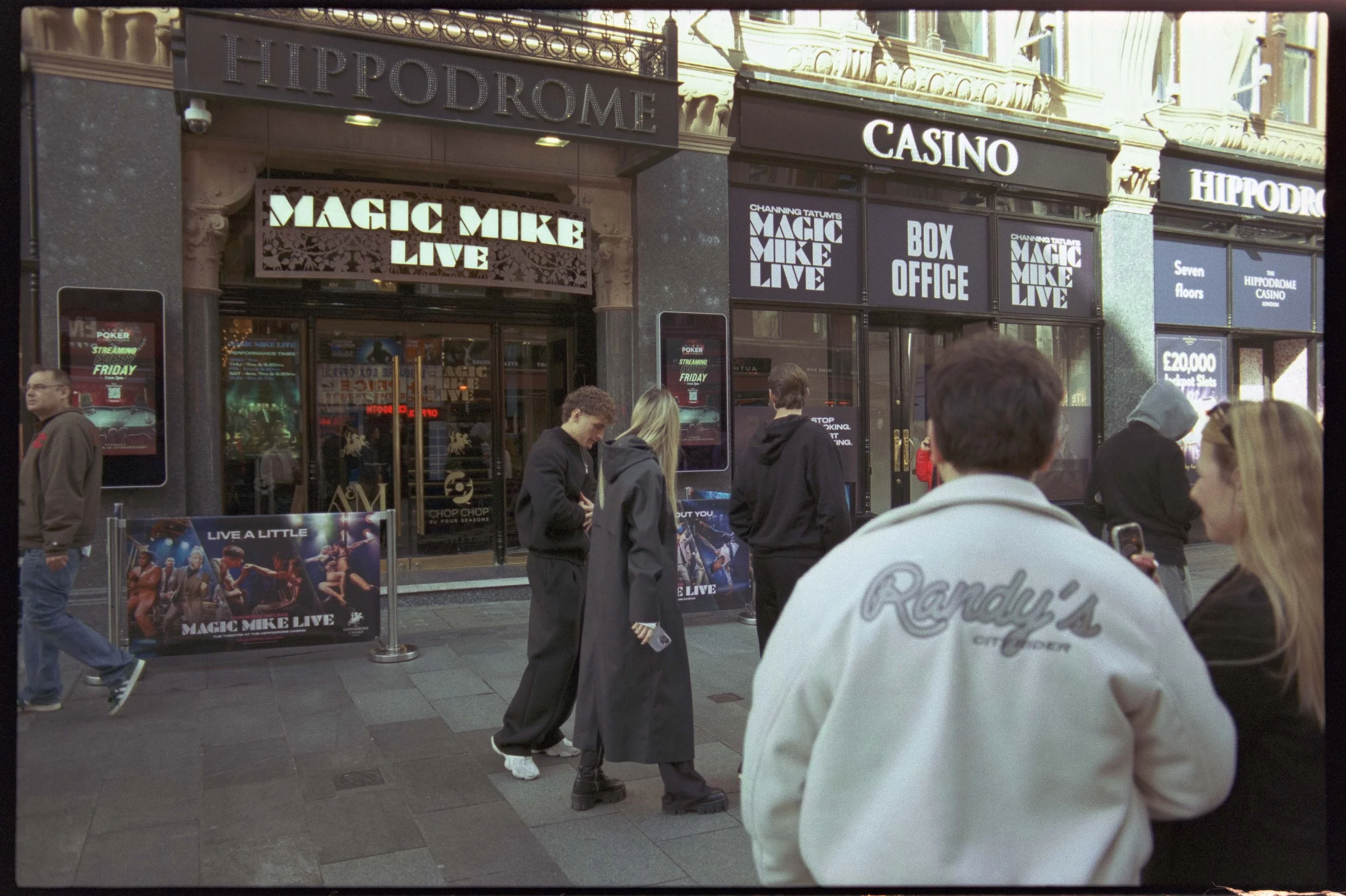
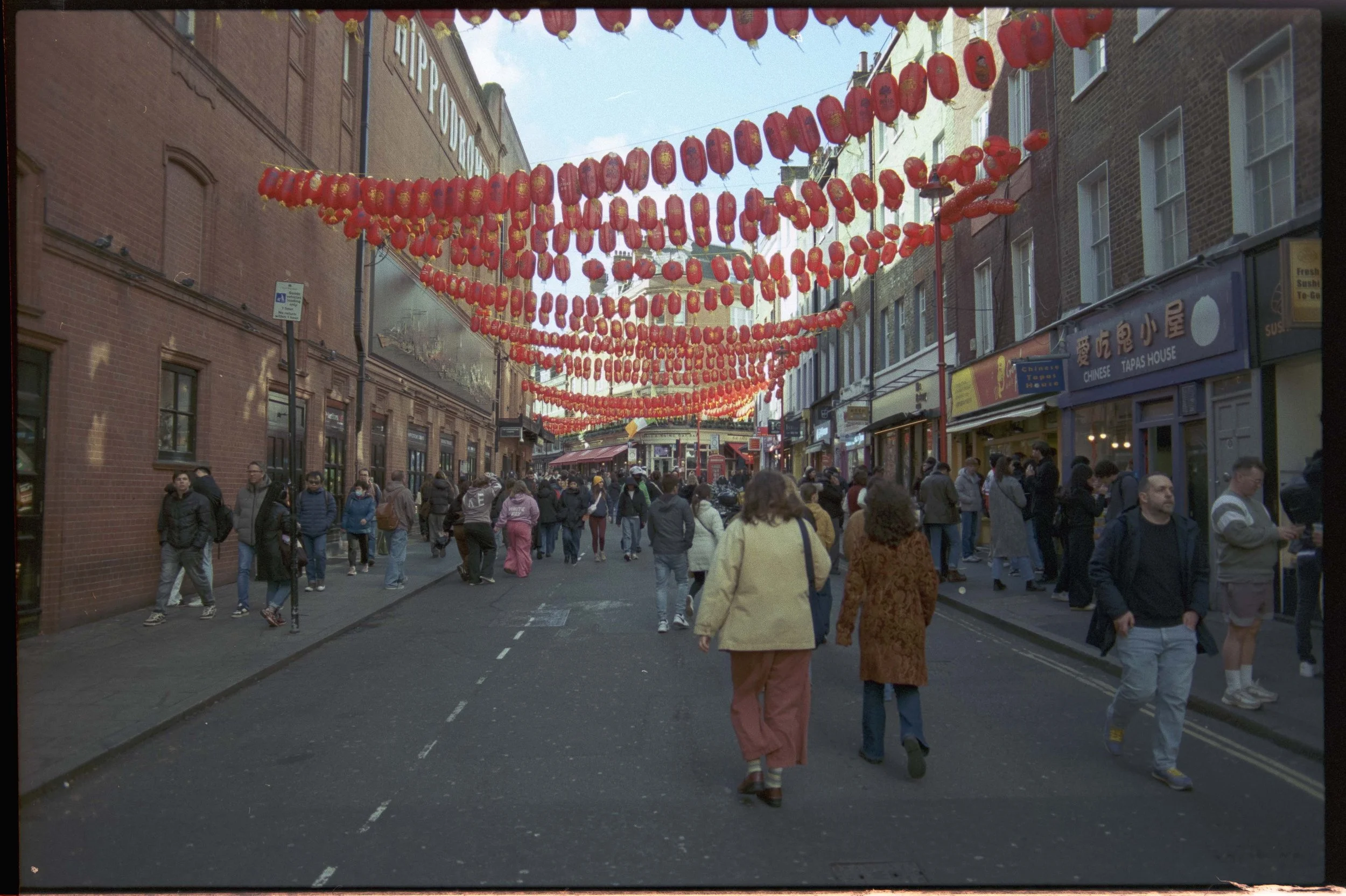
The first one I almost missed. I was walking past the Hippodrome on Cranbourn Street when I clocked it — a man standing on the pavement, back turned, the word Randy's written in large script across the back of his white jacket. Behind him, filling the entire frontage of the venue: Magic Mike Live. He had no idea. The street had assembled itself into a perfect joke and was waiting, with infinite patience, for someone to walk past with a camera.
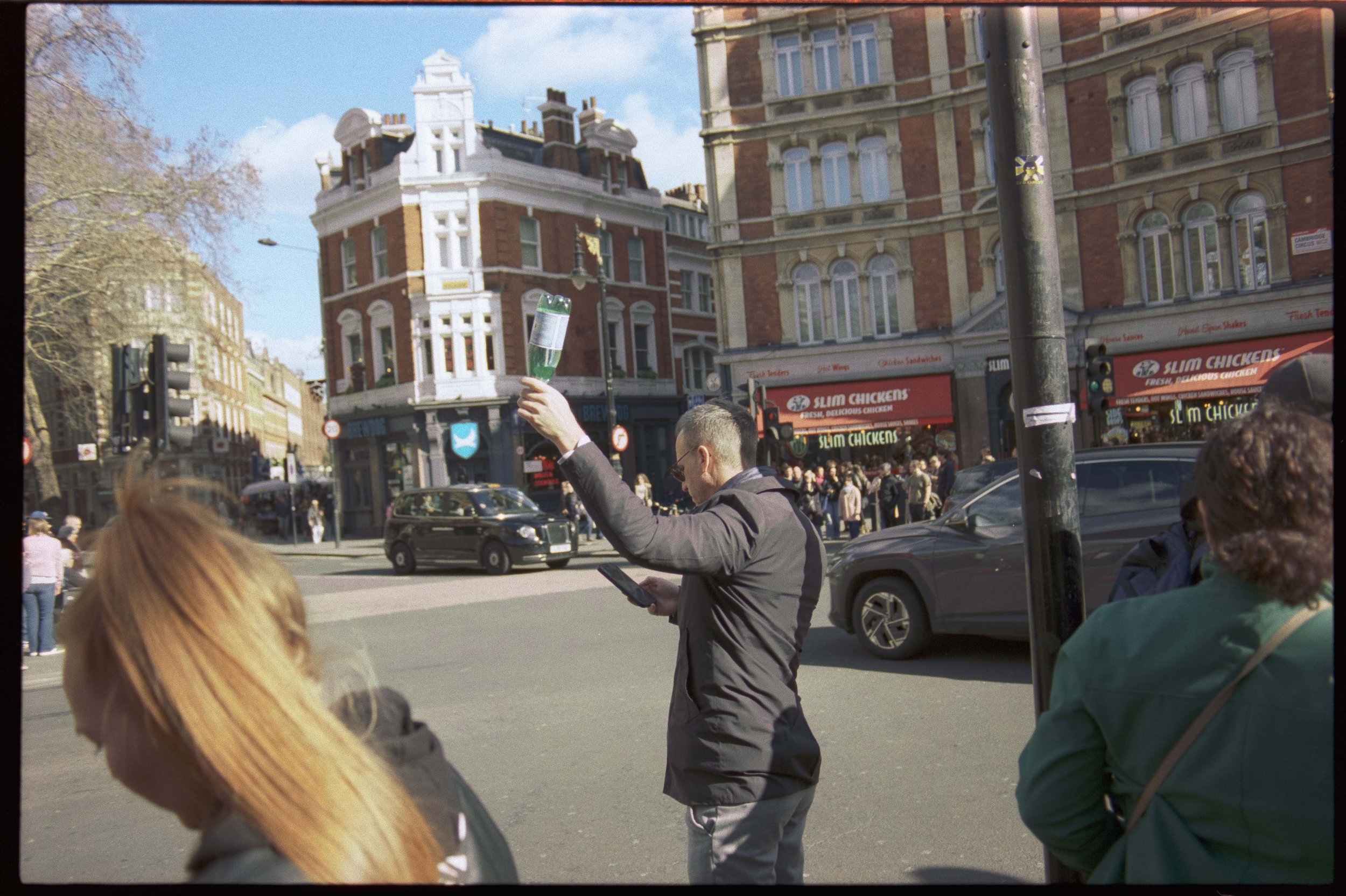
The second came at a crossing near the top of Charing Cross Road. A tour guide — grey hair, suit jacket, every inch the professional — was trying to marshal his group through the lunchtime traffic. His technique was to hold a green bottle above his head like a torch, a beacon for anyone who'd wandered off. He was checking his phone with the other hand. I pressed the shutter at the exact moment his arm went up. He was, without any doubt, leading them to the pub.
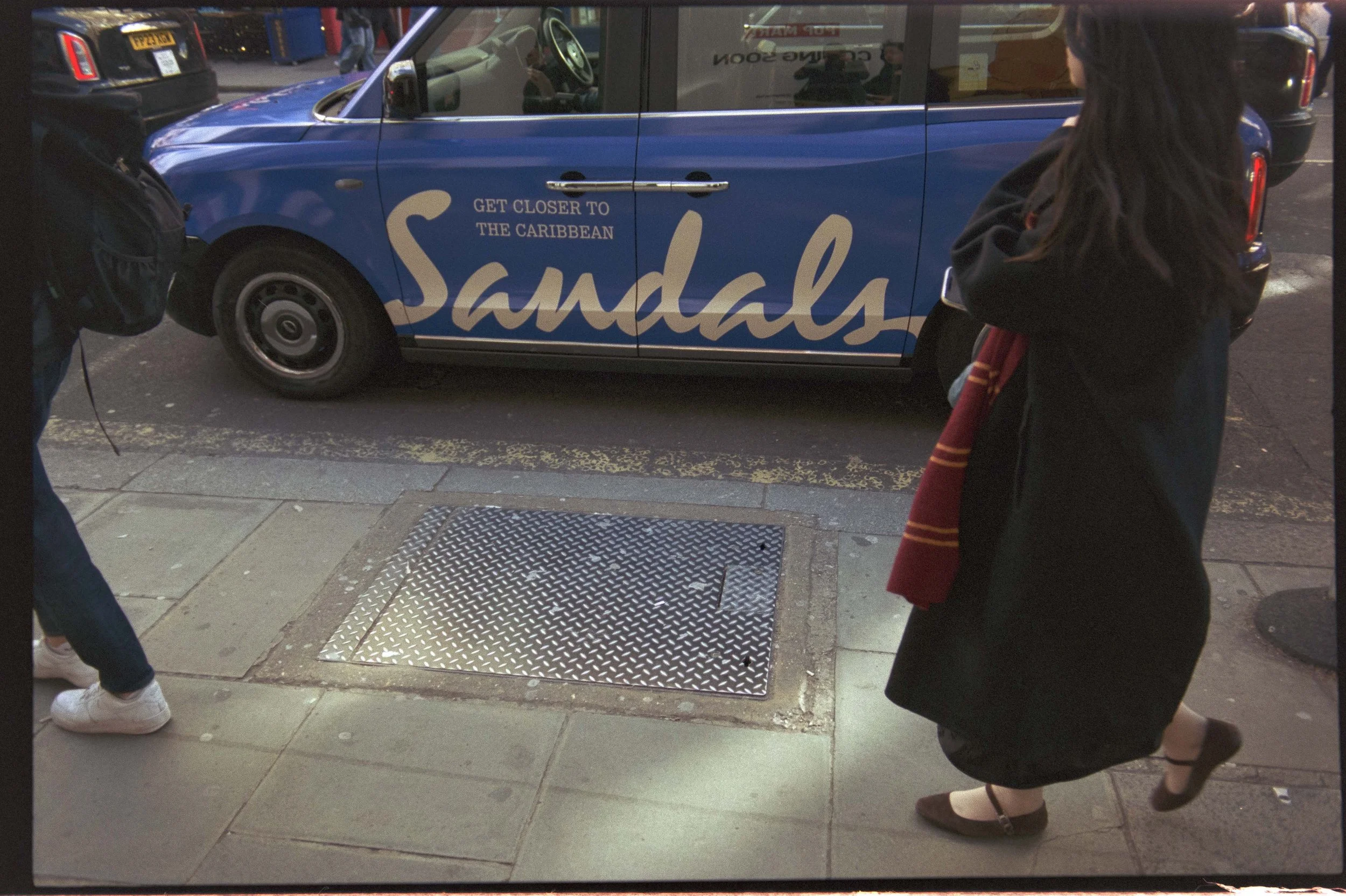
The third was the one I'm most pleased with. A London black cab, completely wrapped in the Sandals Caribbean holiday livery — blue bodywork, the Sandals script in cream, Get Closer to the Caribbean. Passing directly in front of it at that exact moment: a woman in a full Hogwarts Gryffindor robe, red and gold striped scarf trailing behind her. On her feet: sandals. She was heading somewhere else entirely, completely unbothered.
Three found jokes on one roll. Colour made all of them better. Black and white would have served the geometry. Vision3 gave you the blue cab and the red scarf and the warm pavement and the whole absurd London afternoon.
What comes next
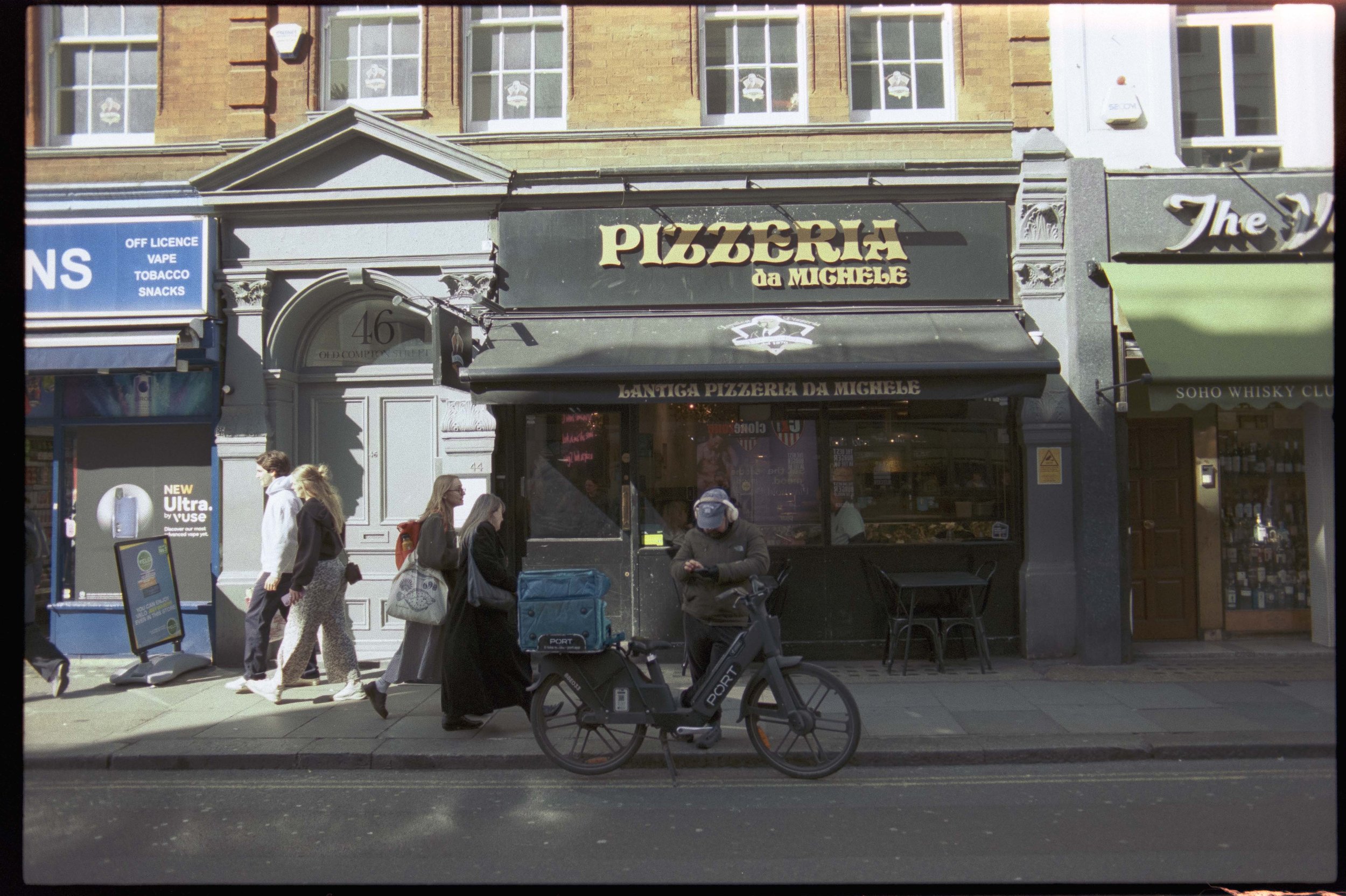
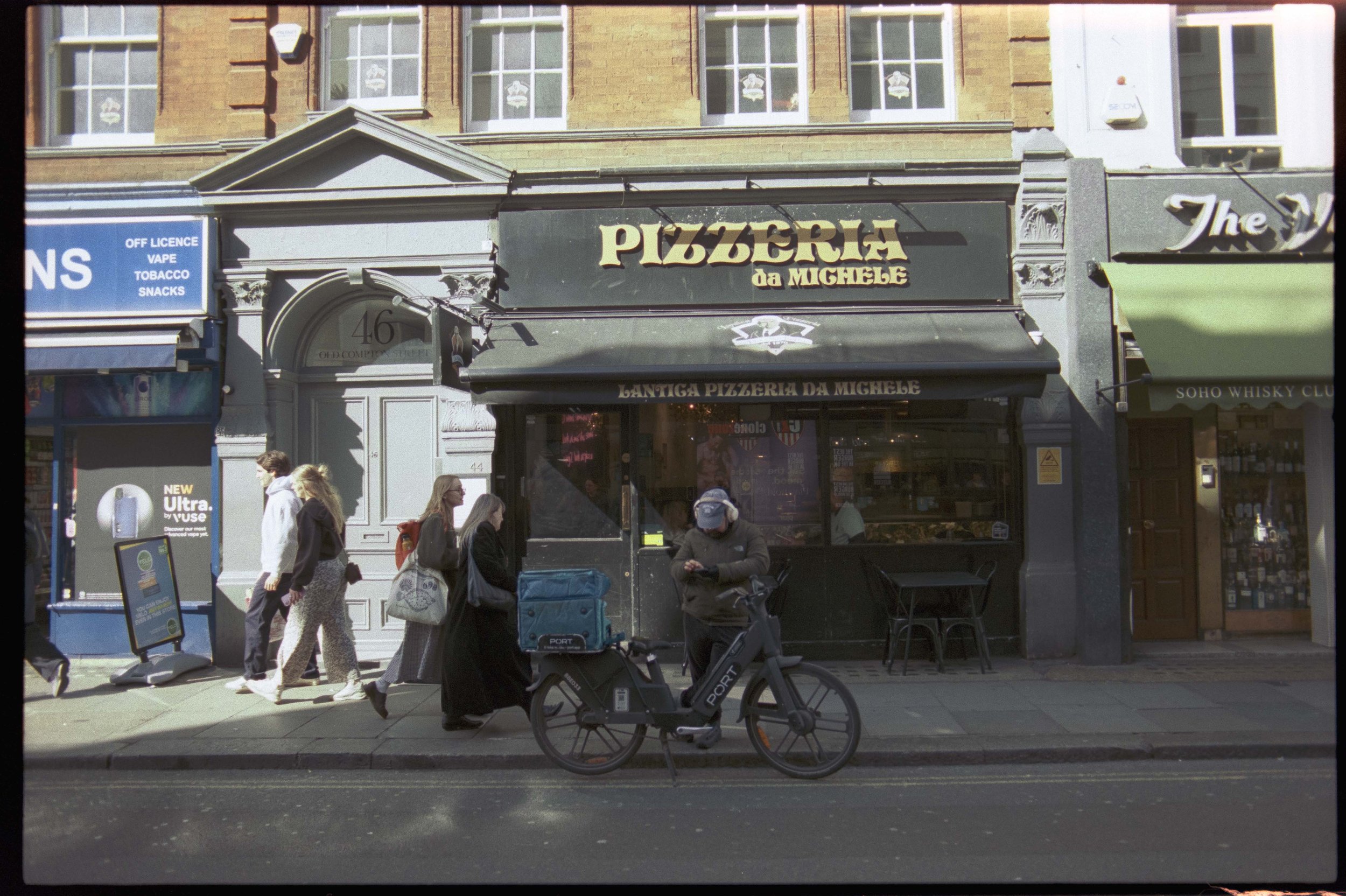
I finished the roll on Old Compton Street — a delivery rider on a PORT bike outside Pizzeria da Michele, checking his phone in the late afternoon light, the gold lettering of the restaurant sign warm above him. A good closer. Unhurried. The sort of frame that makes sense at the end of a day's shooting.
One roll is not enough to draw firm conclusions about a film stock. But it is enough to know whether you want to shoot another one, and the answer here is unambiguously yes. Vision3 250D asks you to work with colour rather than despite it — to look for the moments where the warmth of a late winter afternoon in London becomes part of the story rather than just the backdrop.
After years of reaching for black and white by default, that's a different kind of seeing. I'd been missing it without quite realising.
I've already ordered more rolls. Spring is coming, the light is getting longer, and the streets are filling up again. If the first outing with Vision3 250D is any indication, it's going to be a busy few months.
Black and white isn't going anywhere. But colour just made a very strong case for sharing the bag.
Until next time, keep snapping
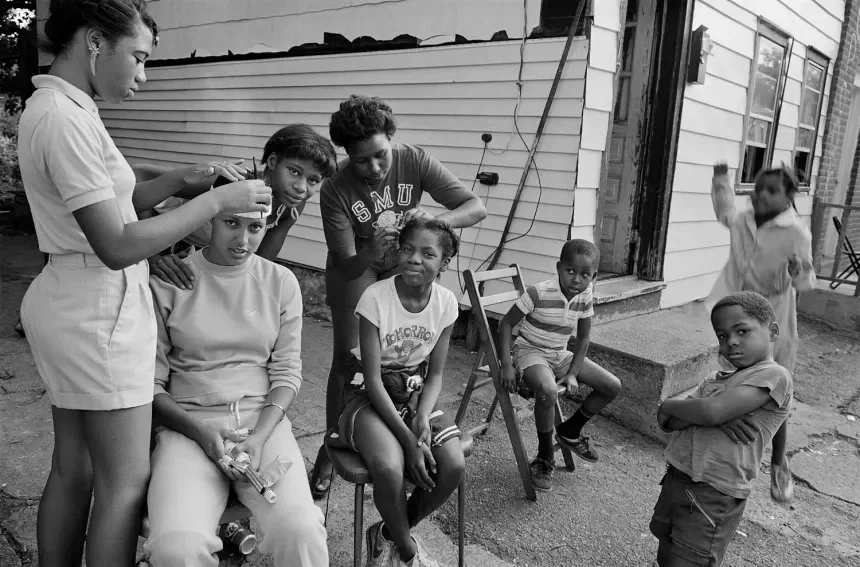
Modern Masters 3: Sage Sohier: The Quiet Observer Who Changed American Photography
On this International Women's Day, we turn our Modern Masters lens onto one of the most quietly radical voices in American documentary photography — a woman who, armed with a wide-angle lens and a warm curiosity, captured the hidden heart of a nation.
A Woman with a Camera and a Question
There are photographers who shout, and there are those who whisper. Sage Sohier has always whispered — and yet her work echoes across decades. Born in Washington D.C. in 1954, Sohier spent the late 1970s and 1980s wandering the working-class neighbourhoods of America, knocking on strangers' doors, gaining their trust, and producing some of the most affecting environmental portraits ever made. She photographed gay couples at the height of the AIDS crisis. She photographed her fashion-model mother growing old. She photographed children playing in the street before the internet arrived to pull them indoors. Her work is, above all, an act of witness.
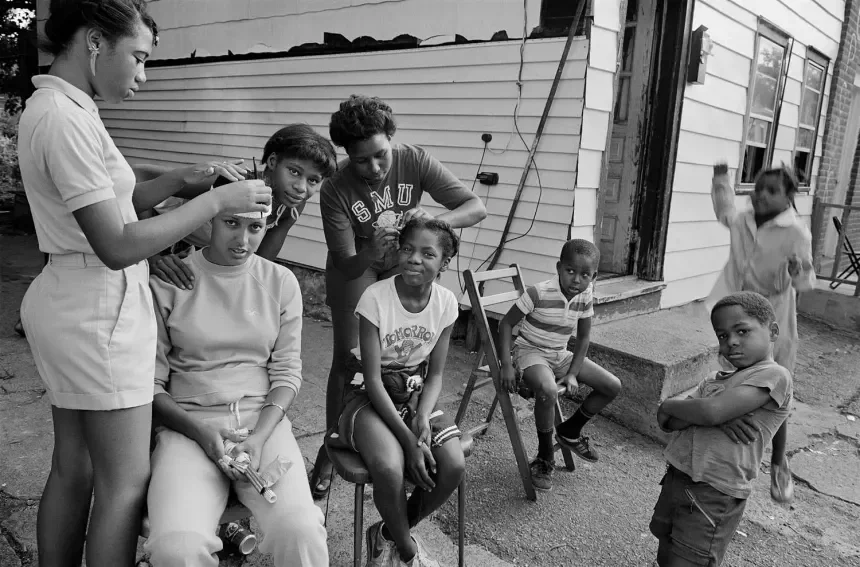
On this International Women's Day, we turn our Modern Masters lens onto one of the most quietly radical voices in American documentary photography — a woman who, armed with a wide-angle lens and a warm curiosity, captured the hidden heart of a nation.
A Woman with a Camera and a Question
There are photographers who shout, and there are those who whisper. Sage Sohier has always whispered — and yet her work echoes across decades. Born in Washington D.C. in 1954, Sohier spent the late 1970s and 1980s wandering the working-class neighbourhoods of America, knocking on strangers' doors, gaining their trust, and producing some of the most affecting environmental portraits ever made. She photographed gay couples at the height of the AIDS crisis. She photographed her fashion-model mother growing old. She photographed children playing in the street before the internet arrived to pull them indoors. Her work is, above all, an act of witness.
Today, on International Women's Day 2026, we celebrate Sage Sohier: a Harvard-educated, Guggenheim-awarded, MoMA-collected artist who never sought the spotlight — and who, perhaps for that reason, is finally getting the recognition she has long deserved.
Origins: Washington D.C. to Harvard Yard
Sage Sohier was born in Washington D.C. in 1954. Growing up, she was drawn to language and narrative — she arrived at Harvard University intending to major in English and, she has said, imagined she might become a writer. But she was restless, ill-suited to sitting alone in front of a typewriter for hours.
Everything changed in her sophomore year when she took her first photography class. As she later told The Photographers' Gallery in London:
"When I took my first photography class as a sophomore, I learned about fine art photography and realised that the medium had narrative possibilities as powerful as fiction writing. I was hooked."
Photography gave her what writing couldn't: a reason to be out in the world, in conversation with strangers, alive to the unexpected. She graduated from Harvard with her B.A. and never looked back.
The Big Break: Tod Papageorge and the East Coast Scene
If there was a single moment that set Sohier's course, it was meeting photographer Tod Papageorge, who visited Harvard as a senior-year artist-in-residence. The encounter was, by her own account, transformative:
"Tod was incredibly eloquent about the medium, and he somehow made me feel not only that I wanted to become a photographer, but also that it was possible for me."
Boston in the 1970s was a fertile environment for a young photographer. Sohier found herself moving in circles that included Nick Nixon, Lee Friedlander, and Garry Winogrand — giants of American documentary photography who would shape her eye and ambition. She was also deeply influenced by Diane Arbus, whose ability to produce psychologically acute portraits she spent years trying to understand, and by Chauncey Hare's book Interior America (Aperture, 1978), which showed her the documentary possibilities within ordinary domestic spaces.
Her early career blossomed quickly. She received a Massachusetts Artists Foundation photography fellowship in 1979, followed by a National Endowment for the Arts photography fellowship in 1980–81. The Guggenheim Fellowship came in 1984–85 — one of the most prestigious awards in American arts — cementing her reputation as a serious artistic voice.
Style: Close, Sharp, and Full of Life
Sohier's photographic style is immediately recognisable: wide-angle lenses, deep depth of field, everything rendered tack-sharp from foreground to background. She favoured apertures of f/11 or f/16, used on-camera flash frequently to fill her frames with even light even in low-light conditions, and shot primarily in black and white during her most celebrated early work. The effect is almost theatrical — a 'picture on a wall' quality, as one critic described it, where the entire stage of life is visible and in focus.
She has spoken candidly about her technique:
"Back in the 70s, most photographers still worked in black and white. I fell in love with wide-angle lenses — I liked how they made the foreground large and the background recede and how playing with scale created stories. I also liked to use on-camera flash, so that I could still shoot with apertures of f16 or f11 and render everything sharp even at dusk."
What makes Sohier's work distinctive is not just technical precision but the quality of presence she achieves. She was never a candid, covert photographer. She approached people directly, explained her project, asked permission, and stayed long enough for the self-consciousness to dissolve. Her subjects — working-class families, teenagers on stoops, gay couples in their living rooms — have a relaxed, unguarded quality that is the product of genuine human connection.
"Approaching people politely and with energy and enthusiasm is key. Intruding on people's personal space could feel awkward, and was never easy to do, but most of the time it seemed that my enthusiasm was contagious and people were able to relax and be themselves."
Later in her career she shifted away from the blunt on-camera flash aesthetic of her 1980s work:
"I don't shoot that way anymore, though I do still use flash a lot. I prefer more of a natural-light effect now."
Equipment: What She Used and What She Didn't
Sohier's technical choices were always in service of her vision. Her kit during the signature years of the 1980s was deliberately unglamorous:
Wide-angle lenses — her primary tool, giving her images their characteristic sense of depth and environment
Small apertures (f/11 and f/16) — ensuring everything in the frame was sharply rendered
On-camera flash — not for drama, but for control, allowing her to shoot in varied light conditions while maintaining sharpness
Medium format cameras — chosen for their exceptional detail and tonal range, which rewarded slow, deliberate composition
Black and white film — the standard of serious documentary work in that era, and a material she fell deeply in love with
What she avoided, by temperament if not always by rule, was anything that created distance between herself and her subjects. She was not a telephoto photographer. She did not hide. She was not interested in bokeh, in dreamy soft focus, in separating subject from environment. She once noted simply: "Back then I wanted everything to be sharp and visible."
She also kept her workflow deliberate and human-paced. The medium format camera required more time and intention than a 35mm point-and-shoot — and that slower rhythm, she has suggested, actually aided her relationships with subjects, giving conversations time to breathe before the shutter clicked.
The Major Series: A Body of Work Like No Other
Sohier has spent her career in long-form documentary projects, returning to the same themes — American identity, domestic life, the nature of love — across decades. Here are the series that define her legacy:
Americans Seen (late 1970s–1980s)
Her foundational body of work, shot across the American landscape from New England to Florida to the rural Midwest. Sohier would load her car and drive south in winter, seeking out strangers in working-class neighbourhoods and asking if she could photograph them. The resulting images — published by Nazraeli Press in 2017 and reissued in a remastered edition in 2024 — are among the finest environmental portraits in American photography. They document a pre-digital, pre-internet America with warmth, clarity, and wit.
At Home With Themselves: Same-Sex Couples in 1980s America (mid-1980s)
This project is arguably Sohier's most historically significant. Begun in 1986, at the height of the AIDS crisis, it was motivated in part by her desire to understand her father, who had left the family when she was a toddler and whom she later discovered was gay. She photographed committed gay and lesbian couples in their homes across America, creating intimate portraits that stood in deliberate contrast to the sensationalised media portrayal of gay life at the time. As she has said:
"I was interested in how, as a culture, we weren't used to looking at two men touching, and was struck by the visual novelty yet total ordinariness of these same-sex relationships."
The series was so culturally ahead of its time that it found no publisher for nearly 30 years. It was finally released by Spotted Books in 2014 — just before the Supreme Court's landmark Obergefell v. Hodges ruling on marriage equality — and was immediately recognised as an essential historical document.
Animals (1980s–1990s)
A black-and-white series depicting people with their pets — companion animals that reveal, Sohier believes, something uninhibited and true about their human owners:
"There is more spontaneity, less self-consciousness, and more chaos when humans and other animals coexist. Love is unconditional, grief is uncomplicated though deeply felt, and life is richer, more vivid, more comical."
Published by Stanley/Barker in 2019, the series became one of her most celebrated books.
Witness to Beauty (2016)
A deeply personal project in which Sohier trained her camera on her own mother — a former fashion model photographed by such legends as Irving Penn and Richard Avedon. Sohier describes herself as the 'foil' to her mother's beauty, always behind the camera rather than in front of it. The book, published by Kehrer Verlag, is a meditation on age, femininity, and the complexity of the mother-daughter relationship.
Passing Time (2023) and Easy Days (2025)
Revisiting her archive during the pandemic, Sohier uncovered a wealth of unpublished images from the late 1970s and early 1980s. Passing Time — awarded Best Book at Paris Photo Week 2023 by Vanity Fair — presents 57 images of young people at leisure in pre-digital America. Easy Days, published by Nazraeli Press in 2025, completes a trilogy of her 1980s work and was the subject of a major solo exhibition at the Center for Photographic Art in Carmel, California.
Iconic Images: Photographs to Look For
Sohier does not have single 'famous' images in the way Cartier-Bresson has his decisive moments — her power is cumulative, architectural, built across series and bodies of work.
Rise to Recognition: Long Overdue
Sohier's path to wide recognition was, by any measure, a long one. She spent the 1980s building her archive while simultaneously teaching — at Harvard (as Lecturer on Visual and Environmental Studies, 1991–2003), Wellesley College (as Assistant Professor, 1997–99), the Massachusetts College of Art, the Rhode Island School of Design, and the School of the Boston Museum of Fine Arts. She was, in many ways, a photographer's photographer: deeply respected within the field, with her work collected by MoMA, the Brooklyn Museum, the San Francisco Museum of Modern Art, the Cleveland Museum of Art, the Nelson-Atkins, and the Portland Art Museum — but not yet broadly famous.
The turning point came with a cluster of major publications and exhibitions from 2012 onward. About Face (Columbia College Chicago Press, 2012), At Home With Themselves (2014), Witness to Beauty (2016), and Americans Seen (2017) established her, finally, as a photographer of genuine historical importance. MoMA's 2010–11 group exhibition 'Pictures by Women: A History of Modern Photography' placed her work in its proper canonical context.
The second act — Passing Time's Paris Photo acclaim in 2023, the remastered Americans Seen in 2024, and Easy Days in 2025 — has introduced her work to a new generation of photographers who find in her images both a technical mastery and a humanity they aspire to.
"I fell in love with photography in college and knew that that's what I had to spend my life doing. It's a kind of addiction, and my life doesn't feel complete unless I have a project or two that I'm working on and excited about."
What Her Peers Say
The photography world has been increasingly vocal about Sohier's importance. Here is what those who know the field best have said:
Alex Webb and Rebecca Norris Webb selected Passing Time as one of their Best Photobooks of 2023 at Photobookstore.co.uk — a significant endorsement from two of the most celebrated names in contemporary colour photography.
Ed Templeton, the skateboarder turned photographer and cult photobook connoisseur, also named Passing Time among the best books of 2023 — a mark of the book's cross-generational appeal.
Vanity Fair designated Passing Time one of the Best Books at Paris Photo Week 2023, the world's most prestigious photography fair.
Shana Lopes, curator of photography at the San Francisco Museum of Modern Art (SFMOMA), appeared in conversation with Sohier at the Center for Photographic Art in 2025, a gesture of institutional validation from one of America's most important photography collections.
What Will You Remember, the photography criticism publication, wrote of At Home With Themselves: "Sohier's ability to amplify the nuance of each relationship is uncanny. Her triumph: encapsulating the touching universality and individuality of our human connections."
Lenscratch, one of the most influential photography platforms online, has described her as "indefatigable" — a photographer with a "long legacy of documenting the human (and animal) condition close to home and on the streets."
Photo Resources:
Use these links to source images for the blog post (always check licensing and credit requirements before embedding):
Sage Sohier's official website — full portfolios organised by series (Easy Days, Americans Seen, Animals, Peaceable Kingdom, At Home With Themselves, Witness to Beauty and more)
The Photographers' Gallery Print Sales — overview with images
YouTube Video Resources
Search for these on YouTube to find embeddable video content:
Essential Photobooks
Sohier has published nine monographs — a body of book work that is itself remarkable for its consistency and range. Here are the essential titles:
Easy Days (Nazraeli Press, 2025) — the final volume in her 1980s trilogy, completing a definitive document of pre-digital American life
Passing Time (Nazraeli Press, 2023) — voted Best Book at Paris Photo Week by Vanity Fair; 57 images of youth and leisure in 1979–85 America; printed on Japanese Kasadaka art paper
Peaceable Kingdom (Kehrer Verlag, 2021) — with an essay by writer Sy Montgomery; her most expansive exploration of the human-animal bond
Animals (Stanley/Barker, 2019) — black-and-white portraits of people with their pets; one of the most charming and psychologically astute books in her catalogue
Americans Seen (Nazraeli Press, 2017; remastered edition 2024) — the cornerstone of her reputation; environmental portraits of working-class America in the 1980s
Witness to Beauty (Kehrer Verlag, 2016) — her intimate, humorous, and moving portrait of her ex-fashion-model mother
At Home With Themselves: Same-Sex Couples in 1980s America (Spotted Books, 2014) — the groundbreaking document of gay domestic life that waited 30 years to find a publisher; now recognised as a civil rights landmark
About Face (Columbia College Chicago Press, 2012) — a study in portraiture and facial expression
Perfectible Worlds (Photolucida, 2007) — her earliest monograph; the beginning of a long conversation with the American domestic landscape
A Final Thought
Sage Sohier once described what drew her to people's lives:
"In my twenties, I began to see the world and understand more about people from a variety of different backgrounds. Meeting people (in order to photograph them) was thrilling, and it changed me. Being a photographer has been a wonderful excuse to wander and to be inquisitive about others' lives and experiences. I will always be grateful to the people pictured here — not just for allowing me to spend time making pictures of them — but also for how these interactions informed and enriched my life."
On International Women's Day 2026, we are grateful in turn to Sage Sohier — for her curiosity, her warmth, her courage to knock on strangers' doors, and her extraordinary eye. She has given us a portrait of America that feels, across every decade, like something essential and true.
Explore her full body of work at sagesohier.com.
Until next time, keep snapping
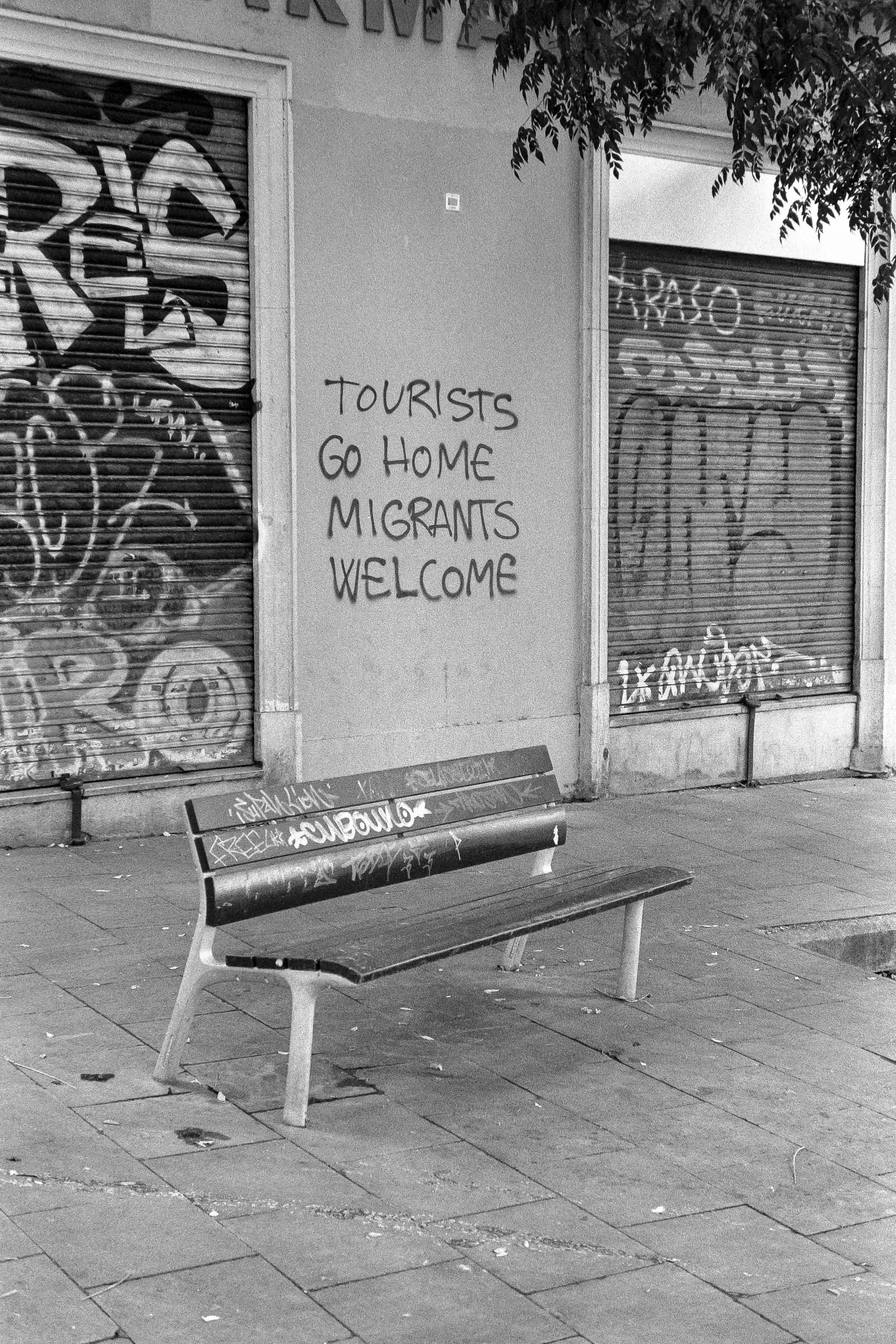
Barcelona, is it over?
Barcelona, is a vibrant Spanish metropolis, which has been a magnet for tourists for decades.
The kids and I undertook our visit to this tourist hotspot in August 2022, as part of my 50th birthday celebrations.
The city's love affair with tourism may be facing a turning point. Local authorities are actively seeking to curb visitor numbers, with news this week that the plan is a cessation of ‘Airbnb style’ short term rentals in the city, by 2028.
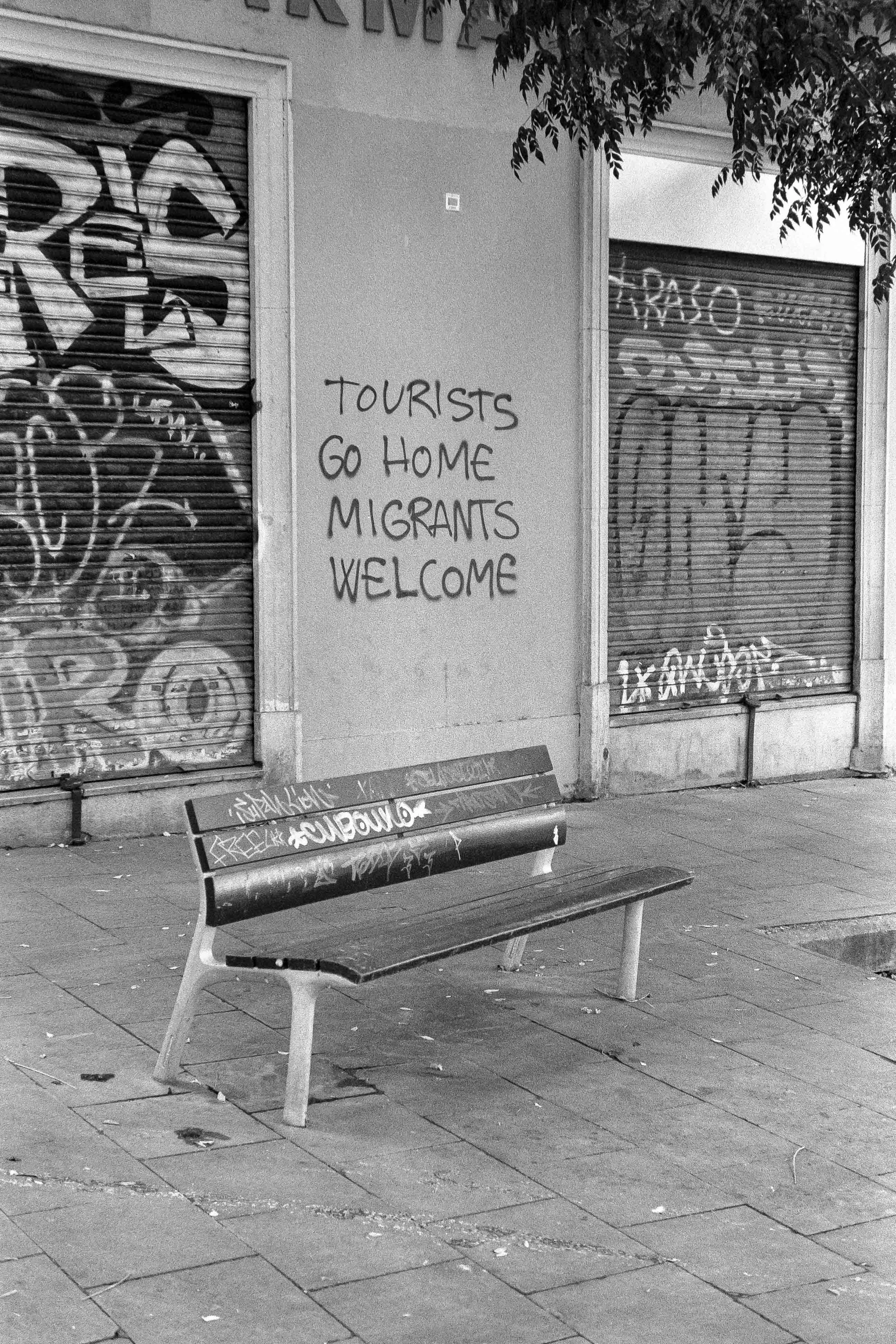
Barcelona, is a vibrant Spanish metropolis, which has been a magnet for tourists for decades.
The kids and I undertook our visit to this tourist hotspot in August 2022, as part of my 50th birthday celebrations.
The city's love affair with tourism may be facing a turning point. Local authorities are actively seeking to curb visitor numbers, with news this week that the plan is a cessation of ‘Airbnb style’ short term rentals in the city, by 2028.
This story in part, has started with local squirting tourists, with water pistols filled with water.
Biting the hand that feeds you? Or is this a drastic measure a necessary step for a city struggling to breathe?


Strains on the City:
Spain sees some 85.1m visitors pa, of which 12.4m visiting Barcelona. The proposed plan on holiday rentals, would return c. 10,000 properties to the indigenous population for primary resident use.
Barcelona's immense popularity has undeniable downsides. Residents complain of overcrowded streets, rising rents fueled by short-term rentals, and a strain on local infrastructure. The city's unique character can be lost as tourist shops and restaurants replace local businesses.
Taking Back Control:
Discussions include limiting cruise ships, restricting hotel development, and promoting alternative destinations within Catalonia. This shift in focus aims to improve the quality of life for residents and ensure a more sustainable future for the city.


Tourism, Redefined:
Barcelona's move doesn't signal the end of tourism. Instead, it's a call for a different kind of tourism. The focus might shift towards attracting visitors who appreciate Barcelona's cultural heritage and architectural beauty, and who contribute positively to the local economy.
The Road Ahead:
While some hail Barcelona's initiative, others fear economic repercussions. Striking the right balance between tourism and livability is crucial. Barcelona's experiment will be closely watched, with the potential to reshape the conversation around tourism in popular destinations worldwide.
Whilst its clear that the tourism pilgrimage to Barcelona is generally bottlenecked into the 2, if not 1 season (Summer or Spring / Summer), here are some interesting numbers comparing Barcelona with London:
Tourist Tale of Two Cities: Barcelona vs. London
While both Barcelona and London are major tourist hubs, their stories differ in scale and recent trends. Here's a comparison based on available statistics:
Visitor Numbers:
London: As of 2023, London held the title of the most searched-for global tourist destination [most searched for global tourist destination ON standard.co.uk]. Though exact visitor numbers can be tricky to pin down due to different methodologies, estimates suggest London attracts well over 20 million visitors annually.
Barcelona: Pre-pandemic figures show Barcelona receiving around 12.4 million visitors a year [STATISTA tourism barcelona ON statista.com]. While this is a substantial number, it falls short of London's massive tourist influx.
Length of Stay:
London: Data suggests shorter stays are becoming more common in London, with a third of trips lasting only 3-4 days [most searched for global tourist destination ON standard.co.uk]. This trend aligns with "city break" style tourism, focused on short, action-packed visits.
Barcelona: Barcelona might see slightly longer stays on average. While specific data is harder to find, the city's focus on cultural experiences and beach getaways could encourage visitors to linger a bit longer.


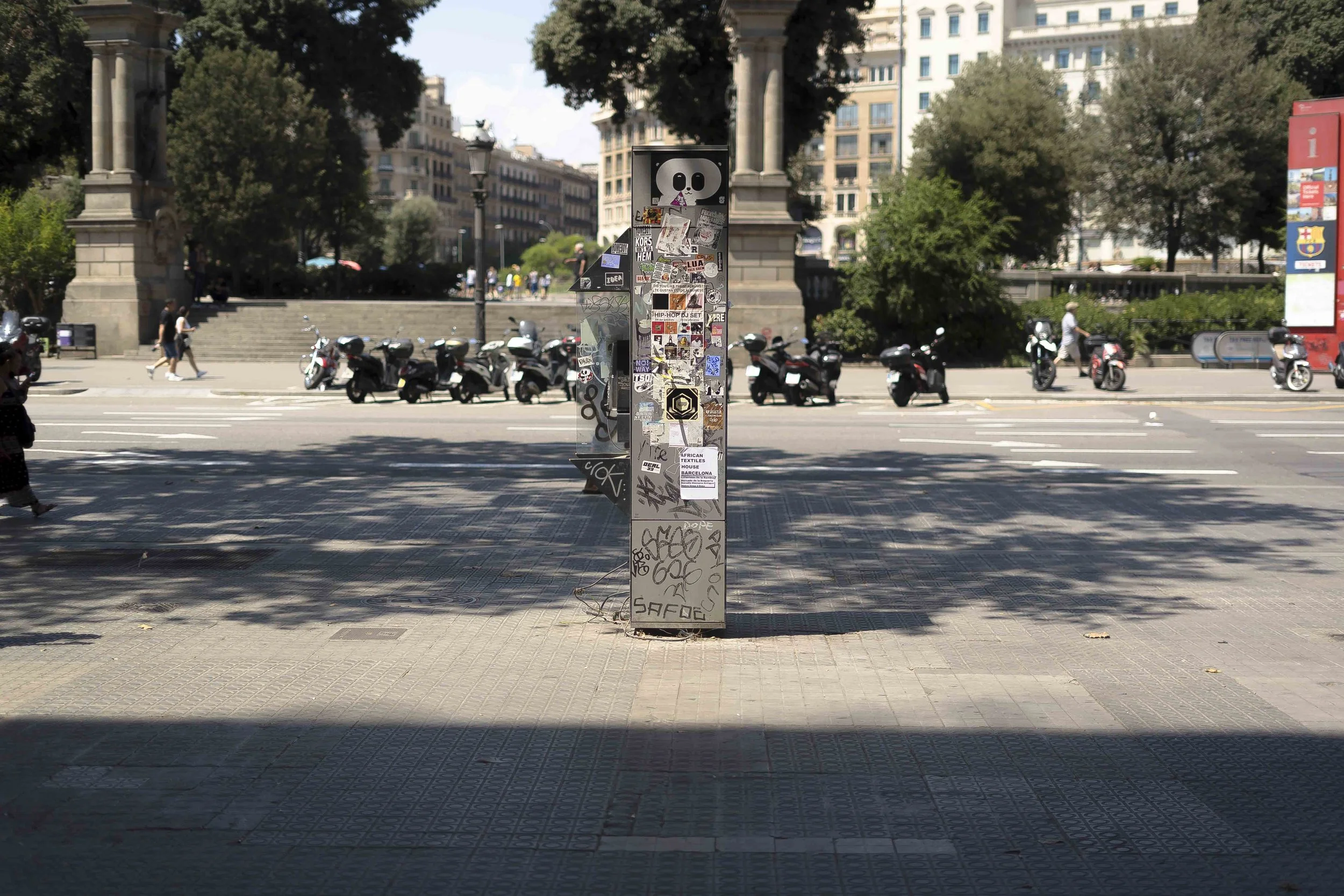
Tourist Spending:
London: London benefits from a diverse tourist base, with visitors coming from all corners of the globe. This can lead to a wider range of spending habits.
Barcelona: Recent reports show a promising trend for Barcelona. While visitor numbers might be dipping slightly, the average tourist spends more (€1,263 in May 2024). This suggests a shift towards a higher-value tourism model in Barcelona.
Local Impact:
Both Cities: Both London and Barcelona grapple with the impact of tourism on residents. Housing affordability is a major concern, with rising rents due in part to short-term rentals.
Key Differences: However, the scale of the issue might be more pronounced in Barcelona due to its smaller size. The sheer volume of tourists in a more compact city center can put a strain on infrastructure and contribute to a feeling of inauthenticity.


Barcelona could potentially strike a balance that promotes responsible tourism while safeguarding the city's well-being for the years ahead.
Lets hope so, as it’s a city I would very much like to visit in the future.
Until next time, keep snapping.
35mm is a gateway drug
Its been nearly 6 years since the film bug bit me.
Originally I was recommended to get into film, to stop at the time, the incessant tinkering with my digital images (read polishing a turd) and concentrate of the process of taking a photo.
I must say, its one of the best pieces of advice I have received.
Not to put it lightly, the learning curve for film, getting your head around using manual controls, the exposure triangle, developing and scanning film at home, is a steep one. But thoroughly enjoyable, nonetheless.
disclaimer: the author accepts no liability for the cost incurred by the reader, in the investment of new film camera gear.
Its been nearly 6 years since the film bug bit me.
Originally I was recommended to get into film, to stop at the time, the incessant tinkering with my digital images (read polishing a turd) and concentrate of the process of taking a photo.
I must say, its one of the best pieces of advice I have received.
Not to put it lightly, the learning curve for film, getting your head around using manual controls, the exposure triangle, developing and scanning film at home, is a steep one. But thoroughly enjoyable, nonetheless.
Being transfixed by the civil rights and vietnam war images of the 1960’s, provided me with the desire and inspiration for me to learn the zone focuing technique, this was revelationary.
I have mentioned it before, there are few hobbies that have a great community spirit like film photography, sharing the knowledge and helpig eachother out. The only other I have encountered is the motorbike community, but having hung up my leathers in 2015, this was a void greatly filled.
I digress. Whilst I was happy shooting 35mm, especially on the exceptional Olympus OM1, I had one eye on the limitations of my scanning setup (the substandard Epson V600) and also a thirst to learn more about this medium. This naturally led to my step into Medium Format / 120 film.


Early on my film journey, I was able to get my hands on the little gem Yashica Mat 124g TLR camera. This TLR medium is underrated, the limitations of the square format allow you to rethink the image the detail of the negative is outstanding.


I became transfixed by the Pentax 67. This is a complete beast, which is probably better placed as a studio based portrait camera, rather than a street photography camera. The 6x7 negatives are enormous, offering rich detail. There are two downsides when using in Street Photography, 1) The sheer weight of the thing!, and 2) The thunderclap of the shutter. You could add a third with the limited 10 images per roll, but this is negated by the stunning negatives.


I therefore wanted a 120 / medium format film camera, that I could hike around with on my photowalk jaunts, and decided on the Fujica GS645s. I was able to snag an absolute mint condition version from Japan, I can only conclude that this was put into a time capsule, as the was like brand new. I choose the version with the bull bar. As I had read stories of the bellow cracking, I didnt want the faff. I have had zero issues with the bullbar.
Also the increased 15 images per roll is well received. The only downside to the camera is the weak rangefnder patch. This is easily resolved with a piece of clear plastic stuck to the viewfinder.


So the crescendo, large format. This ultimately was triggered by a few YouTube content creators that really elevated the medium and I love there work: Ben Horne, Matt Marrash, Bryan Birks, Todd Korol, Robbie Maynard Creates, Nick Carver, Craig Prentis & Steve O’nions to name a few.
I really appreciated the no thrills approach to shooting and also the sloowwwww approach.
The two versions of this format are 4x5 and 8x10. Film photography isn’t a cheap hobby and 8x10 format is no exception, film prices are insane!.
Looking around I had earmarked two models for further consideration, 1) a 1950’s metal field camera, which didnt provide nearly as much refinement on setting up a photo, or 2) A traditional wooden camera.
Initially, I had elected for the former, buying a 1970’s Wista 45d from Japan off eBay. Unfortunately, this was probably the worst buying experience I have ever encountered, this is a tale for another day. But in short, the faulty Wista was soon returned.
I finally decided on the Chamonix 45n2. This camera is a thing of complete beauty. Composed of wood and carbon fiber composite material, is designed to be both light and durable. I get stopped every time I have the camera out by tog’s and non tog’s.


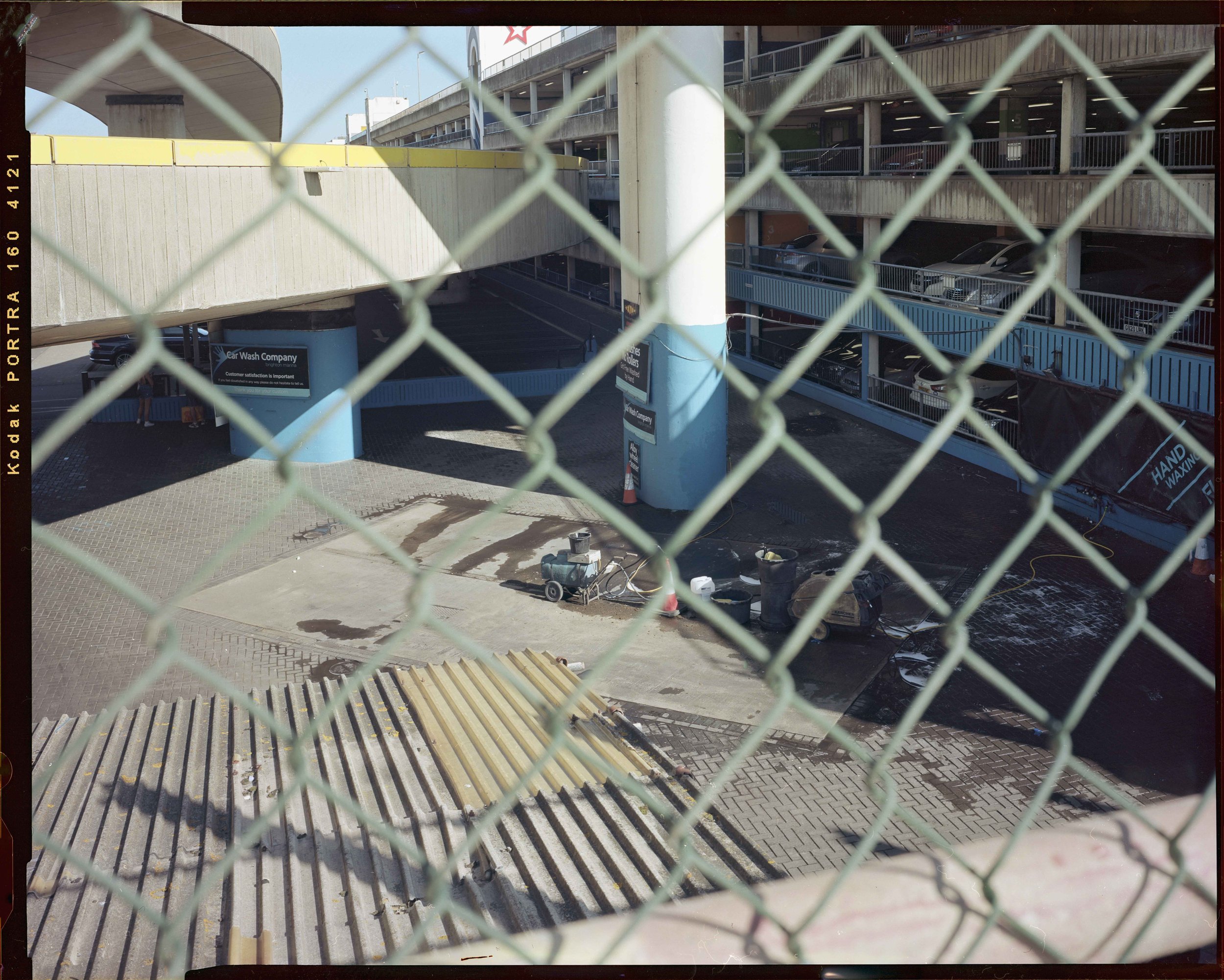


You do have to completely change the approach to image taking, a 10 sheet of Kodak Portra 160 is £58, so £5.80 per photo. This is before the pending price hikes in January 2022.
But the images are outstanding.
The options for B&W are more economical and more palletable on the wallet.
So this year with Large Format and generally in my six year journey, I have learned alot and my understanding is better. I now go back to digital and the positive is that I set the camera up for auto focus, turn off the backscreen and snap away. No Chimping. I have ditched all the lightroom presets and now only use 1 x colour and 1 x BW. No polishing of turds.
I have found that I have turned full circle and that film and digital mendiums compliment eachother and my work, its not a case of one or the other, trust me.
Well thats me for another month, until next time, keep snapping.
A selection of the images within this article are available for sale on the Website or Etsy Store, if you would like to enquire about something else, please click the email icon at the foot of this page.
Patience
I'm impatient. There I've said it.
Its taken me until I'm in my mid to late 40’s that I've finally 'learned' to chill. Whilst I'm pondering this month's blog post, I have a live example of this.
I have a generally hectic day job, so as I've mentioned previously, street photography and film photography is my chill, to zen proportions.

I'm impatient. There I've said it.
Its taken me until I'm in my mid to late 40’s that I've finally 'learned' to chill. Whilst I'm pondering this month's blog post, I have a live example of this.
I have a generally hectic day job, in fact manic. So as I've mentioned previously, street photography and film photography is my chill, to zen proportions.
It generally unwinds the stress of Monday to Friday, using the creative side of my brain, rather than counting numbers and managing risk in the financial services.
I had to send the Leica M4P in for a service. I can totally understand that some folk will file this under ‘first world problems’. But the camera has never been right since I got it.
The issue was a uniformed light leak down the right hand side of the negative, which varied, depending on the shutter speed. I ignored this for 6 months, cropping the issue out of the camera, but finally decided that this was madness.


After taking in some research for 3 weeks, I elected to use Camserve. Based on the positive feedback / reviews on a Leica forum. My experience with Steve at Camserve, was world class service, no doubt about it. Initially on the phone, he mentioned that it could be one of two problems, the first he could fix, which he hoped was the second shutter requiring adjusting, by dismantling the camera, and giving it a thorough CLA (clean, lubricate and adjust), the second, he couldn’t fix and would be very expensive and would need to be sent to ‘a specialist’. I cant remember what the second issue was, as I stopped listening after he said ‘very expensive’.
When I dropped the camera off, I asked if he could take a photo of the camera, with its guts hanging out, not to authenticate that any work was completed, but just to see my baby dismantled, I know, I’m weird like that……..

Thankfully the issue was the former easy fix, not the ‘very expensive’ option.
It took three weeks all in all to resolve and a charge of £144. Exceptional value, full CLA, shutter reset, rangefinder reset. I also received a call each week, with an update. This compared to some stories online of other repairers taking between 3 - 12 months!!.
What was a concern, was that when I collected the camera, I was told it had been opened up by a novice (read seller), who had attempted to clear fungus of the inside of the viewfinder. When they reassembled the camera, they didn’t have a high attention to detail, with a lot of loose screws within the body of the mechanism.
I had noticed this prior to the CLA, the nut on the top of the film winder, kept coming loose.
This has now changed my mind about buying expensive film cameras from Japan, as the import tax and service costs, take out the initial benefit of buying from this market place.
I had put my first expensive of buying my Pentax 67, down to bad luck, but alas, it doesn’t seem to be the case.
I took the camera out on Saturday with a roll of kodak colour plus 200 loaded. I found that my muscle memory had gone, which was expected really. I did find the camera to be a completely different user experience, the winder mechanism was nice and tight, but also I found that I didn’t miss any exposures.
Here’s a couple of images:


It’s nice to have the old lady back in hand, as I was using the digital camera quite a bit, but I missed the slower process of setting up each shot.
Well thats me for another month, until next time, keep snapping.
Housekeeping, its a good thing.
I’m sat here putting the finishing touches to the website update, with a little more time on my hands, whilst we are in this post Xmas / New Year lockdown.
Since my reacquiantance into film, I have added sections relating to Street 35mm & 120, and People 35mm & 120.

I’m sat here putting the finishing touches to the website update, with a little more time on my hands, whilst we are in this post Xmas / New Year lockdown.
Since my reacquiantance into film, I have added sections relating to Street 35mm & 120, and People 35mm & 120.
Whilst this makes the website a little more lumpy in navigation, I have noticed my shooting style differs greatly between the 3 genres.
Whilst I still carry my digital camera on my walks, I using it more for video, as this is something that I want to develop in 2021, short videos for instagram reels and stories.
Here’s a selection of film and digital images I have taken in 2021:


I mentioned in a previous blog post that the film community is alive and fully supportive, I had a lovely exchange with someone on Instagram, who read my recent blogpost on film photography and wanted to scratch their film itch.
I sent over an email, with some links to camera reviews, resources and blog posts that I have found invaluable. Film is alive and well.
until next time, keep snapping.
A selection of the images within this article are available for sale on the Website or Etsy Store, if you would like to enquire about something else, please click the email icon at the foot of this page.
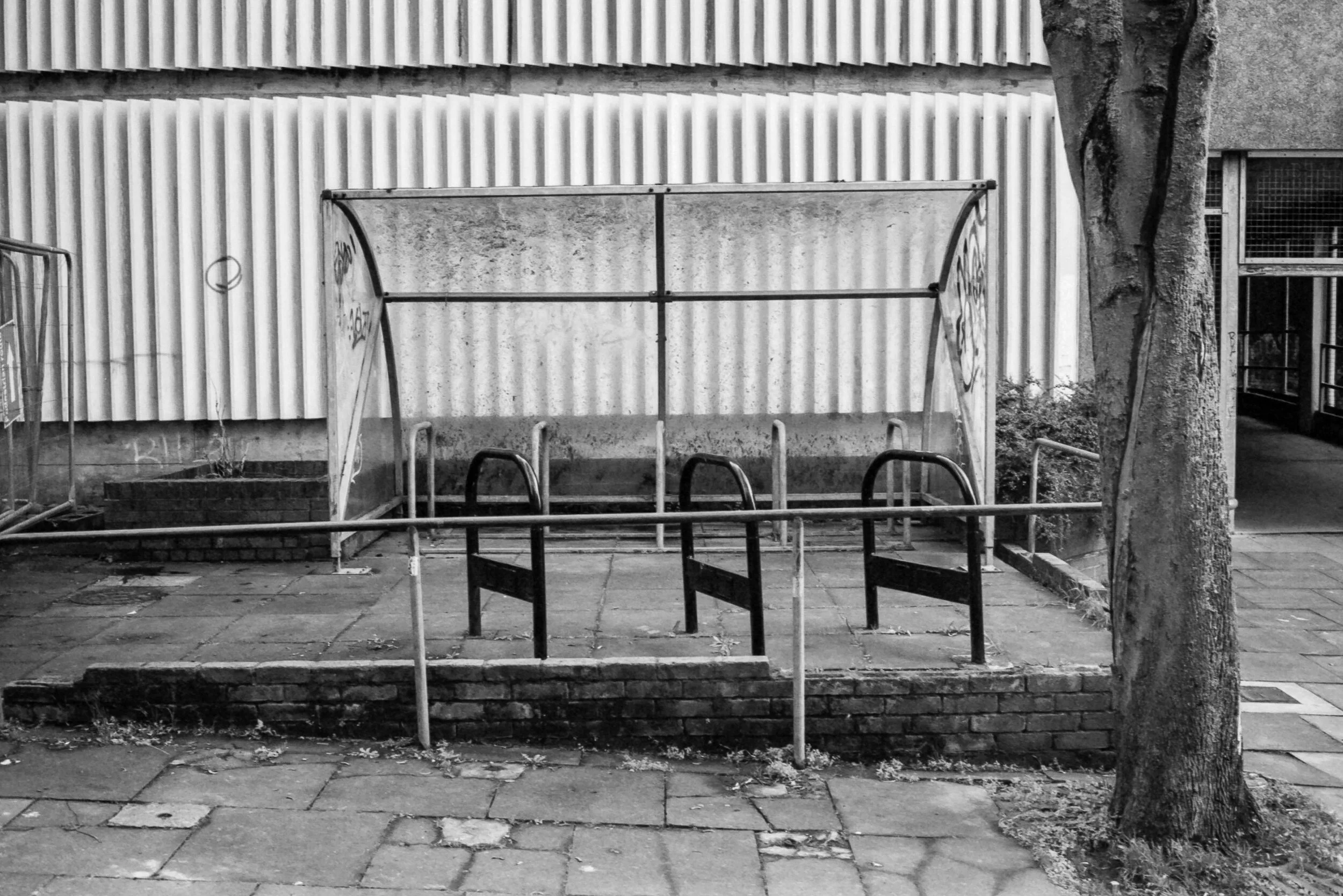
Share the wealth - Film Photography.
Of the many hobbies and leisure activities that I have had over the years, the two that have stood out as having an awesome community, where knowledge, encouragement and help has been in abundance is the motorbike community and film photography community.

Of the many hobbies and leisure activities that I have had over the years, the two that have stood out as having an awesome community, where knowledge, encouragement and help has been in abundance is the motorbike community and film photography community.
I had my fun getting my full bike license at 42 years old (yes a midlife crisis) and rode for 11 months, but after a very lucky escape from a potentially nasty accident, I decided to retire my leathers and continue on a more sedate basis.
The film industry shares many similar approaches to the biking community. When using my film cameras whilst out on photo walks, I have had complete strangers ask me what I’m using? (Normally when I have the Pentax 67 around my neck), or isn’t that cute (when I have the TLR).
It’s the complete opposite when you generally get digital camera snobbery (read all the gear no idea).
The same goes for asking film related questions on Twitter or Instagram, followers or even complete strangers, are happy to share the wealth. I love it. It's what makes the community thrive.
What I have enjoyed about film and the benefits of it, is having one eye of the traditionalist approaches, call it the scientific and one eye on the creative / pioneers that contest the perceived expected norm.
This series aims to share guides and tricks that I have found on my quest to simplify and establish a consistent workflow using and shooting with film.
I don’t aim to plagiarise or steal the authors findings, rather share and credit them.
First up is the groundbreaking blog post by Johnny Patience entitled ‘The Zone System is Dead’.
This is quite simply essential reading deconstructing the longstanding authoritative Zone System by Ansel Adams.
I think this is relevant for film photography in general, but all the more pertaining to street photography. Read in conjunction with Johnny’s other essential blogpost ‘Metering for film’ it demystifies the process of exposing and developing for film, based on the latitude and density of the negative.
I have been shooting at half box speed (iso 400 film at iso 200 in camera), for a couple of years and favour the look and density of the negative. This weekend, I tried developing the same roll at 1 stop over (iso 400 film at 800).
See a couple of examples of the film shot at half boxspeed (iso 400 film speed shot at iso 200 in camera), which is then overdeveloped by one stop at iso 800 development times:


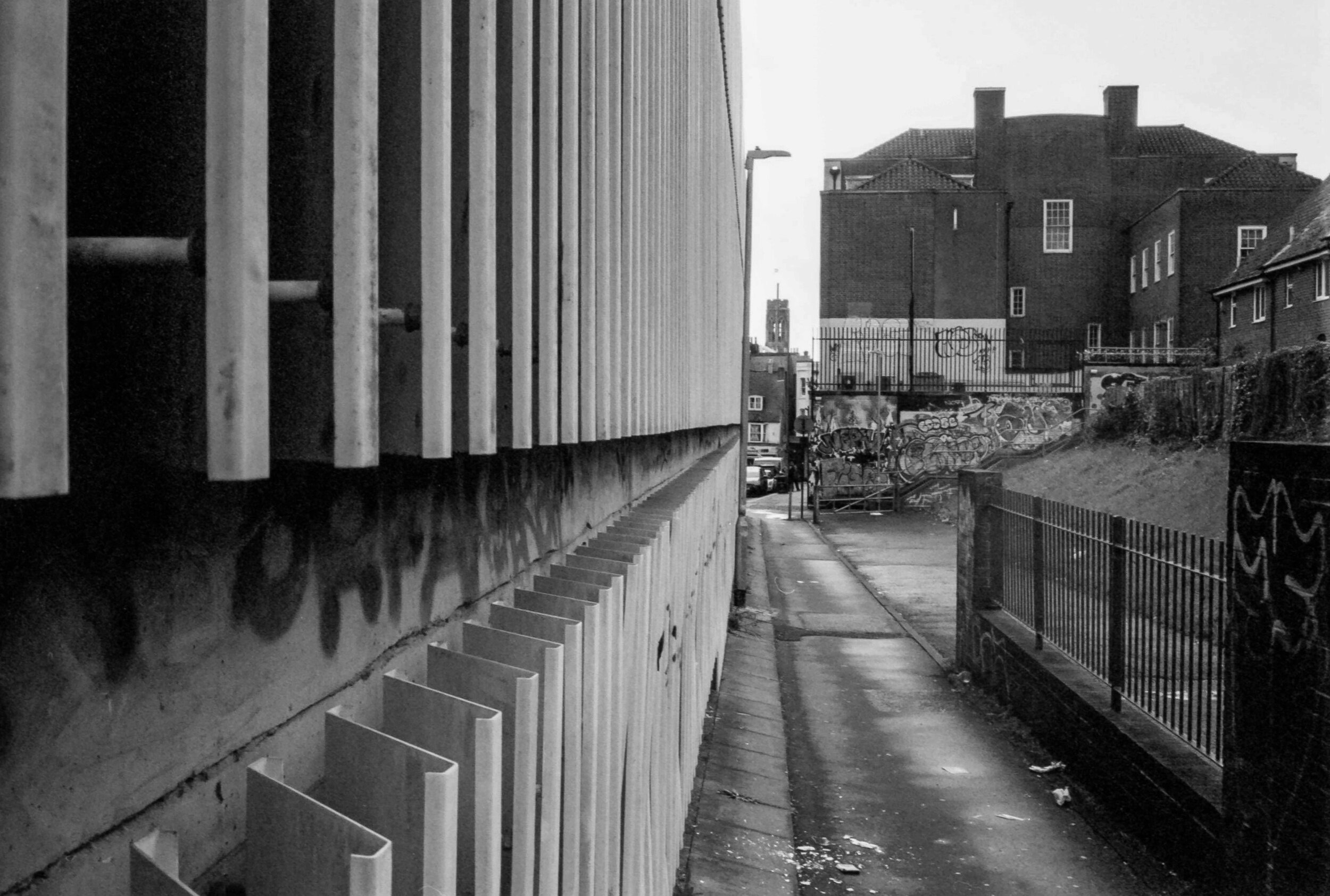
My initial thoughts are you have to pull the whites and highlights to the left in Lightroom, to tweak the highlights, but the density of the negative and the blacks is lovely. I also find there is less tinkering in general.
Hopefully this will help share the knowledge, but definitely head over to Johnny’s blog and read the above two posts!!
until next time, keep snapping.
A selection of the images within this article are available for sale on the Website or Etsy Store, if you would like to enquire about something else, please click the email icon at the foot of this page.
Film Photography aka #Slowphotography
As we head into lockdown 2.0, this is inevitably going to polarise the population about the illogical stance of the government in dealing with the shit storm that is COVID19.
Since the backend of the summer and leading up to the present time, I have been busy getting out and about building up a backlog of images to keyword, log and edit.

As we head into lockdown 2.0, this is inevitably going to polarise the population about the illogical stance of the government in dealing with the shit storm that is COVID19.
Since the back end of the summer and leading up to the present time, I have been busy getting out and about building up a backlog of images to keyword, log and edit.
That coupled with the sheer madness that is the American presidential election results, or at least how someone hasn’t conceded, has provided the heightened need for a little respite.
The one common theme I have noticed during this period, is the sense of folk ‘getting on with it’.
Leading up to lockdown 2.0, there has been the introduction of the 3 tier system in the UK, with the North, initially being hit very hard. Only time will tell if this will be managed well or simply a nightmare.
What I see within the content of instagram, is folk appreciating their predicament, what they have and being close to their loved ones.


Last week, I decided to have a look at some of my old film negatives, I shot film between 2016-2019, as a medium to improve my photography. People have different positive and negatives regarding film, my take away has been that it slowed me down, provided me with a medium to be more considered, but also I enjoy the start to finish process. I.e. from taking the photo, developing the film, scanning and digitally editing in Lightroom.
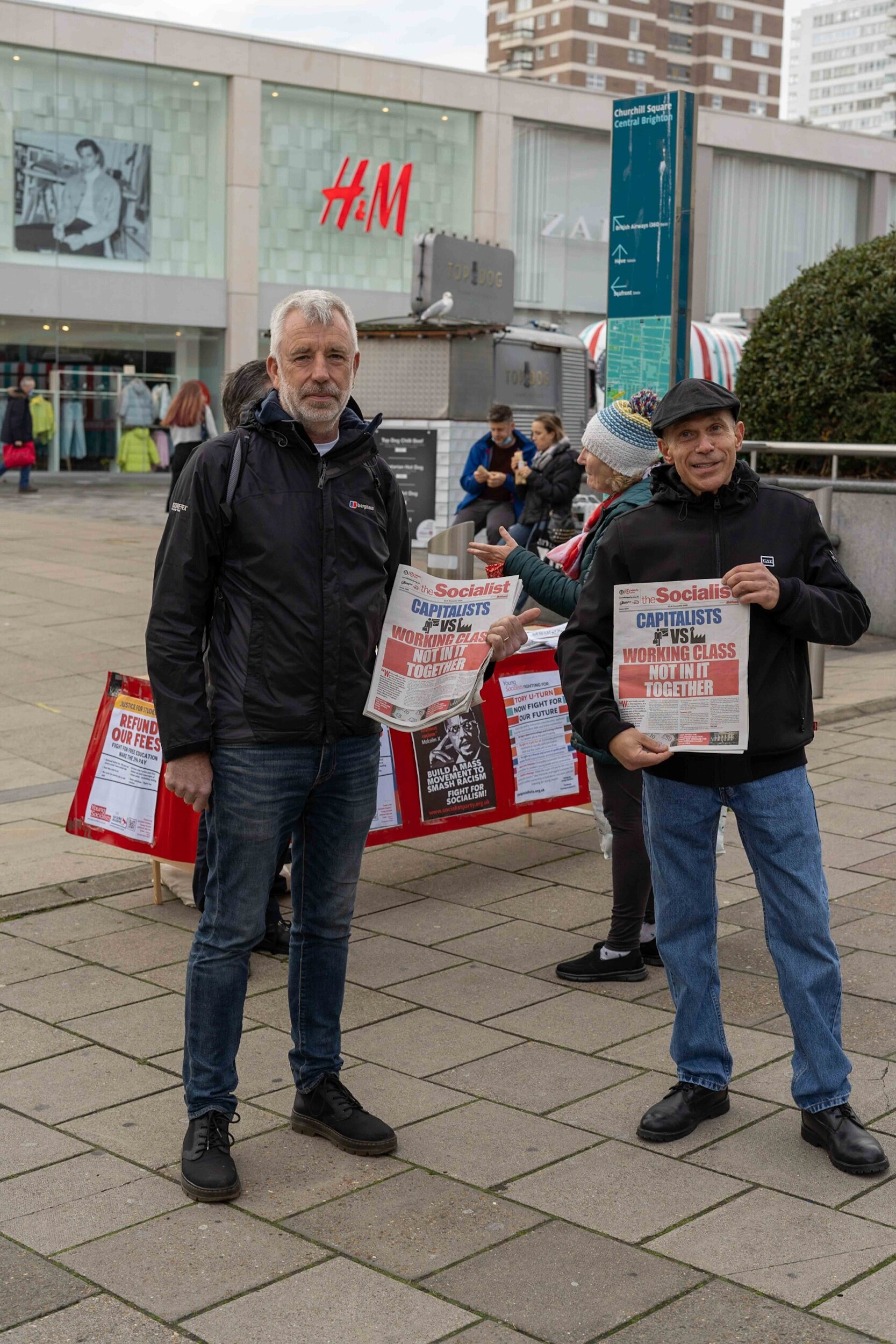
I took the below images of two Socialist Worker Party Volunteers. The black and white image was taken on my Yashica Mat 124g TLR medium format camera, with Ilford HP5 @ ei 200. The colour was taken on my Sony A7iii with 50mm F1.8. Both images offering something different, not better.

I use an Epson V600 flat bed scanner with Silverfast software. Whilst this is good at scanning medium format film negatives, using this for 35mm is somewhat mixed. Especially where using different colour film emulsions.
The current trend for scanning film negatives, is using a DSLR camera with the Negative Lab Pro Lightroom plug in. Whilst I have been getting some decent scans through this method, I concluded that this was more out of eyeballed guess work than a consistent workflow.
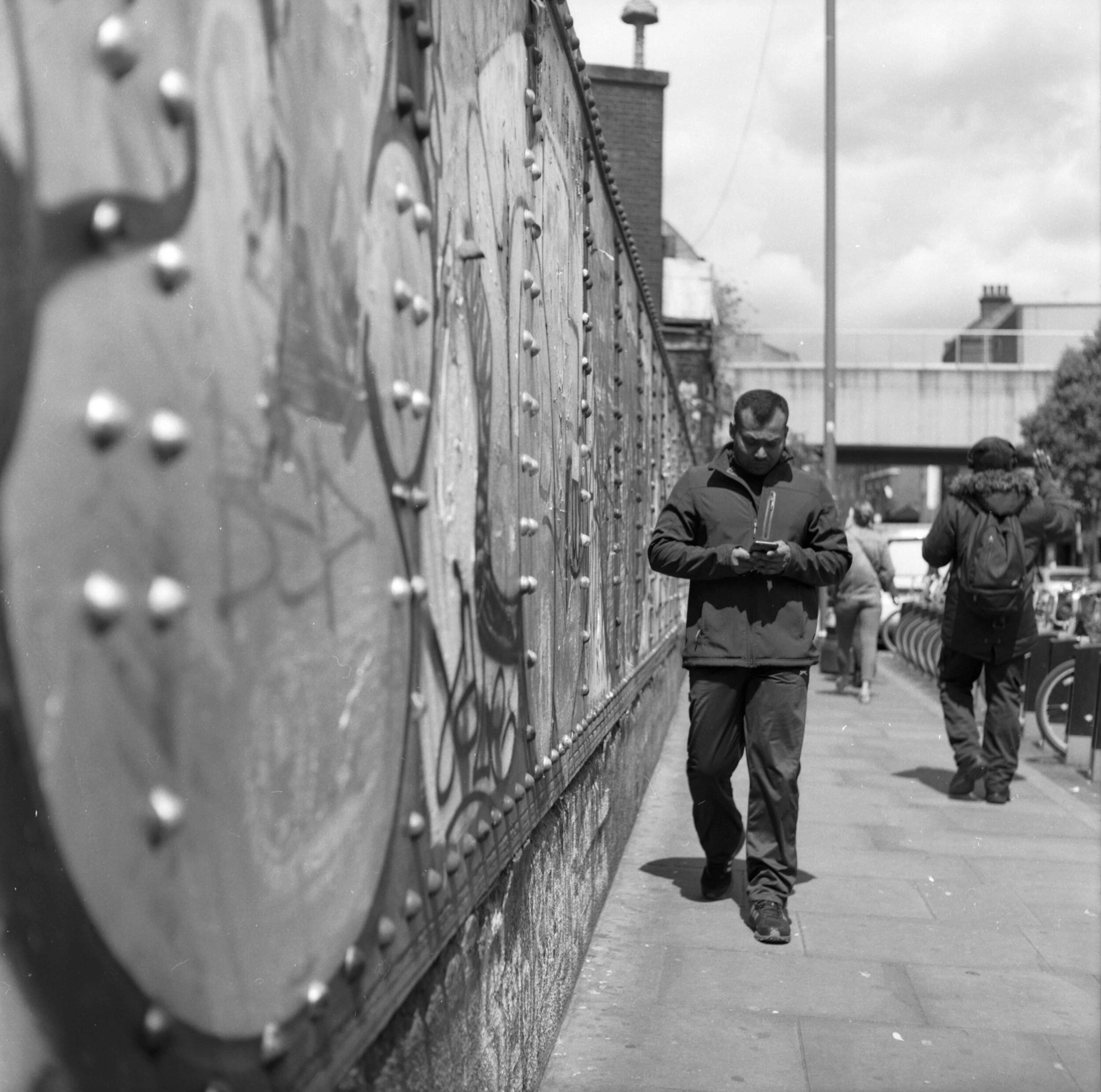

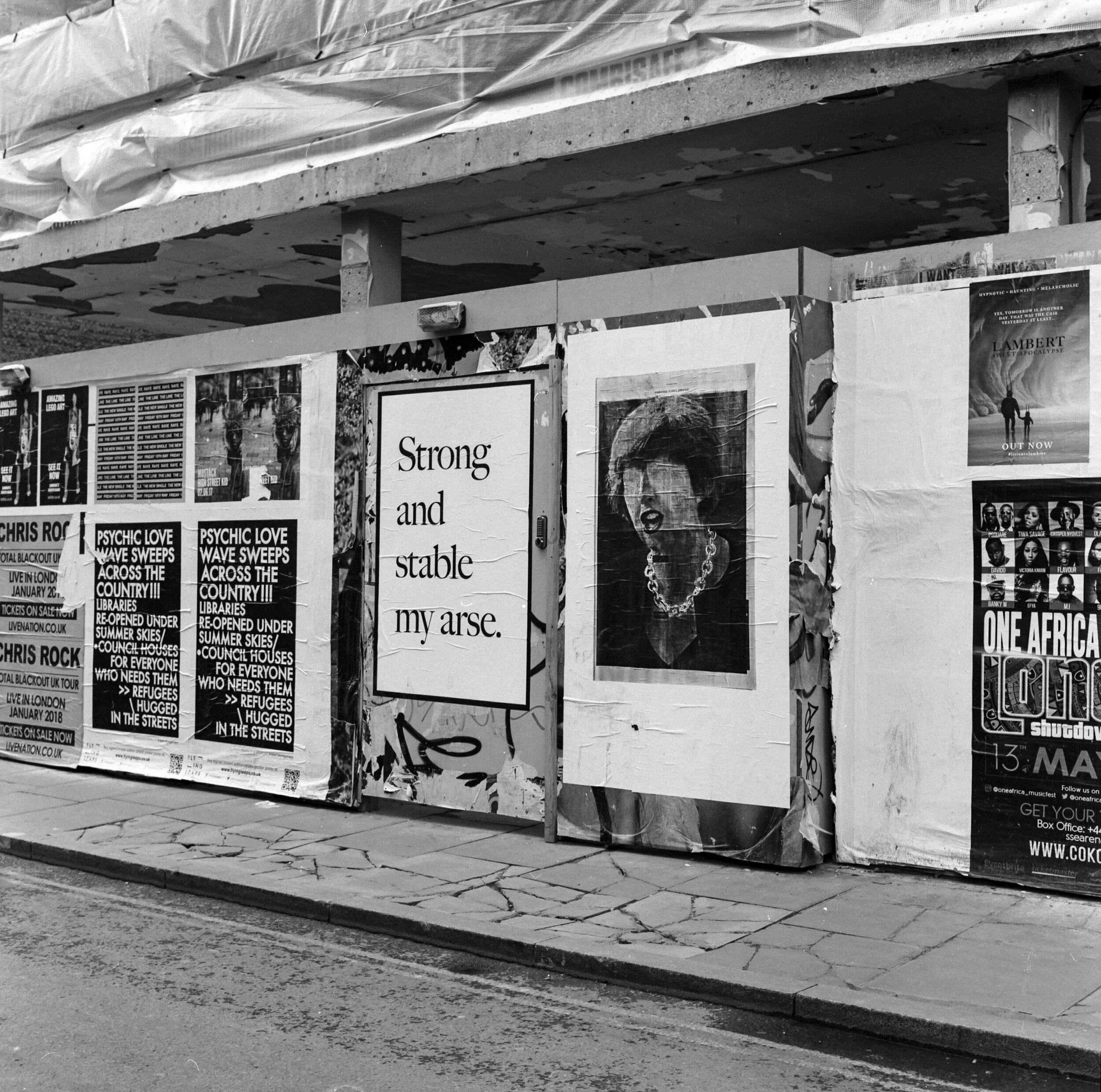
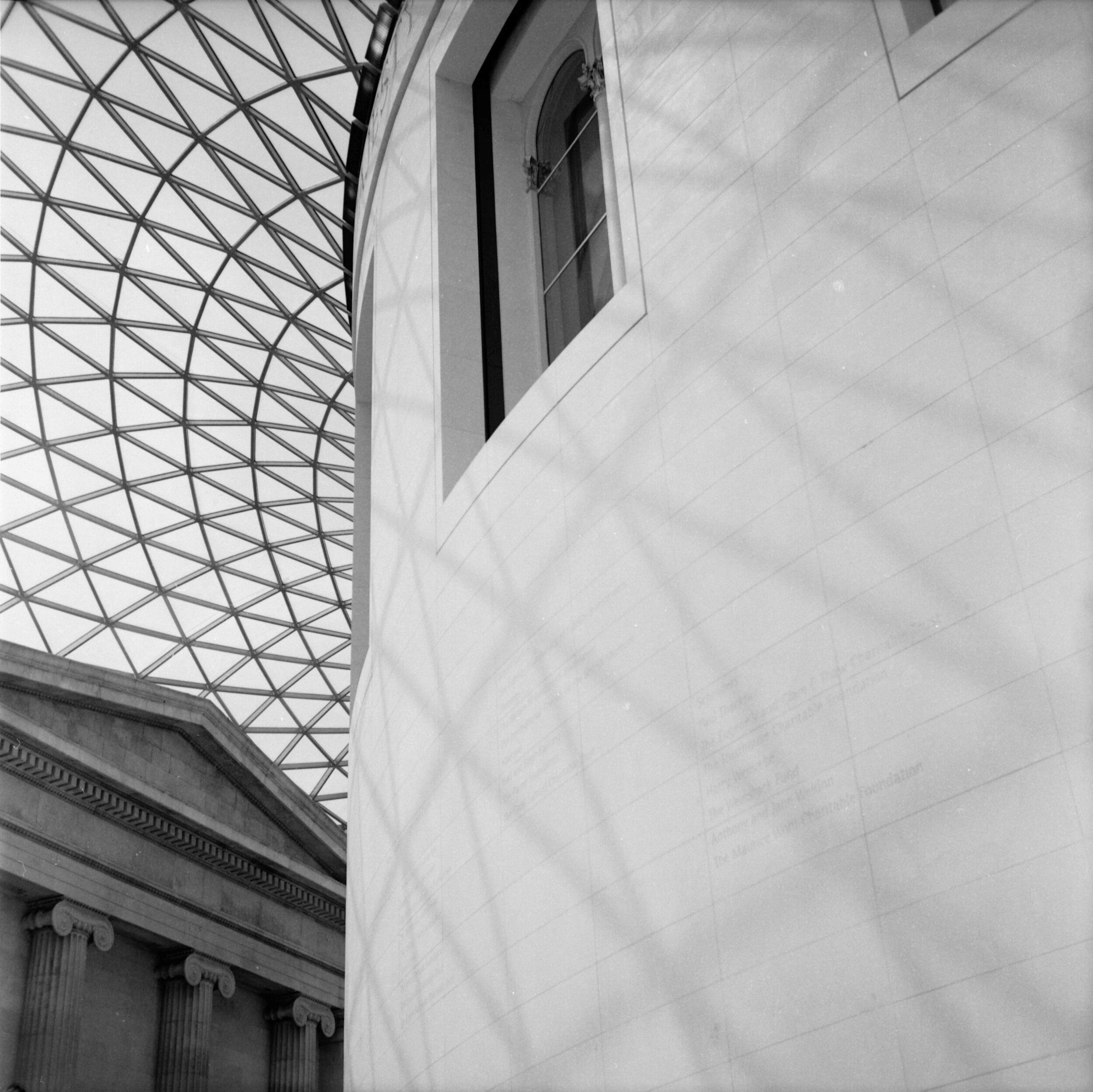


So, now that I am fully re-engaged with film photography, I going to spend the winter months reviewing the archive and also covering the events in Brighton.
Until next time, keep snapping.
A selection of the images within this article are available for sale on the Website or Etsy Store, if you would like to enquire about something else, please click the email icon at the foot of this page.
Yes please, keep me posted when there’s a new blog
Instagram - Film