Modern Masters 3: Sage Sohier: The Quiet Observer Who Changed American Photography
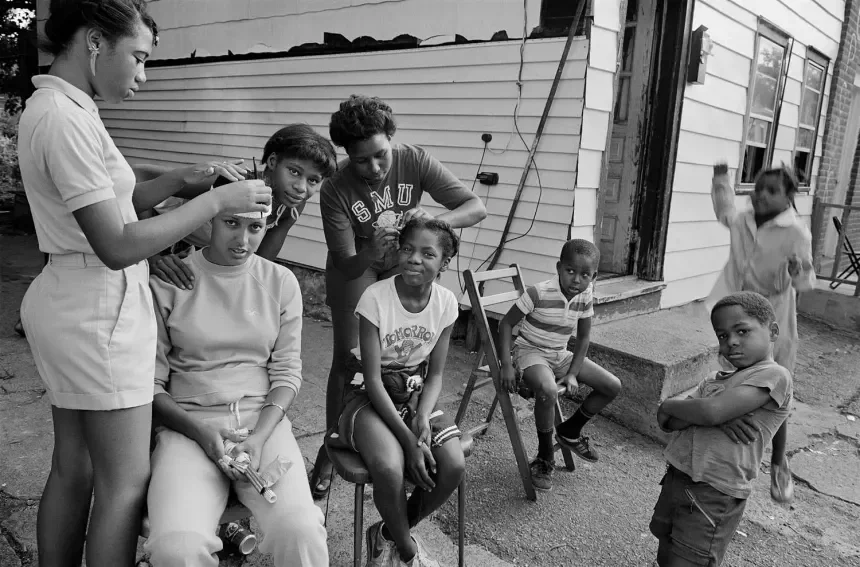
On this International Women's Day, we turn our Modern Masters lens onto one of the most quietly radical voices in American documentary photography — a woman who, armed with a wide-angle lens and a warm curiosity, captured the hidden heart of a nation.
A Woman with a Camera and a Question
There are photographers who shout, and there are those who whisper. Sage Sohier has always whispered — and yet her work echoes across decades. Born in Washington D.C. in 1954, Sohier spent the late 1970s and 1980s wandering the working-class neighbourhoods of America, knocking on strangers' doors, gaining their trust, and producing some of the most affecting environmental portraits ever made. She photographed gay couples at the height of the AIDS crisis. She photographed her fashion-model mother growing old. She photographed children playing in the street before the internet arrived to pull them indoors. Her work is, above all, an act of witness.
Today, on International Women's Day 2026, we celebrate Sage Sohier: a Harvard-educated, Guggenheim-awarded, MoMA-collected artist who never sought the spotlight — and who, perhaps for that reason, is finally getting the recognition she has long deserved.
Origins: Washington D.C. to Harvard Yard
Sage Sohier was born in Washington D.C. in 1954. Growing up, she was drawn to language and narrative — she arrived at Harvard University intending to major in English and, she has said, imagined she might become a writer. But she was restless, ill-suited to sitting alone in front of a typewriter for hours.
Everything changed in her sophomore year when she took her first photography class. As she later told The Photographers' Gallery in London:
"When I took my first photography class as a sophomore, I learned about fine art photography and realised that the medium had narrative possibilities as powerful as fiction writing. I was hooked."
Photography gave her what writing couldn't: a reason to be out in the world, in conversation with strangers, alive to the unexpected. She graduated from Harvard with her B.A. and never looked back.
The Big Break: Tod Papageorge and the East Coast Scene
If there was a single moment that set Sohier's course, it was meeting photographer Tod Papageorge, who visited Harvard as a senior-year artist-in-residence. The encounter was, by her own account, transformative:
"Tod was incredibly eloquent about the medium, and he somehow made me feel not only that I wanted to become a photographer, but also that it was possible for me."
Boston in the 1970s was a fertile environment for a young photographer. Sohier found herself moving in circles that included Nick Nixon, Lee Friedlander, and Garry Winogrand — giants of American documentary photography who would shape her eye and ambition. She was also deeply influenced by Diane Arbus, whose ability to produce psychologically acute portraits she spent years trying to understand, and by Chauncey Hare's book Interior America (Aperture, 1978), which showed her the documentary possibilities within ordinary domestic spaces.
Her early career blossomed quickly. She received a Massachusetts Artists Foundation photography fellowship in 1979, followed by a National Endowment for the Arts photography fellowship in 1980–81. The Guggenheim Fellowship came in 1984–85 — one of the most prestigious awards in American arts — cementing her reputation as a serious artistic voice.
Style: Close, Sharp, and Full of Life
Sohier's photographic style is immediately recognisable: wide-angle lenses, deep depth of field, everything rendered tack-sharp from foreground to background. She favoured apertures of f/11 or f/16, used on-camera flash frequently to fill her frames with even light even in low-light conditions, and shot primarily in black and white during her most celebrated early work. The effect is almost theatrical — a 'picture on a wall' quality, as one critic described it, where the entire stage of life is visible and in focus.
She has spoken candidly about her technique:
"Back in the 70s, most photographers still worked in black and white. I fell in love with wide-angle lenses — I liked how they made the foreground large and the background recede and how playing with scale created stories. I also liked to use on-camera flash, so that I could still shoot with apertures of f16 or f11 and render everything sharp even at dusk."
What makes Sohier's work distinctive is not just technical precision but the quality of presence she achieves. She was never a candid, covert photographer. She approached people directly, explained her project, asked permission, and stayed long enough for the self-consciousness to dissolve. Her subjects — working-class families, teenagers on stoops, gay couples in their living rooms — have a relaxed, unguarded quality that is the product of genuine human connection.
"Approaching people politely and with energy and enthusiasm is key. Intruding on people's personal space could feel awkward, and was never easy to do, but most of the time it seemed that my enthusiasm was contagious and people were able to relax and be themselves."
Later in her career she shifted away from the blunt on-camera flash aesthetic of her 1980s work:
"I don't shoot that way anymore, though I do still use flash a lot. I prefer more of a natural-light effect now."
Equipment: What She Used and What She Didn't
Sohier's technical choices were always in service of her vision. Her kit during the signature years of the 1980s was deliberately unglamorous:
Wide-angle lenses — her primary tool, giving her images their characteristic sense of depth and environment
Small apertures (f/11 and f/16) — ensuring everything in the frame was sharply rendered
On-camera flash — not for drama, but for control, allowing her to shoot in varied light conditions while maintaining sharpness
Medium format cameras — chosen for their exceptional detail and tonal range, which rewarded slow, deliberate composition
Black and white film — the standard of serious documentary work in that era, and a material she fell deeply in love with
What she avoided, by temperament if not always by rule, was anything that created distance between herself and her subjects. She was not a telephoto photographer. She did not hide. She was not interested in bokeh, in dreamy soft focus, in separating subject from environment. She once noted simply: "Back then I wanted everything to be sharp and visible."
She also kept her workflow deliberate and human-paced. The medium format camera required more time and intention than a 35mm point-and-shoot — and that slower rhythm, she has suggested, actually aided her relationships with subjects, giving conversations time to breathe before the shutter clicked.
The Major Series: A Body of Work Like No Other
Sohier has spent her career in long-form documentary projects, returning to the same themes — American identity, domestic life, the nature of love — across decades. Here are the series that define her legacy:
Americans Seen (late 1970s–1980s)
Her foundational body of work, shot across the American landscape from New England to Florida to the rural Midwest. Sohier would load her car and drive south in winter, seeking out strangers in working-class neighbourhoods and asking if she could photograph them. The resulting images — published by Nazraeli Press in 2017 and reissued in a remastered edition in 2024 — are among the finest environmental portraits in American photography. They document a pre-digital, pre-internet America with warmth, clarity, and wit.
At Home With Themselves: Same-Sex Couples in 1980s America (mid-1980s)
This project is arguably Sohier's most historically significant. Begun in 1986, at the height of the AIDS crisis, it was motivated in part by her desire to understand her father, who had left the family when she was a toddler and whom she later discovered was gay. She photographed committed gay and lesbian couples in their homes across America, creating intimate portraits that stood in deliberate contrast to the sensationalised media portrayal of gay life at the time. As she has said:
"I was interested in how, as a culture, we weren't used to looking at two men touching, and was struck by the visual novelty yet total ordinariness of these same-sex relationships."
The series was so culturally ahead of its time that it found no publisher for nearly 30 years. It was finally released by Spotted Books in 2014 — just before the Supreme Court's landmark Obergefell v. Hodges ruling on marriage equality — and was immediately recognised as an essential historical document.
Animals (1980s–1990s)
A black-and-white series depicting people with their pets — companion animals that reveal, Sohier believes, something uninhibited and true about their human owners:
"There is more spontaneity, less self-consciousness, and more chaos when humans and other animals coexist. Love is unconditional, grief is uncomplicated though deeply felt, and life is richer, more vivid, more comical."
Published by Stanley/Barker in 2019, the series became one of her most celebrated books.
Witness to Beauty (2016)
A deeply personal project in which Sohier trained her camera on her own mother — a former fashion model photographed by such legends as Irving Penn and Richard Avedon. Sohier describes herself as the 'foil' to her mother's beauty, always behind the camera rather than in front of it. The book, published by Kehrer Verlag, is a meditation on age, femininity, and the complexity of the mother-daughter relationship.
Passing Time (2023) and Easy Days (2025)
Revisiting her archive during the pandemic, Sohier uncovered a wealth of unpublished images from the late 1970s and early 1980s. Passing Time — awarded Best Book at Paris Photo Week 2023 by Vanity Fair — presents 57 images of young people at leisure in pre-digital America. Easy Days, published by Nazraeli Press in 2025, completes a trilogy of her 1980s work and was the subject of a major solo exhibition at the Center for Photographic Art in Carmel, California.
Iconic Images: Photographs to Look For
Sohier does not have single 'famous' images in the way Cartier-Bresson has his decisive moments — her power is cumulative, architectural, built across series and bodies of work.
Rise to Recognition: Long Overdue
Sohier's path to wide recognition was, by any measure, a long one. She spent the 1980s building her archive while simultaneously teaching — at Harvard (as Lecturer on Visual and Environmental Studies, 1991–2003), Wellesley College (as Assistant Professor, 1997–99), the Massachusetts College of Art, the Rhode Island School of Design, and the School of the Boston Museum of Fine Arts. She was, in many ways, a photographer's photographer: deeply respected within the field, with her work collected by MoMA, the Brooklyn Museum, the San Francisco Museum of Modern Art, the Cleveland Museum of Art, the Nelson-Atkins, and the Portland Art Museum — but not yet broadly famous.
The turning point came with a cluster of major publications and exhibitions from 2012 onward. About Face (Columbia College Chicago Press, 2012), At Home With Themselves (2014), Witness to Beauty (2016), and Americans Seen (2017) established her, finally, as a photographer of genuine historical importance. MoMA's 2010–11 group exhibition 'Pictures by Women: A History of Modern Photography' placed her work in its proper canonical context.
The second act — Passing Time's Paris Photo acclaim in 2023, the remastered Americans Seen in 2024, and Easy Days in 2025 — has introduced her work to a new generation of photographers who find in her images both a technical mastery and a humanity they aspire to.
"I fell in love with photography in college and knew that that's what I had to spend my life doing. It's a kind of addiction, and my life doesn't feel complete unless I have a project or two that I'm working on and excited about."
What Her Peers Say
The photography world has been increasingly vocal about Sohier's importance. Here is what those who know the field best have said:
Alex Webb and Rebecca Norris Webb selected Passing Time as one of their Best Photobooks of 2023 at Photobookstore.co.uk — a significant endorsement from two of the most celebrated names in contemporary colour photography.
Ed Templeton, the skateboarder turned photographer and cult photobook connoisseur, also named Passing Time among the best books of 2023 — a mark of the book's cross-generational appeal.
Vanity Fair designated Passing Time one of the Best Books at Paris Photo Week 2023, the world's most prestigious photography fair.
Shana Lopes, curator of photography at the San Francisco Museum of Modern Art (SFMOMA), appeared in conversation with Sohier at the Center for Photographic Art in 2025, a gesture of institutional validation from one of America's most important photography collections.
What Will You Remember, the photography criticism publication, wrote of At Home With Themselves: "Sohier's ability to amplify the nuance of each relationship is uncanny. Her triumph: encapsulating the touching universality and individuality of our human connections."
Lenscratch, one of the most influential photography platforms online, has described her as "indefatigable" — a photographer with a "long legacy of documenting the human (and animal) condition close to home and on the streets."
Photo Resources:
Use these links to source images for the blog post (always check licensing and credit requirements before embedding):
Sage Sohier's official website — full portfolios organised by series (Easy Days, Americans Seen, Animals, Peaceable Kingdom, At Home With Themselves, Witness to Beauty and more)
The Photographers' Gallery Print Sales — overview with images
YouTube Video Resources
Search for these on YouTube to find embeddable video content:
Essential Photobooks
Sohier has published nine monographs — a body of book work that is itself remarkable for its consistency and range. Here are the essential titles:
Easy Days (Nazraeli Press, 2025) — the final volume in her 1980s trilogy, completing a definitive document of pre-digital American life
Passing Time (Nazraeli Press, 2023) — voted Best Book at Paris Photo Week by Vanity Fair; 57 images of youth and leisure in 1979–85 America; printed on Japanese Kasadaka art paper
Peaceable Kingdom (Kehrer Verlag, 2021) — with an essay by writer Sy Montgomery; her most expansive exploration of the human-animal bond
Animals (Stanley/Barker, 2019) — black-and-white portraits of people with their pets; one of the most charming and psychologically astute books in her catalogue
Americans Seen (Nazraeli Press, 2017; remastered edition 2024) — the cornerstone of her reputation; environmental portraits of working-class America in the 1980s
Witness to Beauty (Kehrer Verlag, 2016) — her intimate, humorous, and moving portrait of her ex-fashion-model mother
At Home With Themselves: Same-Sex Couples in 1980s America (Spotted Books, 2014) — the groundbreaking document of gay domestic life that waited 30 years to find a publisher; now recognised as a civil rights landmark
About Face (Columbia College Chicago Press, 2012) — a study in portraiture and facial expression
Perfectible Worlds (Photolucida, 2007) — her earliest monograph; the beginning of a long conversation with the American domestic landscape
A Final Thought
Sage Sohier once described what drew her to people's lives:
"In my twenties, I began to see the world and understand more about people from a variety of different backgrounds. Meeting people (in order to photograph them) was thrilling, and it changed me. Being a photographer has been a wonderful excuse to wander and to be inquisitive about others' lives and experiences. I will always be grateful to the people pictured here — not just for allowing me to spend time making pictures of them — but also for how these interactions informed and enriched my life."
On International Women's Day 2026, we are grateful in turn to Sage Sohier — for her curiosity, her warmth, her courage to knock on strangers' doors, and her extraordinary eye. She has given us a portrait of America that feels, across every decade, like something essential and true.
Explore her full body of work at sagesohier.com.
Until next time, keep snapping