in the frame
First Roll Loading Kodak Vision3 250D — and what Soho handed back
I've been shooting predominantly black and white for a period of time now of the 35mm film cameras. Years, really. Colour always felt like it needed a reason — a justification for the extra visual information it brings to a frame. Black and white strips a scene back to its essentials. Tone, texture, shadow, geometry. It's a clean way to work.
So loading up a roll of Kodak Vision3 250D AHU into the Nikon F80 felt like a deliberate step off familiar ground. This is a motion picture film stock — designed originally for cinema use in daylight conditions — and it's been building a serious following among still photographers. I'd read about it, seen other people's results, and kept putting it off. This time I just loaded it and went out.
I've been shooting predominantly black and white for a period of time now of the 35mm film cameras. Years, really. Colour always felt like it needed a reason — a justification for the extra visual information it brings to a frame. Black and white strips a scene back to its essentials. Tone, texture, shadow, geometry. It's a clean way to work.
So loading up a roll of Kodak Vision3 250D AHU into the Nikon F80 felt like a deliberate step off familiar ground. This is a motion picture film stock — designed originally for cinema use in daylight conditions — and it's been building a serious following among still photographers. I'd read about it, seen other people's results, and kept putting it off. This time I just loaded it and went out.
I headed into London a couple of weeks ago for an afternoon with no real plan beyond Soho and the West End. That's usually how the best days go. No agenda. Just walking, looking, reacting.
"I wasn't prepared for quite how warm it would be. Not warm in the pushed, processed way you can fake digitally — warm in the way afternoon light in London actually looks."
The film
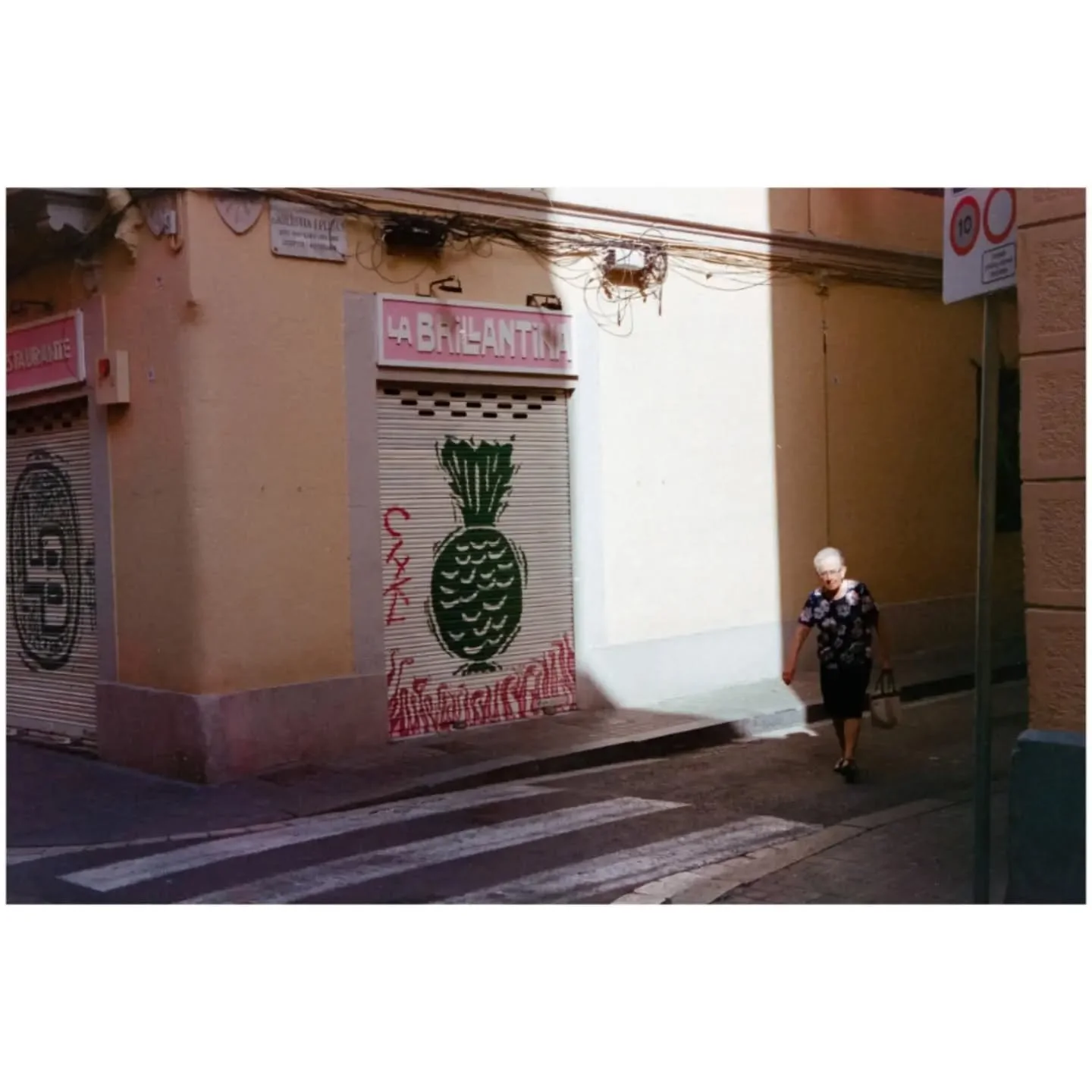
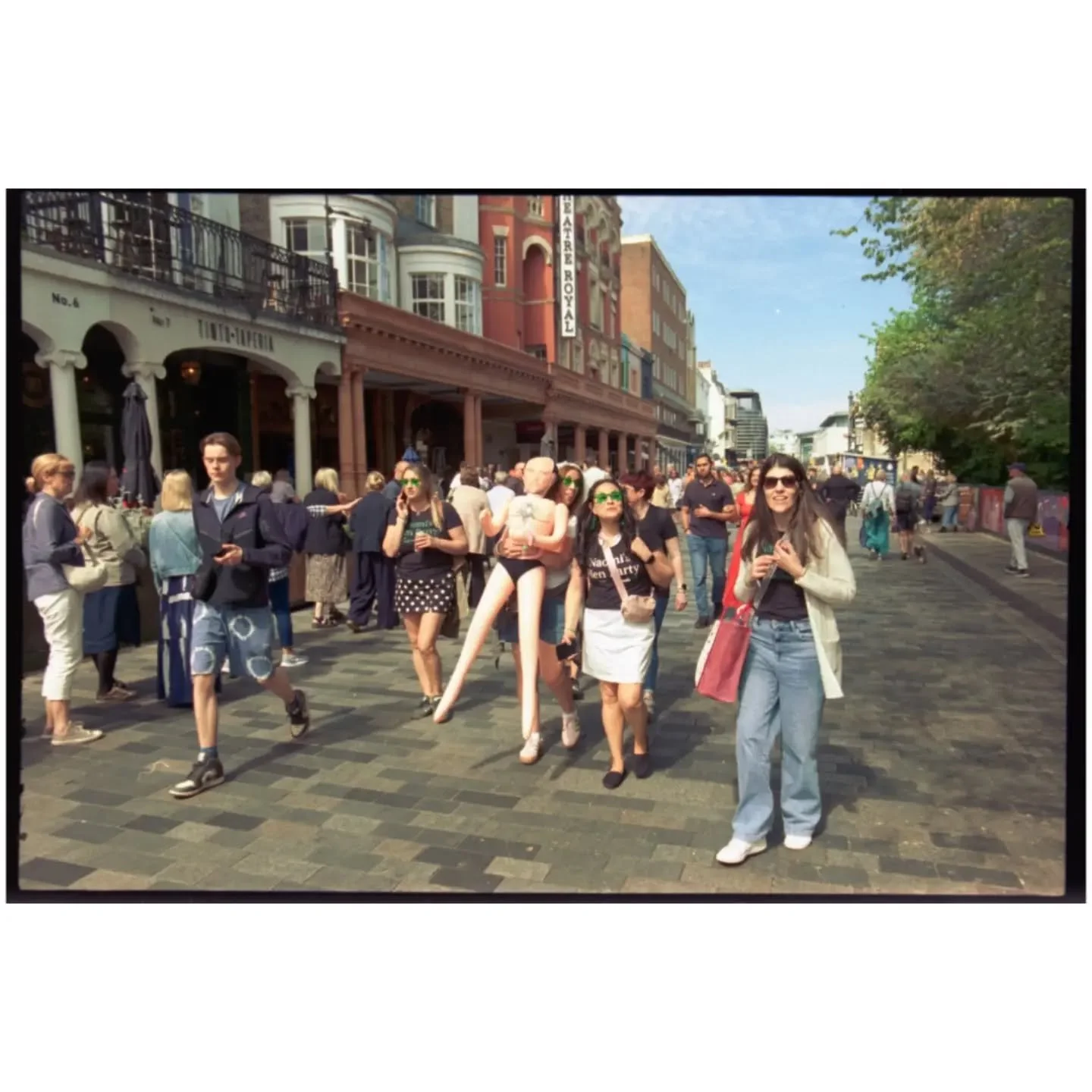
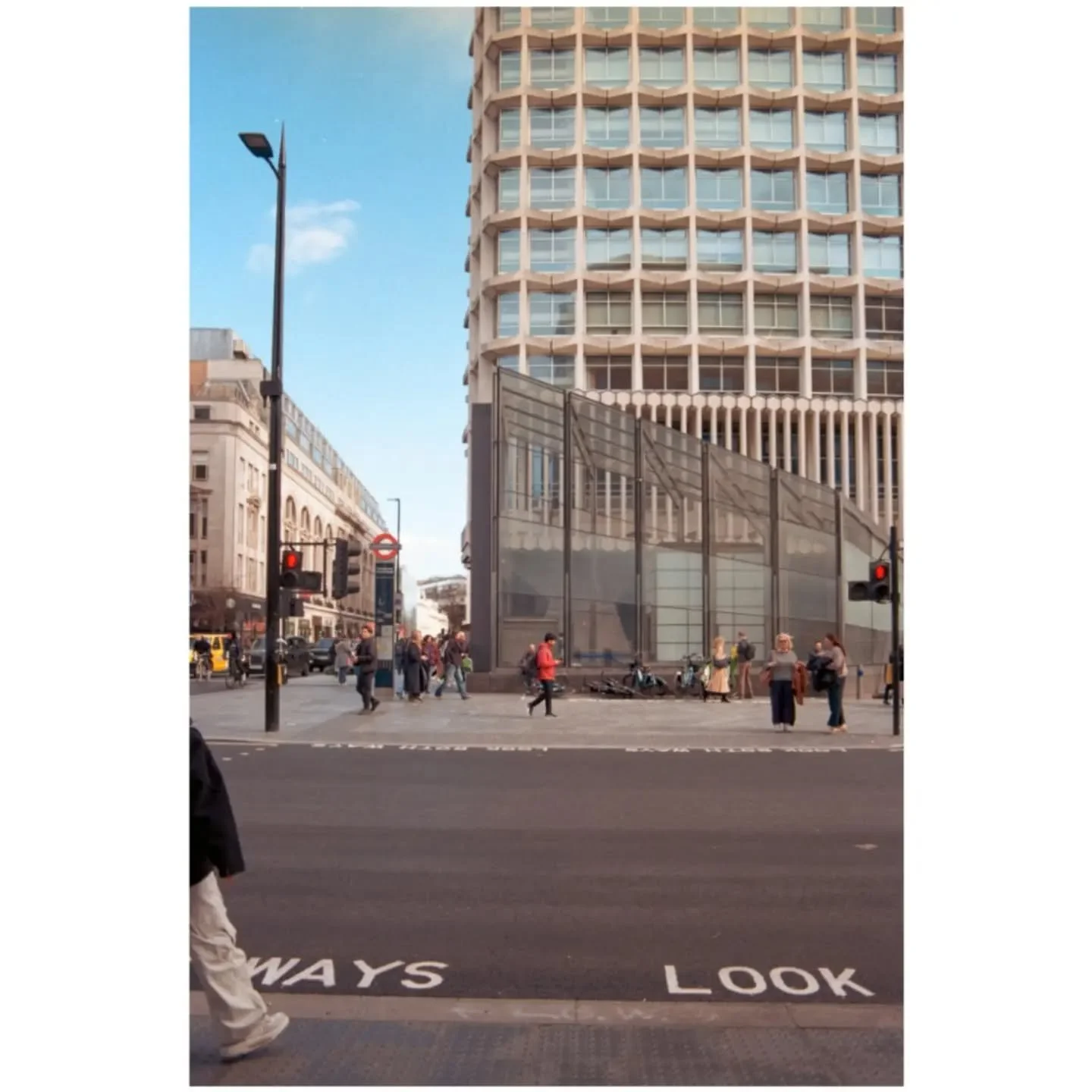
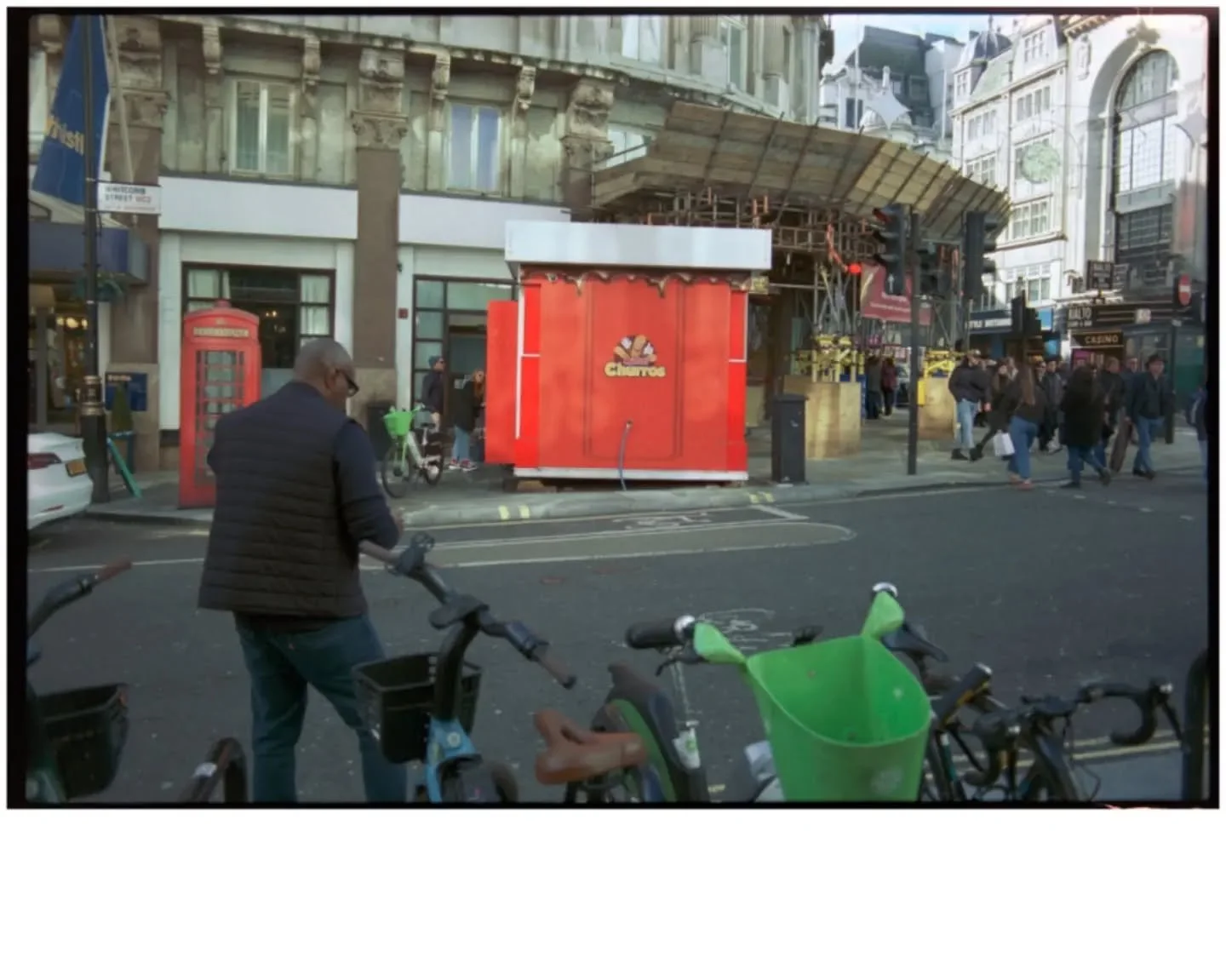
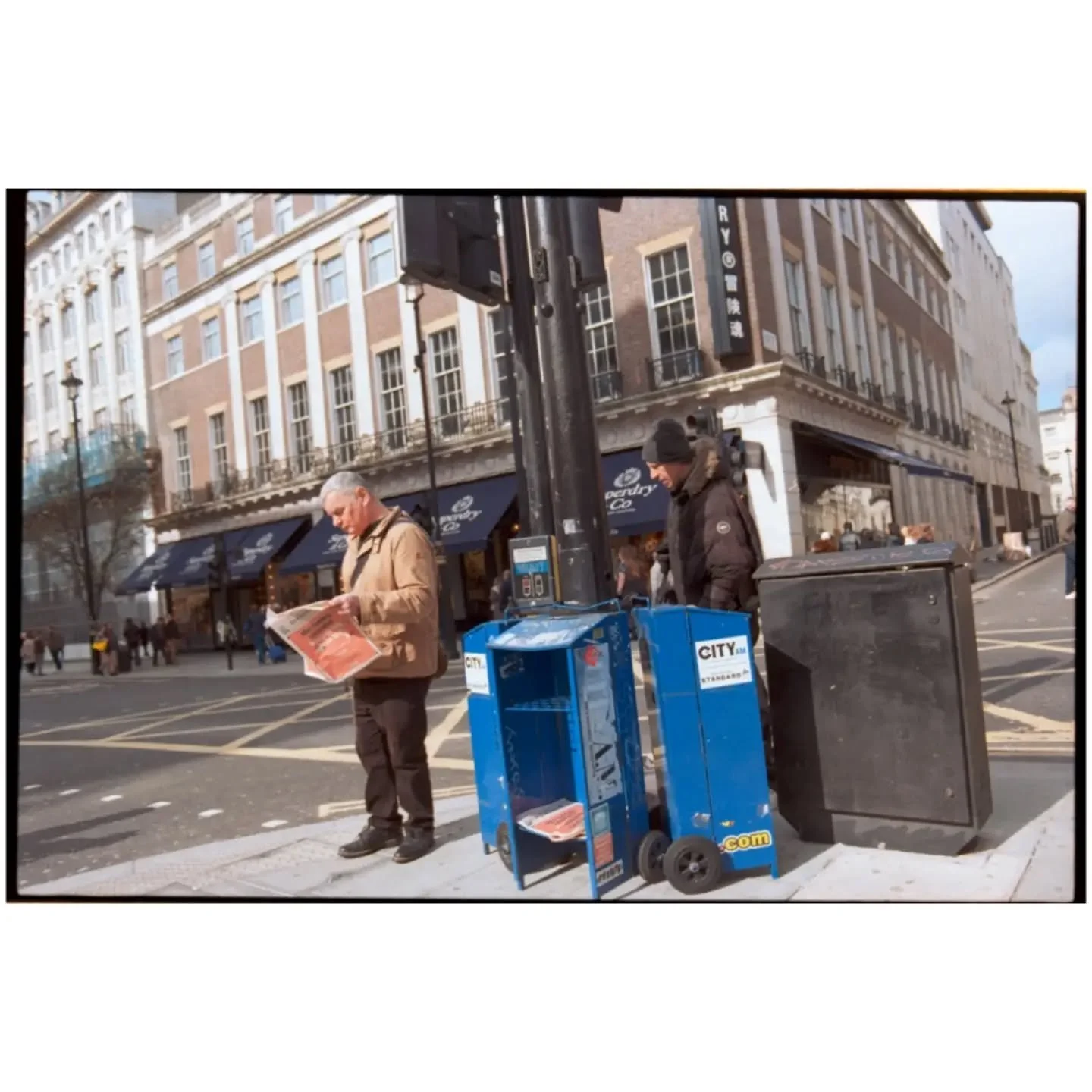
The warmth hit me the moment I got the processed film back. Vision3 250D AHU has a quality to its colour rendition that's difficult to articulate but immediately visible in the frames. It's not the oversaturated, high-contrast look of some colour negative stocks. It's quieter than that. More honest. The way light falls on a green café awning, or a pink coat, or an orange shopfront — it's rendered with a cinematic restraint that suits documentary street work perfectly.
The midtones are where it really earns its reputation. There's a richness in the middle of the tonal range that I haven't found in other stocks I've tried. Skin tones are warm without being ruddy. Shadows hold detail. Highlights — even in the direct afternoon sun I was shooting in — don't blow out catastrophically. For a daylight stock at ISO 250, it handles the contrast range of a busy London street remarkably well.
What Soho gave me
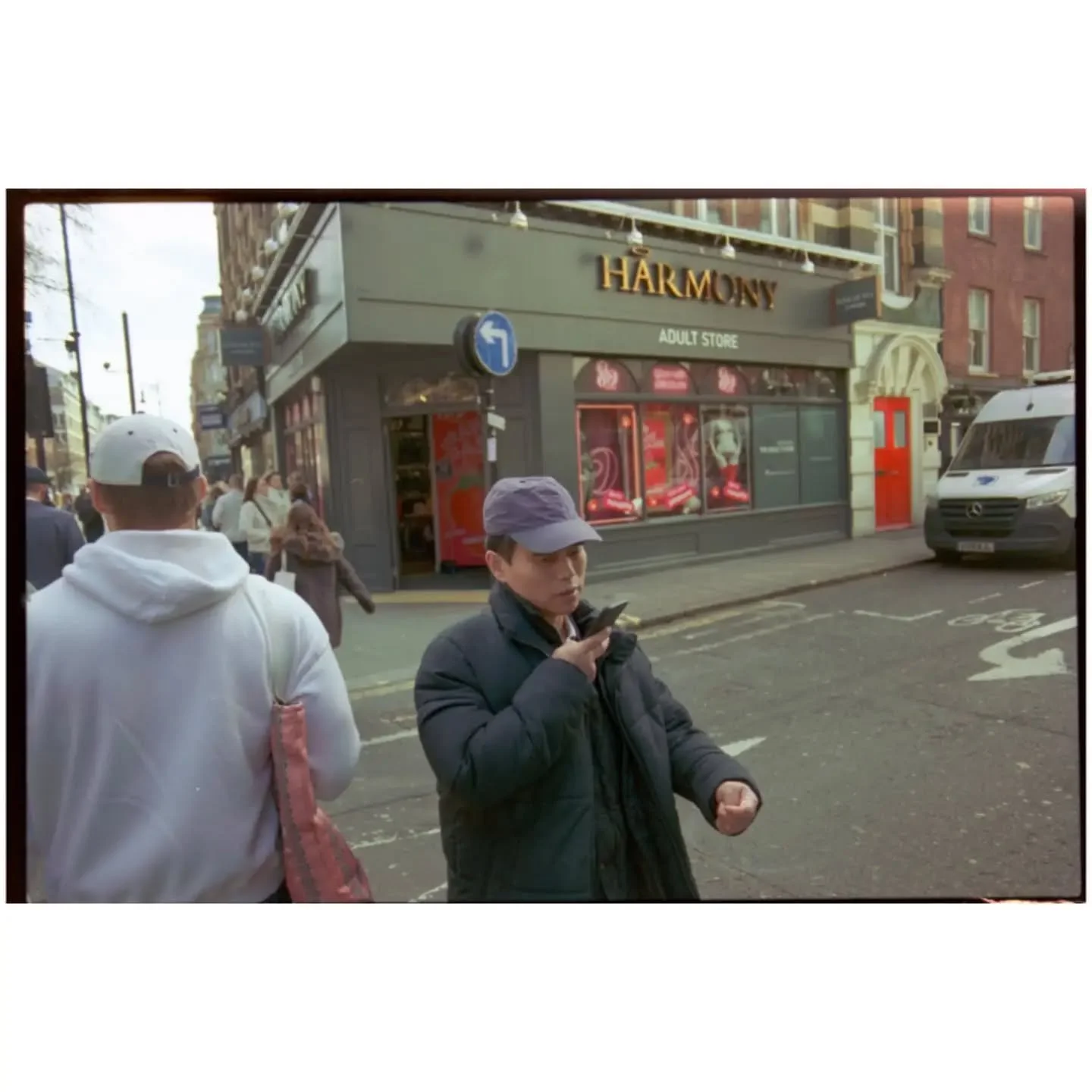
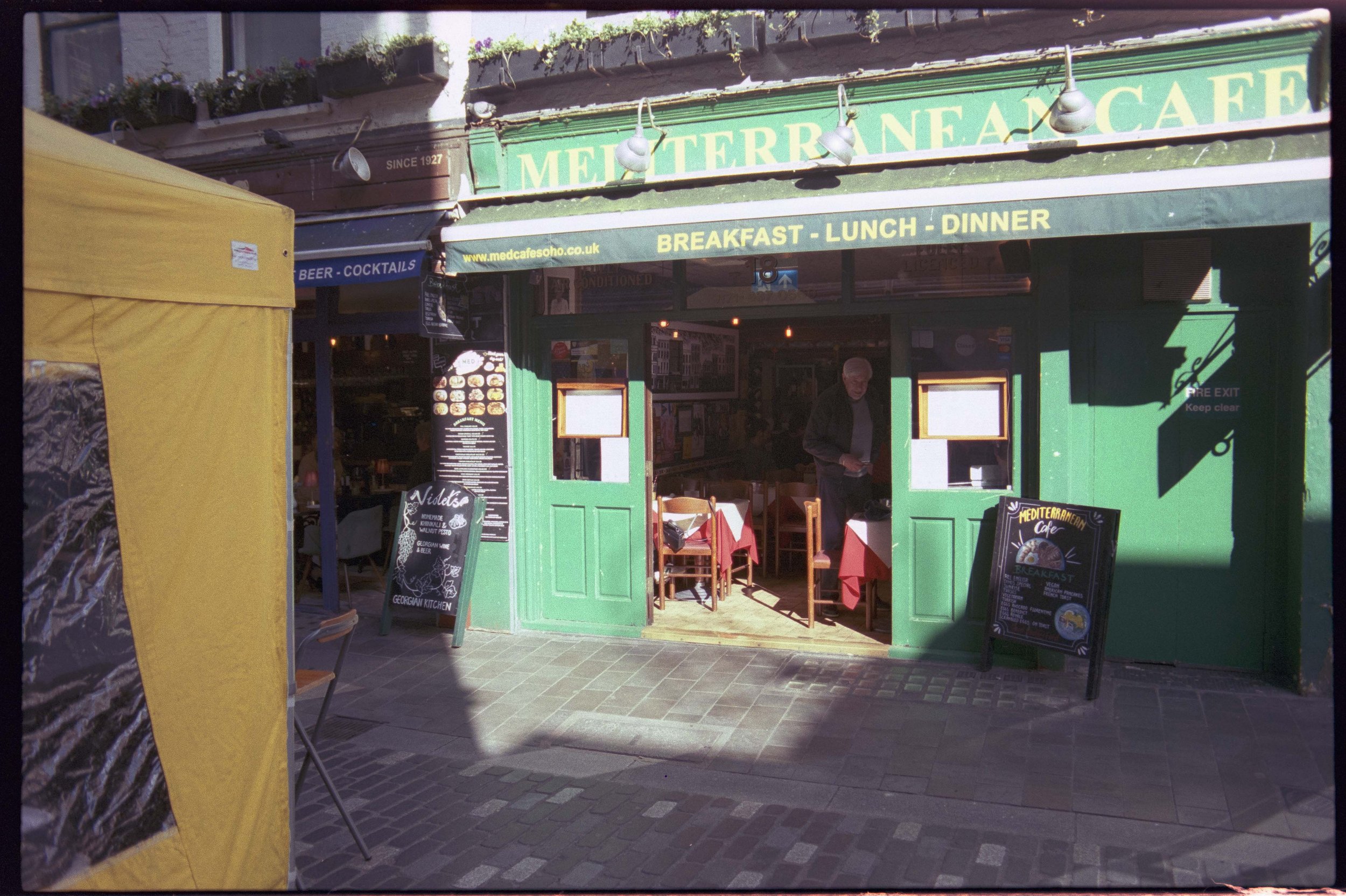
I started on the south end of Soho, working my way north through the afternoon. The Mediterranean Café on Old Compton Street stopped me almost immediately — a place that's been there since 1927, its deep green fascia catching the sun at an angle that Vision3 handled beautifully, the warm gold of the signage glowing against the paint. A man stood in the doorway, just watching the street. I got one frame and kept moving.
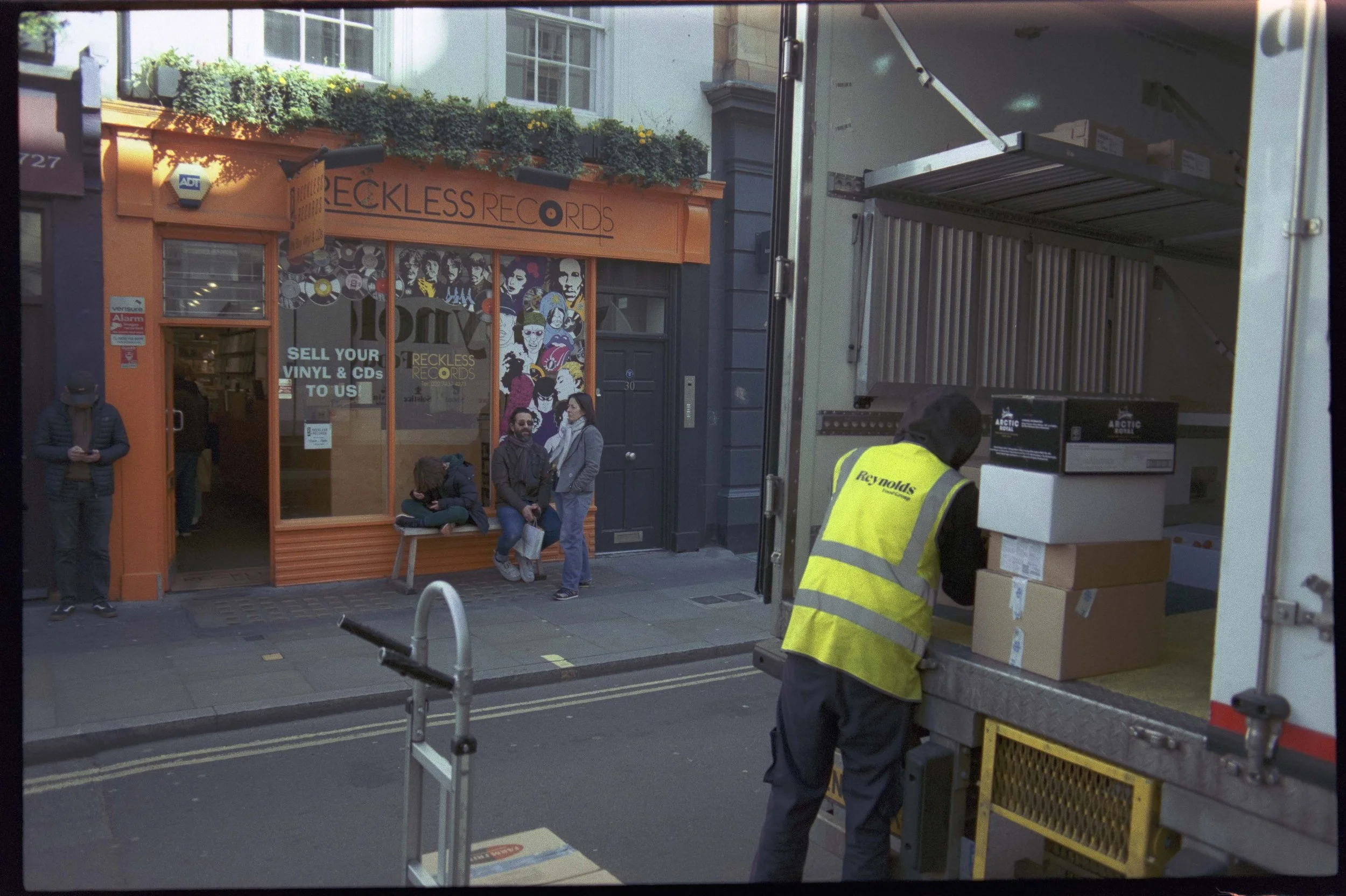
Around the corner, Reckless Records — that vivid orange shopfront with its illustrated window display of musicians — was being interrupted by a delivery driver in a hi-vis yellow jacket unloading boxes from a truck. The contrast of orange and yellow should have been too much. Vision3 made it work. That's one of its qualities: it handles colour density without letting things fight.
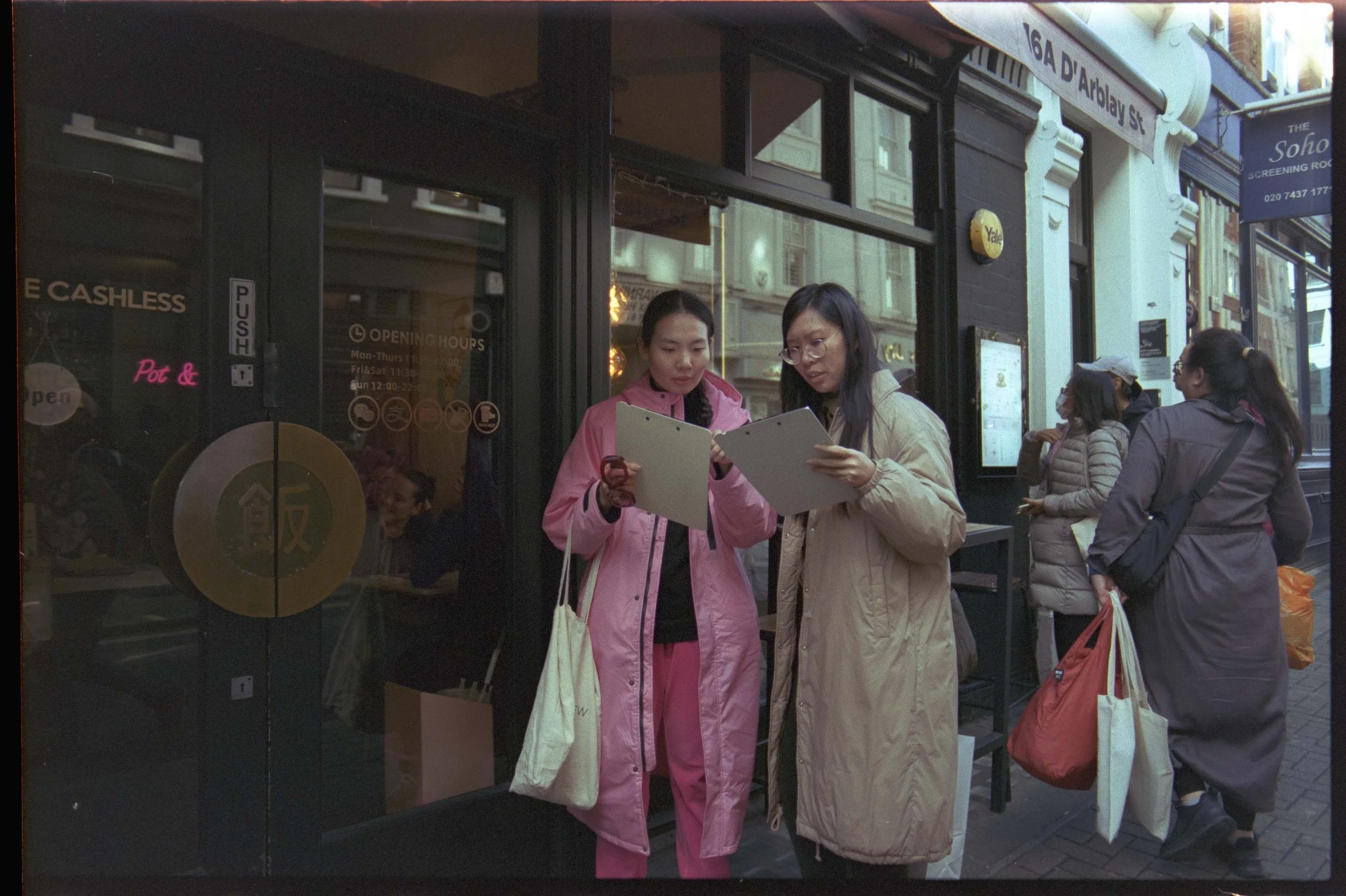
On D'Arblay Street I found two women in matching pink coats, both consulting clipboards outside a restaurant, deep in conversation. The warmth of those coats against the cooler tones of the street behind them is the kind of colour moment that simply doesn't exist in black and white. You don't get to choose that. The stock gives it to you.
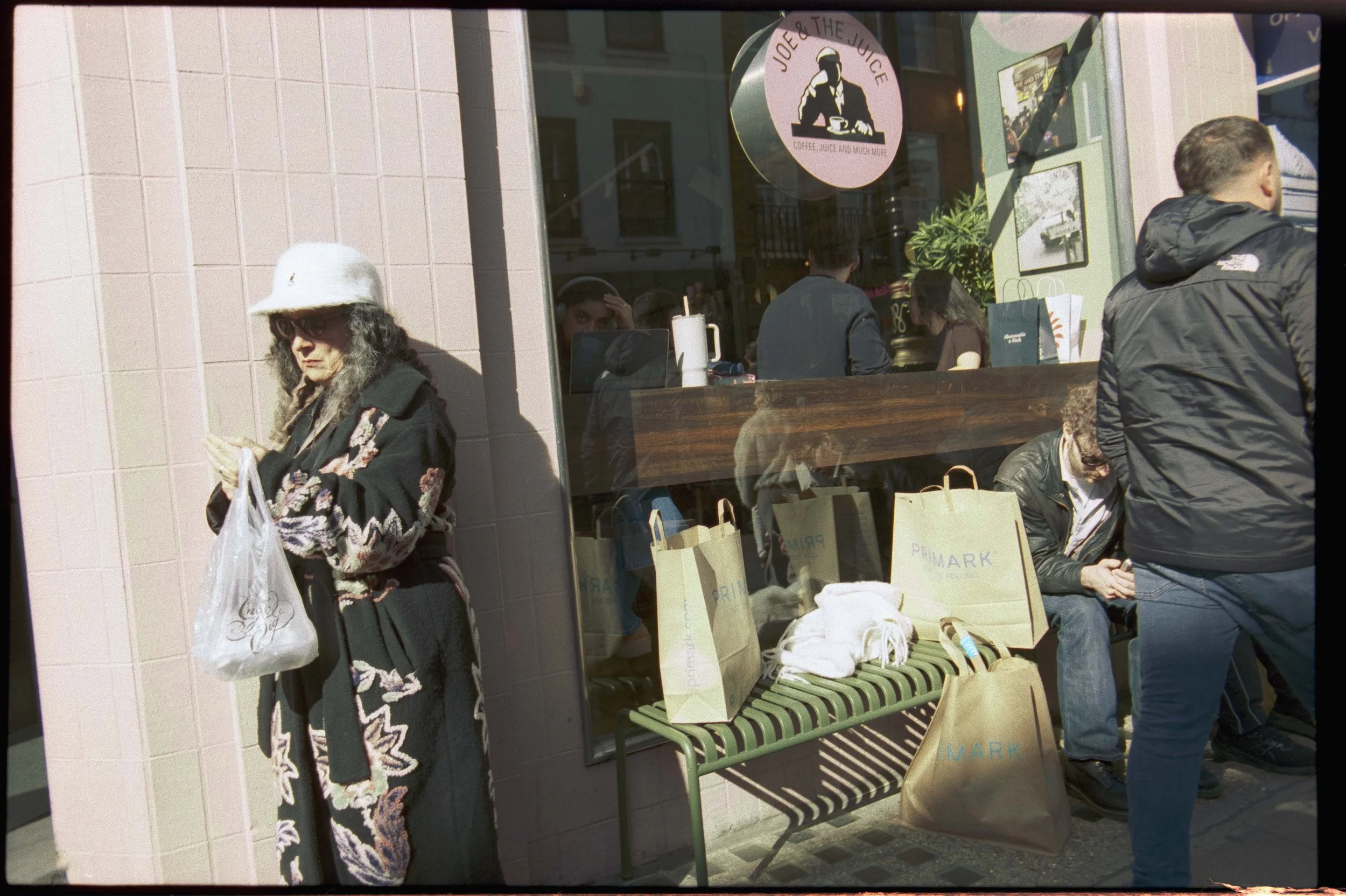
"Vision3 250D handles colour density without letting things fight. That's one of its qualities — and Soho tests it constantly."
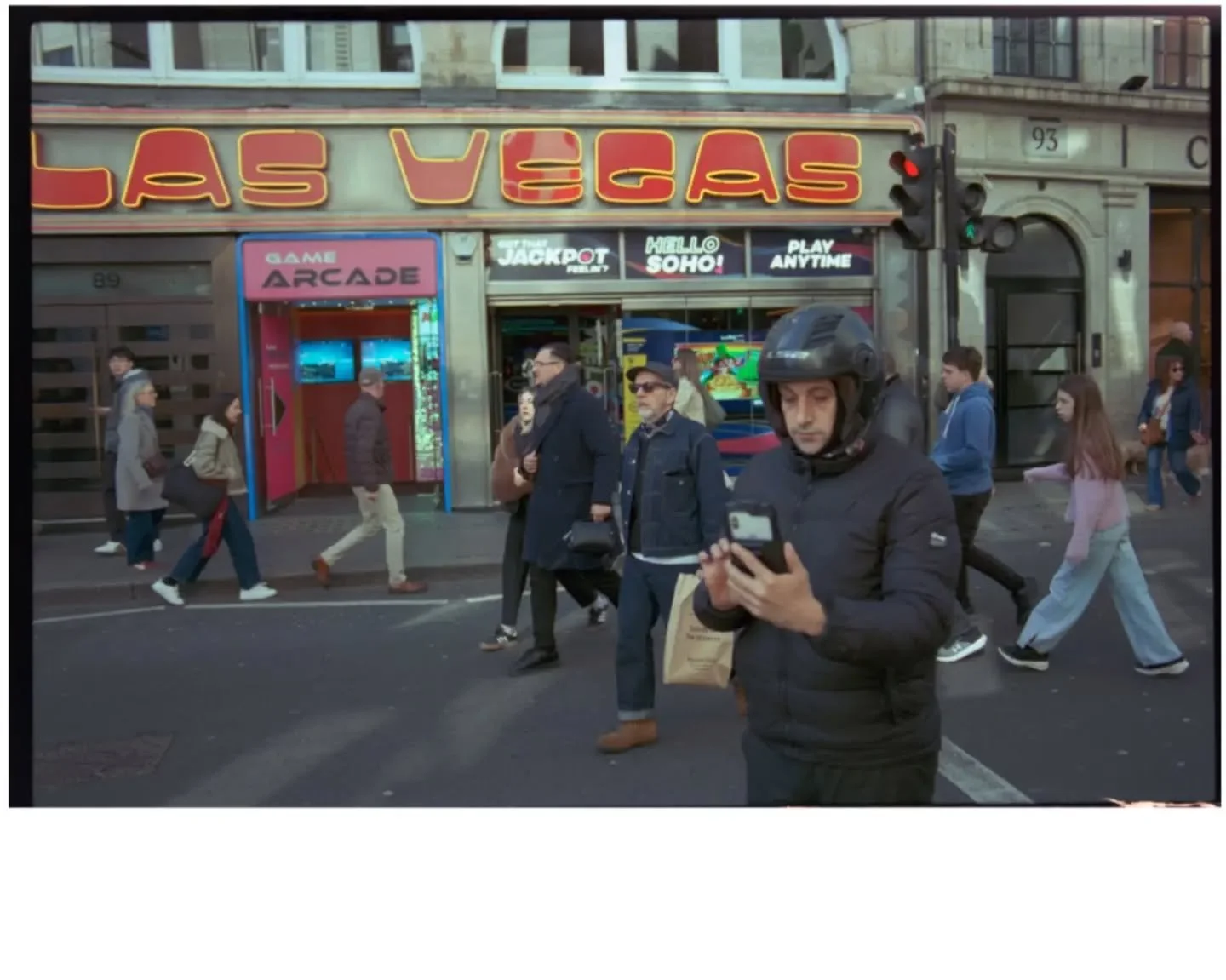
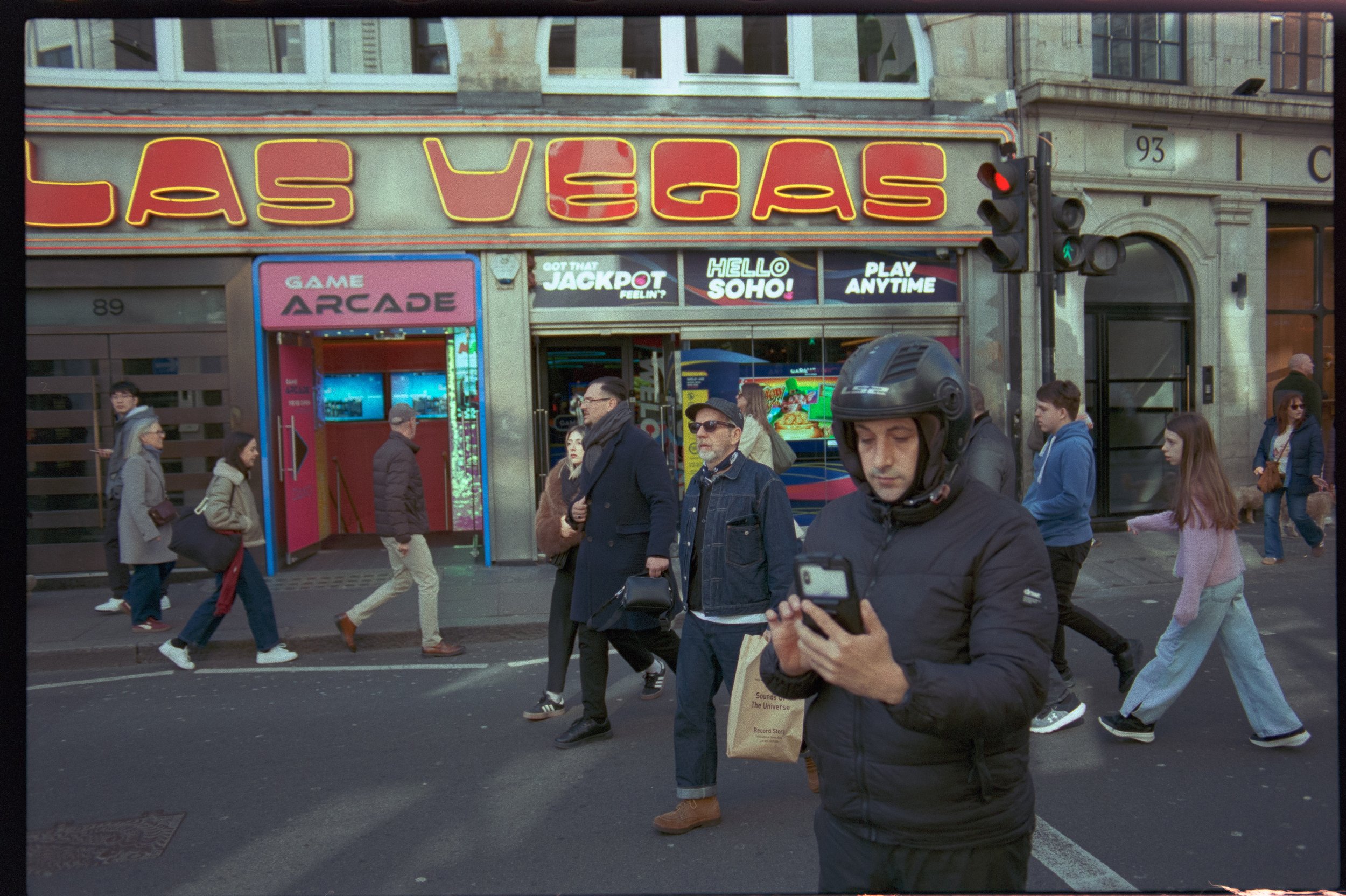
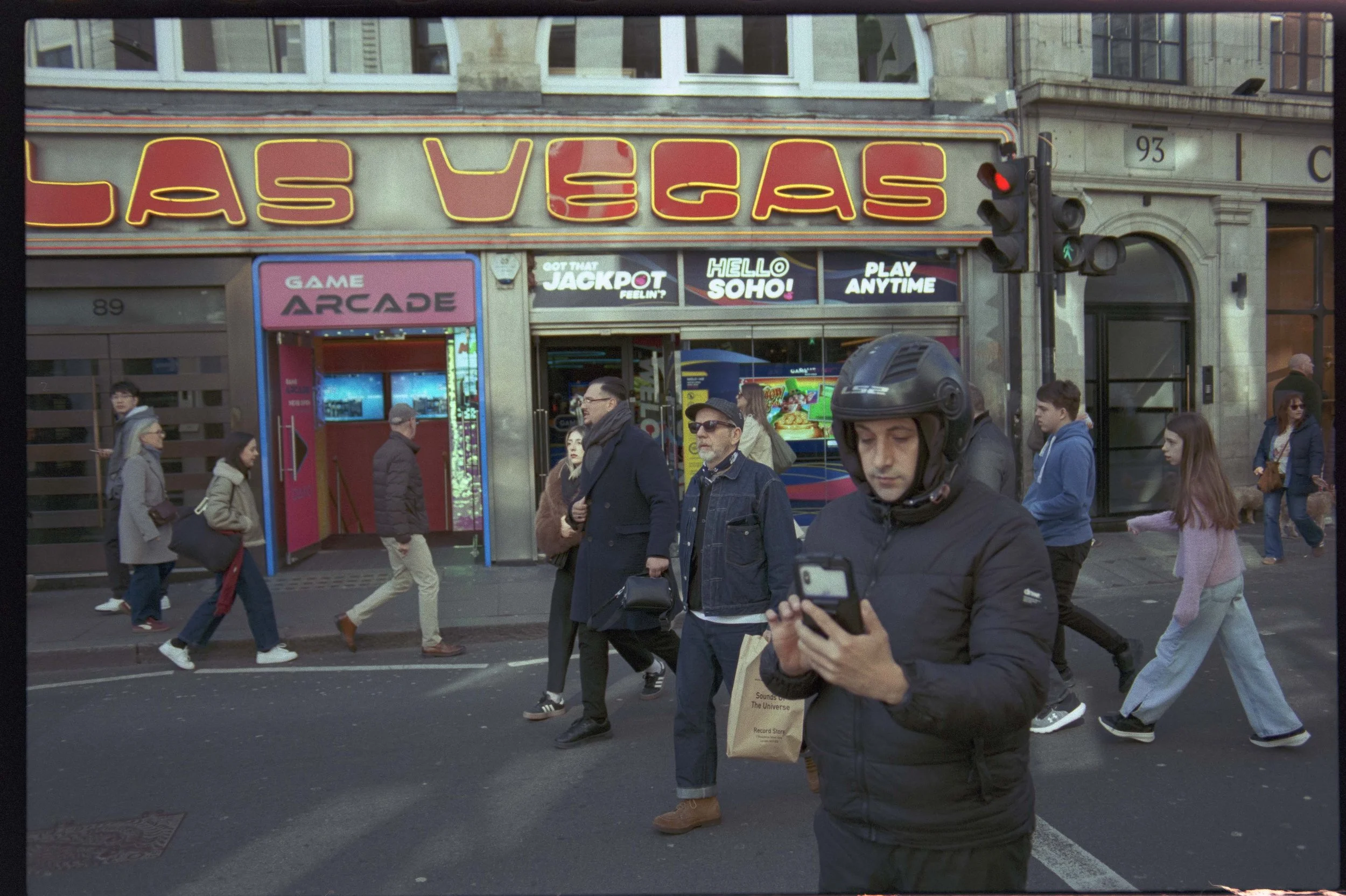
The Las Vegas arcade on what I think was Wardour Street gave me one of the more unexpected frames of the day — a motorcyclist in a full helmet standing at the crossing checking his phone, the enormous neon Las Vegas signage blazing behind him in red and gold, Hello Soho stencilled across the frontage. Vision3 renders neon brilliantly. The warmth of the sign, the cool blue of the afternoon sky in the upper corner of the frame — it's exactly what this stock was made for.
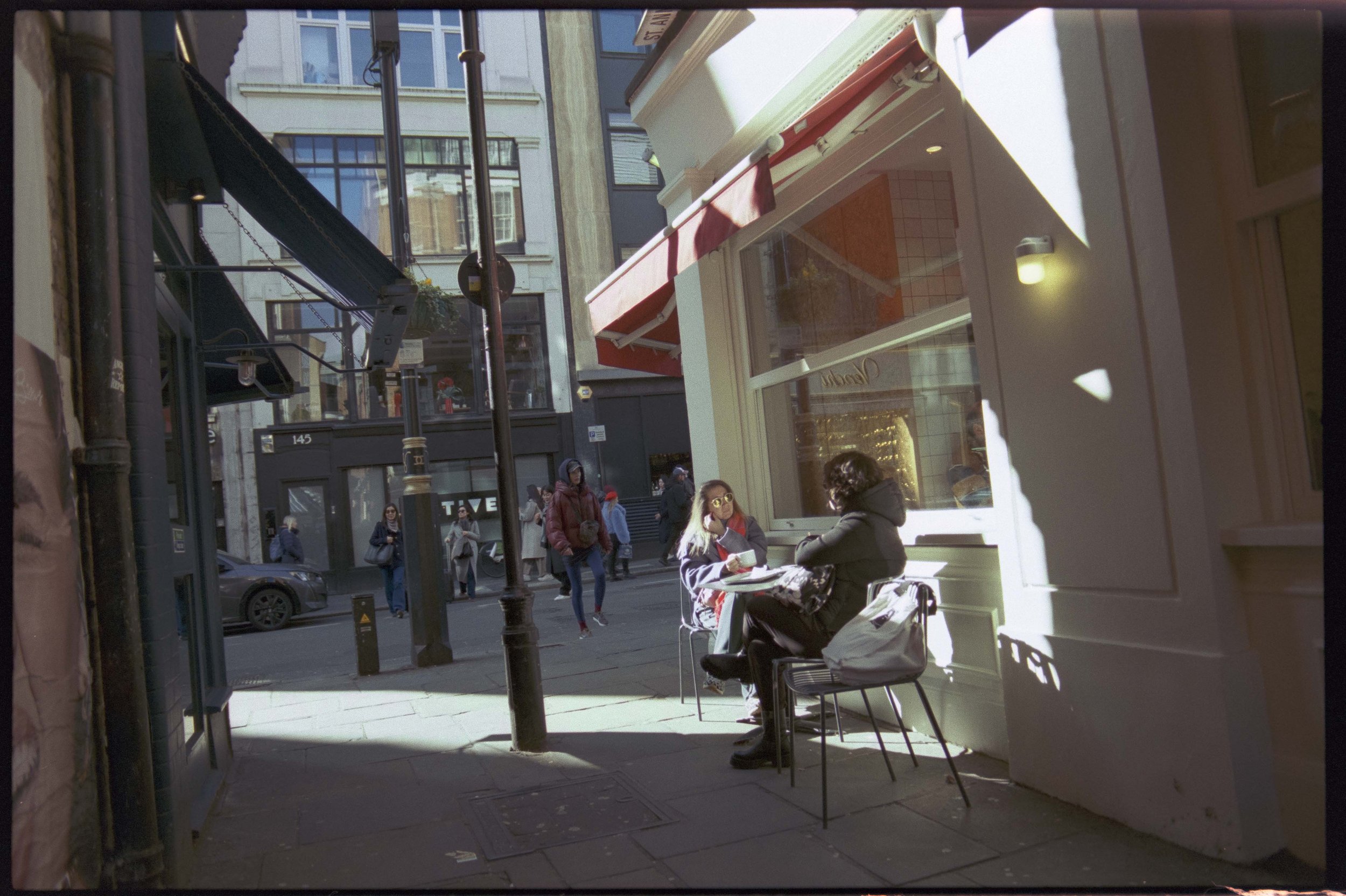
There was a quieter moment mid-roll that I keep coming back to: two women sitting outside a café in a narrow Soho alley, a red awning above them, dappled light falling across the table. No action. No joke. Just two people and an afternoon and the quality of light that Vision3 seems built to hold.
The three jokes
And then London started doing what London does.
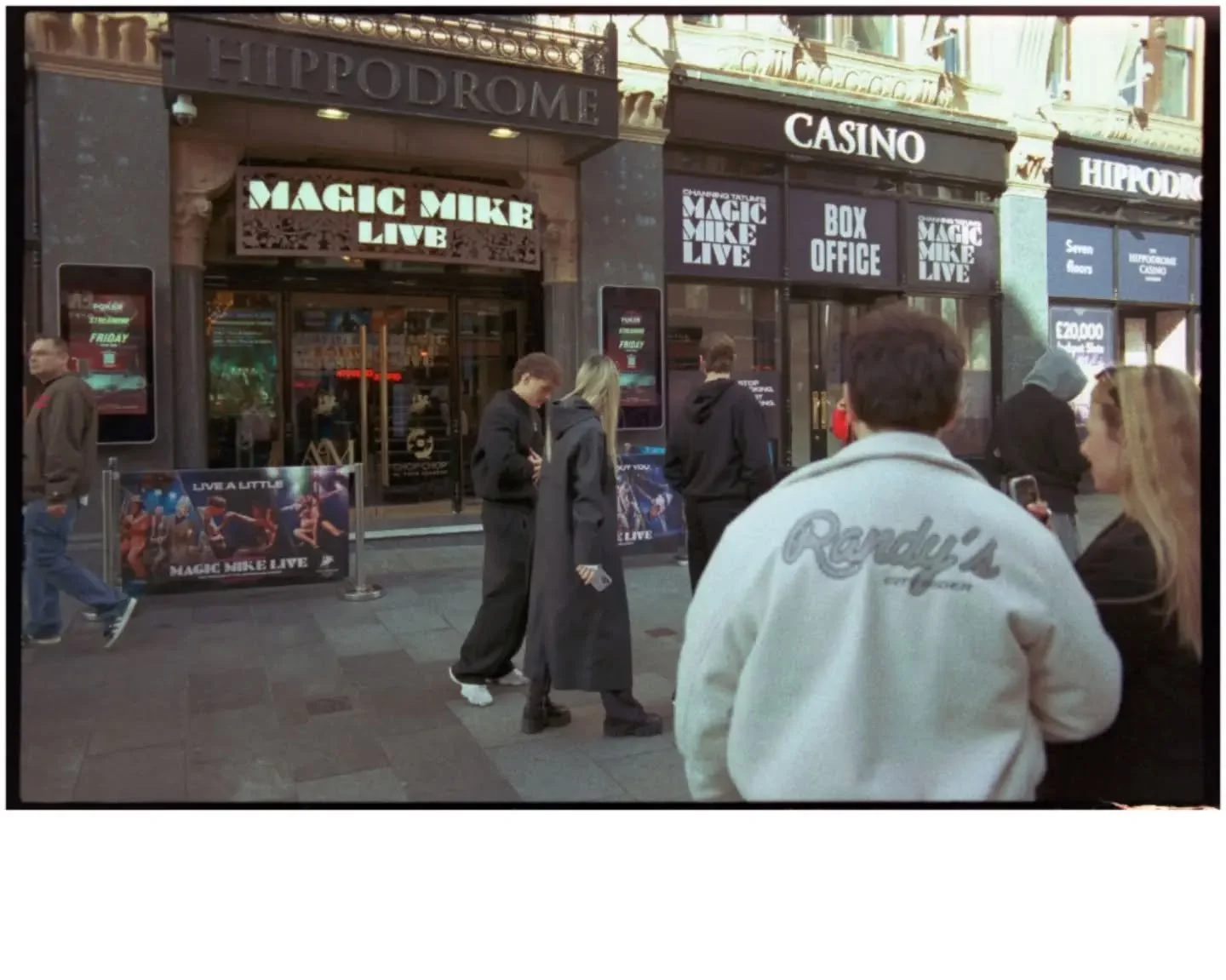
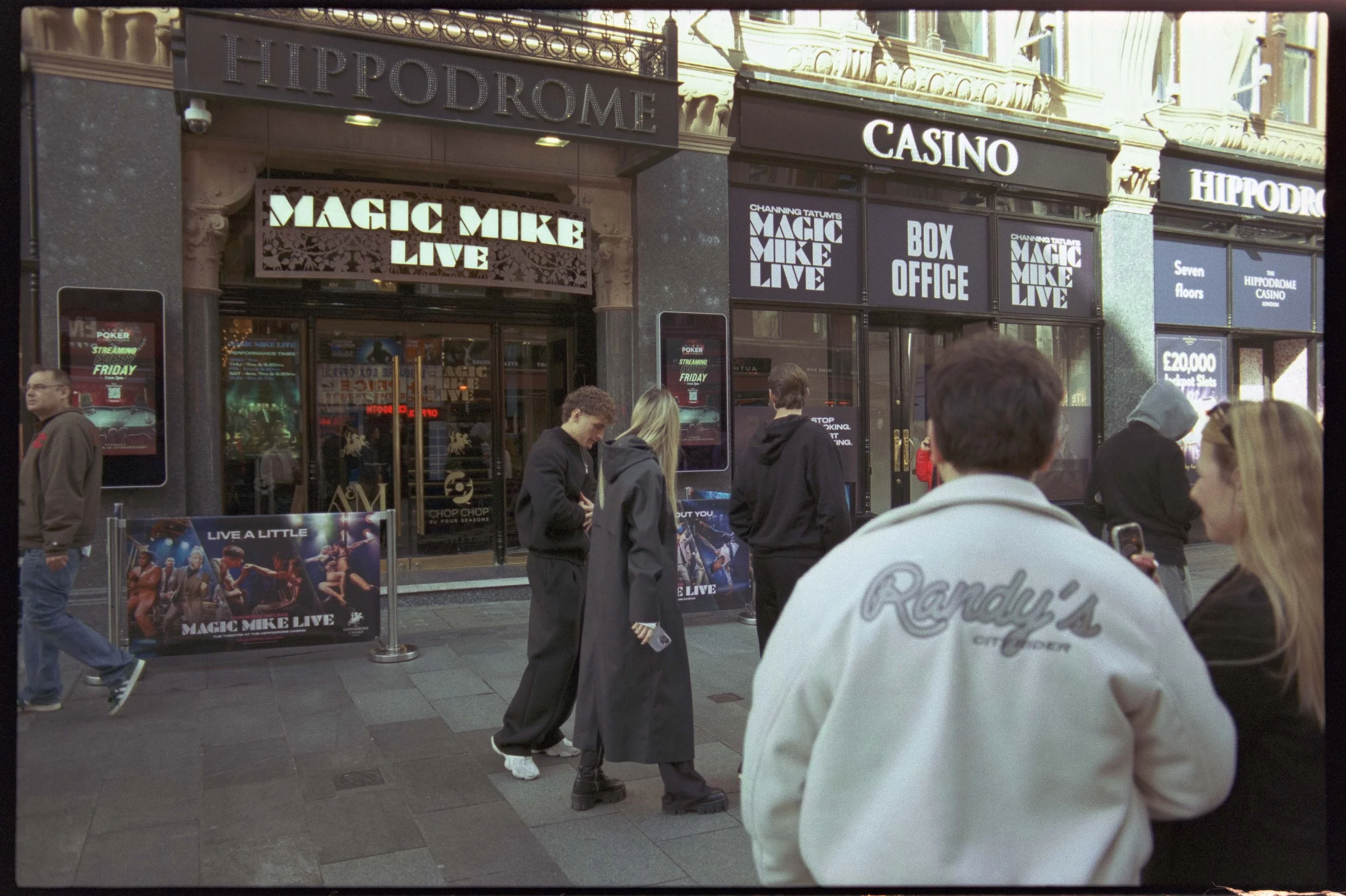
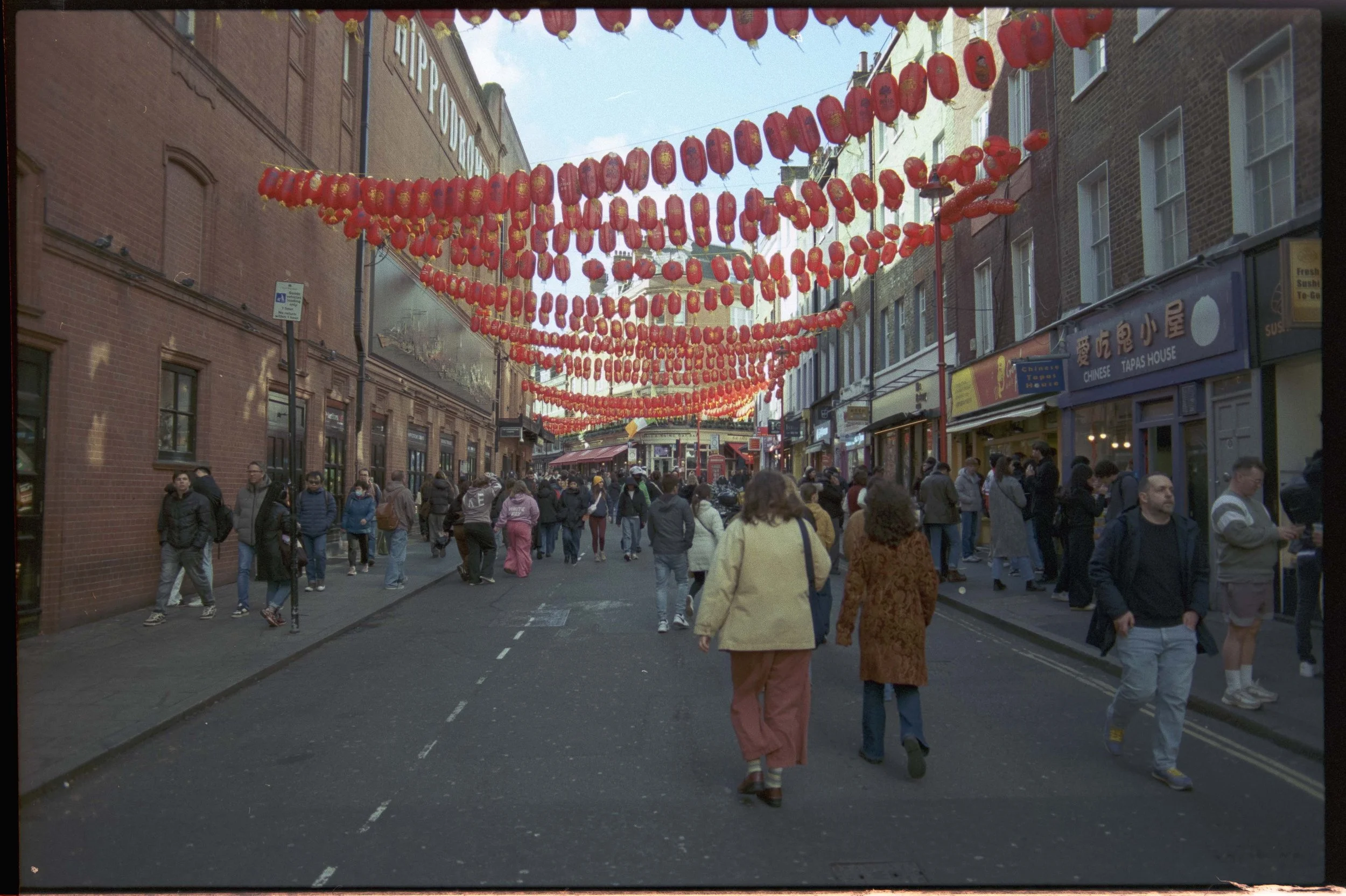
The first one I almost missed. I was walking past the Hippodrome on Cranbourn Street when I clocked it — a man standing on the pavement, back turned, the word Randy's written in large script across the back of his white jacket. Behind him, filling the entire frontage of the venue: Magic Mike Live. He had no idea. The street had assembled itself into a perfect joke and was waiting, with infinite patience, for someone to walk past with a camera.
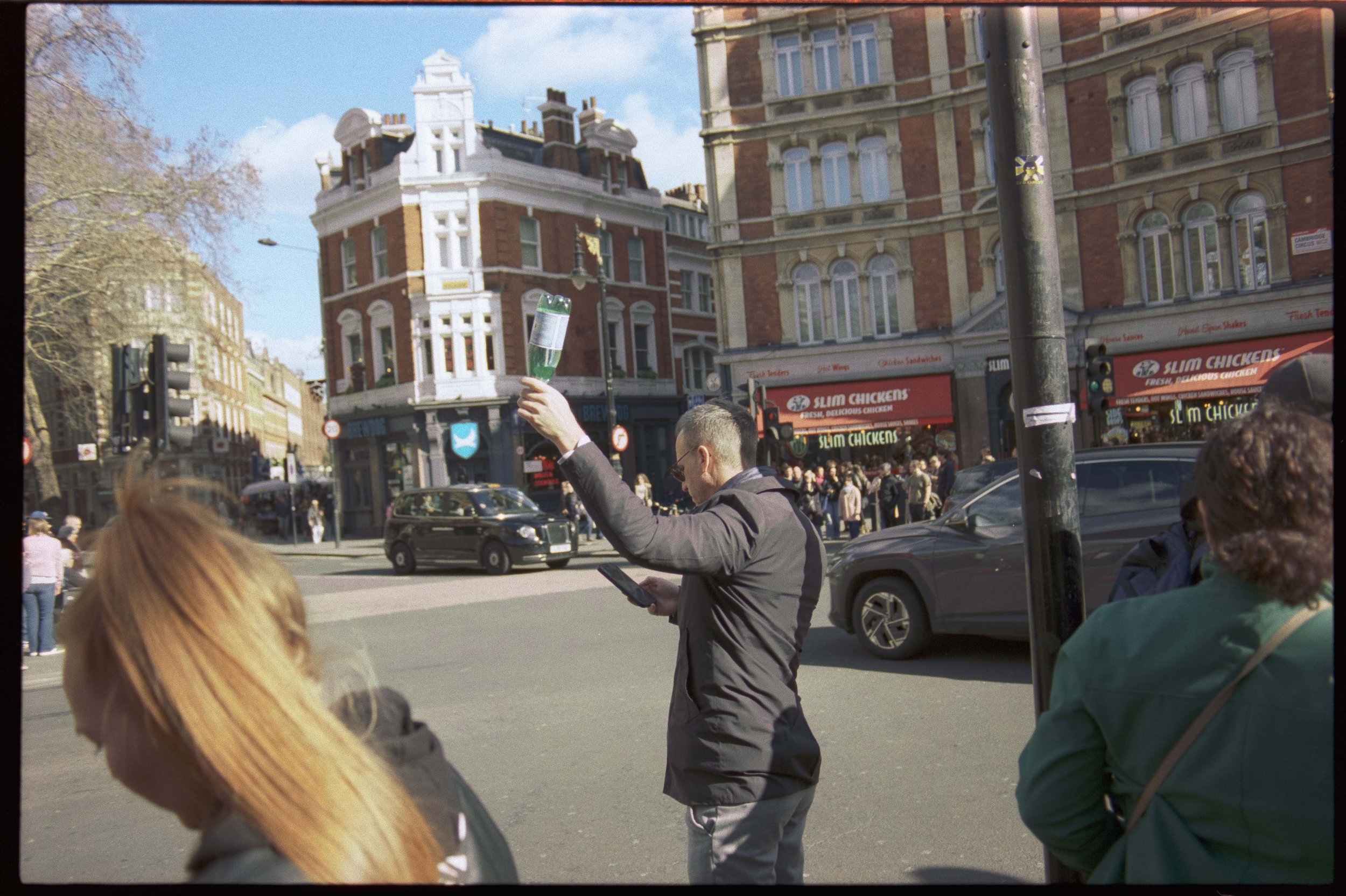
The second came at a crossing near the top of Charing Cross Road. A tour guide — grey hair, suit jacket, every inch the professional — was trying to marshal his group through the lunchtime traffic. His technique was to hold a green bottle above his head like a torch, a beacon for anyone who'd wandered off. He was checking his phone with the other hand. I pressed the shutter at the exact moment his arm went up. He was, without any doubt, leading them to the pub.
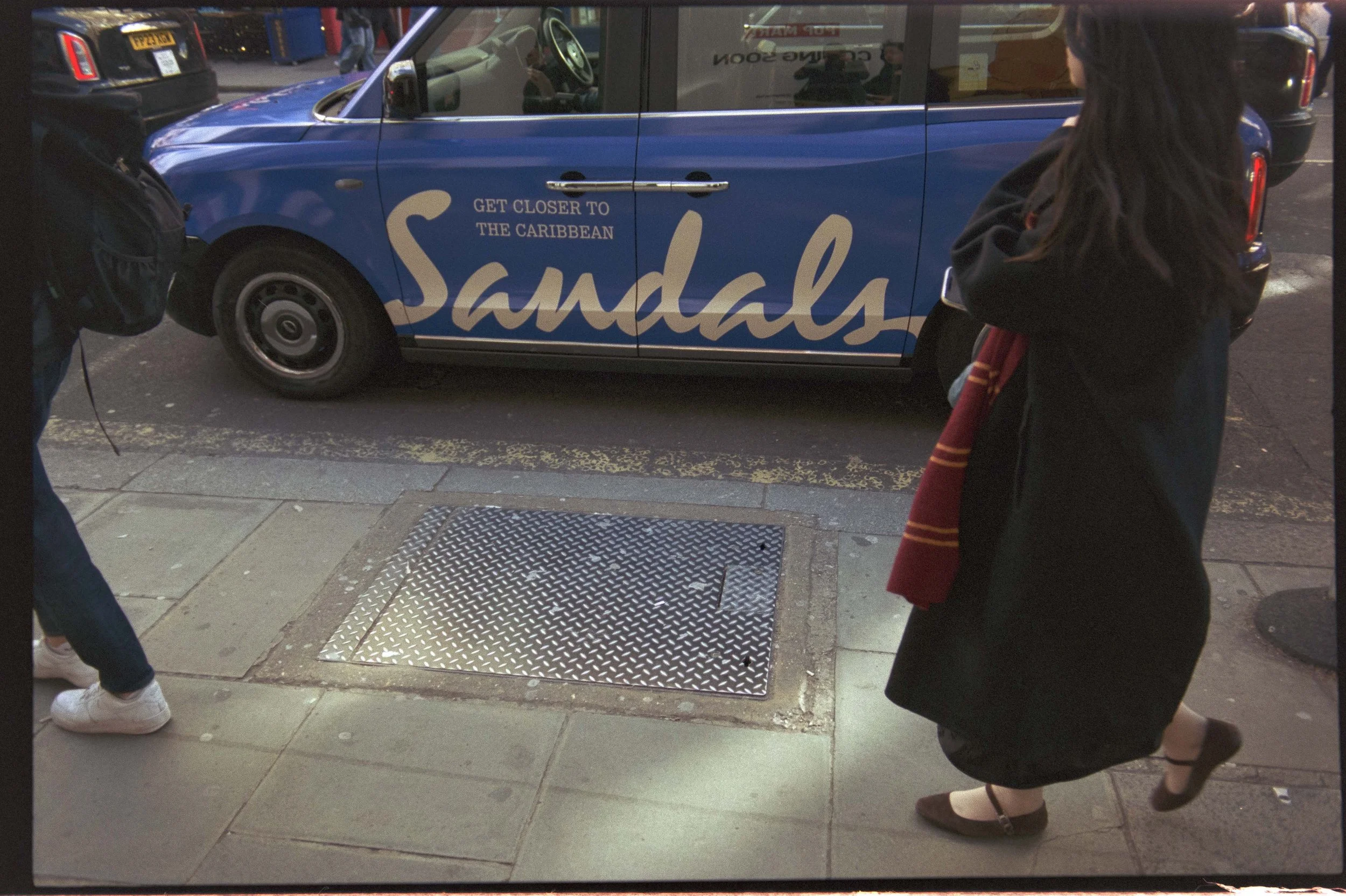
The third was the one I'm most pleased with. A London black cab, completely wrapped in the Sandals Caribbean holiday livery — blue bodywork, the Sandals script in cream, Get Closer to the Caribbean. Passing directly in front of it at that exact moment: a woman in a full Hogwarts Gryffindor robe, red and gold striped scarf trailing behind her. On her feet: sandals. She was heading somewhere else entirely, completely unbothered.
Three found jokes on one roll. Colour made all of them better. Black and white would have served the geometry. Vision3 gave you the blue cab and the red scarf and the warm pavement and the whole absurd London afternoon.
What comes next
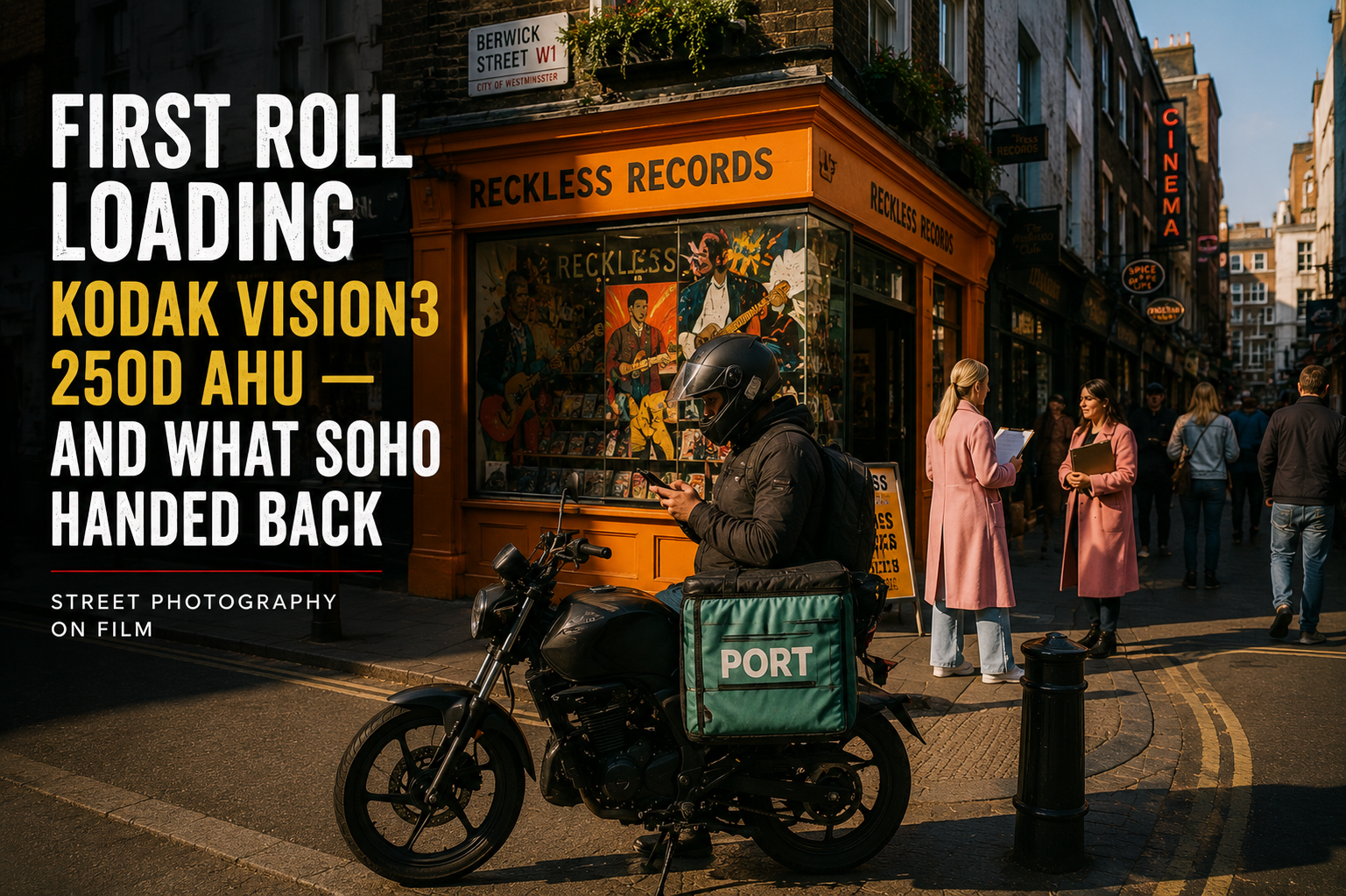
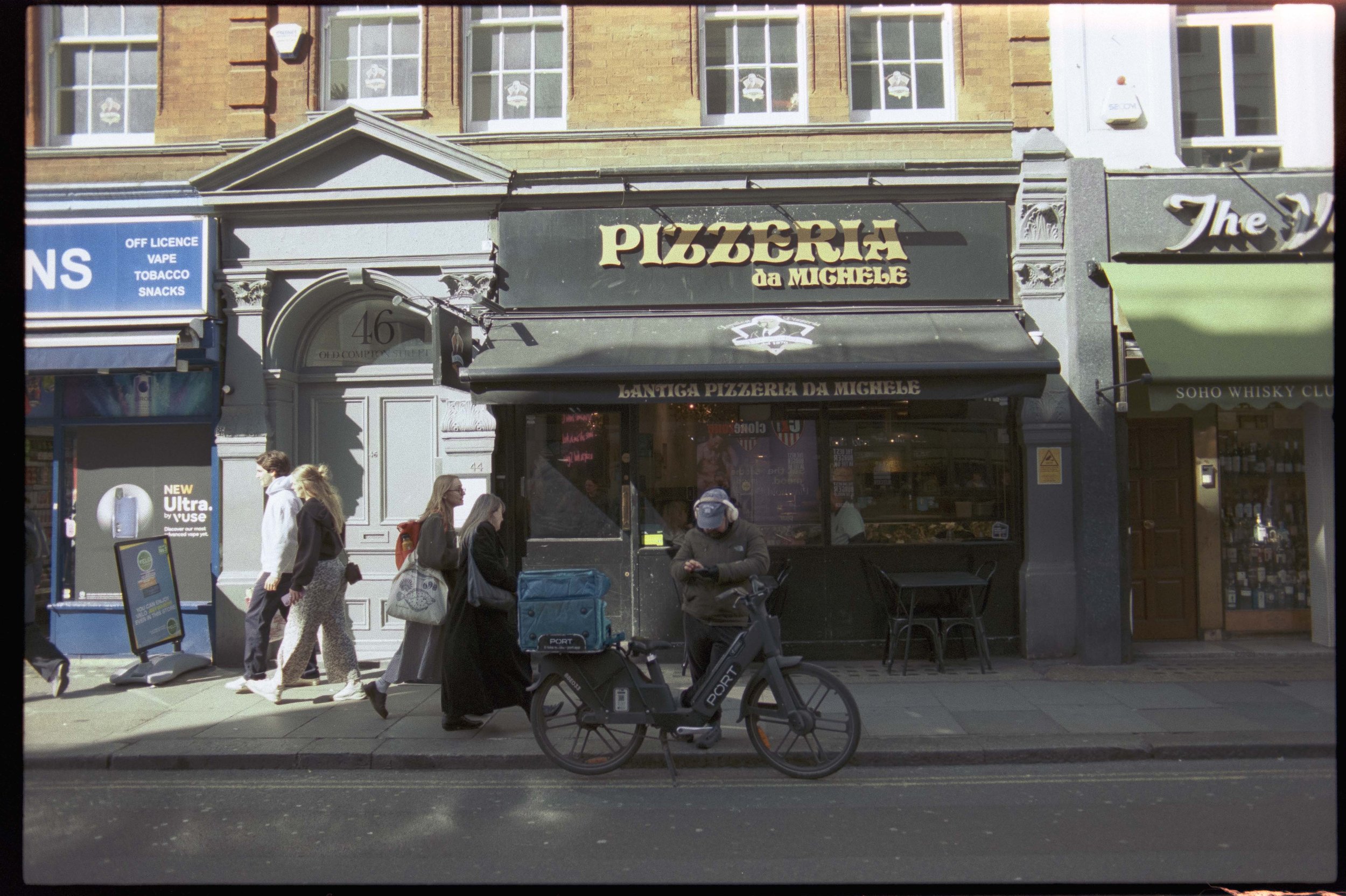
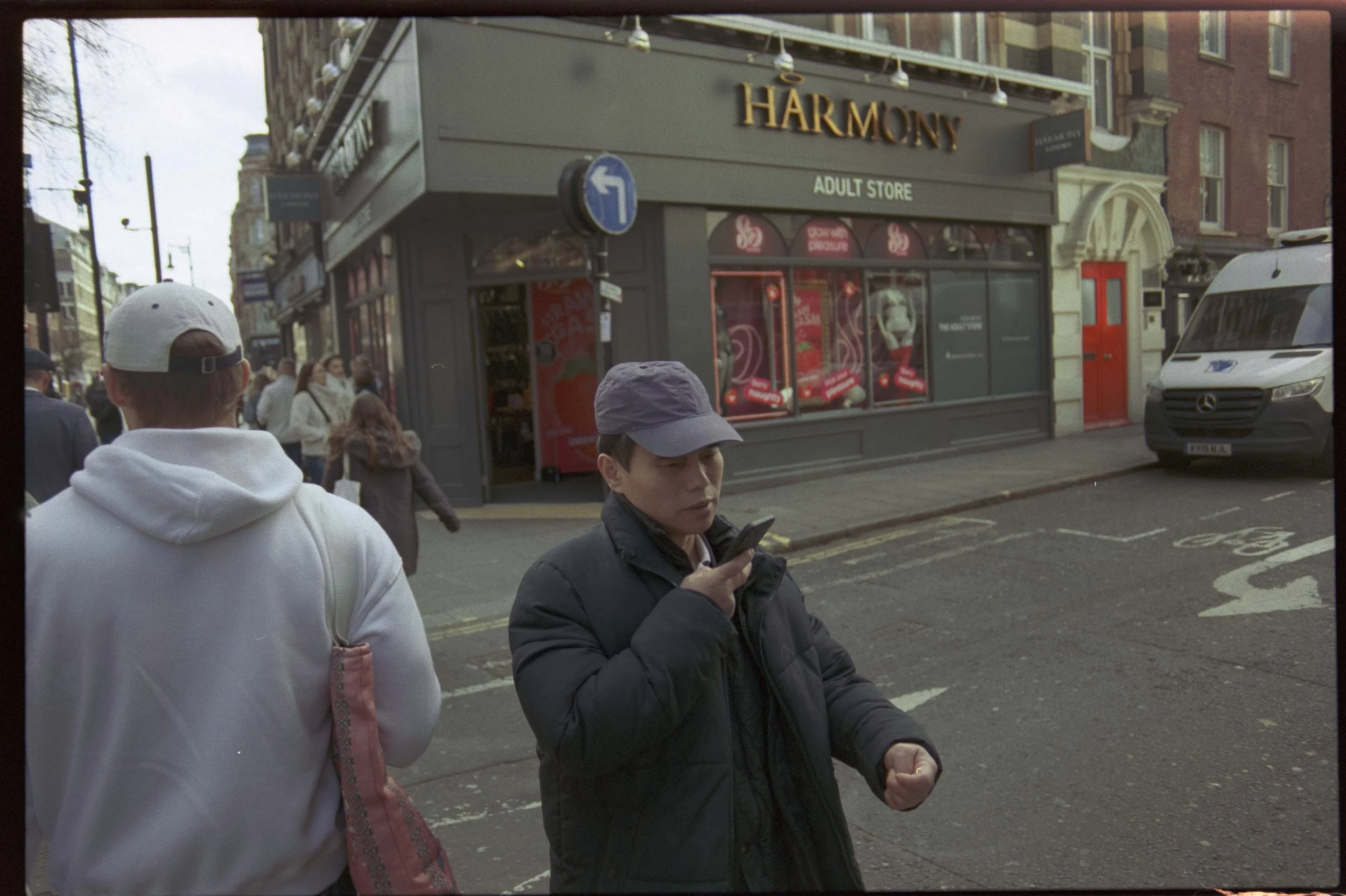
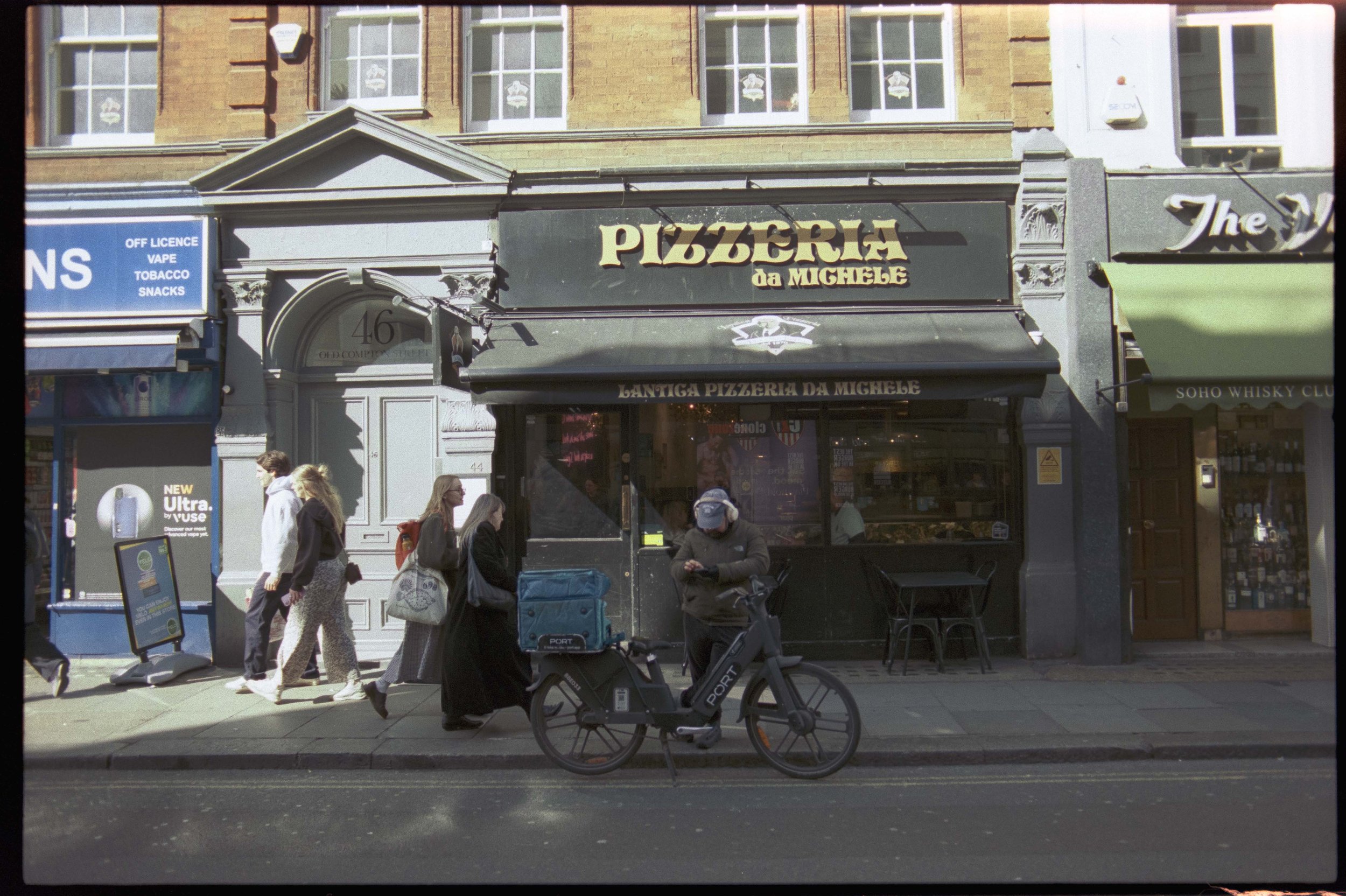
I finished the roll on Old Compton Street — a delivery rider on a PORT bike outside Pizzeria da Michele, checking his phone in the late afternoon light, the gold lettering of the restaurant sign warm above him. A good closer. Unhurried. The sort of frame that makes sense at the end of a day's shooting.
One roll is not enough to draw firm conclusions about a film stock. But it is enough to know whether you want to shoot another one, and the answer here is unambiguously yes. Vision3 250D asks you to work with colour rather than despite it — to look for the moments where the warmth of a late winter afternoon in London becomes part of the story rather than just the backdrop.
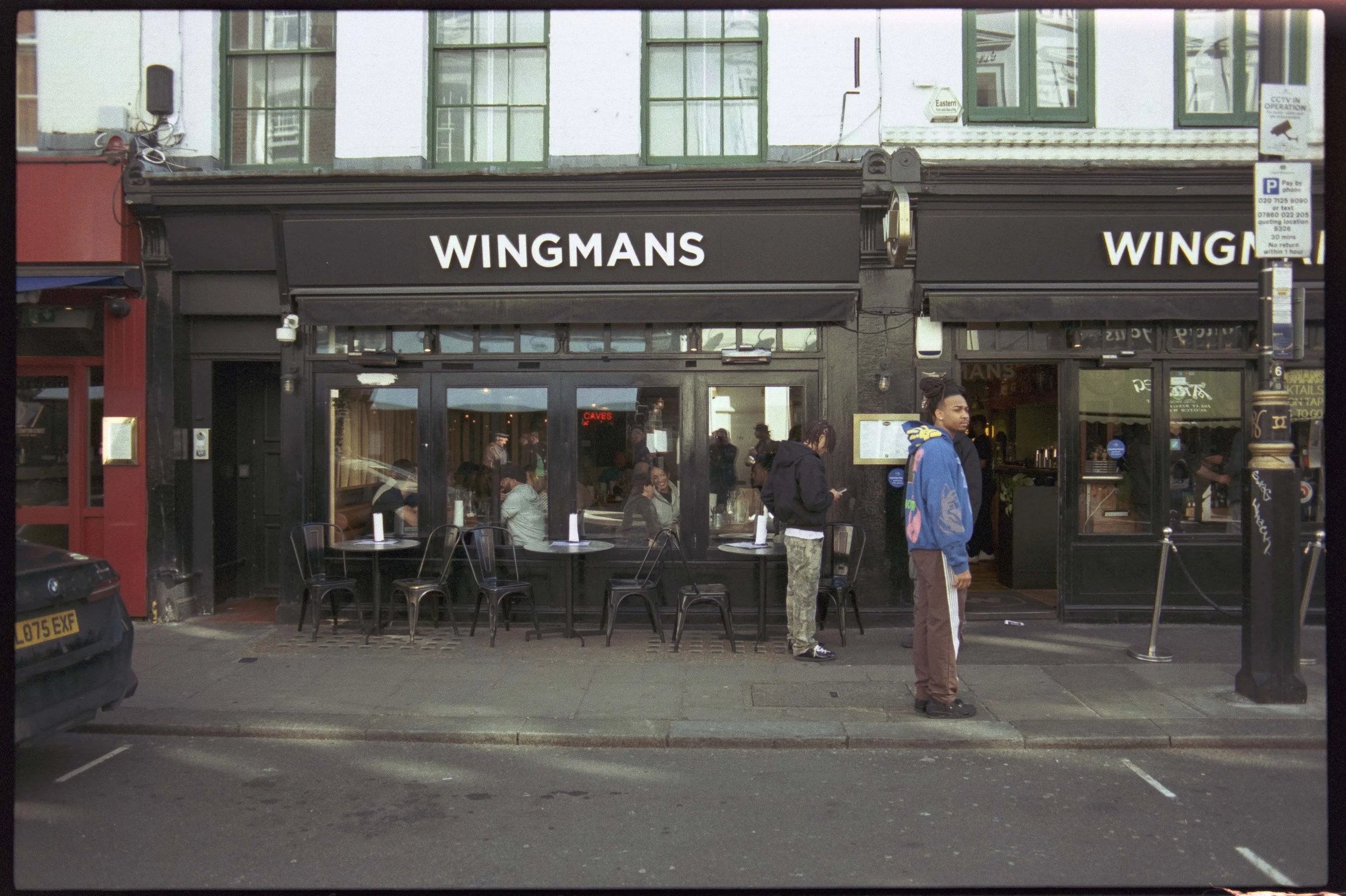
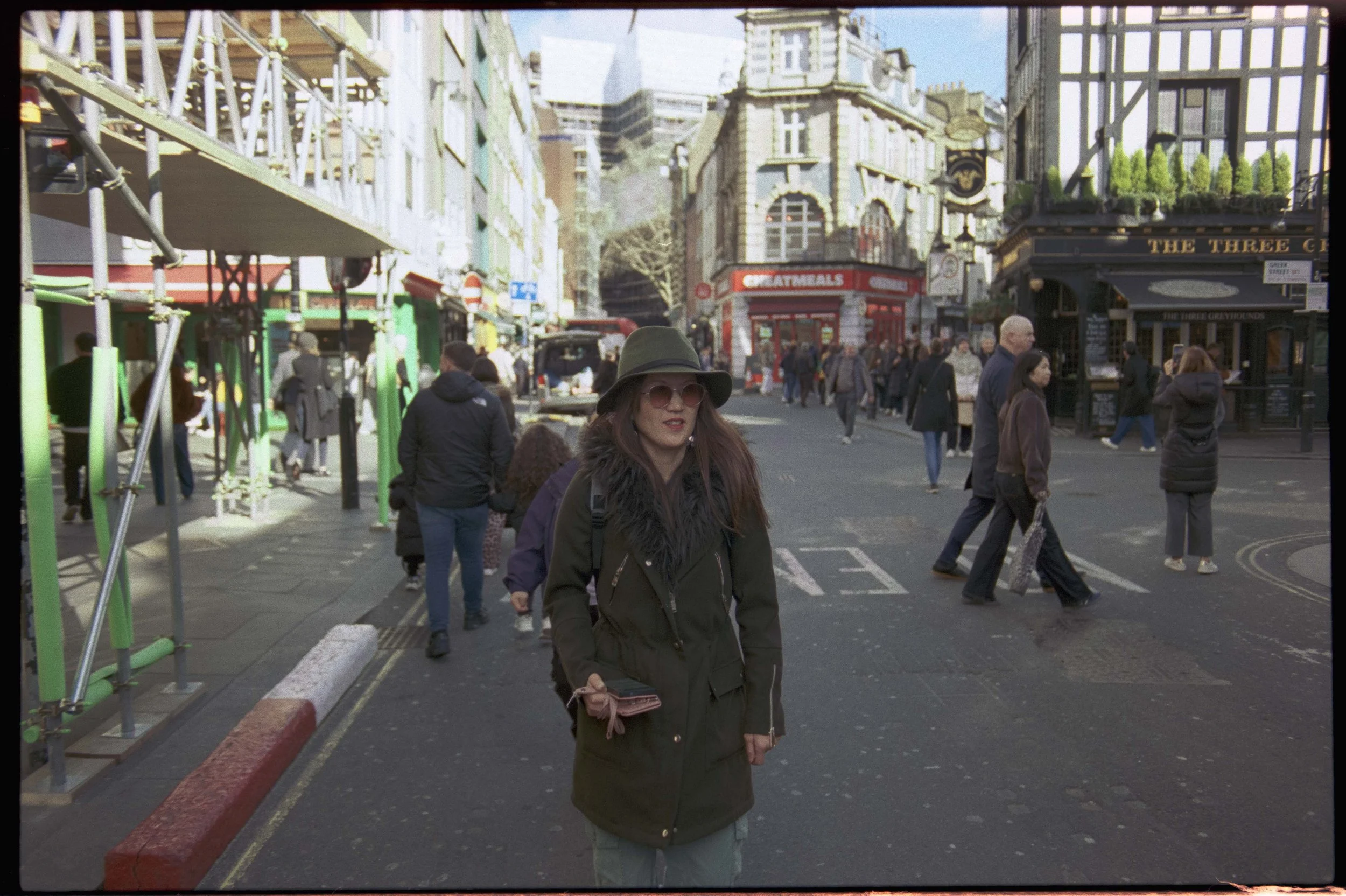
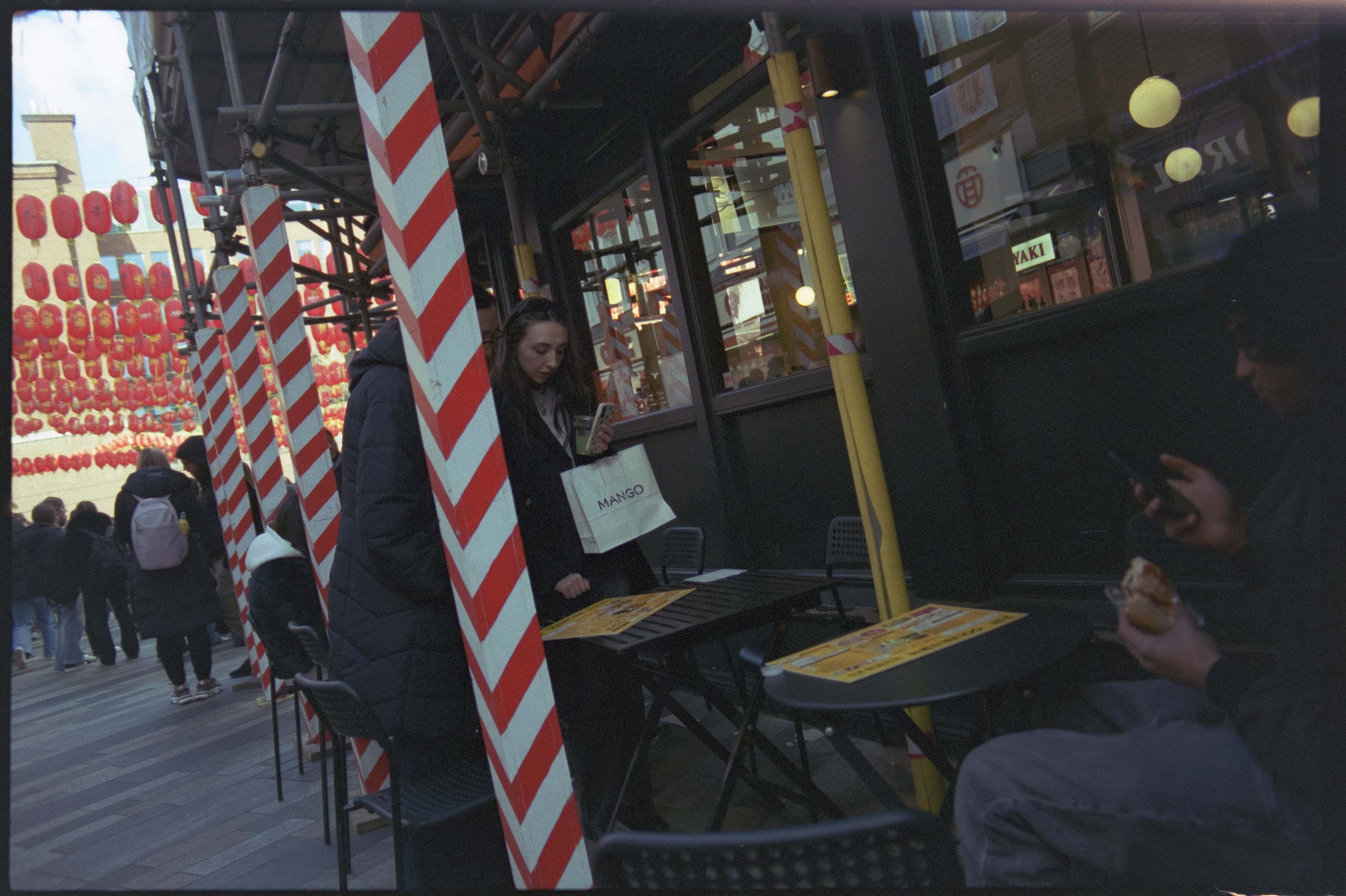
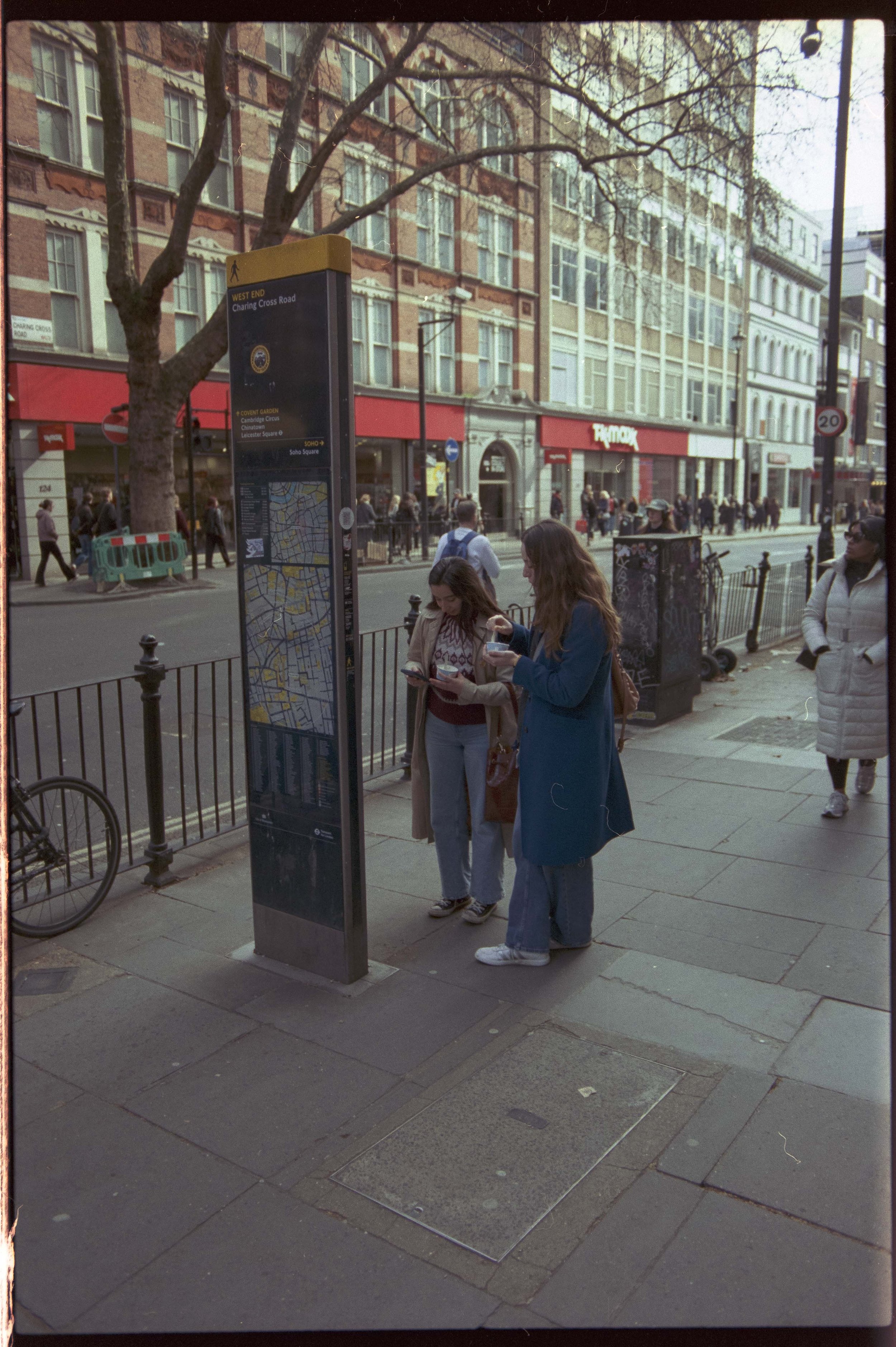
After years of reaching for black and white by default, that's a different kind of seeing. I'd been missing it without quite realising.
I've already ordered more rolls. Spring is coming, the light is getting longer, and the streets are filling up again. If the first outing with Vision3 250D is any indication, it's going to be a busy few months.
Black and white isn't going anywhere. But colour just made a very strong case for sharing the bag.
Until next time, keep snapping
GAS.....? no the easy life
A New Chapter: Embracing the Nikon F80
For years, my photographic journey has been linked to the tactile precision of the Leica system for both my M10 and M6. Zone focusing and manual exposure. I haven’t been one to embrace or use the Sunny 16 rule. The deliberate, fully manual approach of the rangefinder has been my constant companion, a testament to the joy of slowing down and truly making a photograph.

A New Chapter: Embracing the Nikon F80
For years, my photographic journey has been linked to the tactile precision of the Leica system for both my M10 and M6. Zone focusing and manual exposure. I haven’t been one to embrace or use the Sunny 16 rule. The deliberate, fully manual approach of the rangefinder has been my constant companion, a testament to the joy of slowing down and truly making a photograph.
Weirdly, I have found this to be an irritant on the M6 film camera, but something of a joy on the digital M10. I think this is more to do with the chimping effect, than anything else.
Since dropping my M6 and damaging the film winder (I can’t bring myself to write a blog post about it, but in essence I thought the cameara was attached to my wrist strap, let go of it and watched in slow motion as it hit the floor and bent the aluminium film winder), I’ve been using my Minolta X500 camera with a 28mm lens. I must say it’s been an absolute delight. Whilst zone focusing isn’t a direct comparison to the M6, it’s been okay.
I’ve had a rethink with my camera equipment and considered whether or not to dispose of some of my lesser used equipment. Whilst I loved my Chamonix 45N2 4x5 large format camera, I wasn’t using it at all and decided to sell it on eBay and to require some equipment that I would put to better use. I initially considered buying the Fuji GW670 medium format camera, - the Texas Leica - but couldn’t justify the £1,400+ price tag.
On consideration, I decided to look at acquiring a 35mm auto focus film SLR camera. Something that would be a lot more comfortable on the pocket, and also be put into far much more use than a 4x5 view camera.
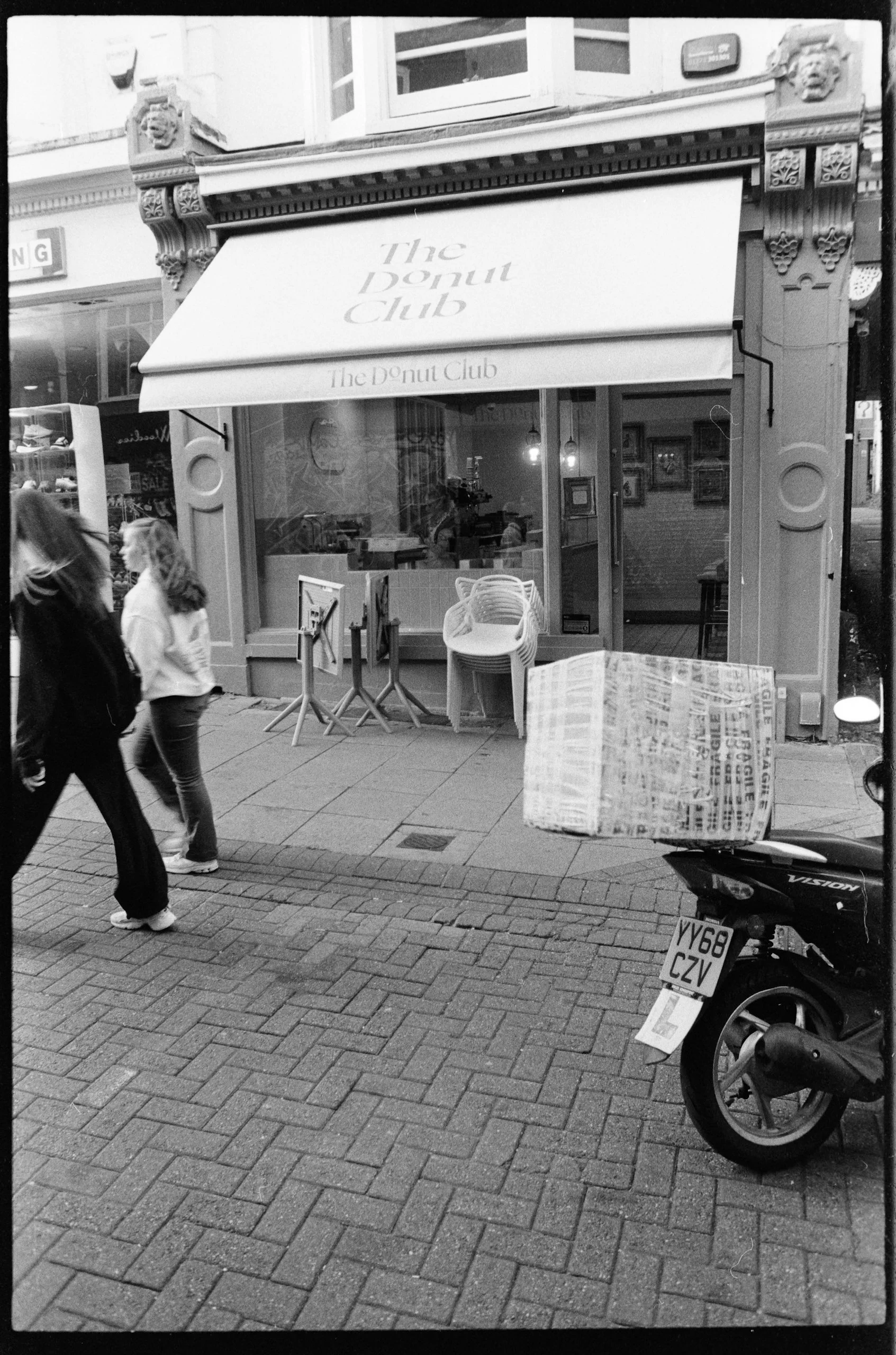
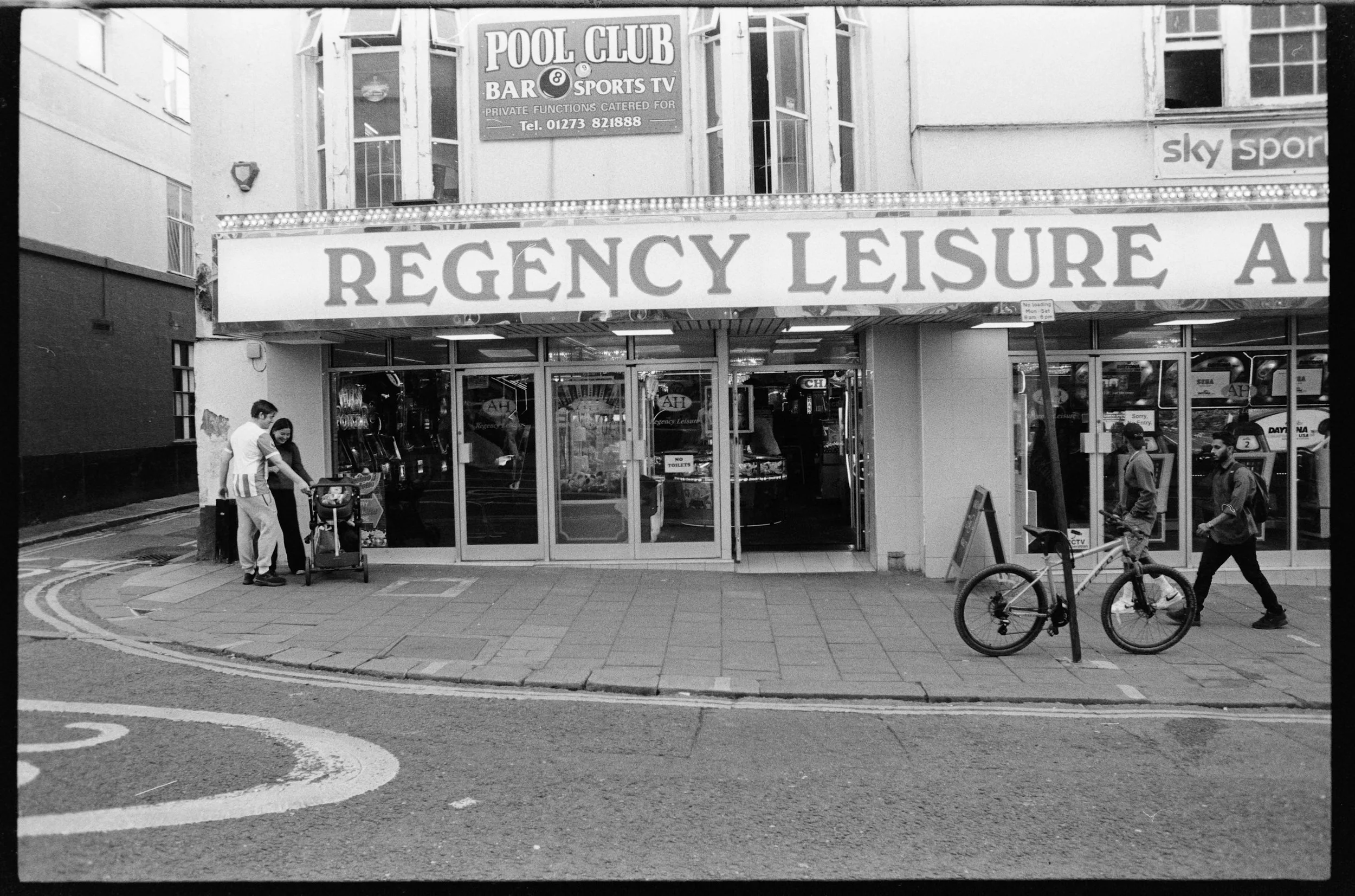
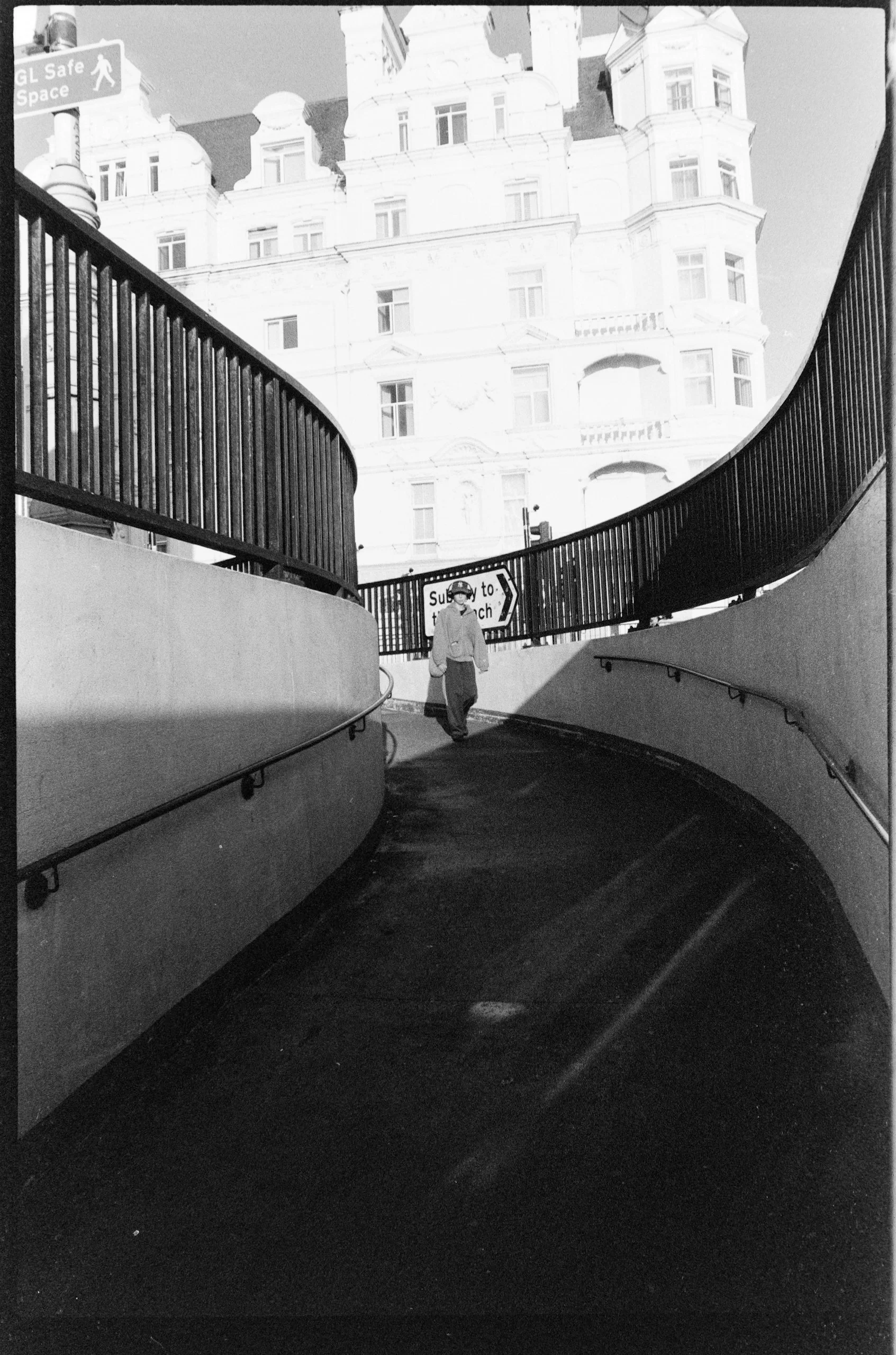
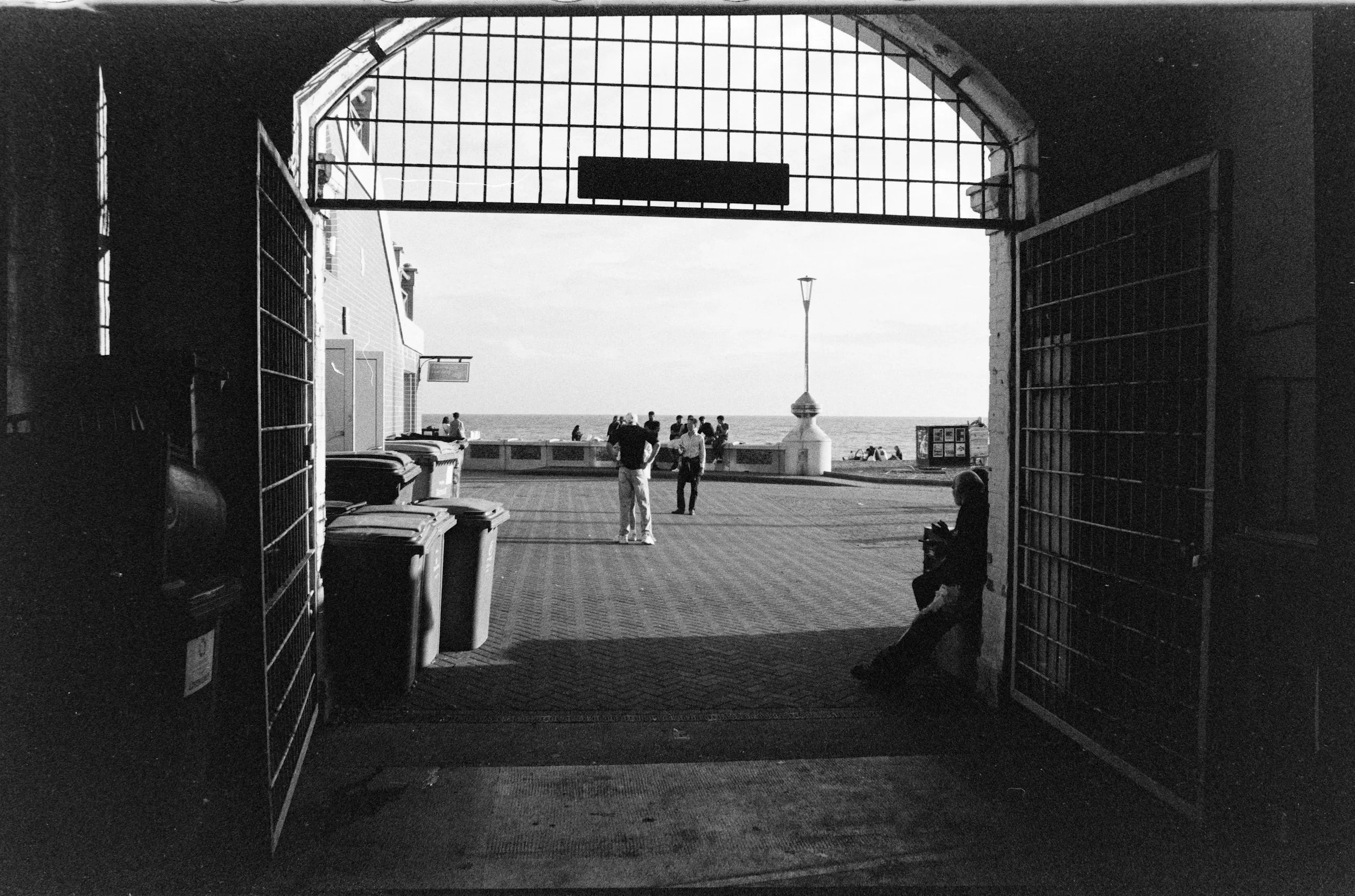
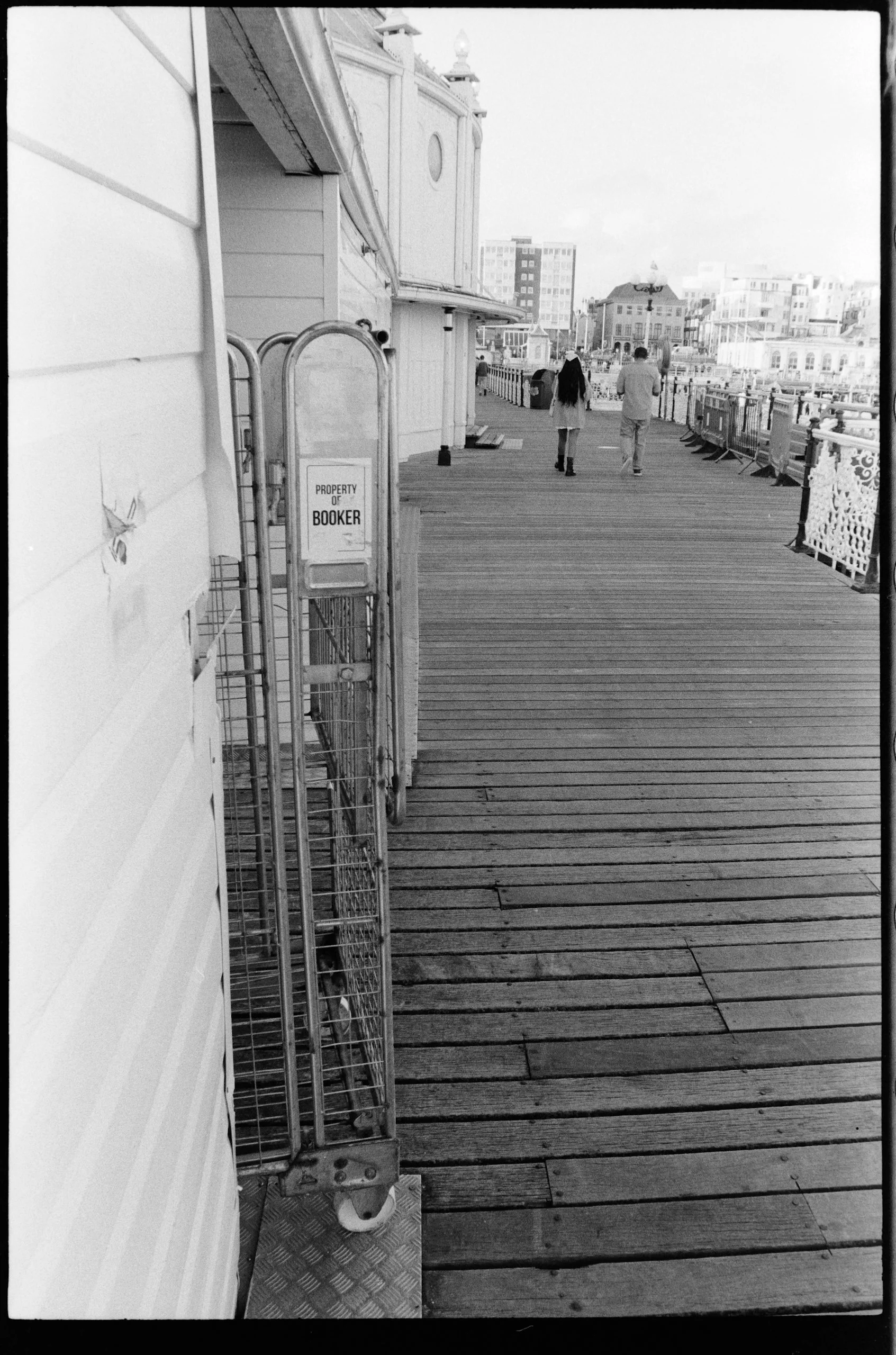
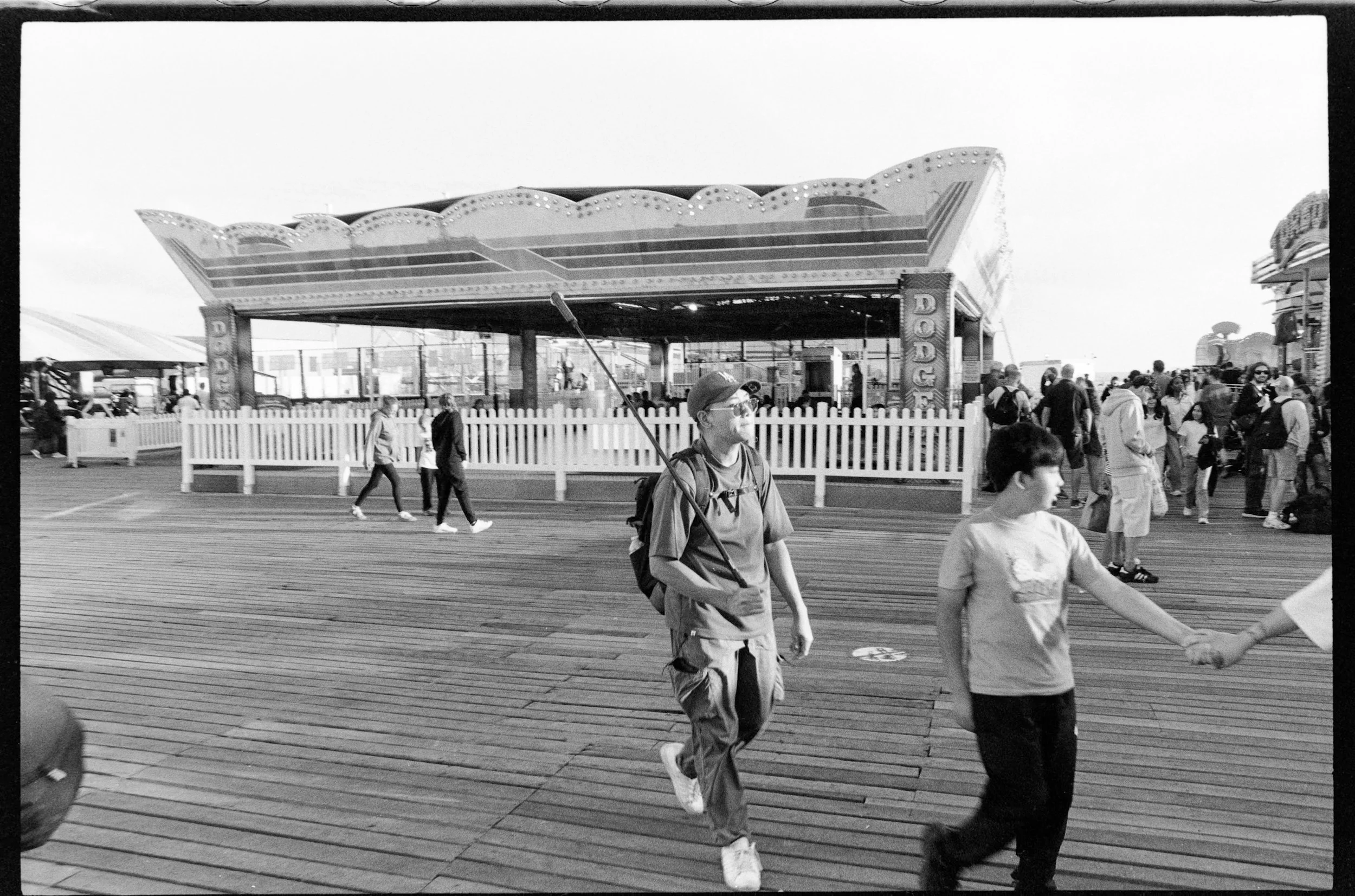
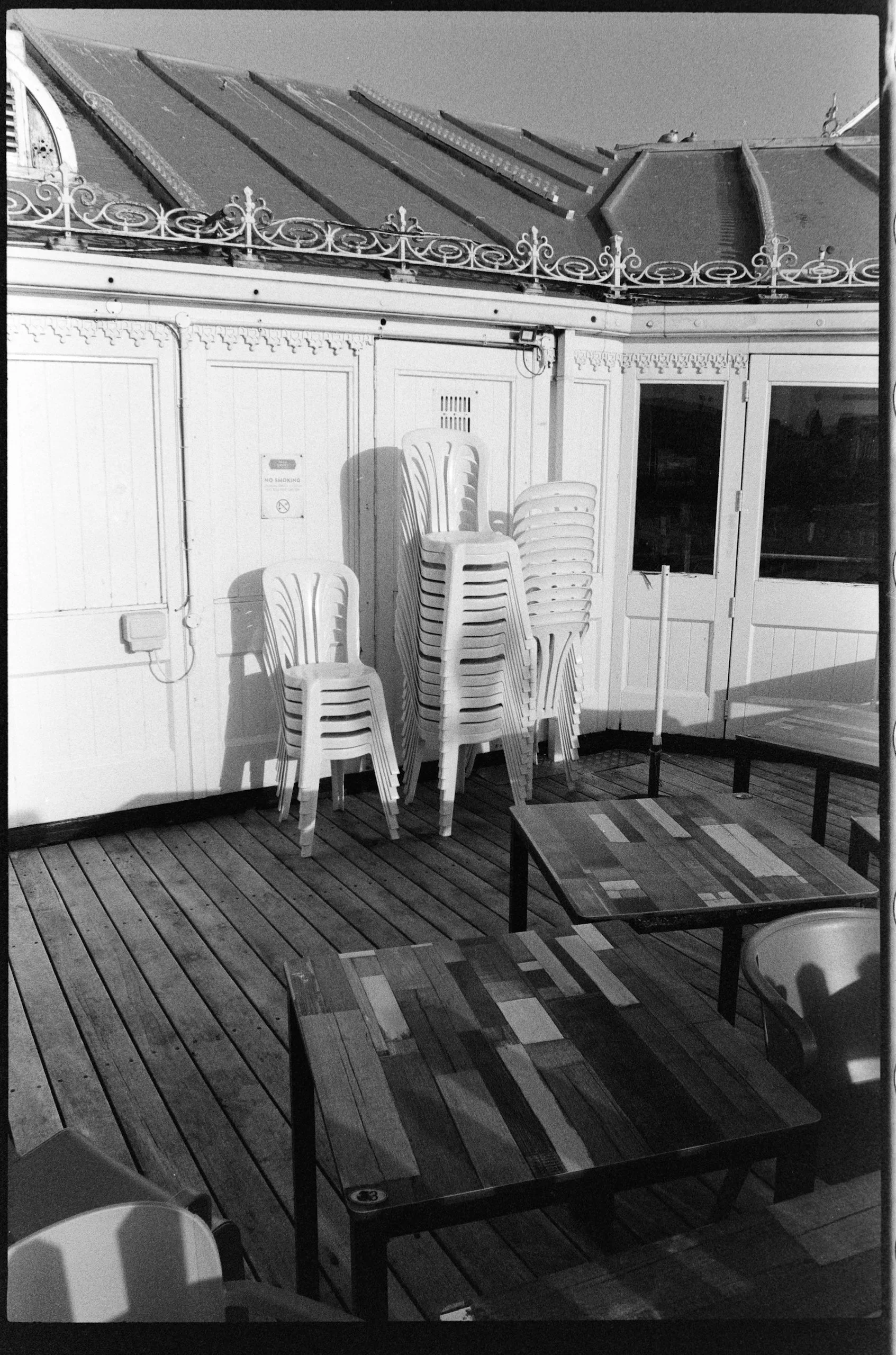
The decision to step away from the purely manual world of the M6 wasn't taken lightly, but the F80 offers a compelling proposition. It represents a bridge, a way to explore the capabilities of a more automated system while still retaining the soul and charm of film.
Autofocus - CHECK, auto film load - CHECK, Auto film rewind - CHECK.
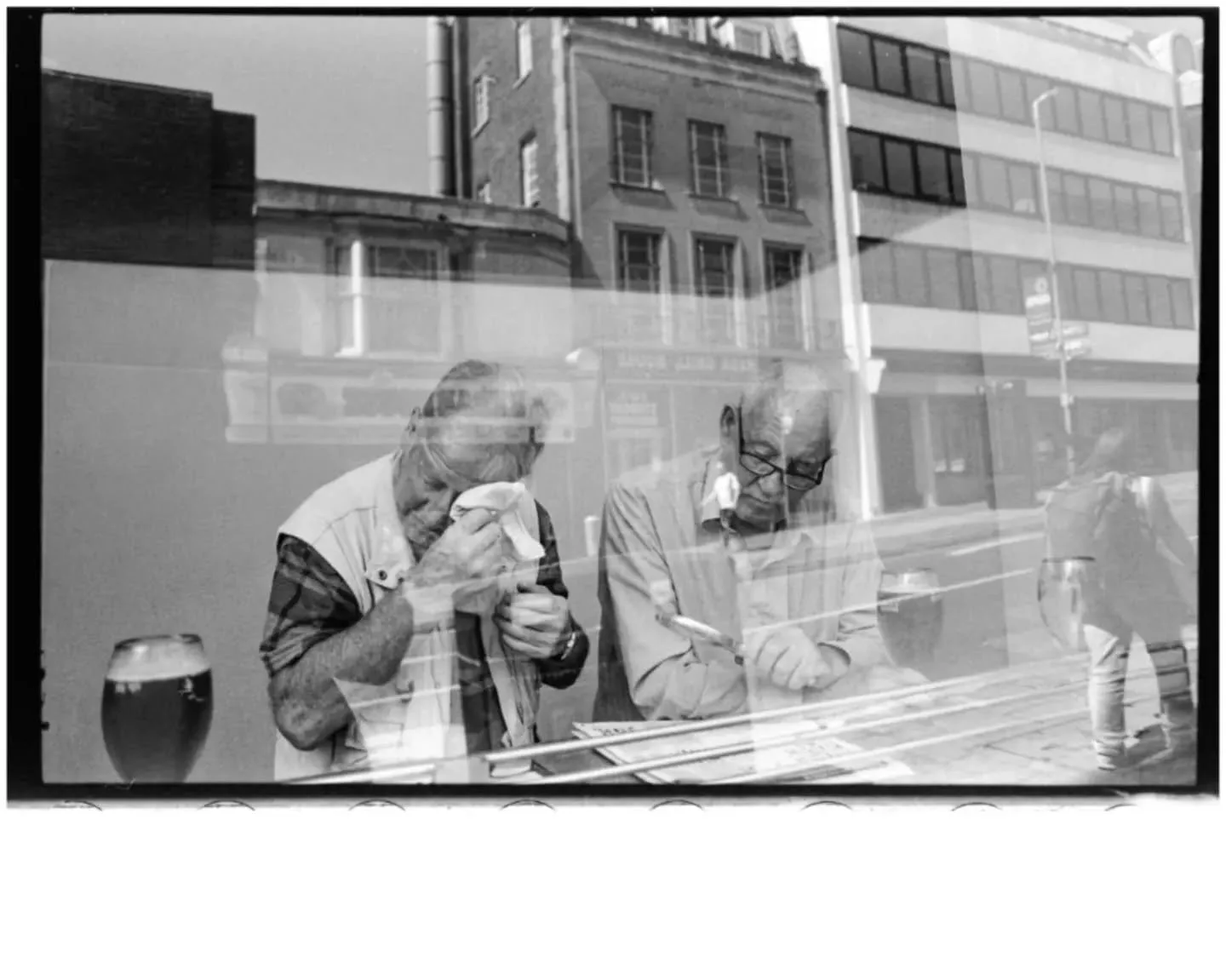
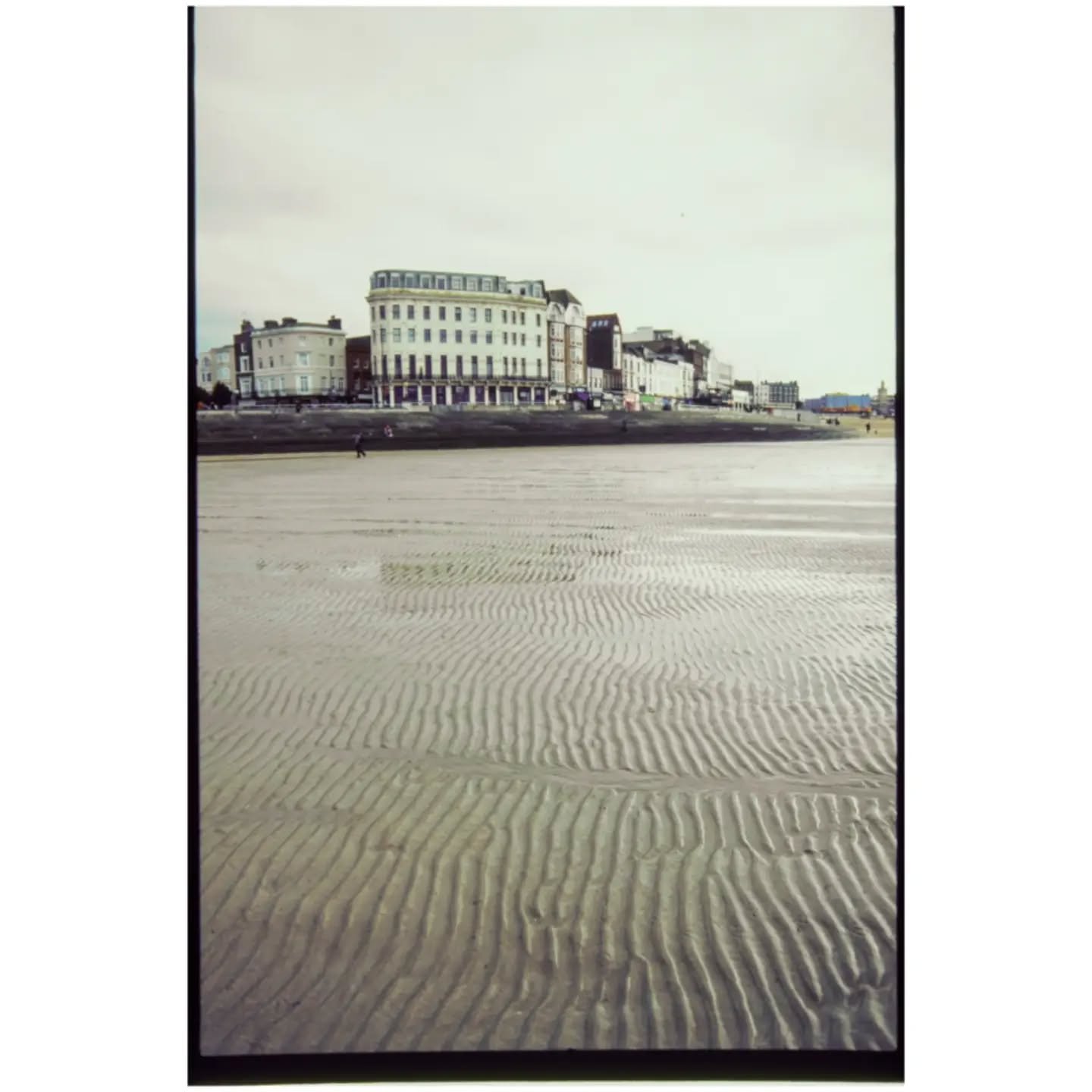
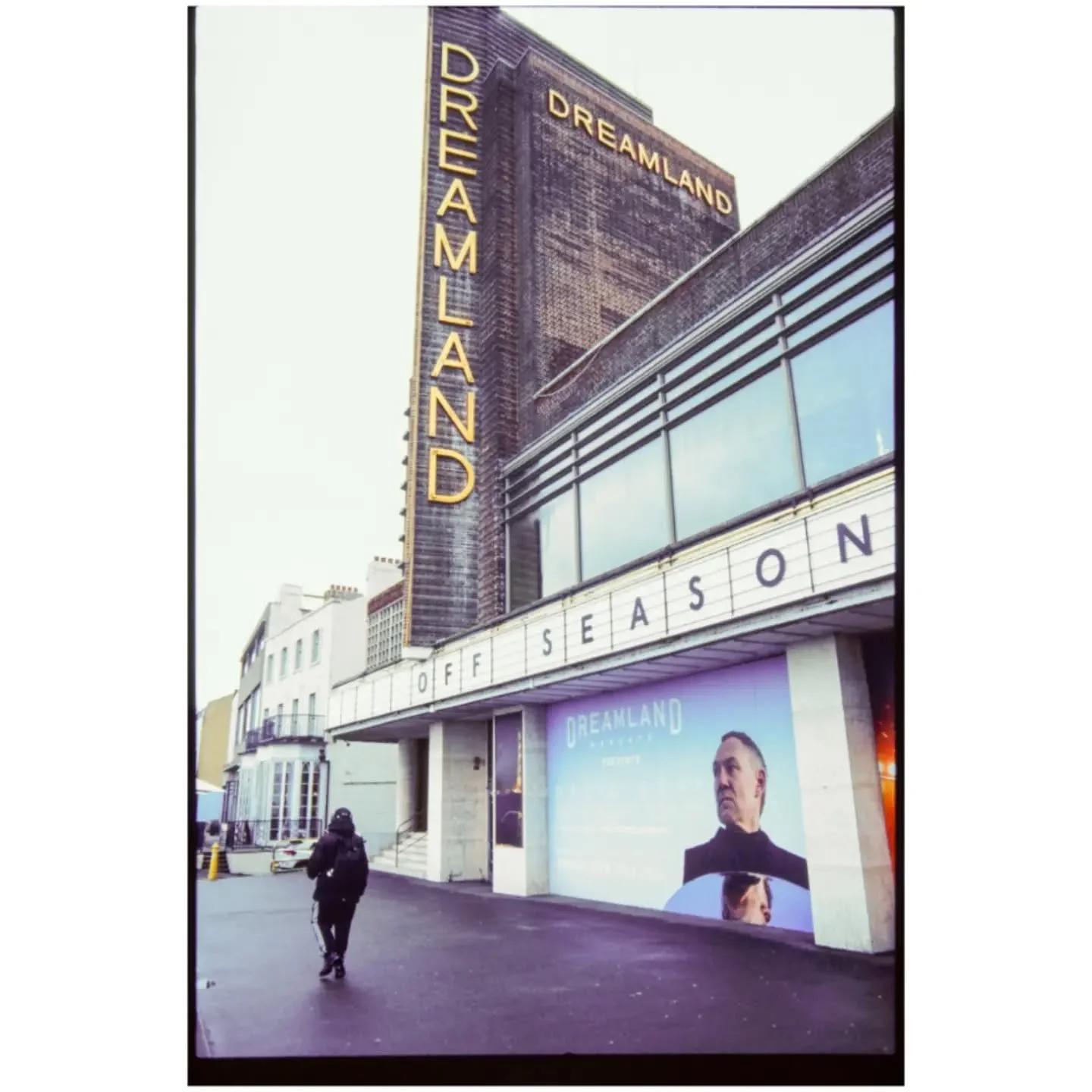
The images in this blogpost, are from the first three rolls, I put through the camera yesterday on Kodak 5222 Double XX film.
The F80, known as the N80 in North America, was a remarkably advanced camera for its time, boasting features that many digital photographers take for granted today.
First impressions are key, and holding the F80, I'm struck by its ergonomic design. It feels substantial yet comfortable in the hand, a far cry from the dense, compact brick of the Leica. The controls are intuitively placed, promising a more fluid shooting experience. I'm particularly excited about the autofocus system. After years of meticulously splitting an image in the rangefinder, the idea of swift, accurate focusing is both liberating and a little daunting.
This isn't about abandoning the Leica; it's about expanding my toolkit. Imagine capturing the bustling Lanes of Brighton and Hove with the speed and precision the F80 offers, or perhaps experimenting with its multiple exposure mode to create ethereal street scenes. I'm eager to see how the matrix metering handles the challenging light often found on the Sussex coast, from the bright, open expanse of the beach to the shadowy alleyways.
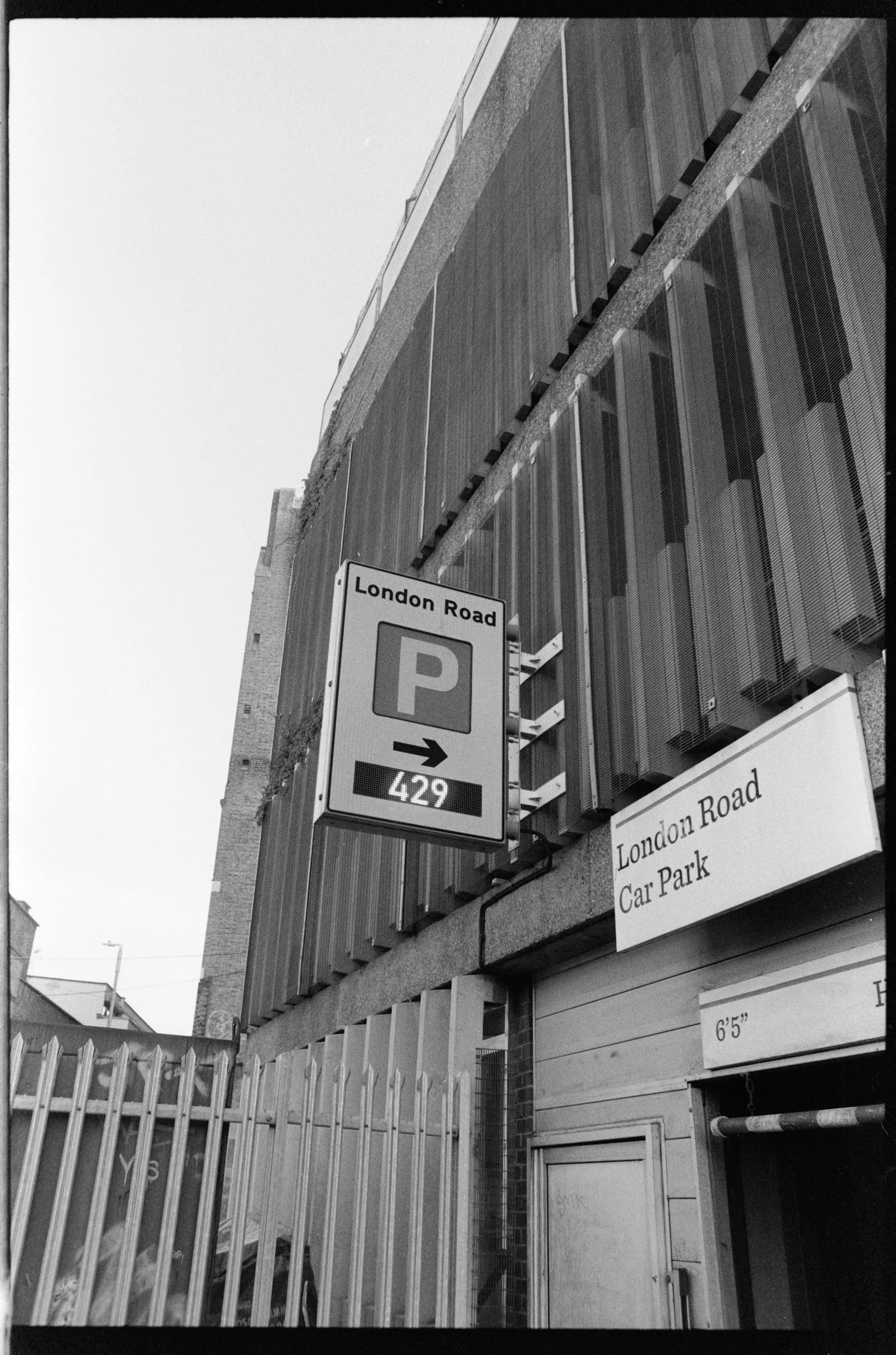
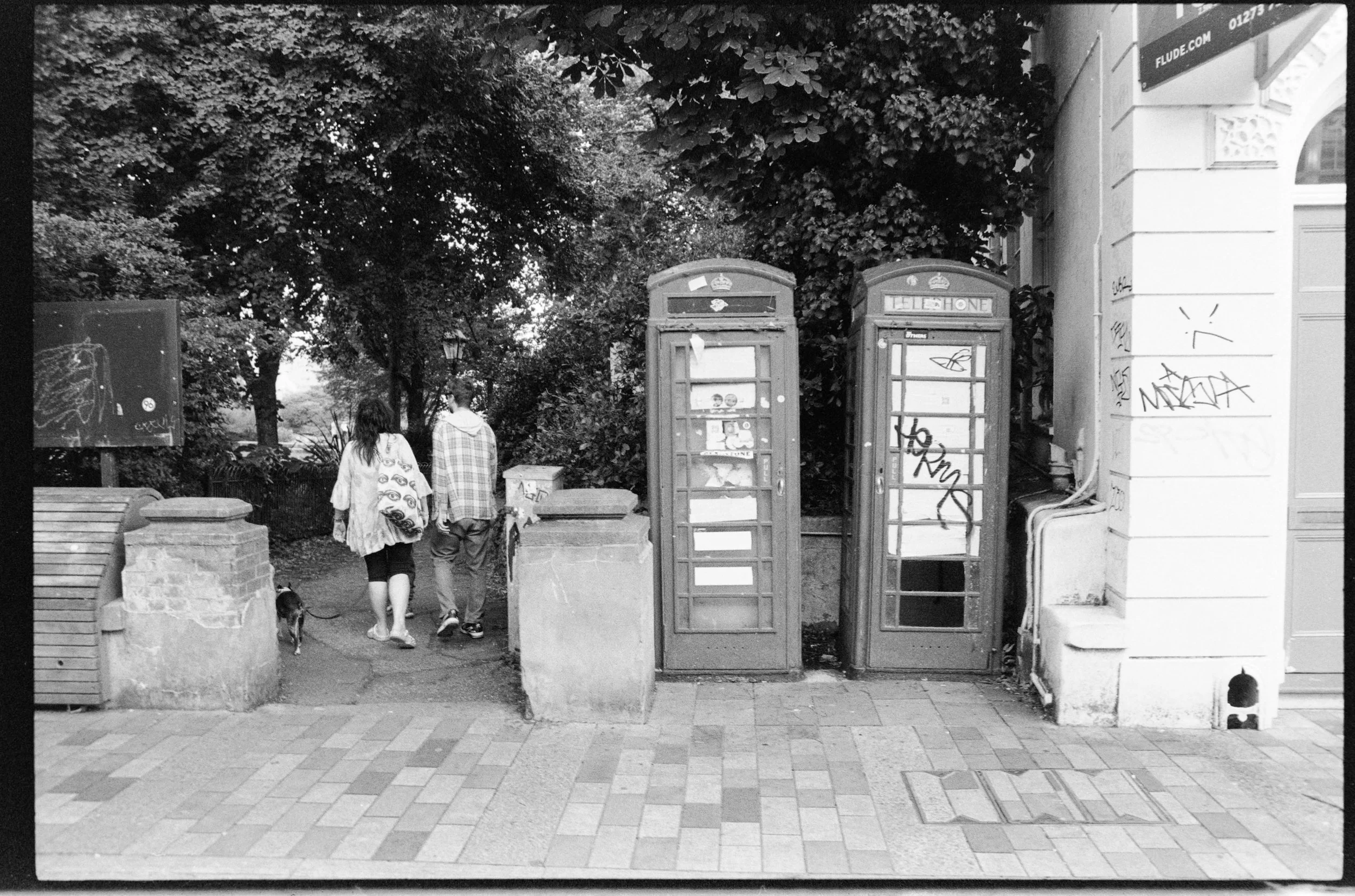
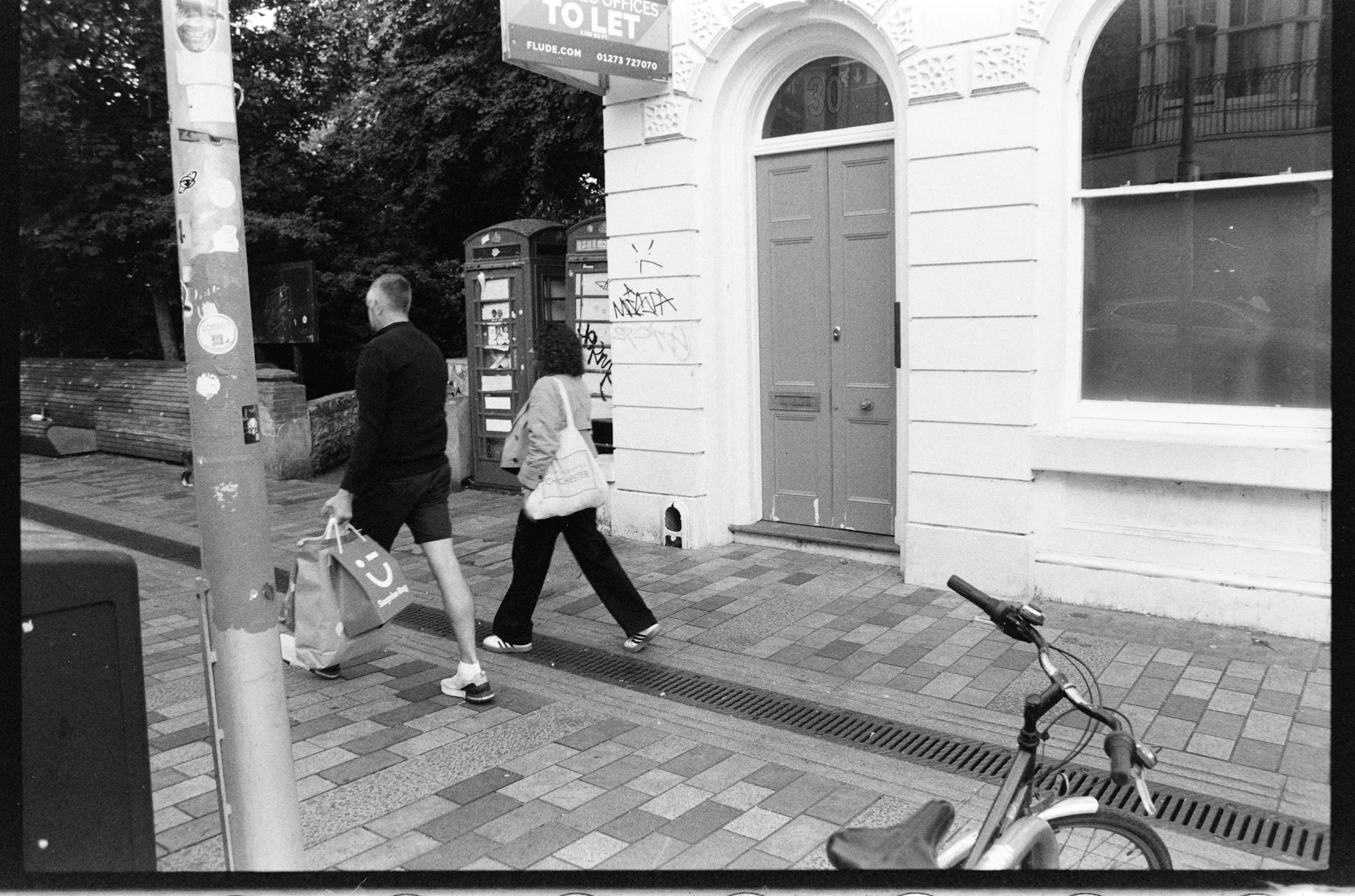
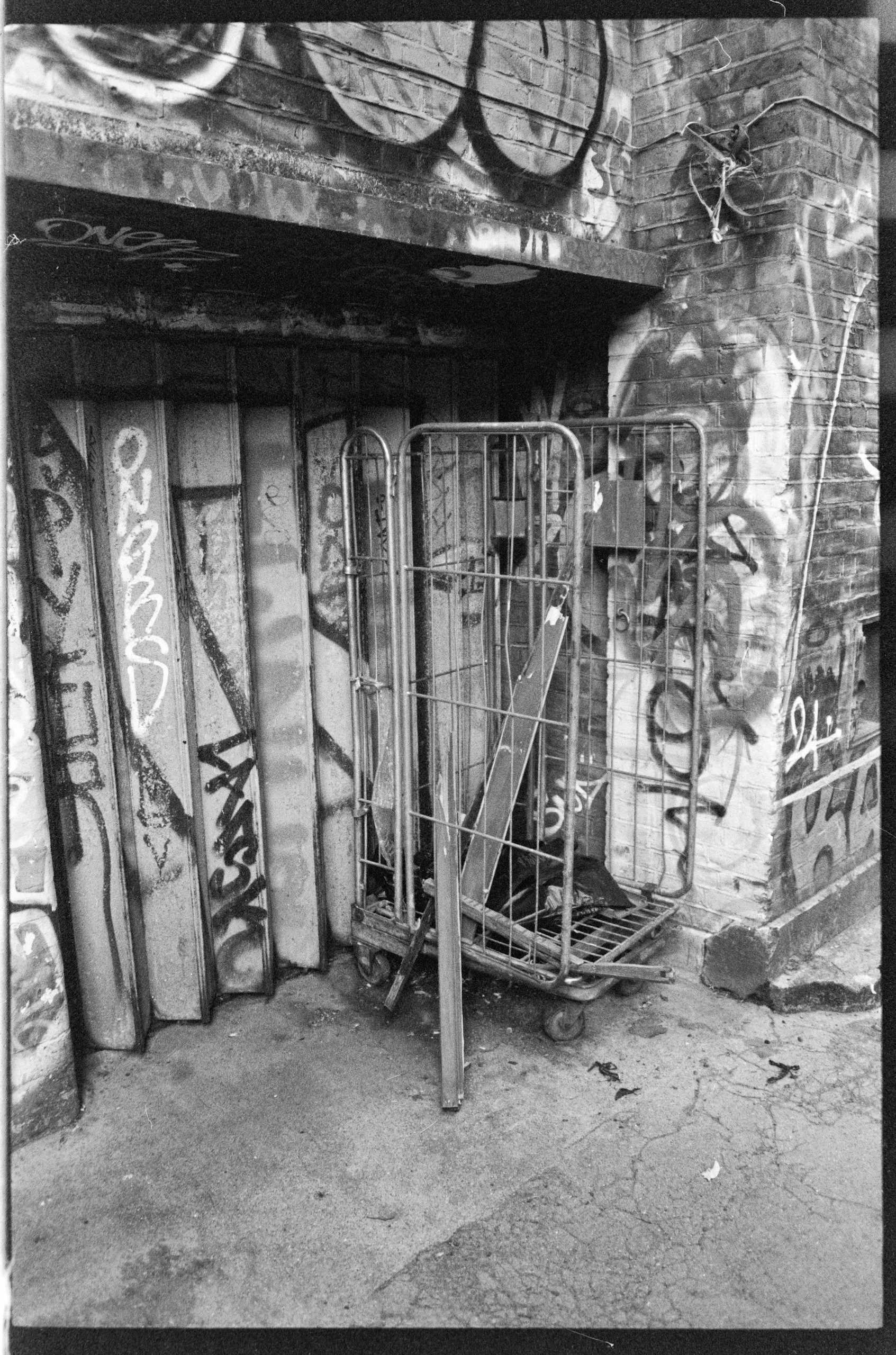
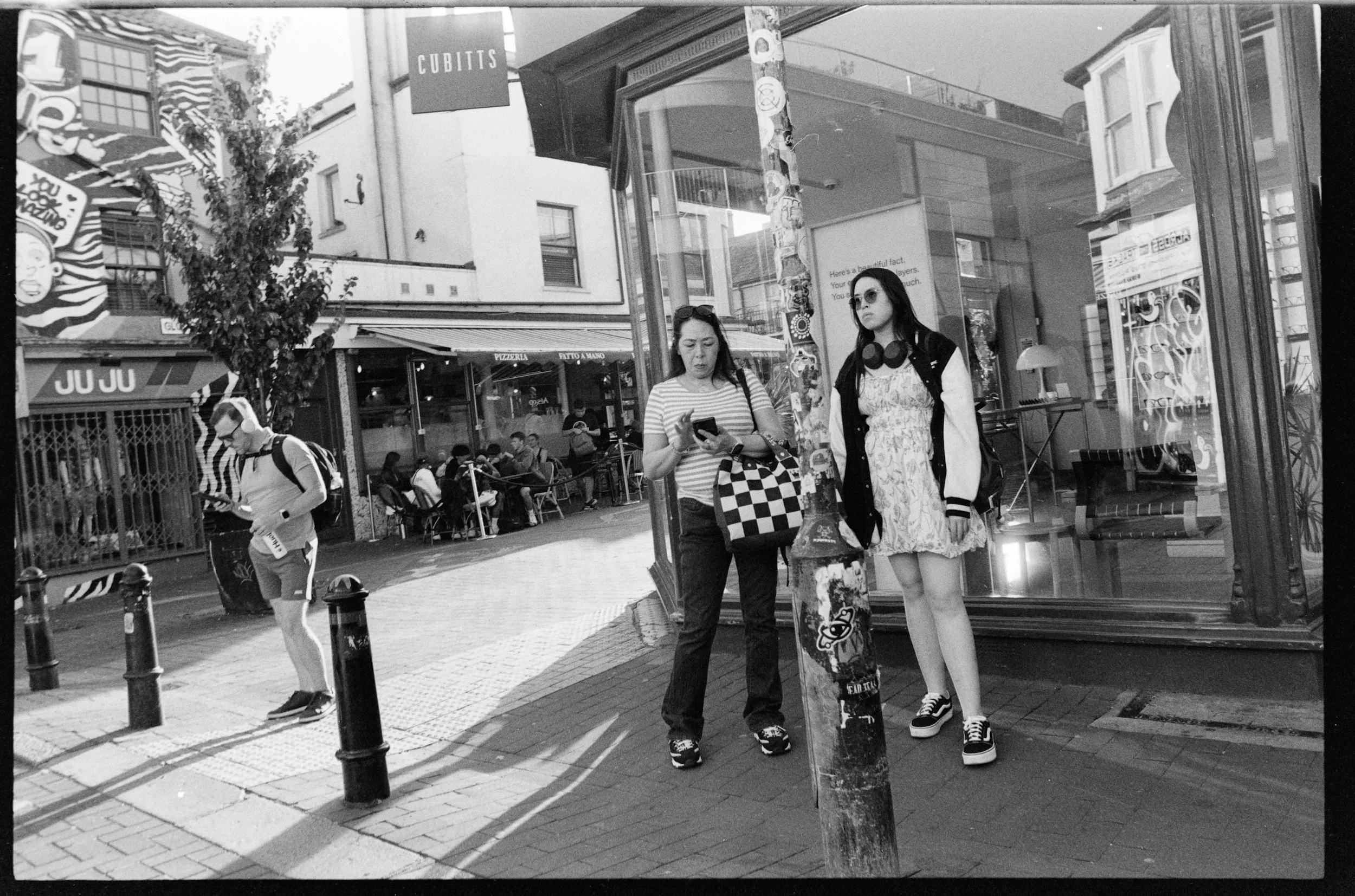
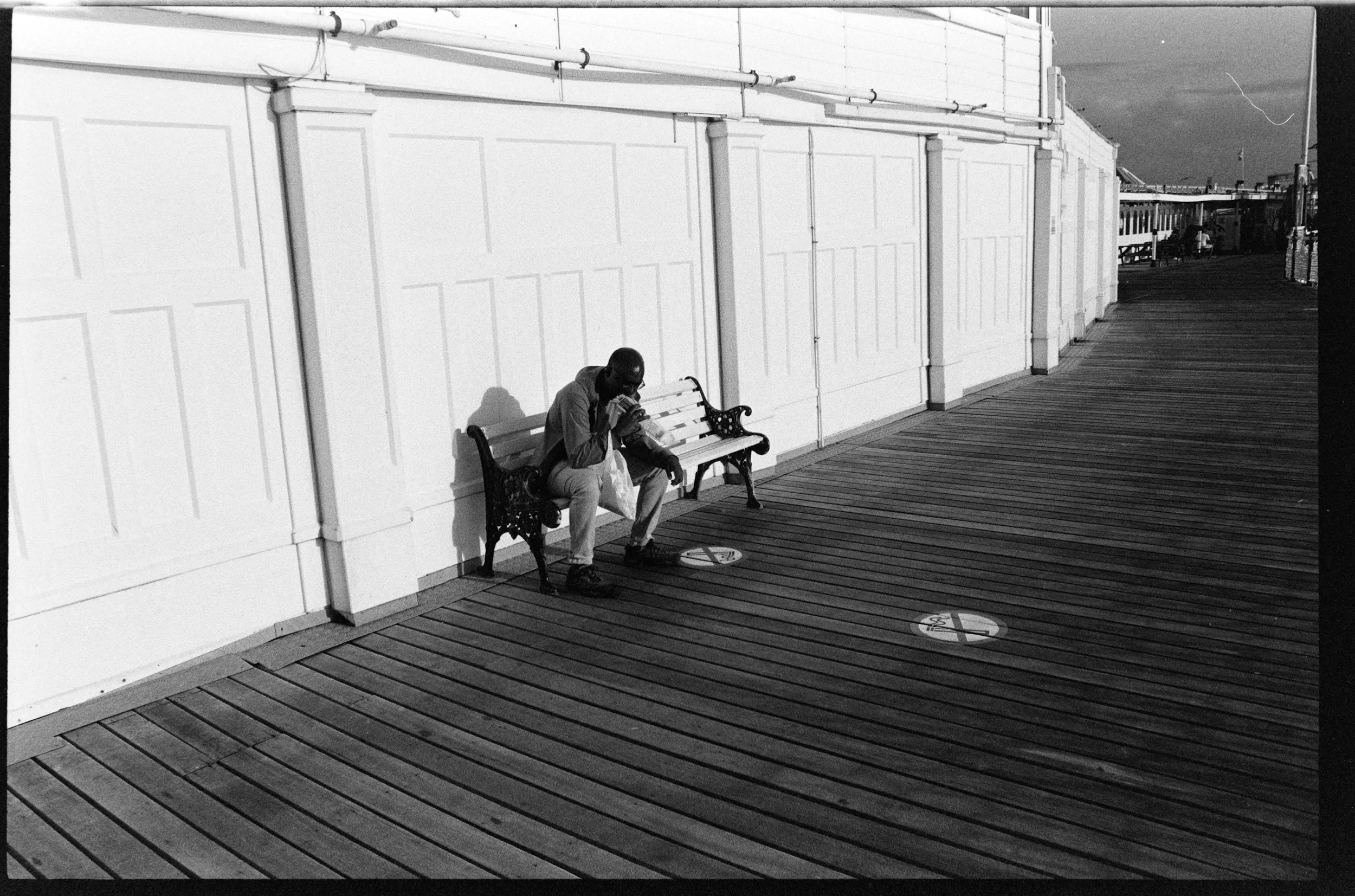
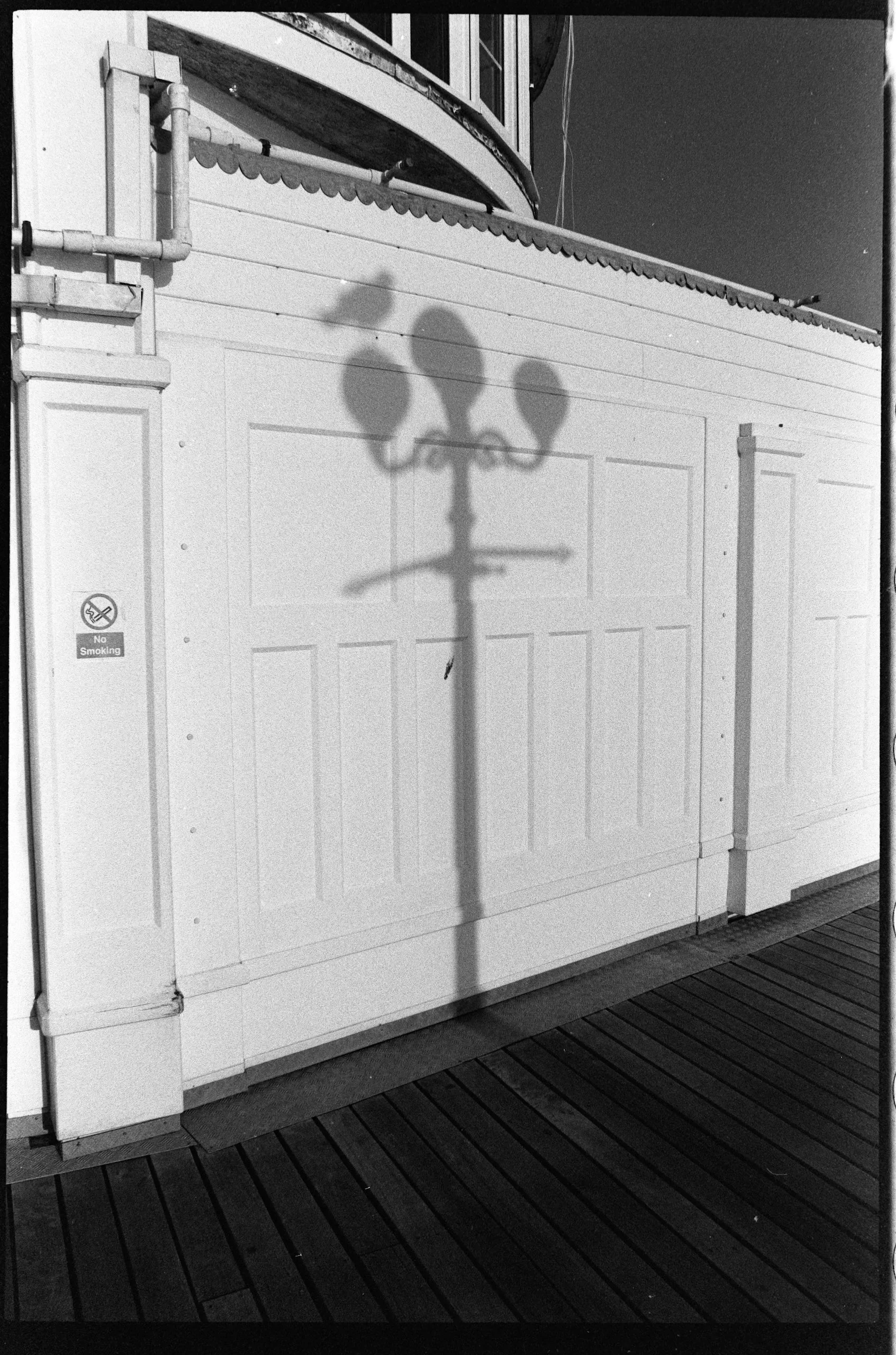
The F80 also opens up a world of Nikon lenses, and I'm looking forward to exploring different focal lengths and apertures that were less practical with my M6 setup. This camera feels like a doorway to new creative avenues, a chance to experiment with different photographic approaches without sacrificing the beautiful rendering of film.
My first roll has been a very pleasant surprise and I'm already envisioning the possibilities. This isn't just a camera; it's an invitation to learn, adapt, and grow as a photographer. Wish me luck as I navigate the exciting new terrain of the Nikon F80! I'll be sharing my initial results and thoughts soon.
Until next time, keep snapping.
Yes please, keep me posted when there’s a new blog
Instagram - Film