in the frame

Take a stand - Bulk up
March 2022 provided an update for a couple of bits in my photography stable, which were long overdue.
Namely my new approach to sourcing colour film and how I develop it. Also my new process for scanning all my film.
I thought I would write this blog post, as I am sure there are a couple of take aways for other film photographers, or points to consider.

March 2022 provided an update for a couple of bits in my photography stable, which were long overdue.
Namely, my new approach to sourcing colour film and how I develop it. Also my new process for scanning all my film.
I thought I would write this blog post, as I am sure there are a couple of take aways for other film photographers, or points to consider.
As we enter into the spring and summer season here in the UK, I’m always keen to shoot some colour film, for the limited time that the summer light cascades our island.
I’m not one to shoot premium black and white film, my normal go to is Fomapan 400, which in 100ft, costs £40. I bulk load at home and the quality, tonal range and price, suits me down to the ground.




Colour film at present is evidencing crazy price hikes here in the UK. So in March 2022, I decided to invest in a 400 ft bulk roll of Kodak Vision 3 250d from the folks at Frame 24, to go down the bulk loading route workflow I have for B&W. At £180 + VAT + Shipping, this was quite a significant investment, but the maths dictated that for 90+ x 30 exposure rolls, this works out at c. £2.50 a roll.


My only problem was how to spool 400ft into 100ft reels for the AP Loader??
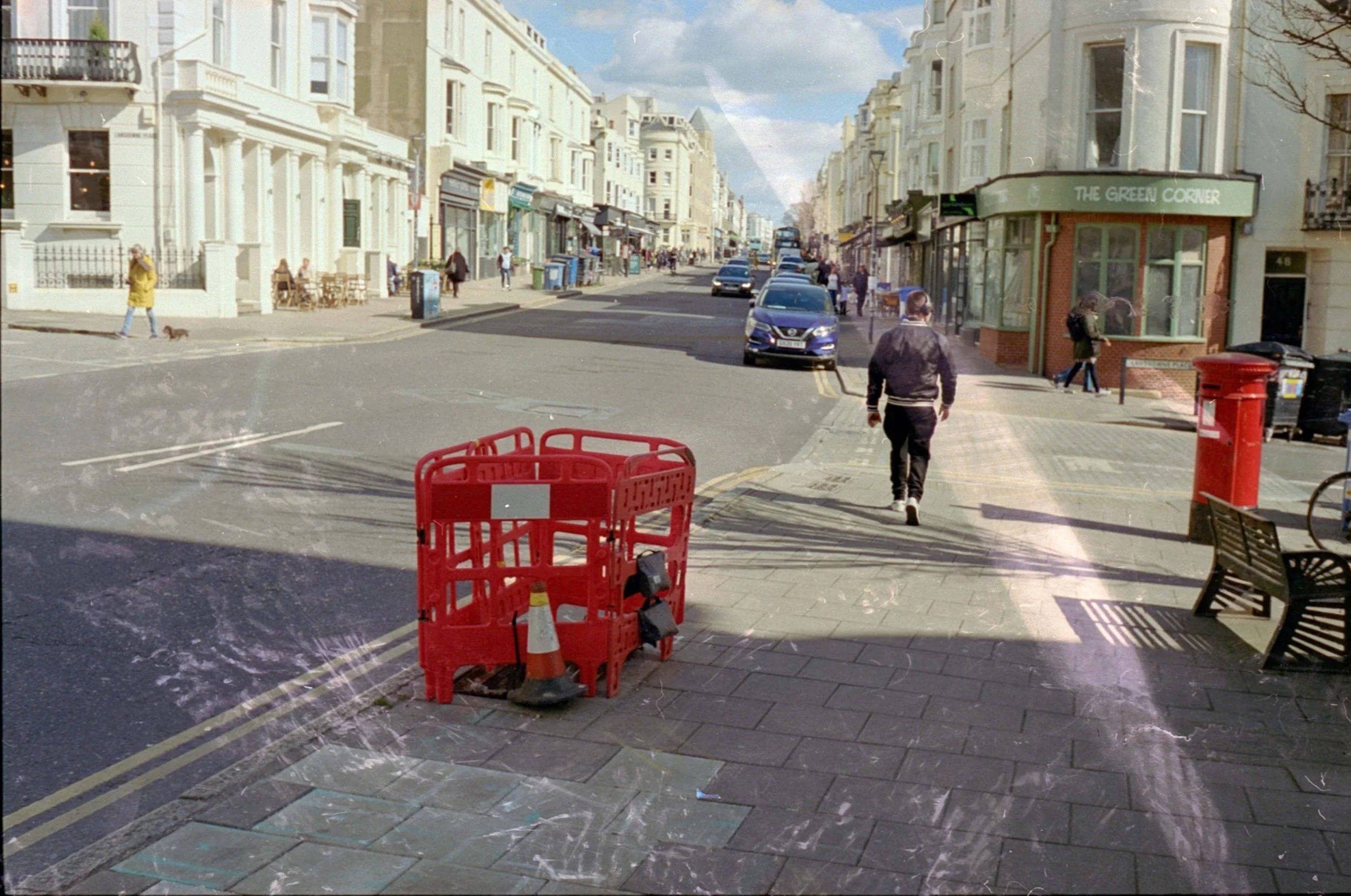
I saw advice on Reddit, that you could spool the film around the cardboard roll from the centre of a toilet roll, inside of a changing bag. For me, this didn’t work, as I found it too labour intensive, my hands got too hot and left too much sweaty residue on the unexposed film, as outlined in the photos below:


After further research, this lead to the world of 3d printing and a Creative Commons license for the following print schematics. A better video working example, can be found here. I have spoken in the past about the excellent community spirit of the film community, which is demonstrated fully by the designer offering his design for free.
A further search, sourced a 3d printing house in Nottingham, who fulfilled the order for £43.
Next up is the (not so) daunting stage of removing the remjet layer from Vision3 film. (an explanation of what remjet is, is here).
Its essential that commercial film developing labs are not sent Vision 3 film to develop, as this will ruin their machines.
This isn't too cumbersome, I found this video on YouTube. In essence, I pre-soak the film for 5 minutes at 38.5 degrees, then pour in the bicarbonate of soda solution for the 2 1/2 agitation, as outlined in the video.
The colour film is then put through the development and blix stage of the development.
Next is the removal of the remaining remjet, for this the secret weapon is a microfibre sponge, I sourced from a local poundshop. This means that you do not touch the film at this stage of the process. For this, I take the film out of the developing reel and hang in the drying clips, I then wipe (and rinse with the sponge) X 3 on both sides of the film, to remove the residual remjet.
I then put the film back on the reel, to complete the stabiliser final stage of development.
Because of the faffing about with the above, I personally add a photoflo rinse stage after stabilising, which removes any remaining stains on the film.


Home scanning has and will always be the bain of the film enthusiast. It's the one process of film that's as close to ‘polishing a turd / editing digital images' in lightroom, it's something that I look to keep as simple as possible, with a rigid and tested workflow.
My introduction to film and in my pursuit to try and manage what some would call the unjust cost in film photography - and also as part of my approach to maintaining a more level of control over the process - I originally invested in a Epson V600 scanner at the beginning of my film journey in 2016, to allow me a ‘one size fits all’ approach to scanning the film that I have been developing at home.
Whilst this journey has been littered with challenges, a steep learning curve, many rolls of ‘spoilt film’ its been a very rewarding one, which I wouldnt change at all.
I think that I have now finally turned a corner and if I can say (with trepidation), is the start of my refined workflow.
Whilst the V600 is a decent beginners bit of kit for 120 / medium format and large format / 4x5, the outputs for 35mm are little more than sub par acceptable, with the ability in getting decent colour scans being somewhat of a lottery. Bearing in mind beginners do not look to expand in to the 120 or 4x5 arena, until a number of years, would deem this bit of kit obsolete?
I had originally given up on using Negative Lab Pro with the V600 as I just couldnt resolve the colour cast that was yielded from my V600 in colour scanning, but I have now discovered that this appears to be entirely the route cause of a cheap amazon light box (read buy cheap by twice).
Until recently, things changed. I was able to ‘invest’ in the Complete Basic Kit for 35mm and 120 Film Scanning by Negative Supply. What a sublime piece of kit.

The copy stand is milled from aluminium and the film holders are produced in plastic (fair cheaper than the original aluminium ones). Its compact and can be set up in seconds.
Where this kits excels is the quality of the lightbox. I elected for the dearer version, producing 99 nits of light.
The speed of this process is night and day compared to the V600 and silverfast software.
The negative supply setup can scan a roll of film in 90 secs, compared to 5-10 minutes on the V600.
I use my mark 1 Olympus OMD EM5 micro four thirds camera for scanning, and convert the .orf raw file into a tiff file in Photoshop. As this is a 8bit file, I import these files into Negative Lab Pro in lightroom and select the ‘tiff prep' option.
This is a part of the NLP that's essential to remove the colour cast on images. I then run the software with standard settings, but I prefer the noritsu to frontier scanner.
I then save the image as a copy and then delete the original positive image of the film negative.
Thats it.
On review some folk send their film to labs, as they do not have the time and/or inclination to develop at home, me I am too much of a spend thrift , but more importantly, want the broader engagement with the entire process.
The above whilst post investment is an excellent workflow to save a few quid, this is probably best fulfilled if undertaken within a group to share the investment costs.
400 ft of Vision 3 250d is £222 for 92 rolls of film or £2.40 per roll, so shared with a group of 5 or 10 folk is very reasonable, compared to the current price of portra 160, 400 or 800 at £15+ or colorplus and gold consumer film now nearing £10 a roll.
Something to consider. Until next time, keep snapping.
35mm is a gateway drug
Its been nearly 6 years since the film bug bit me.
Originally I was recommended to get into film, to stop at the time, the incessant tinkering with my digital images (read polishing a turd) and concentrate of the process of taking a photo.
I must say, its one of the best pieces of advice I have received.
Not to put it lightly, the learning curve for film, getting your head around using manual controls, the exposure triangle, developing and scanning film at home, is a steep one. But thoroughly enjoyable, nonetheless.
disclaimer: the author accepts no liability for the cost incurred by the reader, in the investment of new film camera gear.
Its been nearly 6 years since the film bug bit me.
Originally I was recommended to get into film, to stop at the time, the incessant tinkering with my digital images (read polishing a turd) and concentrate of the process of taking a photo.
I must say, its one of the best pieces of advice I have received.
Not to put it lightly, the learning curve for film, getting your head around using manual controls, the exposure triangle, developing and scanning film at home, is a steep one. But thoroughly enjoyable, nonetheless.
Being transfixed by the civil rights and vietnam war images of the 1960’s, provided me with the desire and inspiration for me to learn the zone focuing technique, this was revelationary.
I have mentioned it before, there are few hobbies that have a great community spirit like film photography, sharing the knowledge and helpig eachother out. The only other I have encountered is the motorbike community, but having hung up my leathers in 2015, this was a void greatly filled.
I digress. Whilst I was happy shooting 35mm, especially on the exceptional Olympus OM1, I had one eye on the limitations of my scanning setup (the substandard Epson V600) and also a thirst to learn more about this medium. This naturally led to my step into Medium Format / 120 film.


Early on my film journey, I was able to get my hands on the little gem Yashica Mat 124g TLR camera. This TLR medium is underrated, the limitations of the square format allow you to rethink the image the detail of the negative is outstanding.


I became transfixed by the Pentax 67. This is a complete beast, which is probably better placed as a studio based portrait camera, rather than a street photography camera. The 6x7 negatives are enormous, offering rich detail. There are two downsides when using in Street Photography, 1) The sheer weight of the thing!, and 2) The thunderclap of the shutter. You could add a third with the limited 10 images per roll, but this is negated by the stunning negatives.


I therefore wanted a 120 / medium format film camera, that I could hike around with on my photowalk jaunts, and decided on the Fujica GS645s. I was able to snag an absolute mint condition version from Japan, I can only conclude that this was put into a time capsule, as the was like brand new. I choose the version with the bull bar. As I had read stories of the bellow cracking, I didnt want the faff. I have had zero issues with the bullbar.
Also the increased 15 images per roll is well received. The only downside to the camera is the weak rangefnder patch. This is easily resolved with a piece of clear plastic stuck to the viewfinder.


So the crescendo, large format. This ultimately was triggered by a few YouTube content creators that really elevated the medium and I love there work: Ben Horne, Matt Marrash, Bryan Birks, Todd Korol, Robbie Maynard Creates, Nick Carver, Craig Prentis & Steve O’nions to name a few.
I really appreciated the no thrills approach to shooting and also the sloowwwww approach.
The two versions of this format are 4x5 and 8x10. Film photography isn’t a cheap hobby and 8x10 format is no exception, film prices are insane!.
Looking around I had earmarked two models for further consideration, 1) a 1950’s metal field camera, which didnt provide nearly as much refinement on setting up a photo, or 2) A traditional wooden camera.
Initially, I had elected for the former, buying a 1970’s Wista 45d from Japan off eBay. Unfortunately, this was probably the worst buying experience I have ever encountered, this is a tale for another day. But in short, the faulty Wista was soon returned.
I finally decided on the Chamonix 45n2. This camera is a thing of complete beauty. Composed of wood and carbon fiber composite material, is designed to be both light and durable. I get stopped every time I have the camera out by tog’s and non tog’s.


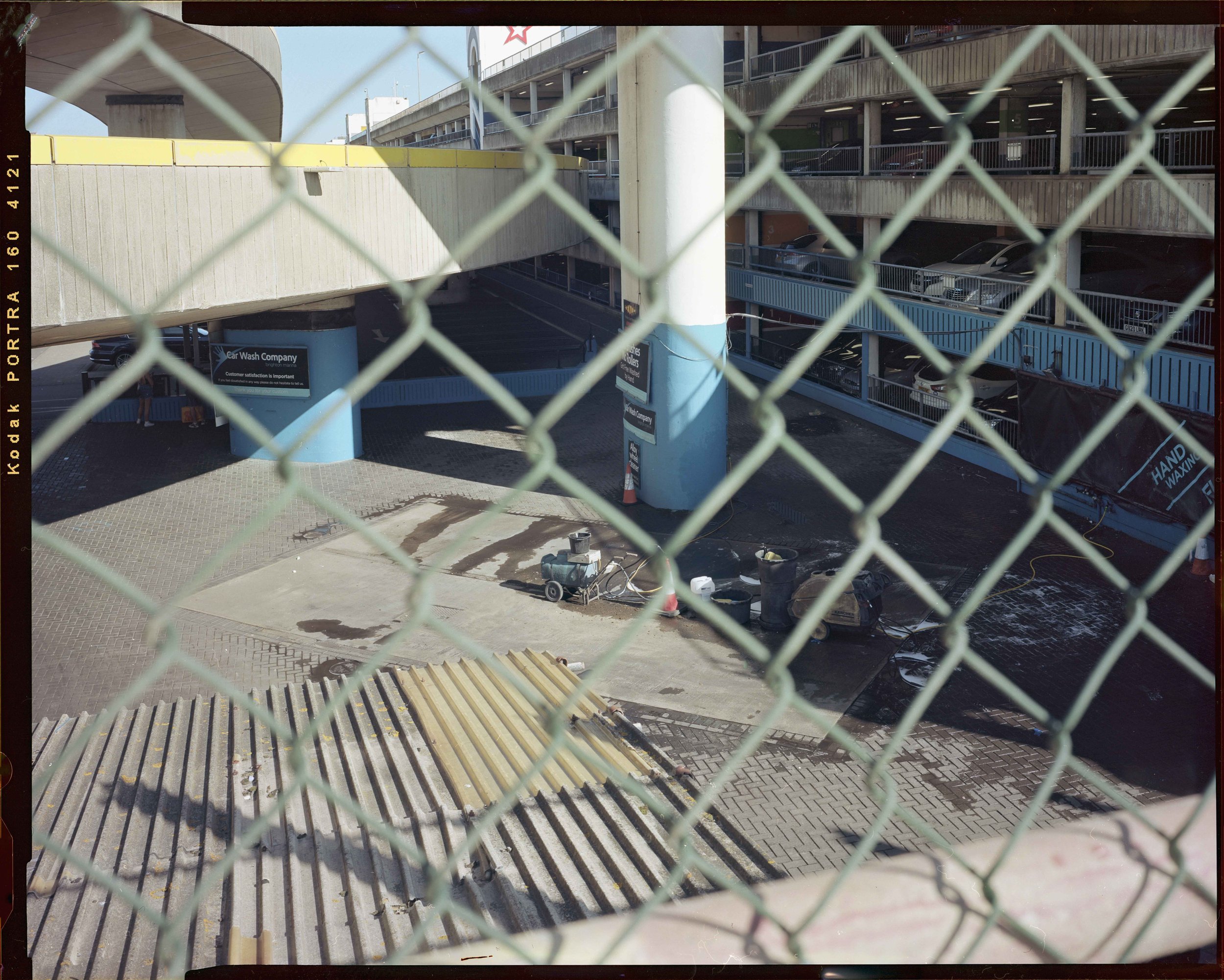


You do have to completely change the approach to image taking, a 10 sheet of Kodak Portra 160 is £58, so £5.80 per photo. This is before the pending price hikes in January 2022.
But the images are outstanding.
The options for B&W are more economical and more palletable on the wallet.
So this year with Large Format and generally in my six year journey, I have learned alot and my understanding is better. I now go back to digital and the positive is that I set the camera up for auto focus, turn off the backscreen and snap away. No Chimping. I have ditched all the lightroom presets and now only use 1 x colour and 1 x BW. No polishing of turds.
I have found that I have turned full circle and that film and digital mendiums compliment eachother and my work, its not a case of one or the other, trust me.
Well thats me for another month, until next time, keep snapping.
A selection of the images within this article are available for sale on the Website or Etsy Store, if you would like to enquire about something else, please click the email icon at the foot of this page.
Yes please, keep me posted when there’s a new blog
Instagram - Film