Pasión: A Journey to the Soul of Spanish Football — A Book Worth Stopping For
Not everything on this blog is about photography. Occasionally a book stops me in my tracks and demands to be written about. This is one of those books.
Miguel Lourenço Pereira's Pasión: A Journey to the Soul of Spanish Football arrived in my reading life at the perfect moment — in the weeks immediately after Spain's 2026 World Cup victory, with Argentina's behaviour still fresh and Spain's dignity under pressure still vivid. I doubt Pereira planned that timing, but it couldn't have been better if he had.
The Right Book at the Right Moment
There is no more instructive way to understand what Pereira is arguing than to watch that World Cup final first. Because Pasión is not really about football results. It is about character — national, regional, cultural — and the 2026 final put that character on the largest possible stage. Spain, provoked, composed themselves. Argentina, for all their talent, showed something else entirely. What separated those two sides in the final wasn't just quality. It was dignity.
"Spanish football — at its best — expresses something deeper than tactics or athleticism: a particular cultural spirit, rooted in the regions, the rivalries, and the contradictions of the country itself."
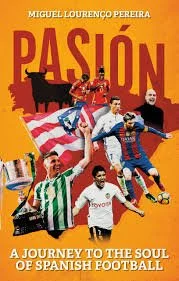
That is Pereira's central argument, and he earns it through specificity rather than sentiment. This is not a book of grand pronouncements. It is a book of places, characters, and ideas — the kind of book that teaches you to look at something you thought you understood and realise you'd only seen the surface.
Several Countries, One Shirt
The pasión of the title is not the noise in the stands. It is something older and more structural: a cultural conviction, passed down through generations of players and managers, that football in Spain is a form of expression as much as competition.
Pereira understands that Spain is not one country. It is, in reality, several — Basque, Catalan, Galician, Castilian, Valencian — each with its own identity, its own grievances, and its own relationship to the game. Spanish football has always had to hold that tension, and somehow still produces something coherent and brilliant on the pitch. How? That is the question the book keeps returning to.
The regional texture is beautifully handled. A recommendation for the tapas strip on Calle Laurel in Logroño — in La Rioja, on the Ebro, between the Basque Country and Castile, shaped by both but fully neither — becomes a meditation on how Spanish identity works. It's a quietly confident choice: Logroño doesn't shout about itself. Which may, Pereira implies, be the point.
I've done the last three football city breaks — Milan, Naples, and Valencia — and Valencia was, by no half measure, the best for a mixture of culture, football, and general life. Reading Pasión, I understood why. Valencia sits outside the Madrid-Barcelona duopoly, fiercely independent, with a football club embedded in the city's DNA rather than imported into it. The Mestalla is one of the most atmospheric grounds in Europe precisely because of that. I experienced something of what Pereira means by pasión without having a word for it at the time.
The Ghost in the Machine
The chapter on Pep Guardiola's tactical inheritance is the book at its analytical finest. Pereira traces the conversion of the second striker into a roaming attacking midfielder back through Juanma Lillo — a deeply philosophical coach who spent his career in the lower divisions of Spanish football, never winning a major trophy, but whose ideas Guardiola absorbed and then exported to Barcelona and Manchester City and beyond.
"Lillo was developing these ideas while the rest of Europe was still playing flat 4-4-2. The intellectual tradition — the idea that football is something to be thought about, argued about, philosophised over — is embedded in the culture."
Guardiola didn't invent that tradition. He was its most visible product. That is a specifically Spanish football story, and Pereira tells it with precision.
Why I'm Writing About It Here
This is a photography blog, and I make no apologies for occasionally taking a detour into books. The truth is, the best photographers and the best football writers are doing the same thing: learning to see what others walk past, and finding the language to make someone else see it too.
Pasión made me see Spain differently. It made me see that World Cup final differently. And it sent me back, in memory, to Valencia — to the Mestalla, to the streets around it, to the people I photographed there — and gave me a framework for what I'd been looking at.
That's what a great book does. It doesn't just describe the world. It changes the resolution.
Essential reading — whether you love football, Spain, or simply good writing about the things that matter to people.
Until next time, keep reading.